
Pavers move for three main reasons: the edge restraint is missing or has failed so the field spreads, the base was not compacted in lifts so it settles unevenly, or the joint material has washed out and the units have lost their interlock. Freeze-thaw makes all three worse. A paver field is repairable in a way a slab is not, provided the base underneath is sound.
01Why are my pavers shifting?
Because a paver surface only works as a single interlocked field, and something has broken the interlock. Each paver is held by its neighbours through the joint material, and the whole field is held at its perimeter by the edge restraint. Lose either and the units start moving independently.
The Interlocking Concrete Pavement Institute's guidance on edges puts it plainly: edge restraints hold the pavers tightly together, allow consistent interlock across the pavement, and stop the pavers spreading under horizontal forces and minor settlement.
02Diagnose it from the pattern
| Symptom | Most likely cause | Fix |
|---|---|---|
| Joints widest near the edges, outer course creeping out | Edge restraint missing or failed | Reinstate restraint, reset edge courses |
| Individual units rocking or lipping | Joints washed out; units lost interlock | Reset units, refill joints |
| Dips and humps across the field | Base not compacted in lifts | Lift, rebuild base, relay |
| Units lifting after winter | Frost heave; water in the base | Fix drainage, reset; see our frost heave guide |
| Lifting near a tree | Roots | Root barrier or redesign around the tree |
| Ruts where cars park | Patio built as a patio, used as a drive | Rebuild the area for vehicle loads |
| Weeds and ants in joints | Joint material low or washed out | Clean and refill joints |
03Is my edge restraint the problem?
If the outer course has moved out and the joints nearest the edge are the widest, yes. That is the classic signature of a field spreading because nothing is stopping it.
Restraints come in several forms: a concrete curb, a mortared soldier course on a concrete haunch, or proprietary plastic or metal edging. The ICPI guidance for plastic edging is that it must be firmly anchored into the compacted aggregate base with spikes that go well into the base. Edging pinned only into soft soil, or laid on top of the bedding sand, will creep.
Edge restraint is one of the cheapest components of the job and one of the most common things missing from a cheap quote.
04Is it the base?
If the movement is dips and humps rather than spreading, it is below the pavers. A base that was dumped and levelled rather than compacted layer by layer keeps consolidating under use, and it does so unevenly. That produces lipping that catches a toe and dips that hold water.
Bedding sand matters too. It is a thin screeded layer, not a levelling course. Where a thick bed of sand was used to hide an uneven base, the sand moves.
On the clay of the Springfield Plateau, and even more over the Fayetteville shale, a base that holds water is a base that moves. Drainage and compaction are the same problem.
05What does joint sand actually do?
It transfers load between units. With full joints, a foot or a chair leg on one paver is shared with its neighbours. With empty joints, each paver carries its own load in isolation, and that is the condition in which they start rocking.
Joints drop over time, especially in the first season as they settle, and polymeric sand wears and needs replenishing. That is maintenance, not a defect.
The most common self-inflicted cause of movement is aggressive pressure washing, which blasts the joint material out. If you wash the patio, refill the joints afterwards.
06Why freeze-thaw speeds it all up
Water that gets into open joints or a wet base freezes and expands by about nine percent. That lifts units. The gap it creates lets in more water, and next winter it lifts further. It is a compounding failure, and it is why a joint problem in year two becomes a real problem by year five.
Northwest Arkansas crosses freezing many times in a typical winter, so this is not an occasional event. Fixing joints and edges early is cheap. Leaving it until the base is disturbed is not.
07How is a shifting paver patio repaired?
- Lift the affected area back past the point where the units are sound.
- Find the cause: edge, base, water or roots.
- Correct the base, compacting in lifts, and restore the fall.
- Reinstate a proper edge restraint, anchored into the base.
- Relay the same pavers on fresh bedding sand and compact them in.
- Refill the joints fully and compact again.
Done well, the repair is invisible. That is the real advantage of pavers over a slab: the surface can be taken up and put back.
08Polymeric sand: what it does and does not do
Polymeric sand is joint sand with a binder that sets once it is wetted, so it resists washing out, weeds and ants better than plain sand. It is a good product for most patios.
It does not hold a patio together on its own. If the base is settling or the edge is spreading, polymeric sand cracks and crumbles along with the movement. It also has to be installed properly: joints filled to the right depth, the surface cleaned of residue before wetting, and wetted as the manufacturer directs. Residue left on the surface leaves a haze that is hard to remove.
09Tree roots
Roots lift pavers from below, usually as a slow ridge or hump near a tree. Cutting large structural roots can harm or destabilise the tree, so the right answer depends on the tree and the species. Sometimes a root barrier, sometimes relaying around the root with a slightly altered level, sometimes redesigning the patio edge to give the tree room.
Building a new patio close to a young tree, without thinking about how big it will get, is how this starts.
10Pavers used as a driveway
Pavers can make an excellent driveway, but a driveway is a different build from a patio: a deeper base, pavers of a thickness and shape made for vehicle loads, and restraints that stand up to tyres turning on them. Patio pavers on a patio base with a car parked on them will rut and spread, usually at the edge where the wheels run. If part of your patio has become parking, rebuild that part for the load.
11Why the first season matters
A new paver patio goes through its biggest adjustment in the first months. Joint sand settles down into the joints as the surface is used and rained on, and it needs topping up. Any weak spot in the base shows itself in the first wet season or the first winter.
A good installer expects this and comes back to check. If a new patio is already lifting or spreading in its first year, that is not settling in; it is the base or the edge telling you something was missed.
12Freeze-thaw and de-icers on pavers
Winter does more to a paver patio here than summer does. Water in open joints and a wet base freezes and lifts units, and the thaw leaves them sitting slightly proud or rocking. Clearing snow promptly, keeping downspouts from overflowing onto the patio, and keeping the joints full are the cheapest defences.
On de-icers, follow the paver manufacturer's guidance for the product you have, and avoid steel-edged shovels, which chip the arrises of the units. If your pavers lift every winter in the same places, that is a drainage and base problem; read our guide to pavers heaving after winter.
13Weeds, ants and joint loss
Weeds and ant hills in paver joints are usually a symptom rather than the problem. They move in where the joint material has dropped or washed out, and ants then carry more sand out, which loosens the units further. Cleaning the joints out, refilling them properly, and fixing whatever washed them out in the first place deals with both. Herbicide alone treats the weed and leaves the empty joint.
14How long should a paver patio stay flat?
A well-built paver patio on a proper base, with working edges and maintained joints, should stay flat for a very long time, and when a unit is damaged it can be replaced individually. The ones that move early nearly always have the same few problems: a thin or uncompacted base, missing edges, or water with nowhere to go. Those are construction faults, not the nature of pavers.
15Questions to ask before a repair
- What is holding the edges, and is it anchored into the base?
- Will you lift the pavers to look at the base before quoting?
- Can my existing pavers be reused?
- What joint material will you use, and how do I maintain it?
- Is any of this area carrying vehicle loads?
The answer to the second one says a lot. A repair priced without looking under the surface is priced on a guess.
16Myths about moving pavers
"Sealer locks them in." Sealer can stabilise the top of the joint sand. It does not replace edge restraint or fix a base.
"A bit of movement is normal." Some joint settling in the first season is normal. Lifting, rocking, spreading and dips are not.
"Mortar the joints and it will stop." Mortar in the joints of pavers on a flexible base cracks as the base moves, and it traps water. Pavers on sand are meant to flex.
17Turf joints, wide joints and large-format pavers
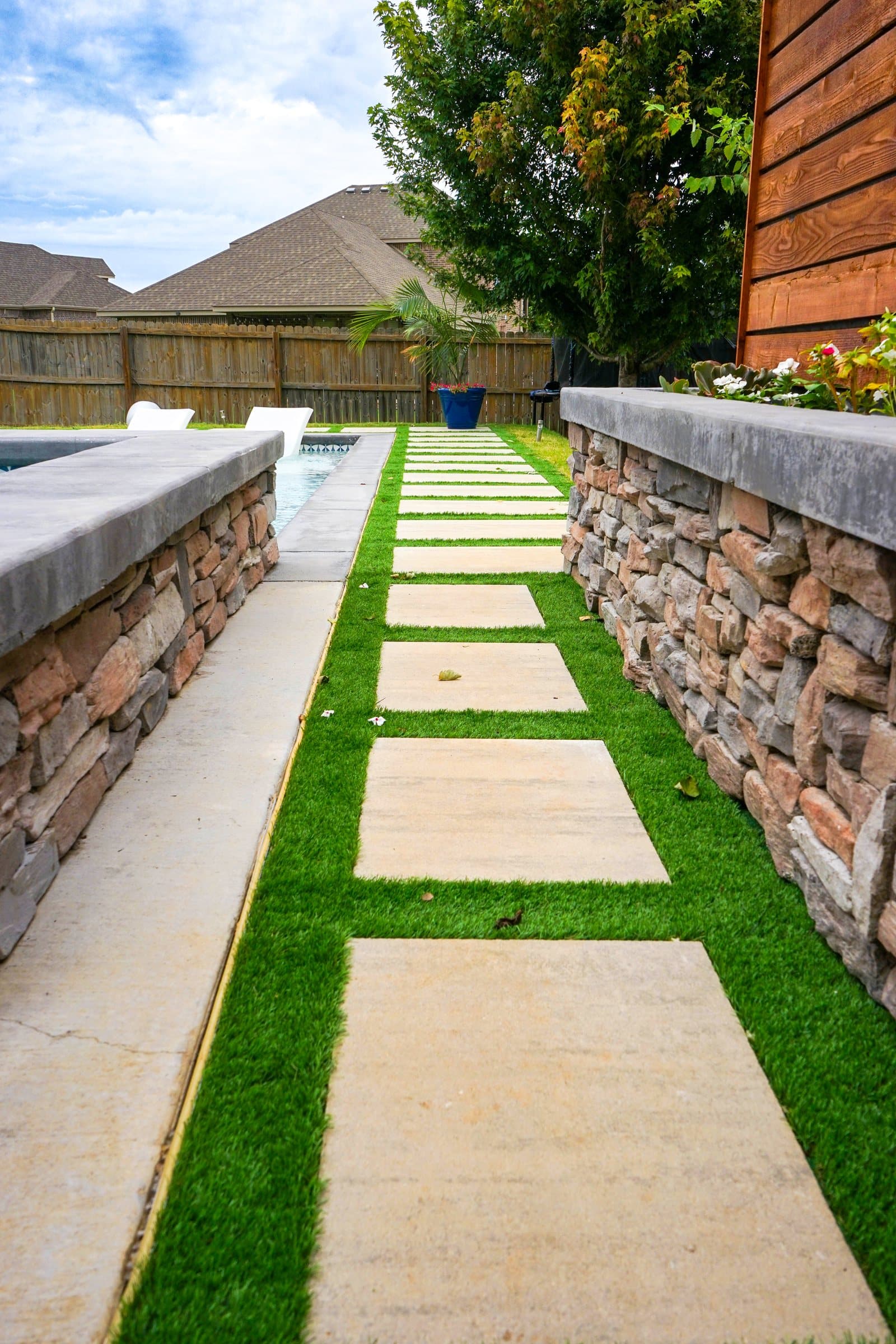
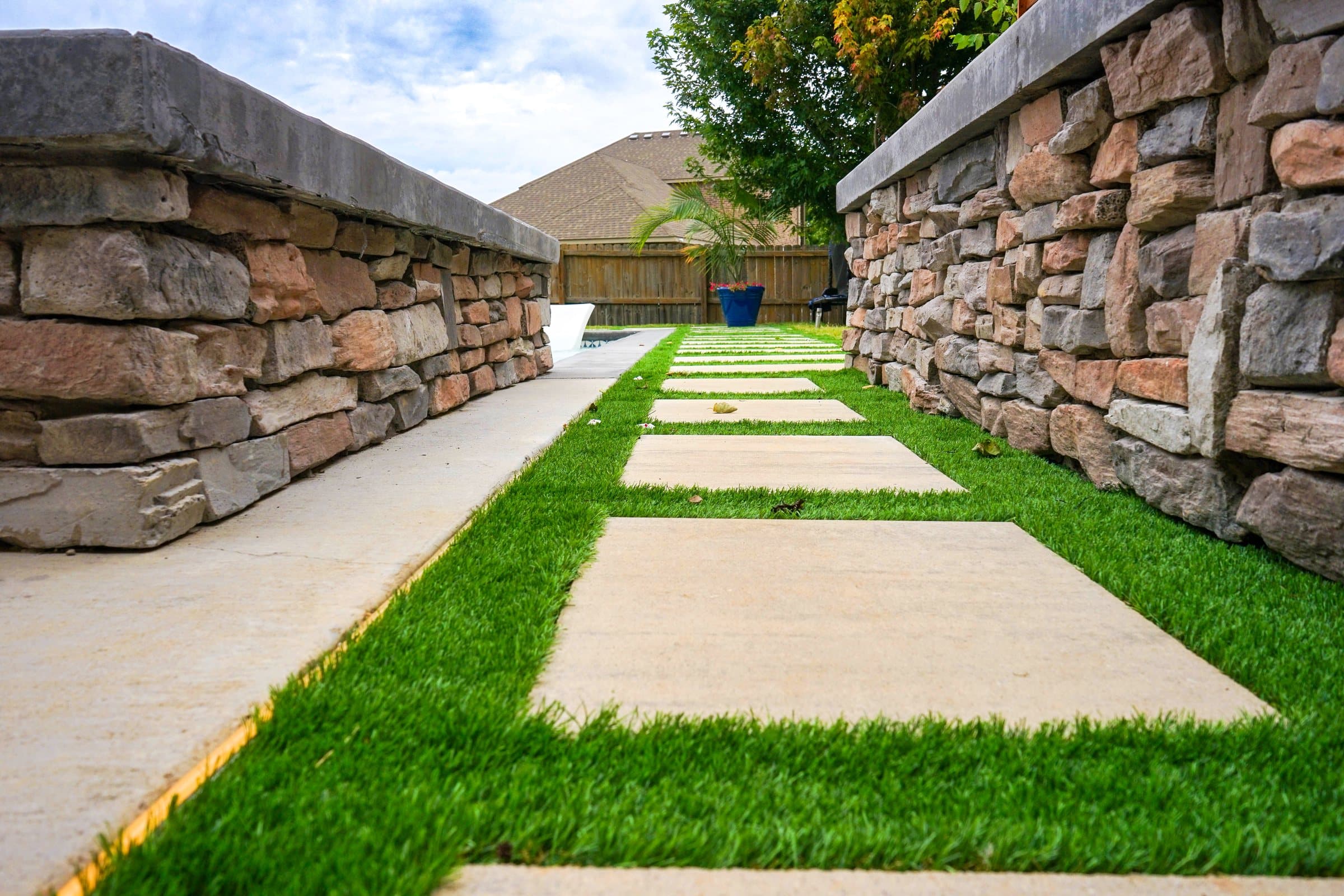
Pavers set with turf or gravel in wide joints, like the large-format pavers on our Cave Springs pool build, do not interlock through the joints in the same way. They rely even more on a well-compacted base and on each unit being properly bedded, because each slab carries its own load. The base has to be right, because there is no interlock to hide a weak spot.
Large-format units are also less forgiving of an uneven base: a small hump under a big slab makes it rock. Preparation matters more, not less.
FAQCommon questions
Can individual pavers be replaced?
Yes, and it is the main practical advantage of pavers over a slab, provided you can still get a matching unit. Keeping a few spares from the original job helps.
How often does paver joint sand need topping up?
Whenever the joints have visibly dropped, and always after pressure washing. The first season often needs a top-up as joints settle.
Do pavers really need an edge restraint?
Yes. Without one the field spreads, joints open and the pattern loses its shape. Plastic edging must be spiked well into the compacted base.
Why are my pavers rocking?
The joint material has washed out, the bedding under that unit has moved, or the base below has settled.
Can I fix sunken pavers myself?
A single unit, sometimes. Anything wider is a base problem, and relaying without correcting and compacting the base just moves the dip.
Does pressure washing damage pavers?
It can strip the joint material, which is what keeps the field locked. Refill the joints after washing.
Why do my pavers lift in winter?
Water in the joints or base freezes and expands. Fix the drainage and the joints, then reset. See our guide on pavers heaving after winter.
REFSources
- ICPI Tech Spec 3: Edge Restraints for Interlocking Concrete Pavementsbramptonbrick.com
- USGS Water Science School: Water Densityusgs.gov
- Arkansas Office of the State Geologist blog: Springfield Plateauarkansasgeological.wordpress.com
NEXTGet it looked at properly
Everything above is general guidance. What your ground actually needs is a site visit, and ours costs nothing. Francisco Gallardo walks it, reads the grade and the drainage, and tells you what is possible.