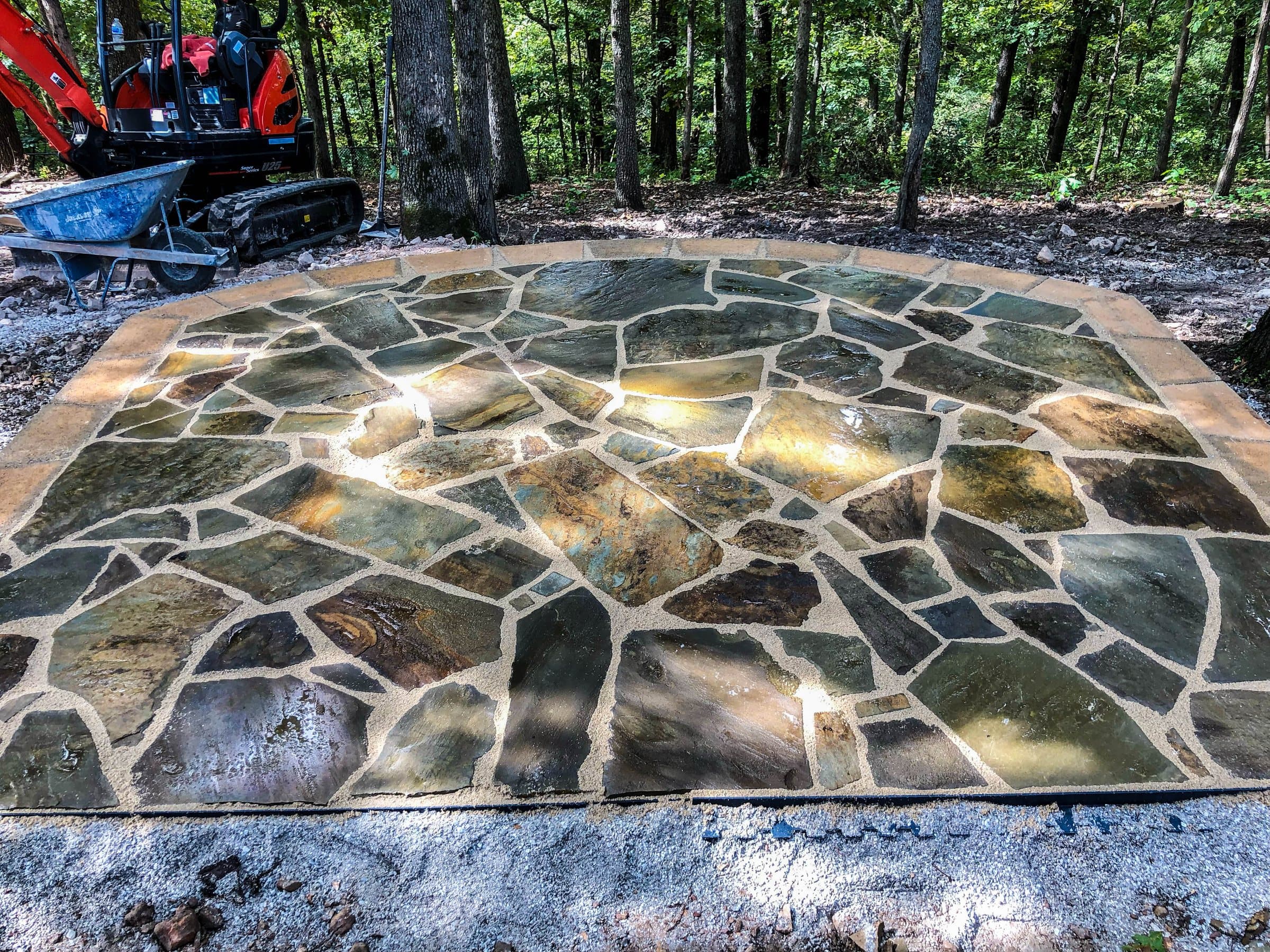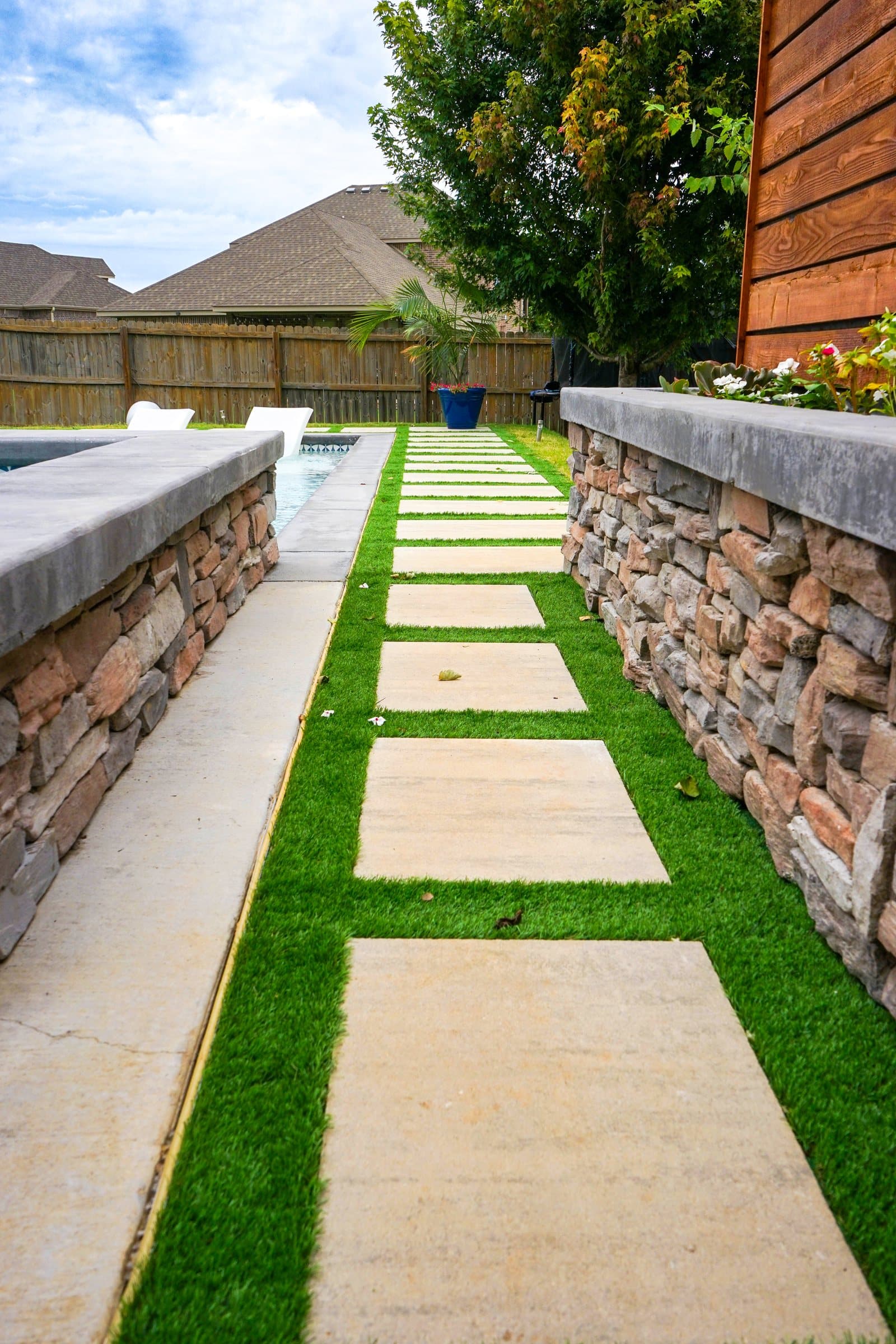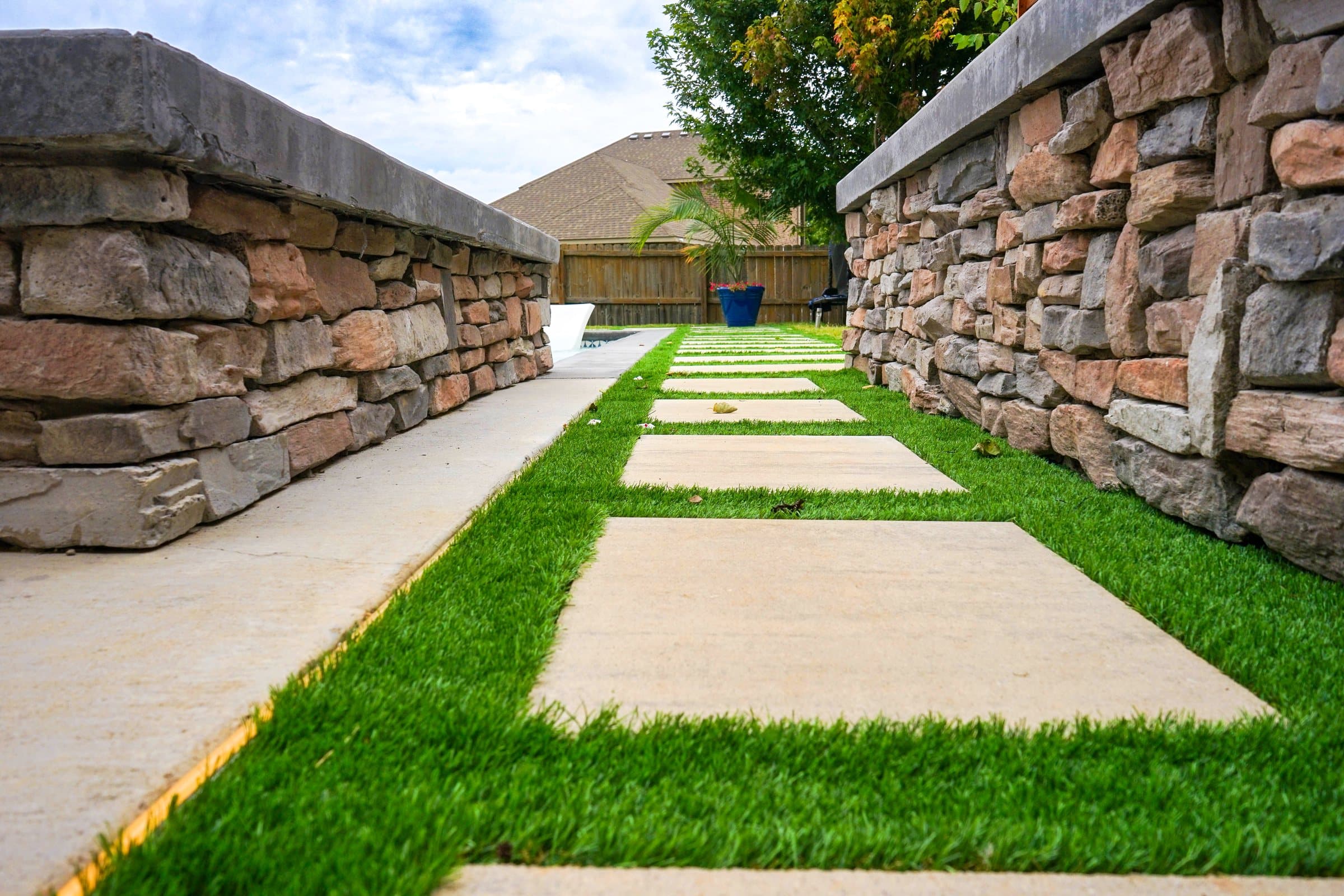

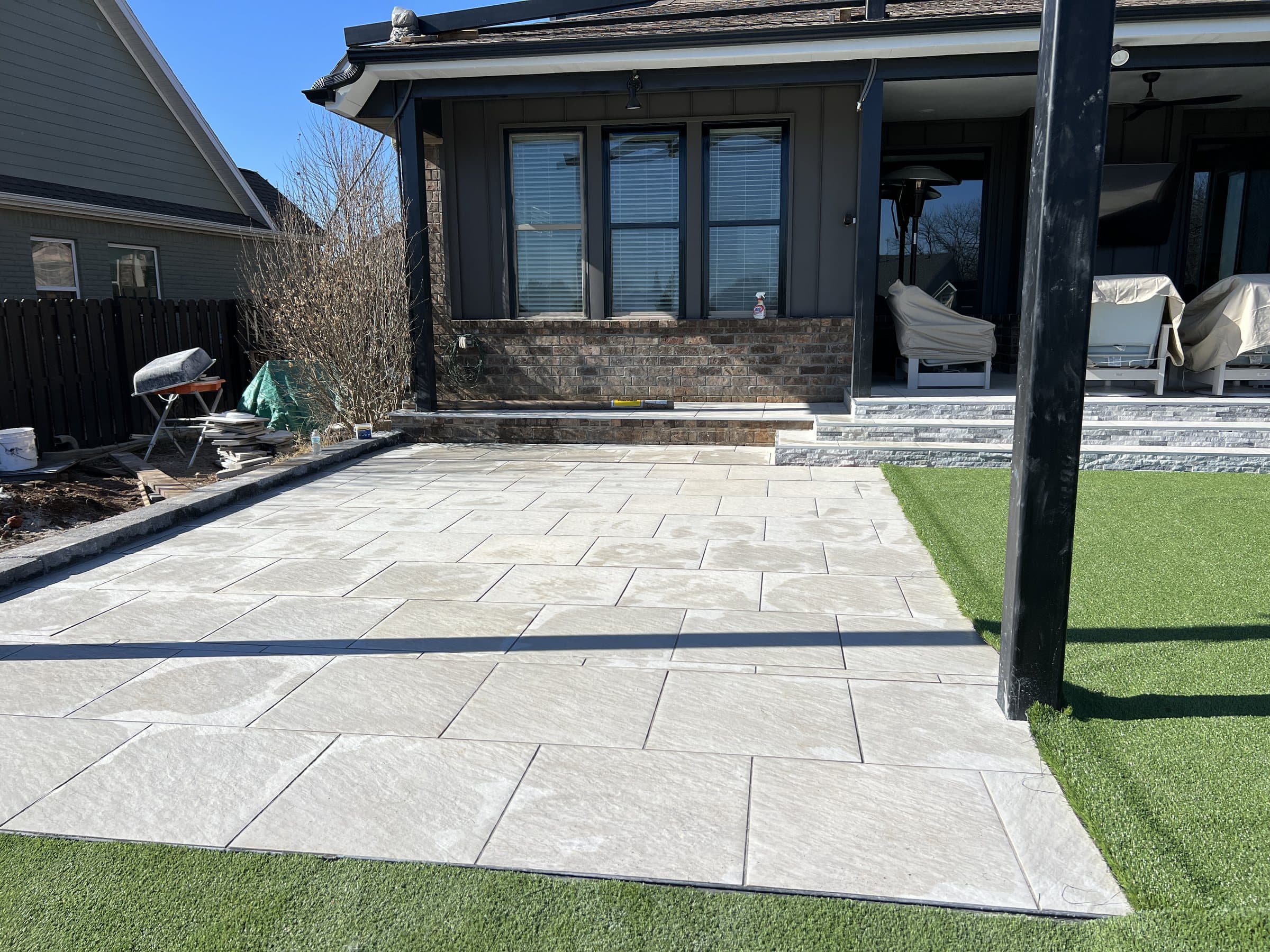
Water pools on a patio because it has no fall, the fall runs the wrong way, part of the surface has settled into a dip, or the water runs somewhere with nowhere to go. A patio needs a gentle slope away from the house, commonly around a quarter inch per foot, and it needs a destination for the water. On pavers the fix is often relaying part of the field; on a concrete slab the options are narrower.
01Why is water pooling on my patio?
Because water only moves one way, downhill, and the patio is not giving it one. There are four ways that happens:
- No fall. It was built dead level because level looks like quality. It is not; a patio needs a slope.
- Fall toward the house. Worse than none. Water heads for the foundation, and it is often the result of backfill settling next to the house after the patio was built.
- A dip. The fall was right, but part of the base has settled and made a bowl.
- Fall to nowhere. The patio sheds correctly onto a lawn that cannot absorb it or into a corner with no outlet. You have moved the puddle, not solved it.
02Diagnosing it
| Where the water sits | Likely cause | Likely fix |
|---|---|---|
| Across the whole surface after rain | No fall | Relay pavers to a fall; slab needs a drain or replacing |
| Against the house | Fall reversed, often settled backfill | Correct the fall; treat as urgent |
| In one low spot mid-patio | Local settlement | Lift, rebuild base, relay |
| Along the far edge | Water has nowhere to go past the edge | Channel drain, swale or regrade beyond |
| In a corner between walls or steps | Trapped low point | Add a drain inlet |
| Where a downspout lands | Roof water discharging onto the patio | Pipe the downspout to an outlet |
Watch it in a real rain, not with a hose. Where the water goes, and where it stops, tells you most of what you need.
03How much fall should a patio have?
Enough to move water, not so much that furniture feels odd. A common guideline for a paved patio is about a quarter inch per foot, running away from the house. Across a patio sixteen feet deep that is around four inches from the house side to the outer edge, which you will not notice standing on it.
The ground next to the house matters too. Fayetteville's residential grading checklist, for example, asks for the dirt grade to drop four to six inches next to a structure and fall at five percent for ten feet away from it. The principle is the same everywhere: water leaves the house, and keeps leaving.
04Why pooling matters more here
Northwest Arkansas winters swing above and below freezing again and again. Water expands by about nine percent when it freezes, according to the USGS. Standing water on a patio freezes, works into any porosity in the surface and the joints, and thaws. Repeat that through a winter and a drainage problem becomes a surface problem: spalling on concrete, lifted units and washed joints on pavers.
A frozen puddle on a patio is also a sheet of ice in the one place people walk out of the house. And in summer, a patio that never dries in the shade grows algae and stays slick.
Underneath, water that sits on a patio is also water getting into the base. On the red clay of the Springfield Plateau or the shale around Fayetteville, a wet base is a moving base.
05Where should the water go?
This is the question most patios skip. A correct fall only helps if the water arrives somewhere that can take it.
- A lawn or bed that drains, if there is enough of it and it falls away.
- A channel drain along the low edge, piped to an outlet. Useful where the patio meets a wall, steps or a pool deck.
- A swale beyond the patio: a shallow, planted or grassed channel that carries water along the garden to where it can leave.
- A piped outlet to daylight further down the slope.
Two cautions. Your neighbour's garden is not an outlet, and Fayetteville's grading code says so in terms. And on karst ground, concentrating a lot of water into one spot in the soil is worth thinking about carefully; in the Cave Springs recharge area the city's drainage manual explains why.
06What can be done about it?
On pavers, if the fall is nearly right, the affected area can be lifted, the base corrected and the units relaid to the proper levels. That is a repair, not a rebuild, and the pavers go back down.
If the fall runs toward the house, that needs solving properly whatever it costs, because the foundation matters more than the paving. Often the answer is relaying the whole field to a new fall, sometimes with a drain along the house side.
On a concrete slab with no fall, options are limited. A slab cannot be re-graded from the surface. A drain at the low edge can give the water a destination; beyond that, it is partial or full replacement.
Sometimes the answer is not the patio at all. A channel at the low edge or a swale beyond it is often the missing piece rather than the slope.
07Covered patios and pavilions
A roof over a patio keeps rain off the surface, and moves it. All the water that would have fallen across the patio now comes off the roof edge in a line, or out of a downspout in one spot. If that line or spot lands on the patio, you have built a pooling problem into a new structure. Gutters and downspouts on a pavilion should be piped to the same outlet plan as the rest of the patio.
08Where the patio meets the house
This is the most important line on any patio. The patio surface should sit below any door threshold and below the level where siding, weep screed or brick weeps need to stay clear, with the fall starting right at the house. A patio poured or laid up tight to the siding at the same height invites water into the wall.
09Things that make it worse
Pressure washing joints out of a paver patio lets water straight into the base, and the base then settles into new dips. Joint material should be topped up after cleaning.
Raising a bed or a lawn edge above the patio traps water on it. So does a new outdoor kitchen, planter or seat wall built across the line the water used to take. Every addition to a patio should be checked against where the water goes.
10Pool decks: the patio that gets wet on purpose
A pool deck takes rain, splash-out, backwash and the water people carry out of the pool, so its fall matters more than any other patio's. Water should move away from the pool edge and away from the house, to drains or an edge that can take it. Water running back into the pool carries dirt with it; water sitting on the deck freezes in winter and grows algae in summer.
Pool decks also sit on ground that was excavated and backfilled around the pool shell, which settles if it was not compacted properly. A dip that appears around the pool edge a year or two after the build is often that backfill, not the deck.
11Shade, algae and stains
A patio that dries within an hour of rain rarely grows algae. One that stays damp under trees or on the north side of the house will, and green slime on a patio is genuinely slippery. Pooling makes it far worse, because the wettest spots never dry at all.
Cleaning treats the symptom. The fix is the fall, the joints and more light and air where you can get them. Tannin and leaf stains follow the same pattern: they collect where water sits.
12Are permeable pavers the answer?
Sometimes. Permeable pavers have wider joints filled with open, clean stone, sitting on a deep base of open-graded stone. Rain goes through the surface into the base instead of running off it, so there is nothing to pool.
They are a system, not a product swap. The base has to be designed to store the water and let it go, either into the ground below or out through a pipe. On tight red clay or shale, which drain slowly, that usually means an underdrain. And on karst ground, sending all the patio's water down in one place needs thought. Done right they work well. Done as a straight swap for ordinary pavers on an ordinary base, they clog, hold water, and heave.
13Why a patio loses its fall over time
Plenty of patios were built with a correct fall and lost it. The usual story: the base was not compacted in lifts and settled unevenly, the ground next to the house sank as the foundation backfill consolidated, or a downspout slowly washed out one corner. On the red clay of the Springfield Plateau, a wet spot in the base softens and drops; over the Fayetteville shale, the ground itself swells and shrinks under the patio.
That is why fixing pooling on an older patio starts with working out whether the fall was ever there. If it was built right and has moved, the base needs attention, not just the surface levels. If it was built level, relaying to a proper fall on the existing base may be enough.
14Questions to ask before you fix it
- Where exactly will the water go once it leaves the patio?
- What fall will you build in, and how will you check it?
- Is the ground next to the house falling away as well?
- Where do the downspouts go?
- Can the existing pavers be reused?
If the answer to the first question is vague, the puddle is going to move rather than disappear.
15Building it right the first time
Set the fall before the base goes down, not after. Decide where every drop of water goes, including what comes off the roof. Put drains in while the ground is open. Compact the base in lifts so the fall you built is the fall you keep. And treat the joint between the patio and the house as the most important line on the drawing.
FAQCommon questions
How much slope should a patio have?
A common guideline is about a quarter inch per foot, running away from the house. Enough to shed water without furniture feeling tilted.
Can you fix a patio that slopes toward the house?
Usually, and it should be fixed. Water running back against the foundation is a bigger problem than the puddle you can see.
Do I need a drain on my patio?
Not always. Where the ground beyond the patio can take the water, the right fall is enough. On flat or tight sites, a drain gives the water a destination.
Why does my patio have puddles after it rains?
No fall, a reversed fall, a settled dip, or water running to an edge with nowhere to go. Watch it in real rain to see which.
Can a concrete patio be re-sloped?
Not from the surface. A drain at the low edge can help, otherwise it means partial or full replacement.
Is standing water bad for pavers?
Yes. It gets into the joints and base, freezes in winter and lifts units, and keeps shaded areas slick with algae.
Does pressure washing cause patio drainage problems?
It can. Blasting joint material out lets water into the base. Re-sand the joints after cleaning.
REFSources
NEXTGet it looked at properly
Everything above is general guidance. What your ground actually needs is a site visit, and ours costs nothing. Francisco Gallardo walks it, reads the grade and the drainage, and tells you what is possible.