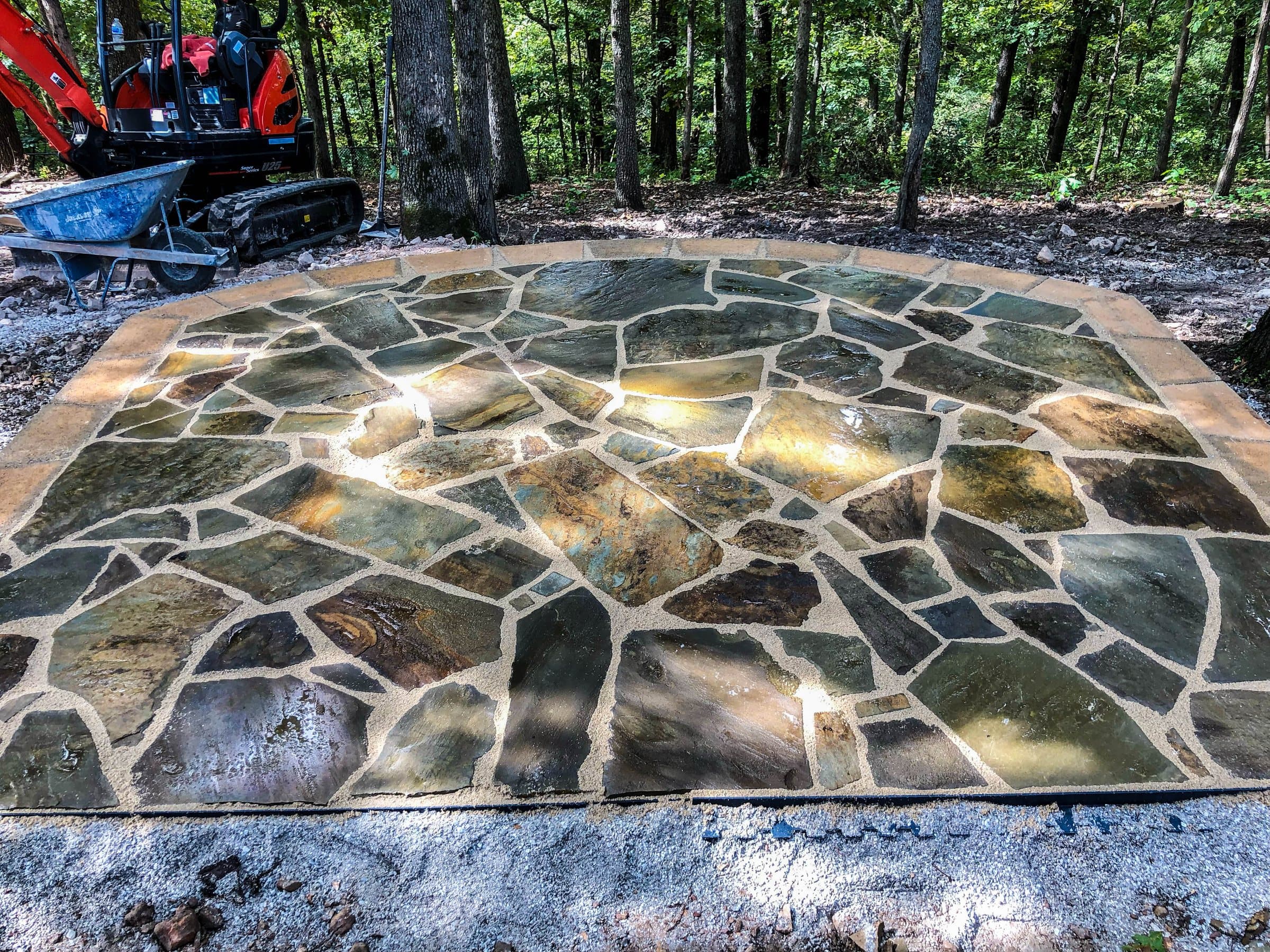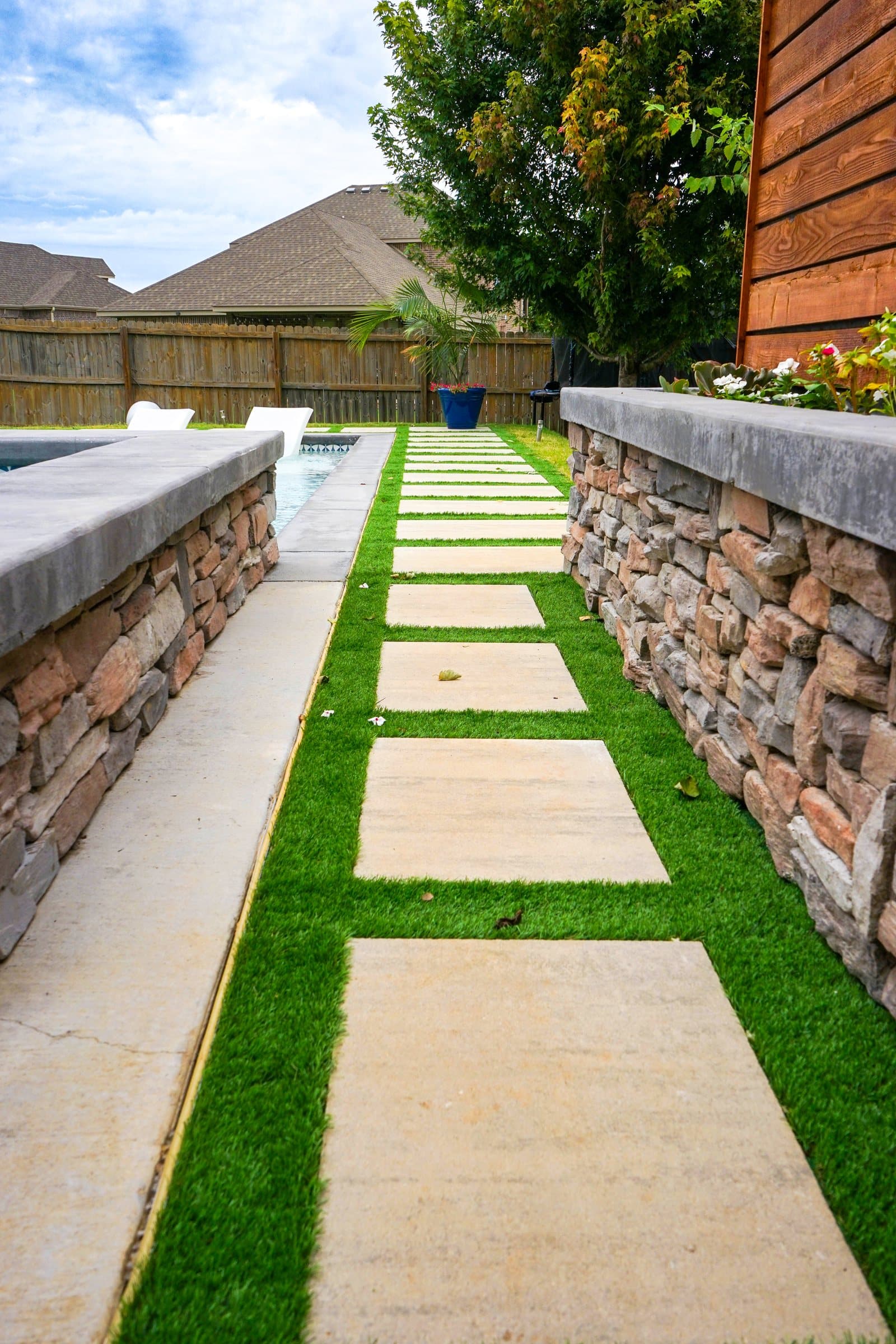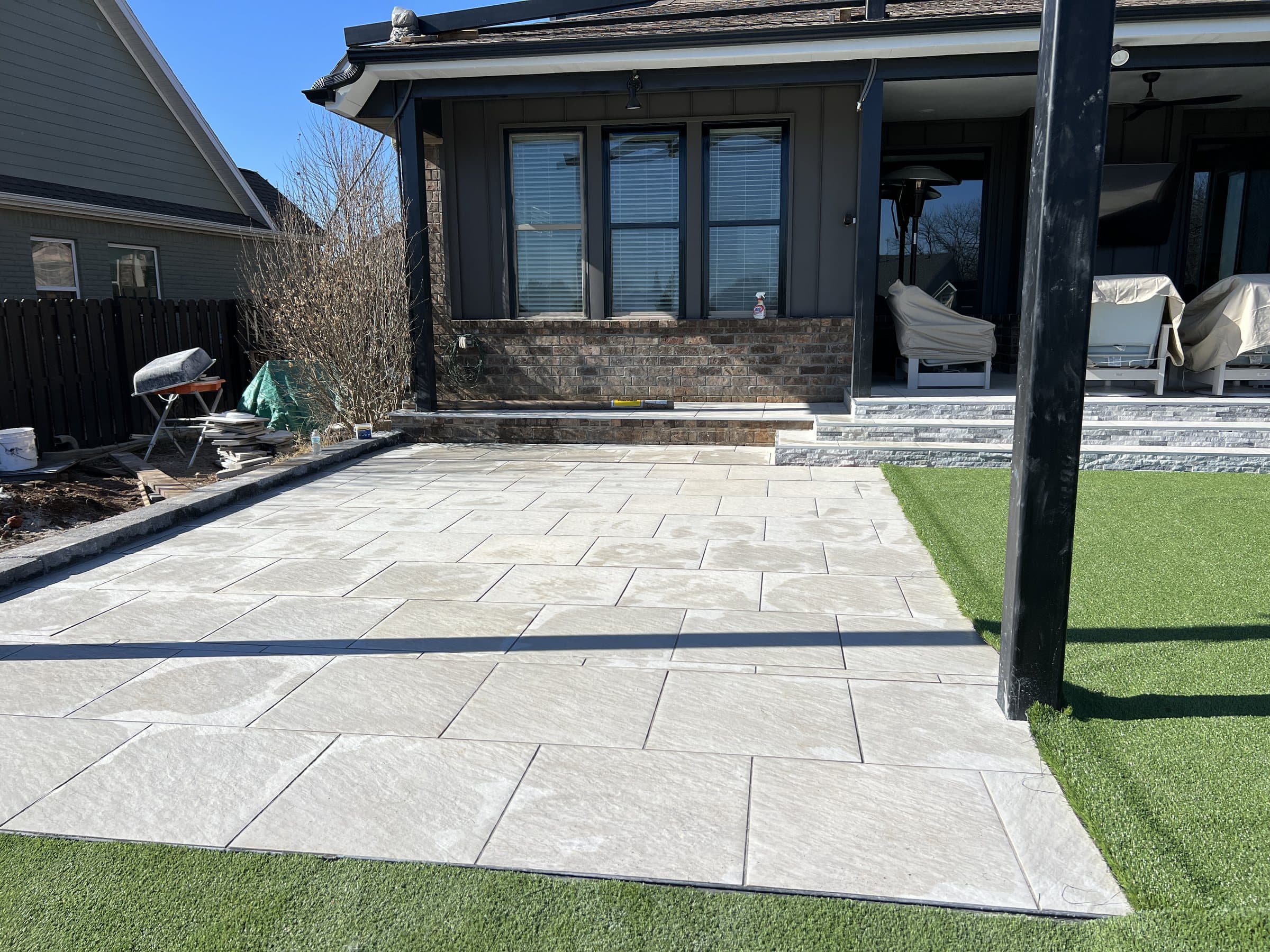

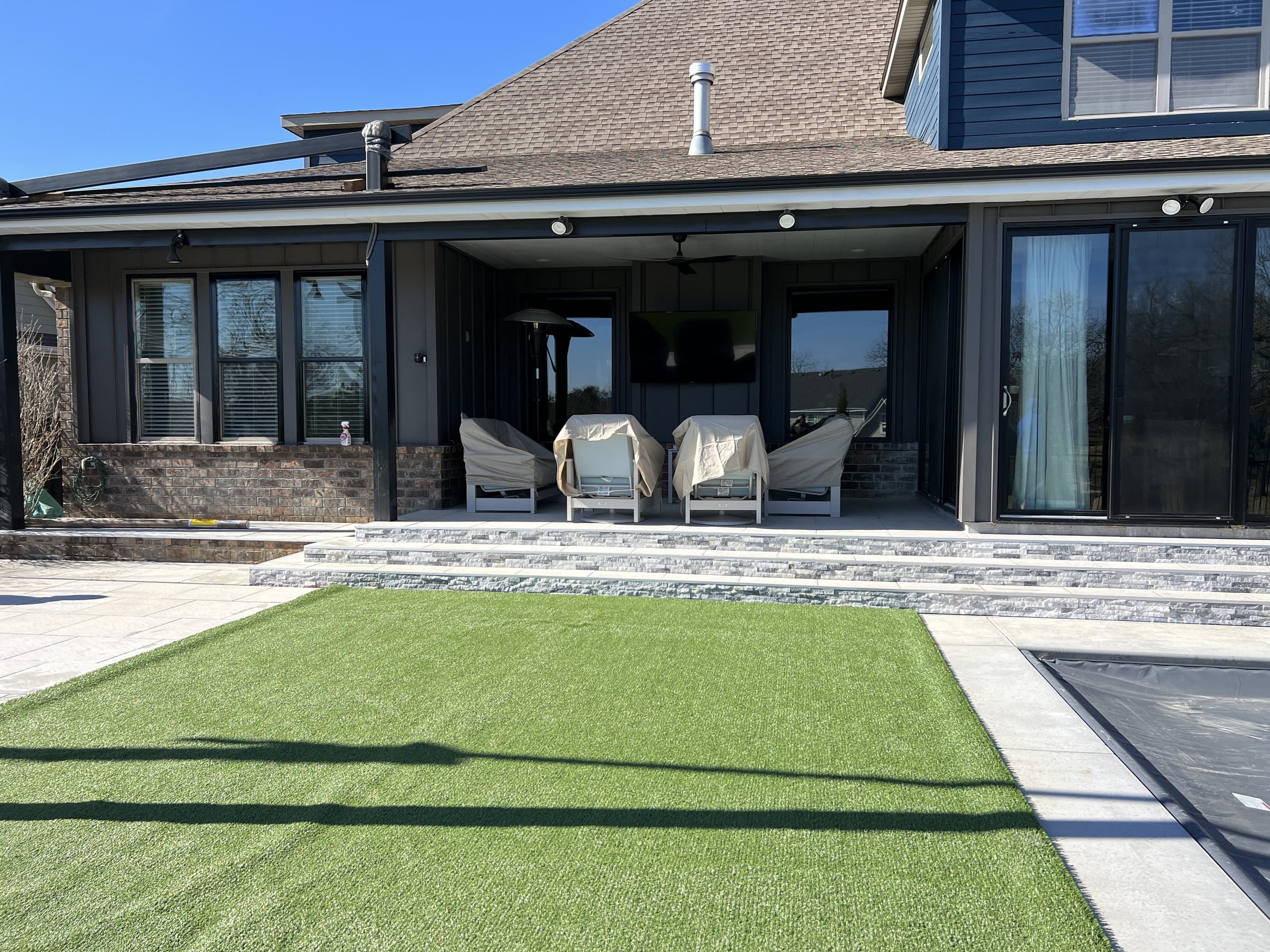
Pavers heave after winter because water in the base or the soil beneath froze. Water expands about nine percent as it freezes, and in fine-grained soils like clay, ice lenses draw in more water and push the surface up. Heave shows where water is trapped: a base holding fines, a low spot, a downspout, or open joints. Units often settle back unevenly in spring, so the fix is drainage and base, then resetting.
01Why do pavers heave in winter?
Because water that was in the ground froze. Ice takes up more room than water, about nine percent more by the USGS figure, so a wet base or a saturated soil under a patio expands as it freezes and pushes the surface up.
That is only part of it. The bigger force is frost heave proper. As the ground freezes from the top down, fine-grained soils draw water up from below toward the freezing zone, where it freezes into layers of ice called ice lenses. The lenses grow as more water arrives, and the ground above them lifts. Silts and clays are the most frost-susceptible soils, because they hold water and move it upward by capillary action.
No water, no heave. Every heaving patio is really a drainage problem showing itself in the coldest weeks.
02Does Northwest Arkansas really get frost heave?
Yes. It is not the deep, long freeze of the northern states, but it is the repeated kind. Northwest Arkansas winters cross freezing again and again, sometimes in the same week, and each cycle freezes and thaws the top of the ground and whatever water is in the patio's base.
The soils make it likely. On the Springfield Plateau, around Bentonville, Rogers, Bella Vista and Cave Springs, the surface is red clay with chert fragments weathered from the Boone Formation. Around Fayetteville, the Fayetteville shale weathers into clay that swells when wet. Both hold water, and both are the fine-grained kind that heaves.
This is why hardscape here has to be built for real freeze-and-thaw seasons rather than for one good-looking summer.
03Where the heave shows up, and what it tells you
| Where the pavers lifted | What it points to | What to fix |
|---|---|---|
| Along one edge or corner | Water collecting at a low point | Fall and outlet |
| Where a downspout discharges | Roof water saturating the base | Pipe the downspout away |
| Next to the lawn or a bed | Soil water wicking into the base | Edge detail, base separation, drainage |
| In the shade by the house | Slow drying, backfill holding water | Fall away from house; drainage |
| Scattered single units | Open joints letting water in | Refill joints; reset lifted units |
| Whole areas, every winter | Base too thin or full of fines over clay | Rebuild the base |
04Will my pavers settle back in spring?
Partly, and not evenly. When the ice melts, the ground settles, but it rarely goes back exactly where it was. The thaw leaves the soil wet and weak, water that melted carries fines, and the bedding under a lifted unit has often shifted. The result is a surface that has a few more humps and dips every year.
Resist the urge to hammer lifted units back down in winter. The ground under them is frozen or soft, and forcing them breaks edges and disturbs the bedding. Wait for the thaw and for the ground to dry, then deal with the cause.
05What in the base makes heave worse?
Fines. A base material full of fine particles holds water and moves it by capillary action, which is exactly what frost heave needs. A well-graded, properly compacted base that drains, over a subgrade that has been prepared, gives water less to work with.
Depth. A thin base puts the frost-susceptible clay closer to the surface, so the freezing zone reaches it and the heave goes straight into the pavers.
Water with no exit. A base sitting in a clay excavation is a bathtub if nothing lets the water out. That is why the edge details, the fall and the outlet matter as much as the stone itself.
Open joints. Every open joint is a funnel into the bedding sand. Keeping joints full is the cheapest frost protection there is.
06How do I fix pavers that heaved?
- Wait for the thaw and for the ground to dry out.
- Find where the water comes from: roof, lawn, low spot, joints.
- Fix that first: downspout outlets, fall, edge drainage.
- Lift the affected area back to sound units.
- Correct the base, removing wet, fines-heavy material where needed, and compact in lifts.
- Relay the same pavers, reinstate edge restraint, and fill the joints fully.
If the heave is everywhere, every winter, the base is the problem and a rebuild on a proper base is the fix. Relaying on the same base puts the same pavers back on the same problem.
07Winter care that helps rather than hurts
Clear snow before it is trodden into ice, and keep snow piles off the patio and away from the house, because a melting pile is a steady source of water into the joints. Use a plastic shovel or a blade with a rubber edge; steel edges chip pavers and gouge concrete.
On de-icers, follow the paver manufacturer's guidance for the product you have. Some chemicals are harder on concrete surfaces than others, and the manufacturer's warranty terms often say which to avoid.
And keep downspouts clear and pointed away. A frozen gutter that overflows onto the patio edge for a week is a heave waiting to happen.
08How to build a patio that resists frost
Frost heave needs three things: freezing temperatures, frost-susceptible soil and water. You cannot change the weather here, and you cannot change the clay, so a good build takes away the water.
- Excavate through topsoil and soft ground, and take the base deep enough that the clay is not sitting just under the bedding.
- Use a base material that drains, compacted in lifts, rather than a fines-heavy fill that holds water.
- Build in a fall and give the water a destination beyond the patio.
- Take every downspout to an outlet away from the paving.
- Detail the lawn and bed edges so soil water is not wicking into the base.
- Fill joints fully and keep them full.
That is what "built for freeze and thaw" means in practice. None of it shows on handover day, and all of it shows by the third winter.
09Pavers or concrete: which copes with frost better?
Pavers, generally, because they are individual units on a flexible base. When the ground moves, a paver field moves with it, and anything that lifts can be taken up and reset. Concrete is one rigid slab. Heave under part of it lifts the whole panel at that point, and the result is often a crack that does not go back.
That does not make concrete wrong. Properly air-entrained concrete on a good, drained base, with control joints in the right places, handles winters well. It is less forgiving of a wet base than pavers are, which is the trade you make for a single continuous surface.
10Steps, walls and edges
Frost does its most visible damage at the edges of things. Steps built on a shallow base lift and tilt. Caps on low walls shift as water freezes under them. Patio edges next to wet lawns lift more than the middle.
Steps and walls usually need deeper footings than the patio next to them, and they need their own drainage. A set of steps that rocks every spring was built on too little, and resetting it on the same base will give the same result.
11Myths about winter damage
"Sealer stops frost damage." Sealer can reduce how much water gets into the surface of a paver or slab. It does nothing about water in the base or the soil, which is what heaves.
"It is just a hard winter." A hard winter shows up weaknesses faster. A patio built to drain comes through it; the one next door that holds water lifts.
"More sand under the lifted pavers will level them." It adds more of the material that holds water, in the place that already has too much.
12Why the lawn edge lifts first
Where a patio meets a lawn or a planted bed, the soil beside the base is watered, rained on and rarely dries. That water moves sideways into the base and the soil under the patio edge, so the edge is the wettest part of the whole installation going into a freeze. It is also where the edge restraint sits, and a lifting edge takes the restraint with it.
The fix is a detail, not a product: a base that extends past the paved edge, an edge restraint anchored into it, and beds or lawn set to shed water away from the patio rather than onto it. Irrigation heads spraying the patio edge are worth adjusting too.
13Winter timing: when to fix it
Fix heave damage in dry weather after the thaw, not during it. The base needs to be dug, rebuilt and compacted at a sensible moisture content, and clay that has just thawed is saturated and will not compact properly. Late spring through autumn is the working window for most repairs.
Use the winter to watch and note. Photograph where the pavers lift and where water sits after rain or snowmelt. That record is the best diagnostic information anyone will have when the repair is planned, because by summer the patio may look almost flat again.
14Questions to ask before a repair
- Where is the water coming from, and how will you stop it?
- Will you look at the base before quoting, and replace it where it holds fines?
- How deep will the new base go, and how will it drain?
- What happens at the lawn and bed edges?
- Can the existing pavers be reused?
15Is it the same as a patio sinking?
They are related. Heave lifts in winter; the thaw that follows leaves voids and wet, weak ground, and the patio settles into it. A patio that heaves every winter will usually also be sinking in places by the third or fourth year. Both are fixed the same way: water out, base right, surface reset.
FAQCommon questions
What is frost heave?
Upward movement of the ground as it freezes. In fine-grained soils, ice lenses form and draw in more water, lifting whatever is on top.
Why did my pavers lift this winter?
Water in the base or soil beneath froze and expanded. Look for where water collects: a low spot, a downspout, open joints, or a wet lawn edge.
Will heaved pavers go back down on their own?
Partly, and usually unevenly. Wait for the thaw and dry ground, fix the water source, then reset the units.
Can I hammer lifted pavers back down in winter?
Better not. The ground is frozen or soft, and forcing units breaks edges and disturbs the bedding. Wait for spring.
Does Arkansas get frost heave?
Yes. Northwest Arkansas winters cross freezing many times, and the local clay soils are the frost-susceptible kind.
How do I stop pavers heaving?
Keep water out of the base: correct fall, downspouts to an outlet, full joints, a well-drained base of adequate depth over prepared ground.
Is rock salt safe on pavers?
Follow the paver manufacturer's guidance for your product. Some de-icers are harder on concrete surfaces than others.
REFSources
- Pavement Interactive: Frost Actionpavementinteractive.org
- USGS Water Science School: Water Densityusgs.gov
- ICPI Tech Spec 3: Edge Restraints for Interlocking Concrete Pavementsbramptonbrick.com
- Arkansas Office of the State Geologist blog: Springfield Plateauarkansasgeological.wordpress.com
NEXTGet it looked at properly
Everything above is general guidance. What your ground actually needs is a site visit, and ours costs nothing. Francisco Gallardo walks it, reads the grade and the drainage, and tells you what is possible.