
Artificial turf earns its place in Northwest Arkansas in three situations: deep shade where grass will not establish, small areas that get walked on constantly, and narrow joints or strips between paving that nobody can mow. Real grass is the better answer for a large open lawn in full sun. Whether turf works at all is decided by the excavated, free-draining base under it, exactly like paving, and that is where cheap installs fail.
01Is artificial turf a good idea in Northwest Arkansas?
It is a good idea in specific places and a poor one as a blanket replacement for a lawn.
Northwest Arkansas sits in what turf scientists call the transition zone, where both warm-season and cool-season grasses can be grown and neither is perfectly at home. Summers are hot enough to stress cool-season grass, and winters are cold enough that warm-season lawns go brown and dormant for months. Add the tree cover that runs through Bella Vista, the older Fayetteville streets and the wooded lots out toward Elkins, and there are places where real grass simply will not hold.
That is where turf is honest. It is not honest as a way to cover a large sunny yard that would grow grass perfectly well with sensible choices, because there the downsides of turf are larger than the upside.
02How do they compare side by side?
| Factor | Artificial turf | Real grass |
|---|---|---|
| Deep shade | Unaffected | Struggles; few grasses cope |
| Heavy daily traffic | Holds up if the base is right | Wears to bare soil and mud |
| Full sun in August | Gets noticeably hot | Stays cooler underfoot |
| Winter look | Green year round | Warm-season lawns go dormant and brown |
| Mowing and watering | None; occasional brushing and rinsing | Regular through the season |
| Drainage | Only as good as the base under it | Soil absorbs, within limits |
| Up-front cost | Higher; the base is real ground work | Lower |
| Joints between pavers | Excellent; no mowing narrow strips | Hard to keep neat |
| Soil and planting | Does nothing for either | Part of a living garden |
03Where does turf genuinely work?
In shade, under constant traffic, and between paving.
Deep shade. The University of Arkansas Cooperative Extension has published guidance on growing turfgrass in shade, and the underlying problem is light: under a dense canopy there is not enough of it for grass to photosynthesise, so it thins and grows upward looking for light rather than spreading. The extension recommends the more shade-tolerant options, such as certain zoysia cultivars, and even those have limits. Under mature oaks on a Bella Vista lot, turf is often the only green surface that will last.
High traffic. A dog run, a side-gate approach, a small garden used by children every day. Grass in those spots is mud from November to March and bare by July.
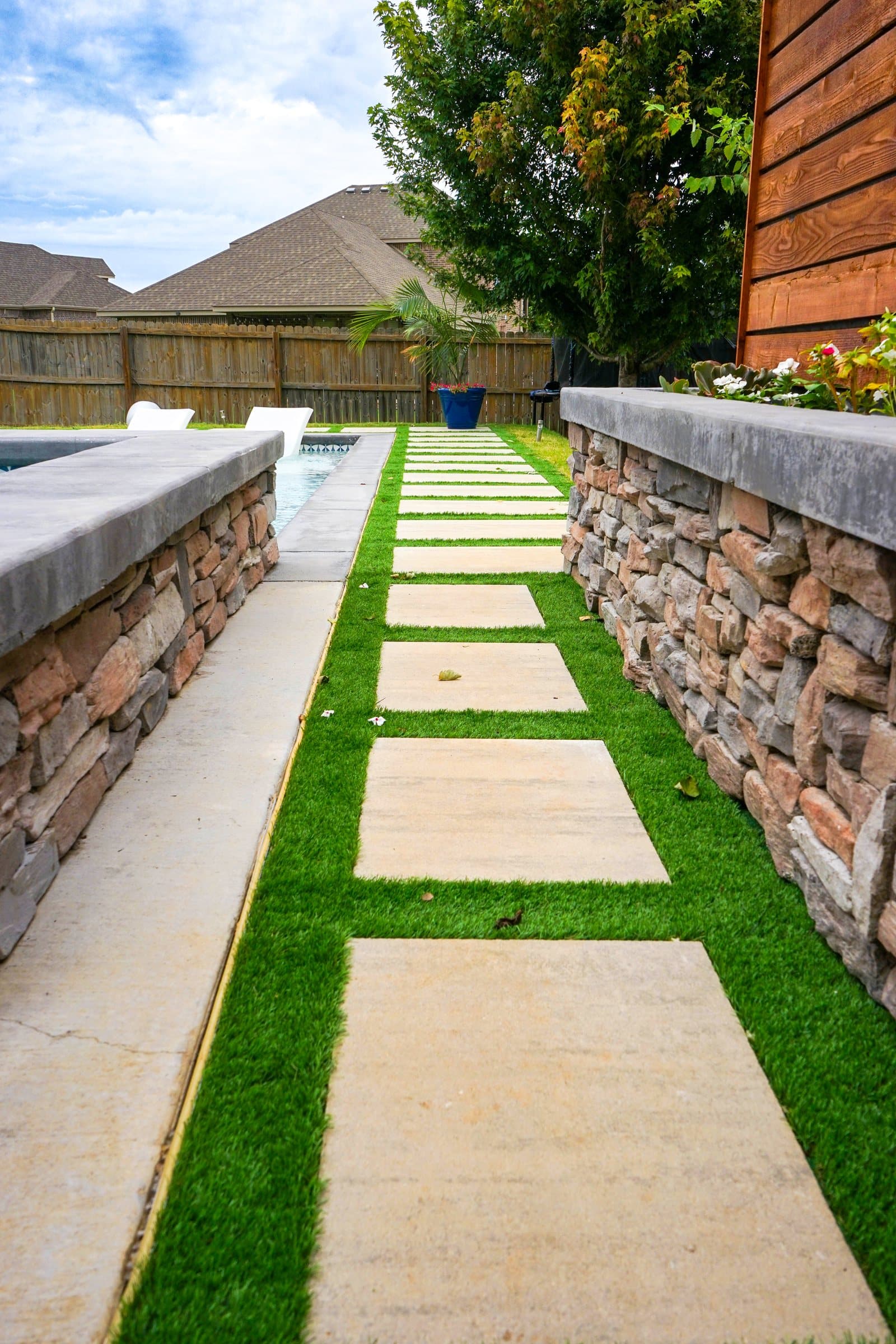
Between paving. Turf joints between large-format units give you the green line without asking anyone to mow or edge a strip a few inches wide. That detail is on the Swindle build in Cave Springs, and it is one of the things people notice first about that terrace.
04Where is real grass the better answer?
On large open areas in full sun, and anywhere you want the garden to feel alive rather than finished.
Turf gets genuinely hot in an Arkansas August, noticeably hotter than grass, and across a big sunny lawn that is unpleasant rather than academic. Children and dogs will tell you quickly. It also does nothing for the soil, nothing for drainage on its own, and nothing for the insects, birds and planting that make a garden feel like part of the landscape. A yard that is entirely hard surface and turf reads like a showroom.
A sunny lawn in Northwest Arkansas can be very good with the right grass for the exposure and the use. The extension's guide to choosing a grass for Arkansas lawns is a sensible starting point. The practical answer on most properties is a real lawn where the sun is, turf where it is not, and hardscape where people actually gather.
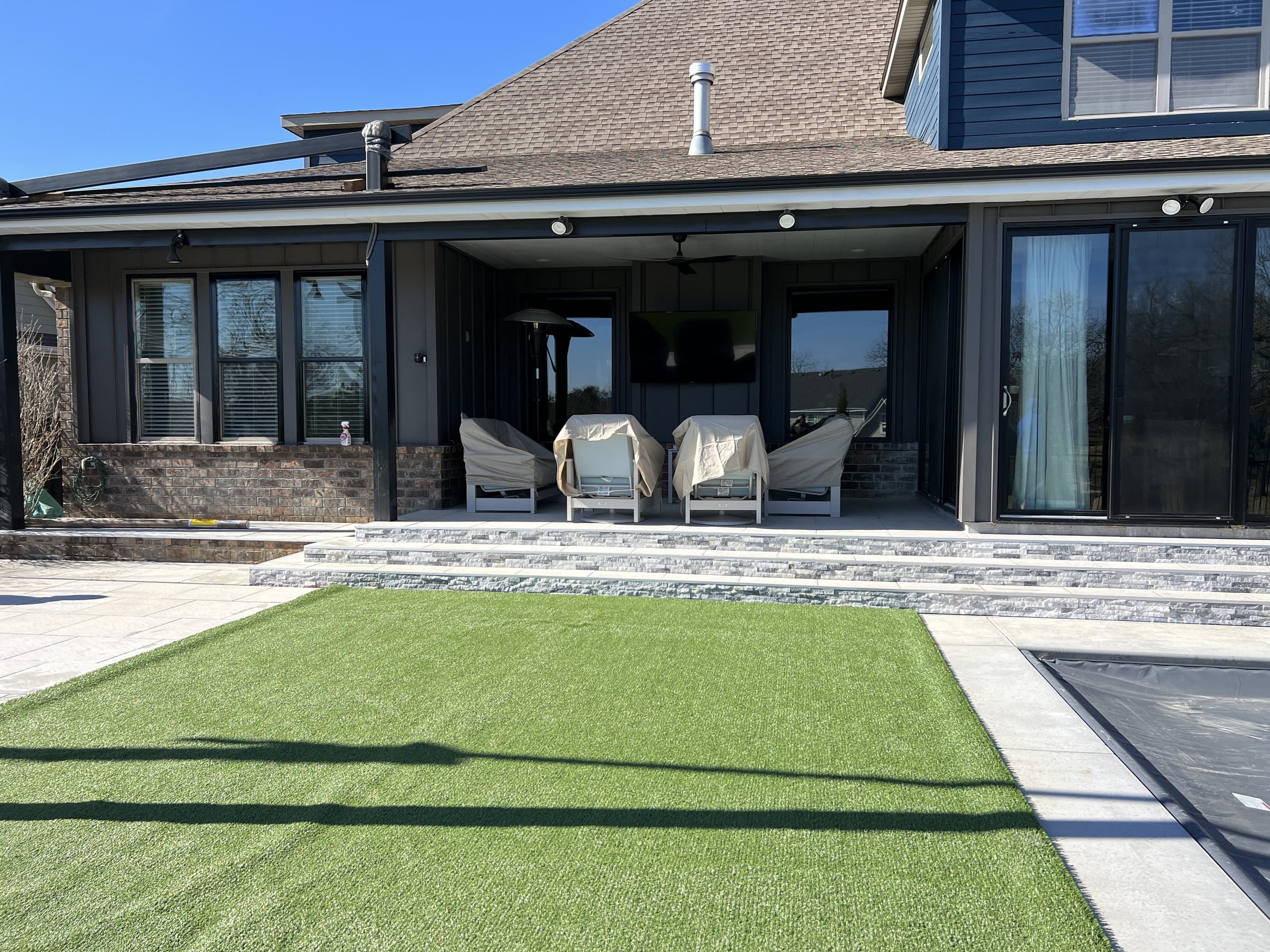
The honest trade-off with a warm-season lawn is winter. From the first hard freeze, which the National Weather Service puts at around the start of November on average at Fayetteville, to spring green-up, a bermuda or zoysia lawn is brown. If the lawn is the view from a covered patio you use all year, that is a fair reason to put turf in the small area right in front of it and keep real grass beyond.
05What decides whether turf works: the base or the product?
The base decides it; the product only decides how it looks while the base does its job.
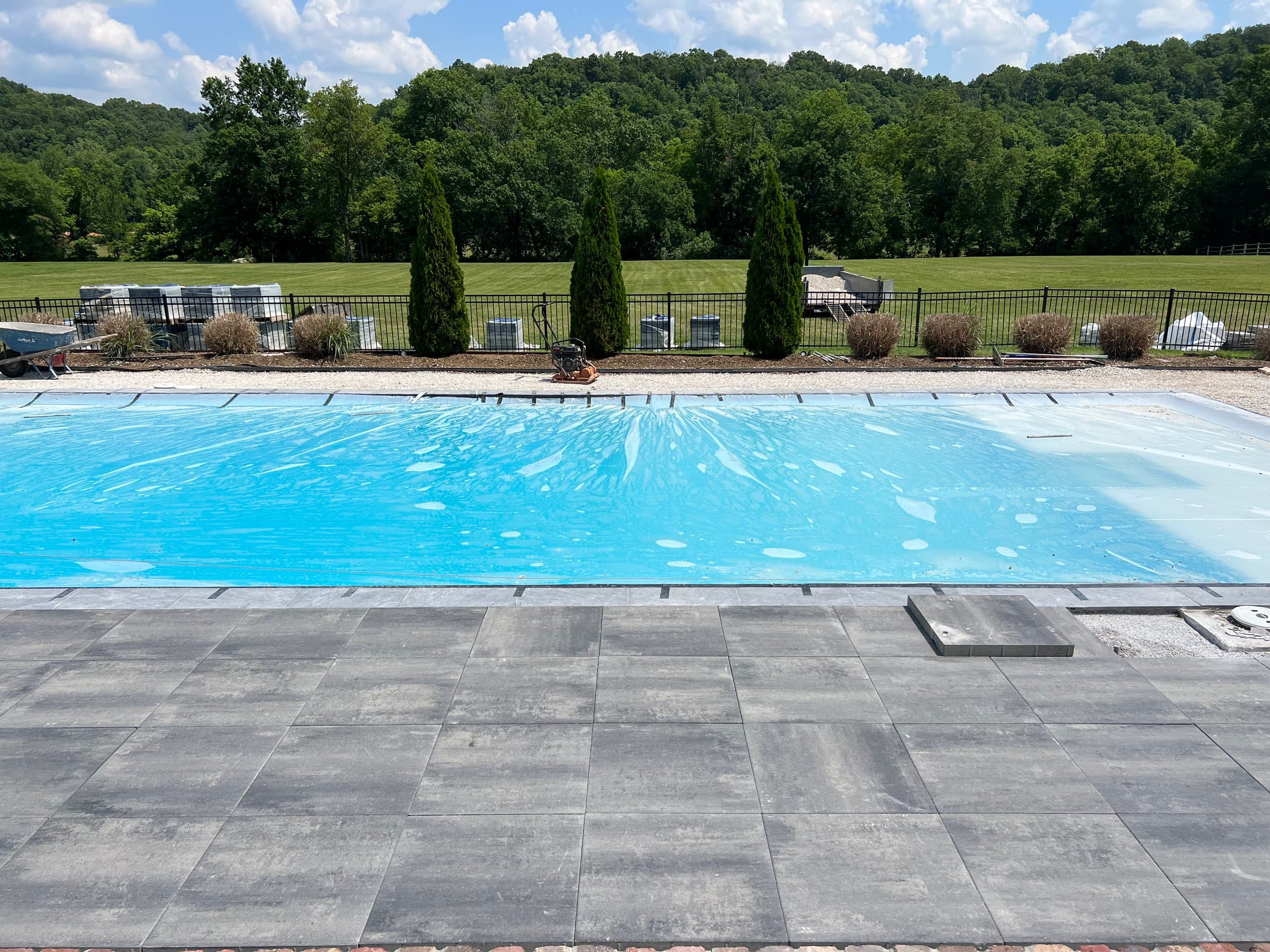
Turf laid over compacted native soil has nowhere to send water. It holds it, smells, grows algae at the backing, and develops dips exactly where people walk. The Synthetic Turf Council's guidelines treat turf as a system: prepared subgrade, a free-draining aggregate base of at least three inches, drainage, perimeter anchoring, seams and infill. They also call for a slight slope in the base away from buildings toward a proper drainage area, because even though turf drains vertically through its backing, water still has to go somewhere once it is through.
In Northwest Arkansas, the somewhere matters. On the Springfield Plateau, across Benton County, the ground is limestone and chert with red clay where the limestone has dissolved. That clay drains slowly, so the base under turf needs a real route out rather than relying on the soil to soak it up. From Fayetteville south, the Fayetteville shale swells when wet and shrinks when dry, which means water held under turf is also water that makes the ground move. The fix in both places is the same unglamorous work as paving: excavate, lay and compact a free-draining base, and give the water a destination.
That is also why turf is not the cheap option people expect. The material is only part of the cost. An installation that skips the base is an installation with a short, smelly life.
06How do you look after artificial turf?
Less than grass, but not nothing.
Brush it against the grain so the fibres stand up, particularly in the walking lines. Clear leaves before they rot on the surface, which under Northwest Arkansas tree cover means autumn matters. Rinse pet areas regularly. Check the edges and seams after the winter, because a perimeter that was not anchored properly shows itself when the ground has been through a few freezes. And keep an eye on low spots, because a dip that holds water is telling you about the base.
If you are combining turf with paving, the transitions need thought: the turf should sit at the right height against the paver edge so it does not become a trip line, and the base under both should be built together so they move together.
07What goes wrong with cheap turf installations?
Almost every turf failure is a base failure, not a product failure.
- Laid on native soil. Water sits under the backing, the area smells after rain, and the surface goes soft
- No fall and no outlet. The base drains into itself and stays wet, which on clay means it stays wet for days
- Base not compacted. Dips appear along the paths people actually walk, and they get deeper each winter as the ground freezes and thaws
- Edges not anchored. The perimeter lifts and curls, and becomes a trip line at the patio edge
- Seams done badly. Visible lines and gaps that open in the heat
- Downspouts pointed at it. Concentrated roof water washes out infill and overwhelms even a decent base
Every one of those is avoidable at build time and expensive to fix afterwards, because fixing the base means lifting the turf. If you are comparing quotes, ask how deep each contractor excavates, what the base is, how it is compacted, and where the water goes. The answers separate them faster than the price does.
08Can turf and real grass work in the same yard?
Yes, and on most Northwest Arkansas properties that mix is the best design.
The pattern that works is to map the yard by light and by use before choosing any surface. The shaded strip under the tree line and the dog run by the side gate go to turf. The open sunny area where children play and where the lawn will actually thrive stays as grass. The places where people sit, cook and gather become hardscape, and the joints and strips between large pavers take turf because nobody wants to mow them.
The edges between them need designing rather than improvising. A steel or stone edge between turf and grass keeps the lawn from creeping into the turf and makes mowing straightforward. Where turf meets paving, the heights should be set so there is no lip. And the drainage plan should treat the whole yard as one system, so water leaving the turf base does not end up saturating the lawn beside it.
09What does each one cost?
Grass is cheaper to install and costs more in time every season; turf costs more up front because of the base and very little in time afterwards.
We will not quote per-square-foot figures here, because the base work and the site decide the number. Turf is usually part of a larger hardscape project for us rather than a job on its own, and our projects start around seven and a half thousand dollars. Financing is available through Acorn Finance.
10Which should you choose?
Choose turf for deep shade, for small high-traffic areas, and for joints and strips between paving, and only on an excavated, free-draining base with a real outlet for the water.
Choose real grass for large open areas in full sun, for anywhere children and dogs will be on it in August, and for the parts of the garden you want to feel alive.
On most properties the best result is both, placed by light and use rather than by preference, with hardscape where people gather. If you want to work out the split for your yard, call Paco on (479) 379-2226.
FAQCommon questions
Does artificial turf drain?
The turf does, through its backing. The ground under it decides whether the water actually goes anywhere. Without an excavated free-draining base and a slope to an outlet, it sits and smells.
Does artificial turf get hot in Arkansas?
Noticeably hotter than grass in full sun in August. In shade it is a non-issue, which is one reason shaded areas are where turf works best.
What grass grows in shade in Northwest Arkansas?
The University of Arkansas extension points to the more shade-tolerant options, such as certain zoysia cultivars, but under dense canopy even those thin out. That is where turf becomes the honest answer.
Is artificial turf good for dogs?
For a small, heavily used dog area it is often better than grass, which turns to mud. It needs a free-draining base and regular rinsing.
How long does artificial turf last?
A good product on a proper base lasts far longer than cheap product on compacted soil, which looks tired within a couple of seasons. The base matters more than the pile.
Can you put turf between pavers?
Yes, and it is one of the best uses for it. It gives a clean green joint without mowing a narrow strip, as on the Swindle build in Cave Springs.
Does artificial turf stay green in winter?
Yes. Warm-season lawns in Northwest Arkansas go dormant and brown for the winter, and turf does not, which is part of its appeal next to a patio used year round.
REFSources
- University of Arkansas Cooperative Extension FSA-6140: Growing Turfgrass in Shadeuaex.uada.edu
- University of Arkansas Cooperative Extension FSA2112: Choosing a Grass for Arkansas Lawnsuaex.uada.edu
- Synthetic Turf Council: Guidelines for Synthetic Turf Base Systemscdn.ymaws.com
- Arkansas Geological Survey: Karst in the Arkansas Ozarks, Part 2arkansasgeological.wordpress.com
- National Weather Service Tulsa: Fayetteville hard freeze climatology (28F)weather.gov
NEXTGet it looked at properly
Everything above is general guidance. What your ground actually needs is a site visit, and ours costs nothing. Francisco Gallardo walks it, reads the grade and the drainage, and tells you what is possible.