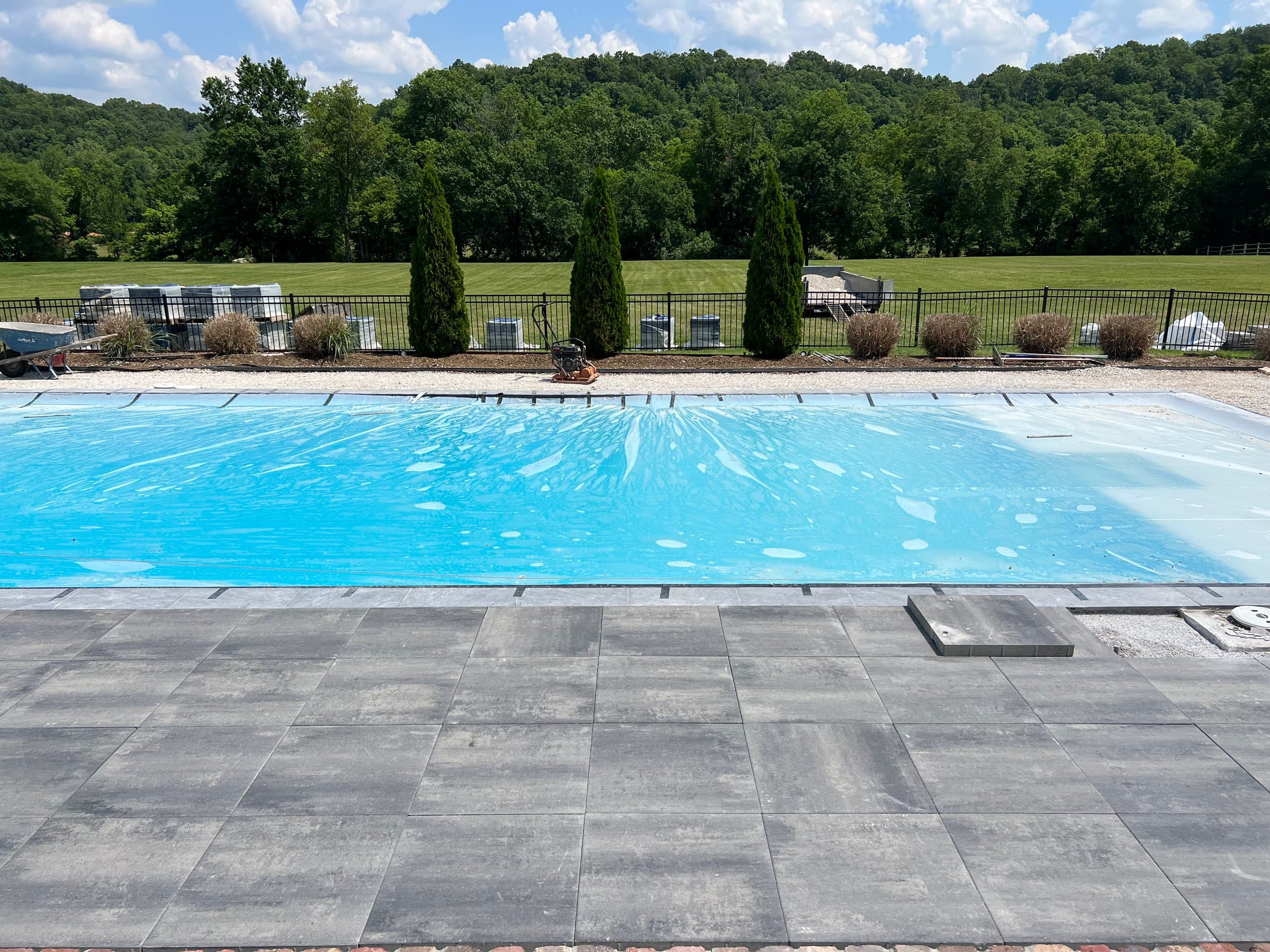

Concrete pavers are consistent, predictable, quicker to lay and made to a published freeze-thaw standard, and they come in large formats that suit modern architecture. Natural stone costs more, varies unit to unit, takes more skill to lay, and looks better against an older house the longer it is down. In Northwest Arkansas the deciding factors are the house it sits against and whether the specific stone can take a freeze-thaw winter, not the budget alone.
01What is the real difference between natural stone and concrete pavers?
Concrete pavers are a manufactured product made to a specification; natural stone is quarried material whose properties depend on the stone, the quarry and the bed it came from.
That one difference drives almost everything else. A concrete paver made to ASTM C936, the standard referenced in ICPI Tech Spec 2, has to meet a minimum average compressive strength of 8,000 psi, absorb no more than five percent water, and pass a 50 cycle freeze-thaw test. You can hold a manufacturer to that. Natural stone is covered by its own ASTM specifications by stone type, which the Natural Stone Institute lists, and within one type the absorption and strength vary. Some flagstones and limestones are superb outside in a freezing climate. Some are beautiful in a showroom and spall in the second winter.
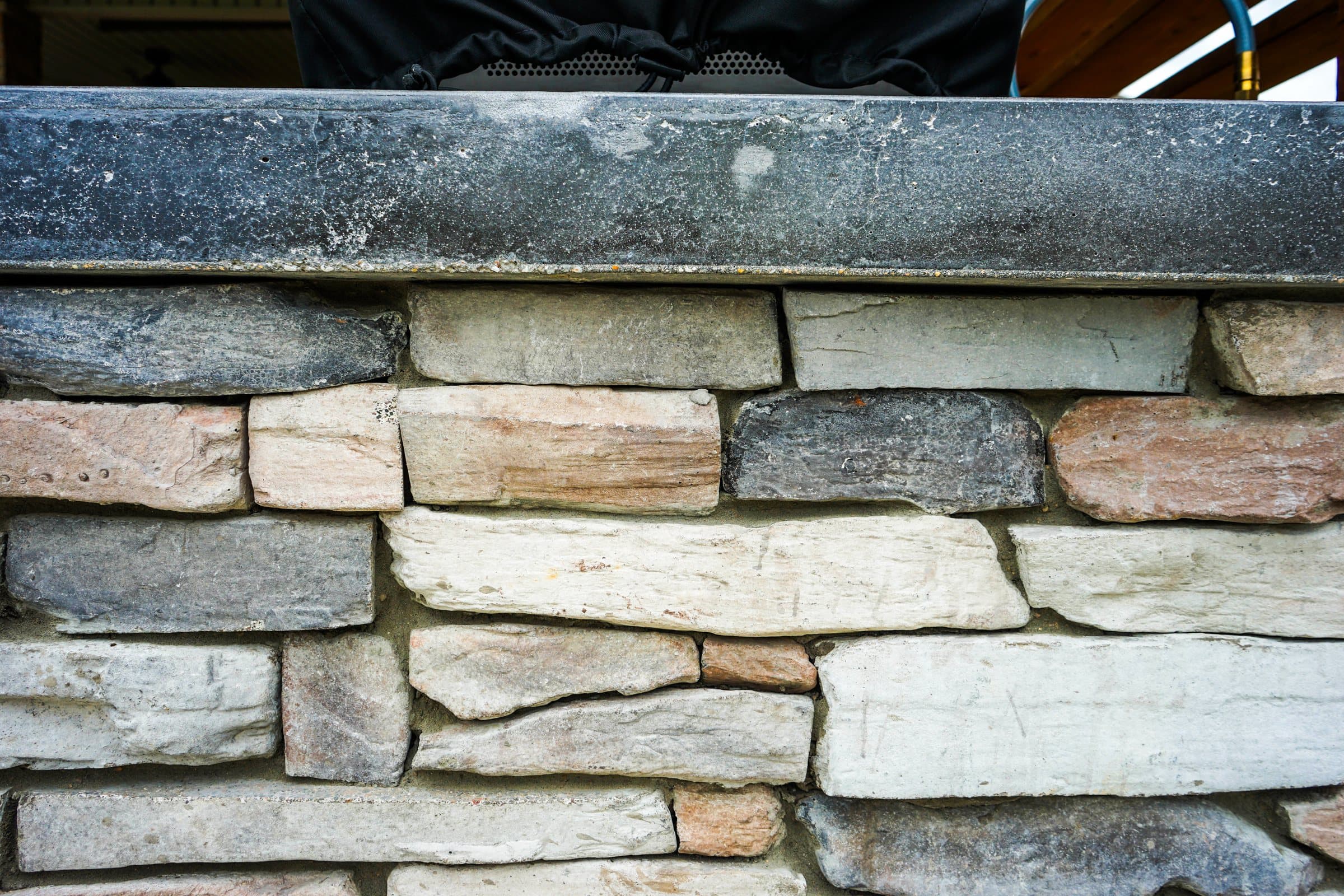
Neither is automatically the premium answer. Large-format concrete units with tight joints are a deliberate, architectural choice on a modern house. Natural stone is the right material where the house and the landscape already have age and texture to answer to.
02How do they compare side by side?
| Factor | Natural stone | Concrete pavers |
|---|---|---|
| Material and labour cost | Higher on both | Lower on both |
| Consistency | Varies unit to unit; that is the appeal | Uniform by design |
| Freeze-thaw performance | Depends entirely on the specific stone | Set by ASTM C936 (50 cycle test) |
| Water absorption | Varies widely by stone | No more than 5% under C936 |
| Laying | Slower, more cutting, more skill | Faster, modular |
| Replacing one unit later | Matching can be hard | Same product, straightforward |
| Ageing | Weathers in, often improves | Colour softens; quality decides how much |
| Formats | Irregular flagstone, cut stone, steps, walling | Standard units to large-format slabs |
| Best suited to | Older and traditional houses, walls, steps, detail | Contemporary houses, large calm fields, driveways |
03How do they survive a Northwest Arkansas winter?
Both survive it if the unit resists water absorption and the base drains; both fail if either of those is wrong.
The National Weather Service station at Fayetteville records an average last 32 degree night in mid April and an average first one in mid October, with hard freezes at 28 degrees typically running from early November to early April. Through that stretch, surfaces go through repeated freezing and thawing. Water that soaks into a porous unit expands by roughly nine percent when it freezes, and it does that from the inside. The result is spalling, where the face flakes off in layers, and it is the classic failure of the wrong stone in this climate.
With concrete pavers the protection is the standard: buy a product made to C936 and ask the supplier for the test data. With natural stone the protection is asking the right questions: what is the absorption of this specific stone, and where has it performed outside in a climate that freezes? A quarry that cannot answer that is telling you something.
The base matters as much as the unit, for both. ICPI calls for a minimum four inch compacted base for patios over well-drained soils and notes that thicker bases are often used where there are numerous freeze-thaw cycles or expansive soils. Northwest Arkansas has both, depending on which side of Fayetteville you live.
04Does the ground under the house affect the choice?
It affects how either one is laid more than which one you choose.
On the Springfield Plateau, across Bentonville, Rogers, Springdale, Bella Vista and Cave Springs, the Boone Formation is limestone and chert. Rock is often shallow, and where the limestone has dissolved there is red clay with chert fragments. Both materials do well here on a properly built aggregate base. The risks are excavation that hits rock early and water that follows fractures under the patio.
From Fayetteville south, into Farmington, Prairie Grove and Elkins, the Fayetteville shale swells when wet and shrinks when dry. A dry-laid surface, stone or concrete, on a deep free-draining base will tolerate that movement and can be reset. Natural stone mortared onto a concrete slab behaves exactly like the slab underneath it, and a slab on shale is the thing most likely to crack. If you want mortared stone south of Fayetteville, the slab and its base are where the money has to go.
One local quirk worth knowing: there is no natural sand source in Northwest Arkansas. Bedding and joint sand is brought in by rail, which is one more reason to get the specification right the first time rather than re-bedding later.
05Which house does each one suit?
Natural stone suits houses that already have age and texture; large-format concrete suits houses built around clean lines.
Around the Bentonville square, in Siloam Springs and on the older Fayetteville streets, brick and stone have been weathering for decades. Natural stone and restrained detailing sit properly against that, and a very uniform manufactured surface can look like a catalogue page dropped in front of a period house.
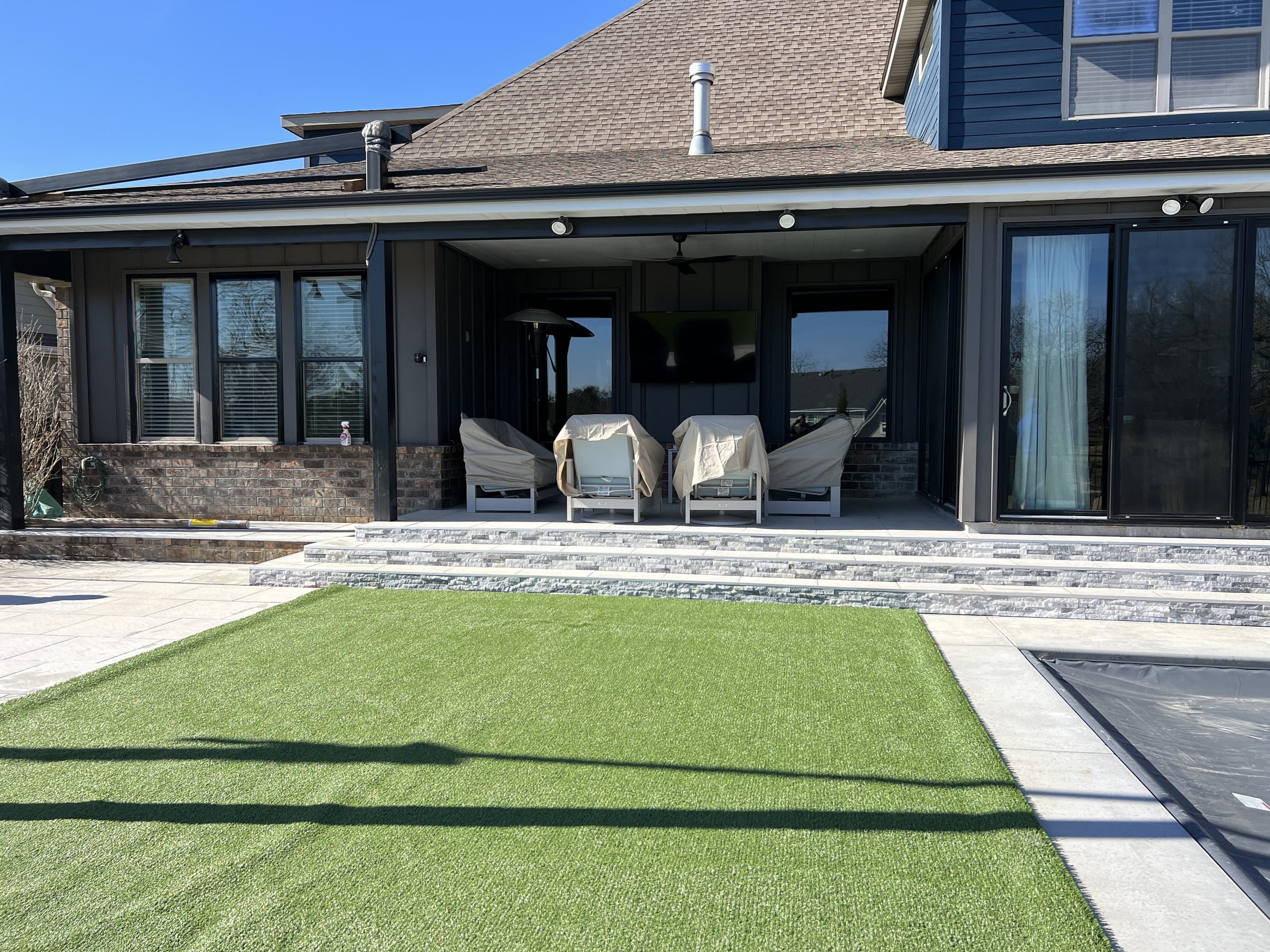
On the newer architecture out toward Centerton, Highfill and the west side of Bentonville, large-format concrete units with tight joints read calm and deliberate. Irregular flagstone against a very clean facade can look fussy, because the variation that makes stone beautiful fights the building.
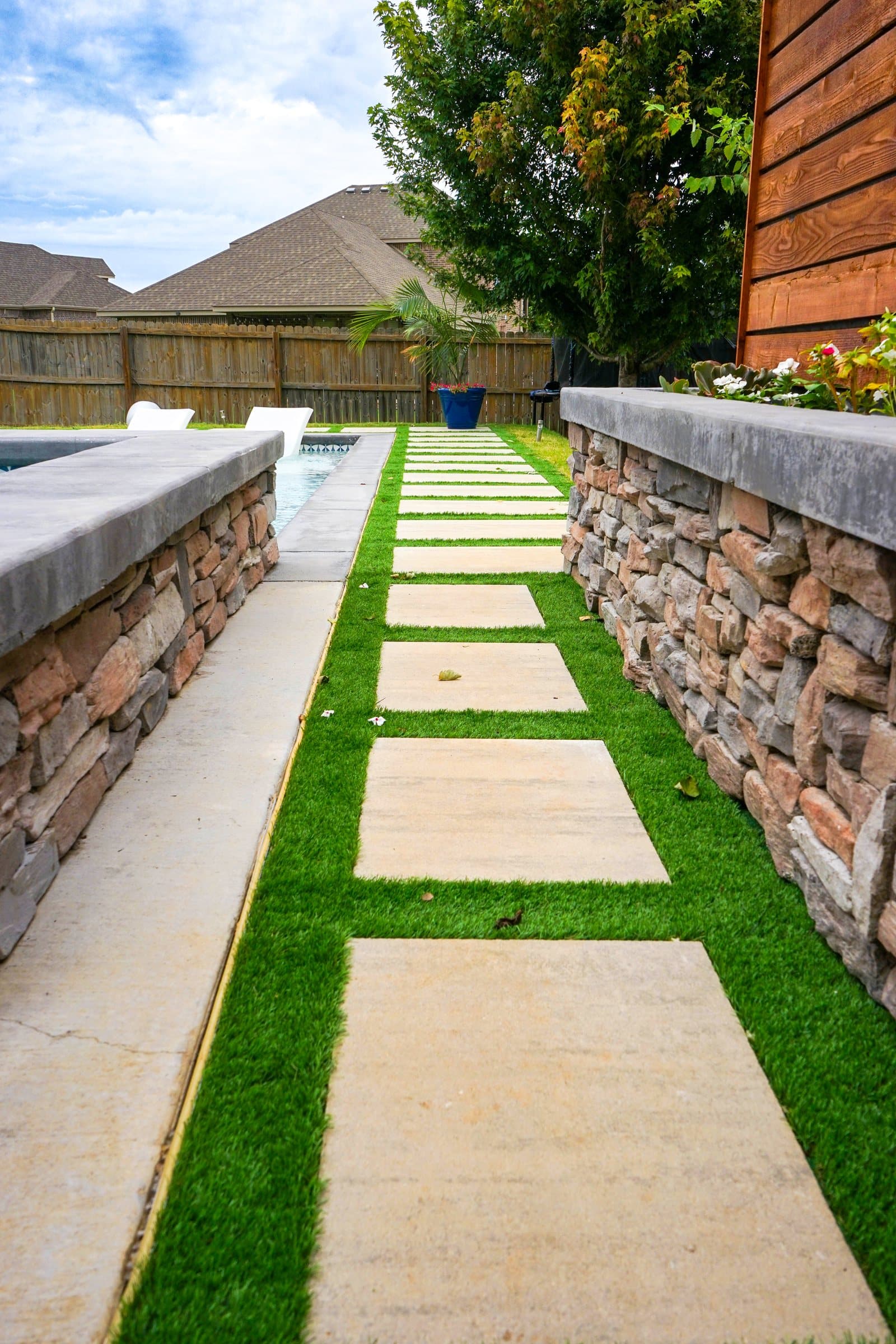
Mixing both deliberately is often the best answer. On the Swindle build in Cave Springs we used stacked stone on the walls and the raised spa, and large-format pavers with turf joints for the field. Stone carries the texture where you look at it up close; the manufactured field stays calm and consistent underfoot.
06What does each cost to live with?
Concrete pavers are cheaper to buy, lay and repair; natural stone costs more at each step and repays it in how it looks as it ages.
We will not put per-square-foot figures on this page, because on real projects the ground work moves the total more than the surface does. Excavation, base, drainage and access decide most of the budget. Our projects start around seven and a half thousand dollars, and financing is available through Acorn Finance.
Maintenance is similar for both when they are dry-laid: joint sand topped up, the occasional unit lifted and reset, and a decision about sealing. Our guide on sealing pavers in Arkansas covers that. Repair is where they differ. A damaged concrete paver is replaced with the same product. A damaged stone may come from a bed or a quarry that no longer produces that colour, so keep spare units from the original delivery in the garage. It costs nothing and it saves a visible patch later.
07How is each one laid, and why does it matter?
Both can be dry-laid on a compacted aggregate base or mortared to a slab, and the method decides how the finished surface behaves far more than the material does.
Dry-laid means an excavated, compacted aggregate base, a screeded bedding layer, the units, and joint material between them, all held by an edge restraint. ICPI's guidance is to compact the base in four to six inch lifts and give the finished surface a fall of at least 1.5 percent so water leaves it. Concrete pavers are designed for exactly this. Natural stone can be laid the same way if the pieces are thick and consistent enough, and it is the more forgiving method for flagstone on shale, because it moves with the ground rather than against it.
Mortar-set means stone bonded to a concrete slab. It allows thinner and more irregular stone, it gives a very solid feel underfoot, and it looks right on some traditional houses. It also turns the stone into a skin on a rigid slab, so the slab's joints, its base and its drainage become the whole question. Mortar joints need attention over time, and water that gets behind the stone and freezes will lift it.
Neither method is wrong. The mistake is choosing the look first and the method by default, without asking what the ground under the patio is going to do.
08What should you ask before committing to either?
A handful of questions separates a good specification from an expensive lesson.
- For concrete pavers: is the product made to ASTM C936, and can the supplier show the test results?
- For natural stone: what is the absorption of this specific stone, and where has it been used outside in a climate that freezes?
- How deep is the base, what is it made of, and how is it compacted?
- Dry-laid or mortar-set, and why that method on this ground?
- What is the edge restraint, and where does surface water go once it leaves the patio?
- How many spare units will be left on site for future repairs?
A contractor who answers those without hesitation has done this before. Our list of questions to ask a hardscape contractor goes further.
09Which should you choose?
Choose natural stone if the house is older or traditional, if the stone has a proven record outside in a freezing climate, and if you value how it weathers over how uniform it is.
Choose concrete pavers, particularly large-format units, if the house is contemporary, if you want a calm and consistent field, if you want a published freeze-thaw standard behind the product, or if easy like-for-like repair matters to you.
Choose both, deliberately, if the project has walls, steps and a large field: stone for the parts people touch and look at closely, manufactured units for the part they walk on. Whichever way you go, the base decides whether it is still flat after the winters. Talk it through with Paco on (479) 379-2226.
FAQCommon questions
Is natural stone worth the extra cost?
Against an older house, usually yes. Against a very modern one, often not, because the variation that makes stone beautiful can fight a clean facade.
Is natural stone or concrete pavers better for freeze-thaw?
Concrete pavers made to ASTM C936 are tested to 50 freeze-thaw cycles. Natural stone depends entirely on the specific stone and its absorption, so ask for data and a track record in a freezing climate.
Will concrete pavers fade?
They soften over time. Better products hold colour for longer, and the difference between a cheap paver and a good one shows up in the later years, not the first.
Why is my flagstone flaking?
Usually water absorbed into the stone is freezing and pushing the face off in layers, which is called spalling. It means the stone is too porous for the exposure or water is being held against it.
Can I mix natural stone and concrete pavers?
Yes, and it often looks better than either alone. Stone for walls, steps and detail, large-format pavers for the main field.
Is mortared flagstone a good idea in Arkansas?
Only on a slab that is built to stay put. Mortared stone behaves like the slab under it, so on the Fayetteville shale the slab and its base need particular care.
Which is easier to repair?
Concrete pavers, because the same product is usually still available. With natural stone, keep spare units from the original delivery.
REFSources
- ICPI Tech Spec 2: Construction of Interlocking Concrete Pavementsorco.com
- Natural Stone Institute: ASTM standards relevant to natural stonenaturalstoneinstitute.org
- National Weather Service Tulsa: Fayetteville hard freeze climatology (28F)weather.gov
- Arkansas Geological Survey: Karst in the Arkansas Ozarks, Part 2arkansasgeological.wordpress.com
- Talk Business & Politics: Shale rests at root of construction problemstalkbusiness.net
NEXTGet it looked at properly
Everything above is general guidance. What your ground actually needs is a site visit, and ours costs nothing. Francisco Gallardo walks it, reads the grade and the drainage, and tells you what is possible.