
For a pool deck in Northwest Arkansas, pavers win on repairability and on how they tolerate ground movement, and poured concrete wins on cost per square foot across a large, simple area. Heat underfoot and grip when wet are decided by colour and finish, not by the category. If anything under the deck will ever need reaching, or the house sits on the Fayetteville shale, pavers usually earn their extra cost.
01Which is better around a pool, concrete or pavers?
Neither is better everywhere; they fail in different ways, and the right one is the one whose failure you can live with on your ground.
A pool deck is a harder job than a patio. It is wet far more often, it is splashed with treated water all summer, it has plumbing, light conduit and often a bond or equipment run underneath it, and it sits right against a structure that must not move differently from the surface around it. Whatever goes down has to shed water away from the pool and away from the house, stay flat enough that nobody trips on a lifted edge, and give grip to wet bare feet.
Poured concrete does that as one continuous slab. Concrete pavers do it as thousands of individual units on a compacted aggregate base and a bedding layer, locked together by joint sand and held at the edges by a restraint. Those two structures respond to the same Arkansas winter very differently, and that difference is most of this decision.
02How do they compare side by side?
The table below is the short version. Each row is expanded further down.
| Factor | Concrete pavers | Poured concrete |
|---|---|---|
| Up-front cost per square foot | Higher | Lower across large, simple areas |
| How it handles ground movement | Flexes; individual units can settle | Cracks at the weakest point, ideally at a control joint |
| Repairing one damaged spot | Lift and reset those units | Patch that shows, or cut out and repour a section |
| Reaching a pipe or conduit underneath | Take up, dig, relay the same units | Saw, break out, repour; the repair rarely matches |
| Freeze-thaw resistance | Set by the unit spec (ASTM C936 tests 50 cycles) | Set by the mix, air entrainment and finishing |
| Heat underfoot | Decided by colour | Decided by colour |
| Grip when wet | Decided by surface texture | Decided by finish (broom, exposed, textured) |
| Ongoing maintenance | Joint sand topped up; optional sealing | Resealing, control joints kept sealed |
| Look across a big area | Modular, joint lines visible | Continuous, uninterrupted |
03What does an Arkansas winter do to a pool deck?
It freezes water inside and under the deck, repeatedly, and every cycle tests the base and the surface.
The National Weather Service station at Fayetteville puts the average first 32 degree night in mid October and the average last one in mid April. Between those dates the deck goes through a long run of nights below freezing and days above it. Water expands by roughly nine percent as it freezes, so any water held in the surface, in the joints or in a poorly drained base pushes, then leaves a void when it thaws. A pool deck gets more water than any other hardscape on the property, which makes it the first place that cycle shows up.
For pavers, the defence is the unit and the base. Pavers made to ASTM C936, as referenced in ICPI Tech Spec 2, are required to average at least 8,000 psi, absorb no more than five percent water, and survive a 50 cycle freeze-thaw test. Put those on a properly compacted, free-draining base and the surface has little to fear from the cold itself.
For concrete, the defence is the mix and the finishing. The concrete industry's own guidance on scaling (NRMCA CIP 2) is that air-entrained concrete resists freeze-thaw damage and surface scaling far better than non-air-entrained concrete, and that deicers should be kept off new concrete through its first winter. A pool deck poured without air entrainment, or overworked at the surface, is the one that flakes.
04Does the ground under the house change the answer?
Yes, and in Northwest Arkansas it changes it more than anywhere we could name, because two very different grounds sit twenty minutes apart.
North of Fayetteville, across Bentonville, Rogers, Springdale, Bella Vista, Centerton, Cave Springs and the rest of Benton County, you are on the Springfield Plateau. The Arkansas Geological Survey describes the Boone Formation there as limestone interbedded with chert, and as probably the most karst-susceptible formation in the Ozarks. For a pool that means shallow rock that changes the excavation, red clay with chert fragments where the limestone has gone, and water that finds its own route. On a good base, both slab and pavers perform well here. The risks are drainage and whether the dig was priced honestly.
Fayetteville south, into Farmington, Prairie Grove and Elkins, you are in the Boston Mountains, on sandstone and the Fayetteville shale. University of Arkansas geologist Walter Manger put it bluntly: "Shale expands and contracts, caused from the clay's weathering." A rigid slab sitting on ground that swells when wet and shrinks when dry will crack. A modular surface on a deeper base will move a little and can be reset. That is where the flexibility of pavers earns its money.
05Which one stays cooler and which one is less slippery?
Whichever is lighter in colour stays cooler, and whichever has more surface texture has more grip; the material category decides neither.
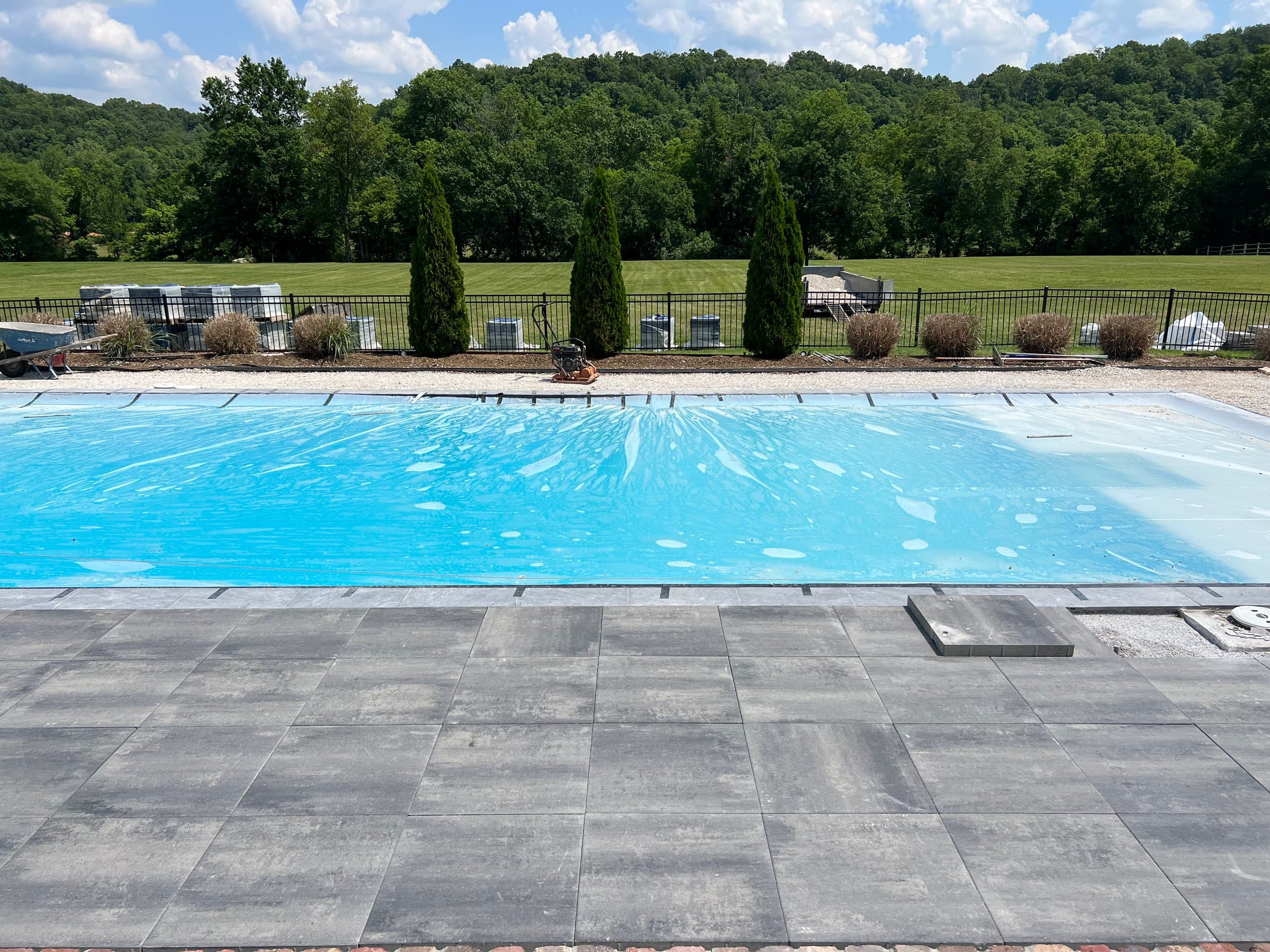
A pale broom-finished concrete deck is kinder to bare feet in August than a charcoal paver, and a pale textured paver is kinder than a dark stained slab. If heat matters to you, and around a pool in an Arkansas summer it should, choose the colour first and the material second.
Grip works the same way. Polished or sealed-to-a-gloss surfaces of any kind are slippery when wet. Broomed, exposed aggregate, shot-blasted and textured paver faces are what you want within splashing distance. Be careful with sealers on either material: some leave a film that makes a grippy surface slick, and near water that matters more than the colour boost.
06What actually goes wrong with each?
Pavers fail at the base and the edges; concrete fails at the joints and where the ground moves.
Paver failures we see: settlement where the base was not compacted in lifts, usually along the pool coping or over a trench that was backfilled loose; units creeping at an edge that had no proper restraint; and joint sand washed out by splash and hosing until the field loosens. Every one of those is repairable without replacing the deck. See why pavers shift and lift.
Concrete failures: cracks that ignore the control joints because they were cut too shallow or too far apart, a slab that settles as one piece and tilts toward the pool or the house, scaling where the mix or finishing was wrong, and colour that no patch will ever match. The honest summary is in repair or replace a cracked slab.
The failure that matters most around a pool is the one that happens over the plumbing. At some point somebody will need to reach a line, a light niche conduit or a return. Pavers come up and go back. Concrete gets saw-cut, broken out and repoured, and the patch is visible for the life of the deck.
07What does each cost to live with?
Concrete usually costs less on day one, and pavers usually cost less to put right over the life of the deck; which matters more depends on your ground and your plans.
We are not going to put a per-square-foot figure on a page, because the number that decides a pool deck budget is the ground work, not the surface. Excavation through chert, hauling spoil, base depth, drainage and the coping detail move the total more than the choice of finish does. Our projects start around seven and a half thousand dollars, and pool decks are usually well past that because they come with the pool. Financing is available through Acorn Finance if it helps to spread it.
What we will say is where the money should go on either option: base depth, compaction in lifts, a fall of at least the 1.5 percent ICPI recommends as a minimum for paved surfaces, and a deliberate route for the water once it leaves the deck. A cheap deck is almost always cheap in exactly those places.
08Does a pool deck need anything else in Arkansas?
It needs a barrier plan and, in most cities, a permit, and both are easier designed in than added later.
Pools are permitted essentially everywhere in Northwest Arkansas. Rogers lists swimming pools explicitly among the work that needs a permit, and even in unincorporated Benton County, where detached accessory structures no longer need building permits, pool barriers still have to meet code. The US Consumer Product Safety Commission publishes barrier guidelines for home pools that are worth reading before the deck layout is fixed, because the fence line, the gates and the house doors all interact with where the deck stops. Rules checked September 2026; confirm with your city.
09Which should you choose?
Choose pavers if you are on the Fayetteville shale, if there is plumbing or conduit under the deck you may need to reach, or if you want to be able to fix one spot without the repair showing forever.
Choose poured concrete if the deck is large and simple, the ground is stable plateau ground with good drainage, the budget is fixed on day one, and you like a continuous surface without joint lines. Insist on an air-entrained mix, properly spaced and cut control joints, and a textured finish.
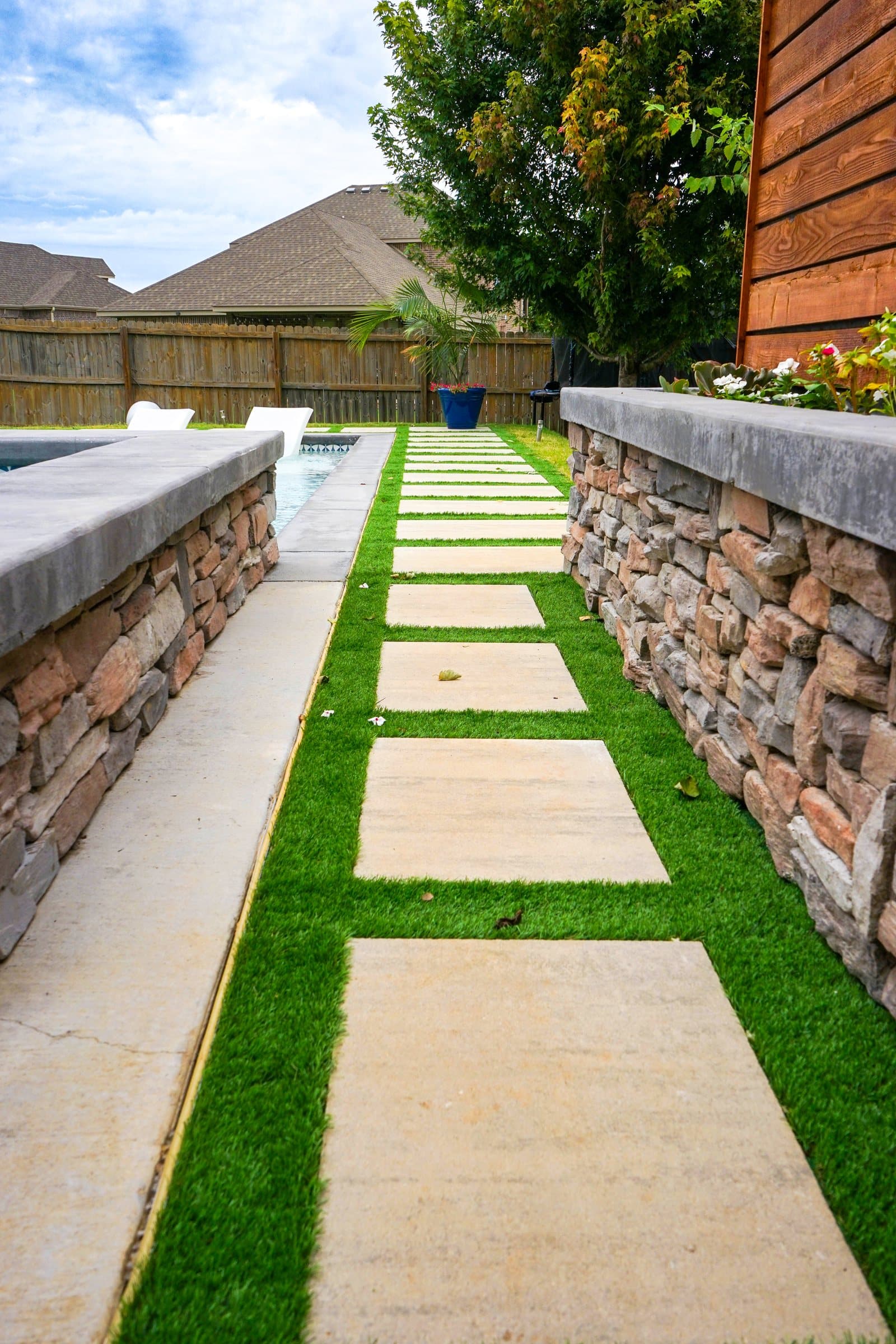
Whichever you choose, pick the colour for heat and the texture for grip, and put the money into the base. On the Swindle build in Cave Springs we used large-format pavers with turf joints, which gives the calm of a big unit with the repairability of a modular one, and the green lines soften what would otherwise be a large, flat, pale field. If you want the same conversation about your own yard, call Paco on (479) 379-2226.
FAQCommon questions
Which is cheaper around a pool, concrete or pavers?
Poured concrete is usually cheaper per square foot over a large, simple area. Whether it is cheaper over the life of the deck depends on your ground and on whether anything under the deck ever has to be reached.
Which pool deck gets less hot in summer?
Whichever is lighter in colour. Colour, not material, is what decides how hot a deck gets under an Arkansas August sun.
Which is less slippery when wet?
Whichever has more surface texture. Avoid polished finishes and glossy film-forming sealers near water in either material.
Will a concrete pool deck crack in Arkansas?
All concrete cracks. Correctly spaced and cut control joints decide where. On the Fayetteville shale, which swells and shrinks with moisture, a slab has a harder life than on the limestone plateau further north.
Do pavers around a pool move or sink?
Only if the base was not compacted properly or the edges were not restrained. When they do, the affected units are lifted, the base corrected and the same pavers relaid.
Can I put pavers over my existing concrete pool deck?
Sometimes, if the slab is sound and the coping and door thresholds leave room for the extra height. If the slab is already cracking or tilting, overlaying it just carries the problem up.
Do I need a permit for a pool deck in Northwest Arkansas?
The pool itself is permitted almost everywhere, and barrier rules apply even in unincorporated Benton County. Checked September 2026; confirm with your city before work starts.
Should pavers around a pool be sealed?
It is optional. If you do, choose a product that keeps the surface textured, because a glossy film near water is a slip risk. See our guide on sealing pavers in Arkansas.
REFSources
- ICPI Tech Spec 2: Construction of Interlocking Concrete Pavementsorco.com
- NRMCA CIP 2: Scaling Concrete Surfacesnrmca.org
- Talk Business & Politics: Shale rests at root of construction problemstalkbusiness.net
- National Weather Service Tulsa: Fayetteville frost and freeze climatology (32F)weather.gov
- U.S. CPSC: Safety Barrier Guidelines for Home Poolscpsc.gov
NEXTGet it looked at properly
Everything above is general guidance. What your ground actually needs is a site visit, and ours costs nothing. Francisco Gallardo walks it, reads the grade and the drainage, and tells you what is possible.