
Late spring through autumn is the most comfortable building window in Northwest Arkansas, and that is exactly why it books up first. Hardscape can be built in dry winter weather; what stops work is saturated ground and hard freezes, not the temperature alone. If you want to use a patio by early summer, start the conversation the previous autumn or winter so design and any permits are done before the spring rush.
01When is the best time to build a patio in Northwest Arkansas?
The best time to build is whenever the ground is dry and firm, and the best time to plan is several months before that. In practice, most people want a patio in use by Memorial Day, which means planning over the winter and building in spring.
National Weather Service records for Fayetteville, kept since 1949, put the average last spring frost at 16 April and the average first autumn frost at 19 October. Hard freezes, 28 degrees or colder, average a last date of 2 April and a first date of 1 November. Those dates are averages, not promises: the latest last freeze on record in Fayetteville came on 12 May, in 1960.
That leaves a long, comfortable season from April to October, with the shoulder months either side perfectly workable when the weather is dry. The table below is how the year actually plays out for hardscape here.
| Season | Ground and weather | What it means for your project |
|---|---|---|
| Winter (Dec to Feb) | Dry cold spells between wet ones; hard freezes common | Excavation, base and paver work on dry days; concrete and mortar need freeze protection; best time for site visits and design |
| Early spring (Mar to mid Apr) | Frequent rain, saturated clay, last hard freeze on average early April | Wet ground stops compaction; schedules slip; permits and orders should already be in |
| Late spring (mid Apr to May) | Warming, still wet spells, last frost on average mid April | Peak demand; the most booked weeks of the year |
| Summer (Jun to Aug) | Hot, often dry, occasional storms | Reliable building weather; early starts in the heat; concrete needs curing care |
| Autumn (Sep to Nov) | Drier, mild, first frost on average mid October | Excellent building weather, shorter queue, patio ready for fire pit season |
02Why is the contractor queue the real constraint?
The queue, not the weather, decides when most people get their patio. Everyone in the metro decides they want to be outside on the first warm weekend in April, and every good contractor in Northwest Arkansas is at capacity at the same moment.
A project also has stages before anyone digs. There is a site visit, a design, a quote and decisions on materials. There may be a permit: a covered patio in Rogers, a retaining wall over four feet in Bentonville, a grading permit on a Fayetteville slope, ACC approval in Bella Vista. Materials have to be ordered, and in a region with no natural sand source, bedding sand and aggregate are trucked or railed in. Arkansas 811 needs at least two full business days' notice before digging. Each of those takes time, and each takes longer in spring.
Starting the conversation in November for a May build is not early. It is on time. Starting in April for May usually means July.
03What weather actually stops hardscape work?
Wet ground stops more projects than cold does. You cannot compact mud, and a base that was never properly compacted is the root of most patio failures.
Saturated ground stops excavation and compaction. The red clay on the Springfield Plateau, across Bentonville, Rogers, Springdale and Cave Springs, holds water after a wet week, and machinery on it makes ruts rather than progress. On the Fayetteville shale further south, working ground that is swollen with water means building on a surface that will shrink back later. A wet spring delays far more projects than a cold winter.
Hard freezes stop concrete and mortar work, because water in fresh concrete freezing before it cures damages it. There are methods for marginal conditions, blankets, heated enclosures and adjusted mixes, and a contractor should tell you which one they are using rather than pouring and hoping. Air-entrained concrete, which the National Ready Mixed Concrete Association recommends for freeze-thaw exposure, and keeping deicers off a new slab in its first winter both matter here.
Dry cold stops very little. Excavation, base work, retaining wall block and dry-laid pavers can all go in on a clear January day. Plenty of good hardscape gets built in Arkansas in winter.
Heat does not stop work either, but it changes it. Summer days start early, concrete needs careful curing so it does not dry too fast, and crews need the shade and water breaks that keep the work to standard in the afternoon.
04Is winter a good time to start an outdoor project?
Winter is often the smartest time to start, even if it is not the time to finish. Two things make it worthwhile.
First, you are ahead of the queue. Design, quoting, permits and material orders done in December to February mean the build can start the moment the ground allows, instead of joining the back of a spring waiting list.
Second, a February site visit tells you more than a July one. With the leaves off, grade and drainage are far easier to read. After a wet week you can see exactly where water sits, which way it runs off the roof and where it leaves the lot. In karst ground on the plateau, water can appear in places nobody expects, and winter is when it shows itself. That information shapes the design, and it is hard to get in a dry summer.
Some jobs are well suited to being built in winter too: excavation and base on dry days, retaining walls, and structural work for a pavilion or covered patio. Doing the heavy ground work early leaves spring for surfaces and finishes.
05Is autumn better than spring for building?
For many projects, autumn is the best building season in Northwest Arkansas. The ground is usually drier than in spring, the heat has broken, and demand is lower once summer ends.
It also lines up with how people actually use a patio here. A patio finished in October is ready for fire pit evenings through the autumn and again the first warm weekend in spring, with no rush. A covered patio or pavilion finished in autumn gives you a sheltered space through the shoulder months, which is when a roof pays for itself.
The one caution is concrete late in the year. With the average first frost in mid-October and hard freezes on average from the start of November, pours scheduled late in autumn need the same freeze planning as winter ones.
Autumn is also a good time to fix what the summer revealed. If a storm sent water across the yard toward the house, or an old wall started to lean after a wet spring, the dry months are when drainage and wall work go in most cleanly, before the winter rain tests them again.
06What about pools and larger outdoor living projects?
Larger projects need a longer runway, so the planning window moves earlier. A pool with a deck, a covered kitchen and a retaining wall is several trades in sequence, each depending on the one before, plus permits and inspections at more than one stage.
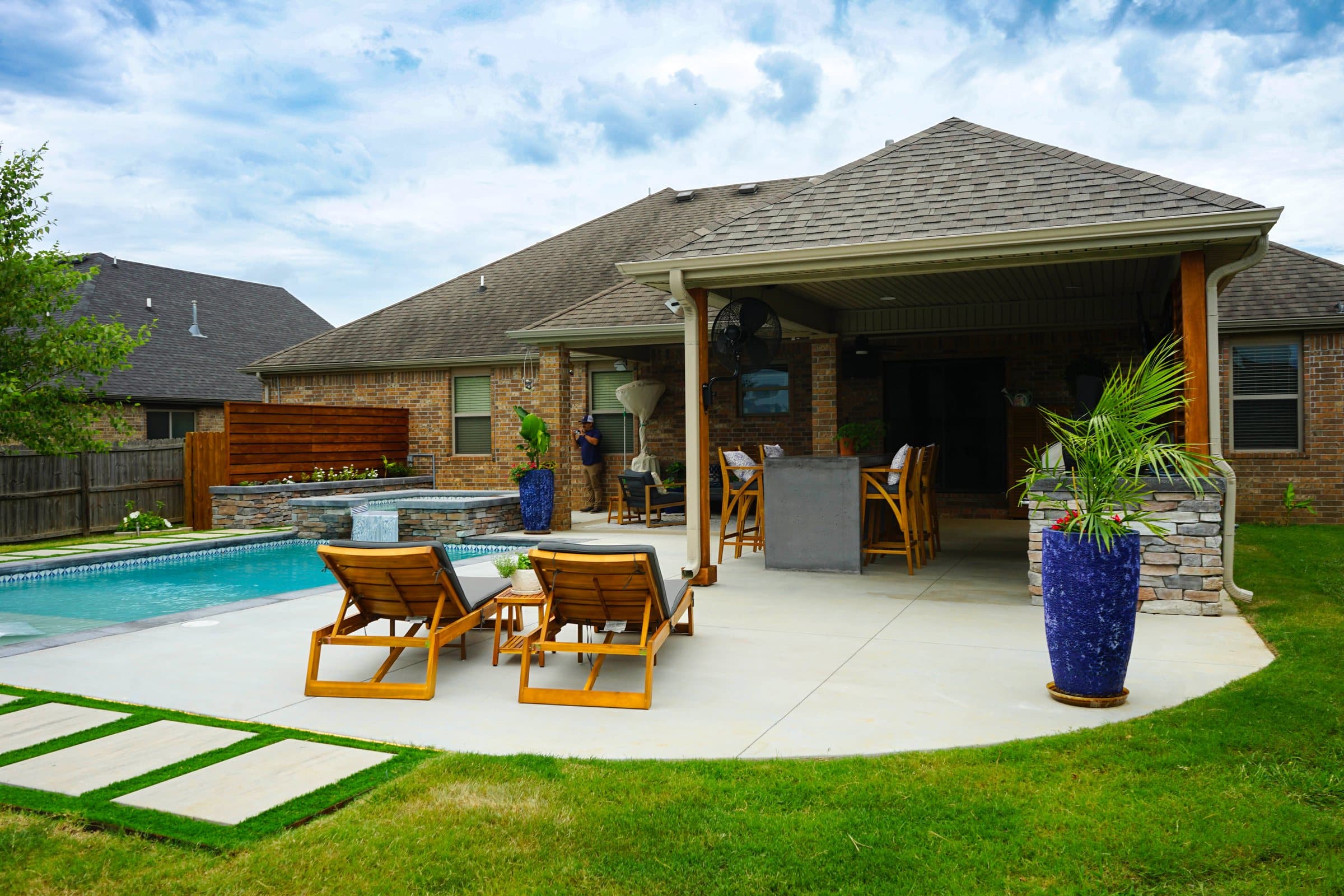
If you want to swim in early summer, the useful time to start design is the autumn before. Building the pool, deck and surrounding hardscape as one project with one team keeps the levels, drainage and materials in agreement, which is what we did on the Swindle build in Cave Springs: pool, raised spa, stacked stone, large-format paving and a covered outdoor kitchen, designed together.
For more on sequencing, see how long a patio or outdoor living project takes.
07How should you plan a spring build, working backwards?
Work backwards from the date you want to be sitting on it. For a patio in use by early summer, a sensible sequence looks like this.
- Autumn: decide what you want the space to do. Dining, lounging, cooking, a pool, somewhere to sit round a fire. Get a site visit booked
- Late autumn into winter: site visit, design and quote. Read the grade and drainage with the leaves off. Settle materials
- Winter: permits and approvals where needed, HOA or ACC review, material orders placed, financing arranged if you are using it
- Late winter into spring: Arkansas 811 locates, then excavation and base on the first run of dry weeks
- Spring: surfaces, walls, structures and finishes as the weather settles, concrete once the hard freezes are behind you
The point of the sequence is that everything slow happens while the ground is not ready anyway. When a dry fortnight arrives in March, the job is ready to go.
08Does the ground under your house change the timing?
It does, a little, because the two kinds of ground in Northwest Arkansas behave differently when wet. On the Springfield Plateau, across Benton County, the red clay and chert drain unevenly and shallow rock can slow excavation, but the ground firms up reasonably quickly after rain. On the Fayetteville shale from Fayetteville south, the ground swells as it wets and shrinks as it dries, so building the base on ground that is at its wettest is exactly what you do not want. A contractor who knows which ground you are on will plan the dig for the right window rather than the first free week.
09Is it cheaper to build in the off season?
Off season scheduling is easier, which has value, but price follows scope far more than it follows the calendar. Projects with us start around seven and a half thousand dollars whenever they are built.
What the off season does buy you is time: more choice of start date, a design that was not rushed, and a build that is not squeezed between two others. The cheapest patio is still the one that is built once, on a properly compacted base, in weather that allowed it.
If you are thinking about next spring, now is the time to talk. Call (479) 379-2226.
FAQCommon questions
What month is best to build a patio in Arkansas?
Late spring through autumn is the most comfortable window, and autumn is often the best of it. Plan over the winter so you are ahead of the spring queue.
Can you lay pavers in winter in Arkansas?
Yes, in dry cold. What stops the work is saturated ground and hard freezes, not the temperature alone.
When is the last frost in Northwest Arkansas?
In Fayetteville the average last 32 degree frost is 16 April and the average last hard freeze is 2 April, per National Weather Service records since 1949.
Can concrete be poured in winter?
Yes, with freeze protection while it cures. Pouring into a hard freeze without protection damages the slab.
How far ahead should I book a patio contractor?
For a spring build, start the conversation the previous autumn. Design and permitting happen before anyone breaks ground.
Why was my patio project delayed in spring?
Usually rain. Saturated clay cannot be compacted, and a good contractor waits rather than building a base that will settle.
Is it cheaper to build off season?
Scheduling is easier off season, which is worth something. Price follows scope more than the calendar.
REFSources
NEXTGet it looked at properly
Everything above is general guidance. What your ground actually needs is a site visit, and ours costs nothing. Francisco Gallardo walks it, reads the grade and the drainage, and tells you what is possible.