
Patio projects in Northwest Arkansas generally start around seven and a half thousand dollars and rise with size, material and how much ground work the site needs. Square footage sets the floor, material sets the multiplier, and excavation, grading and drainage set the ceiling. The same patio can cost very differently on flat Centerton ground and on a Fayetteville slope, so a real number comes from a site visit.
01What actually moves the price of a patio?
Four things move the number, and size is the least interesting of them. The other three are material, ground work and access, and on most Northwest Arkansas lots the ground work is where two quotes for the same drawing drift furthest apart.
Size. More square feet means more base, more surface and more labour. It scales roughly in a straight line, which is why it is the part everyone focuses on and the part that surprises nobody.
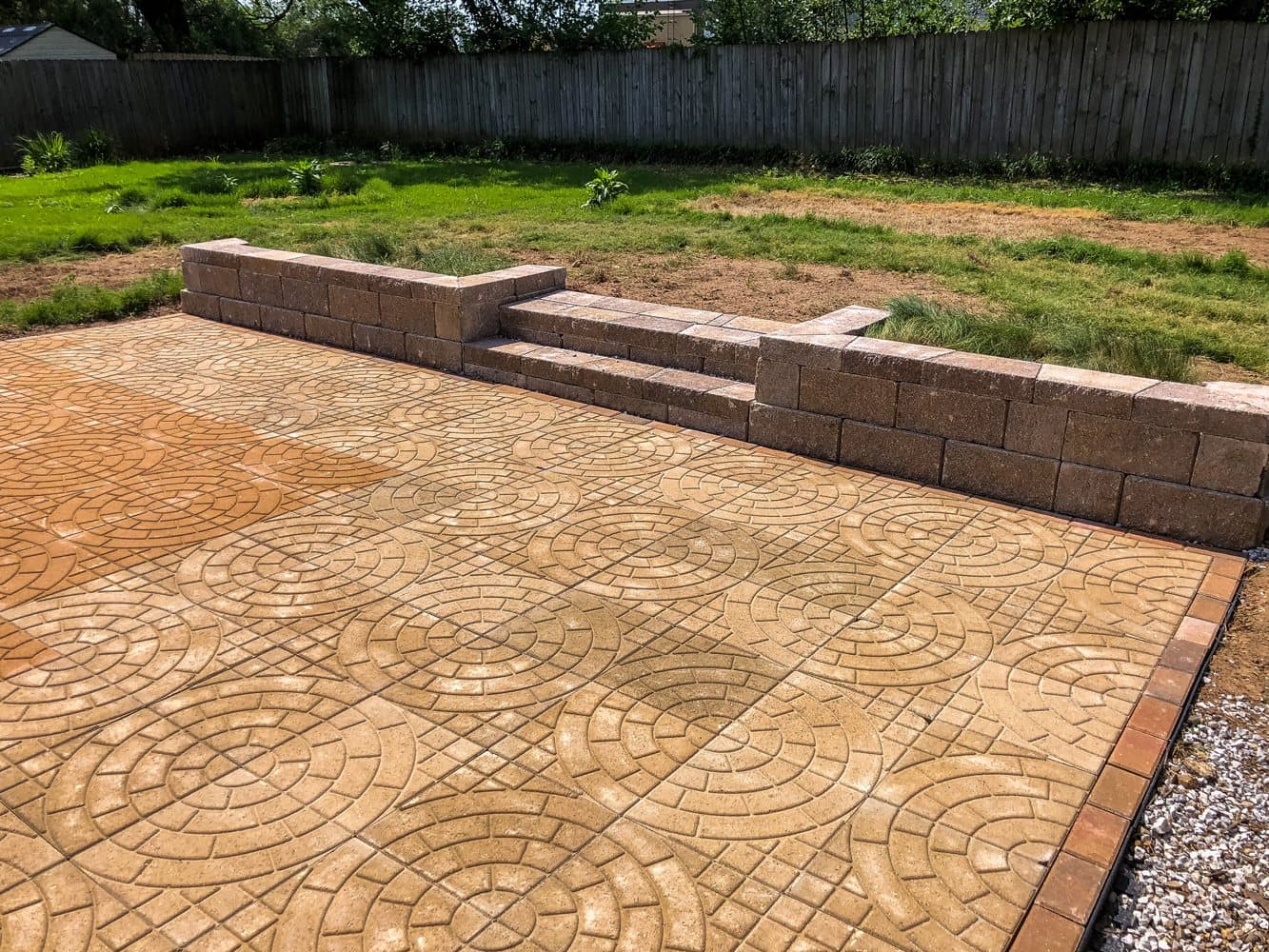
Material. Stamped concrete is generally the lowest cost per square foot across a large area. Standard concrete pavers sit above it. Large-format units and natural flagstone sit above that, partly on the material and mostly on the labour, because big units and irregular stone take longer to cut and set well.
Ground work. Excavation depth, hauling spoil away, grading, drainage and retaining anything that needs retaining. On a flat, well-drained lot this is modest. On a Bella Vista hillside or a sloping Fayetteville back yard it can be most of the project.
Access. If a compact machine can get to the back of the property, the job is straightforward. If every tonne of stone comes through a side gate in a wheelbarrow, the labour line changes, and so does the schedule.
| Cost driver | Pushes it down | Pushes it up |
|---|---|---|
| Size | A compact, well-used footprint | Large area that nobody furnishes |
| Material | Stamped concrete, standard pavers | Large-format units, natural flagstone, intricate patterns |
| Ground | Flat, well-drained, no rock | Slope, shallow rock, expansive shale, poor drainage |
| Access | Machine access to the work area | Hand-carried through a gate, tight lots near a town square |
| Extras | A plain field of paving | Steps, seat walls, lighting, a fire feature, a cover |
02Why does the ground under Northwest Arkansas change the quote?
Northwest Arkansas sits on two different kinds of ground, and each one attacks a patio budget in its own way. Two lots twenty minutes apart can need very different preparation for the same finished surface.
North of Fayetteville, across Benton County and the top of Washington County, you are on the Springfield Plateau. The rock is the Boone Formation, limestone interbedded with chert, and where the limestone has dissolved you get red clay full of chert fragments. It is karst country, so springs and sinkholes are normal features rather than surprises. The practical consequence in Bentonville, Rogers, Springdale, Centerton or Cave Springs is shallow rock: a dig planned at one depth meets chert well above it, and the method has to change. That is why excavation is the line on a quote most likely to be wrong.
From Fayetteville south into Farmington, Prairie Grove and Elkins, you are at the edge of the Boston Mountains, on sandstone and the Fayetteville shale. Walter Manger, a geology professor at the University of Arkansas, put it plainly: "Shale expands and contracts, caused from the clay's weathering." His summary of the region was shorter still: "Limestone is good. Shale is bad." A patio on shale that is allowed to wet and dry will move. The answer is a deeper, better-drained base, and that costs more than a thin one.
One more local detail: there is no natural sand source in Northwest Arkansas. It is railed in. Bedding sand and aggregate are real line items here, not an afterthought.
03Where should the money in a patio budget go first?
The base is where the money should go, because it is the one part you cannot fix later without taking the patio up. The cheapest quote is almost always cheap in the same place: excavation depth, base material and compaction.
The Interlocking Concrete Pavement Institute's construction guide sets a minimum of four inches of compacted base for patios over well-drained soil, and notes that thicker bases are used where there are numerous freeze-thaw cycles or expansive soils. Northwest Arkansas has both. Fayetteville averages its last spring frost in mid-April and its first autumn frost in mid-October, according to National Weather Service records going back to 1949, and the months in between the two see plenty of nights either side of freezing. So the minimum is a floor, not a target.
The same guide calls for the base to be compacted in lifts of four to six inches with a proper plate compactor, and for the finished surface to fall at least 1.5 percent so water runs off it. Both of those are invisible on handover day. Both decide whether the patio is still flat after three winters.
If you are comparing quotes, ask each contractor three things: how deep they excavate on your ground, what they backfill with, and how they compact it. The answers will separate them faster than the price does. For the full detail, see our guide on how deep a patio base should be in Arkansas.
04Which patio material gives the best value?
The best-value patio is the one on a properly built base; after that, material is a choice about look, repairability and budget. Each surface earns its place somewhere.
Stamped concrete covers a large area for the least money per square foot and reads as one continuous surface. It lives by its control joints and its sealer, and when it cracks the crack is permanent. It should be air-entrained concrete, which resists freeze-thaw scaling far better, and it should not see deicing salt in its first winter.
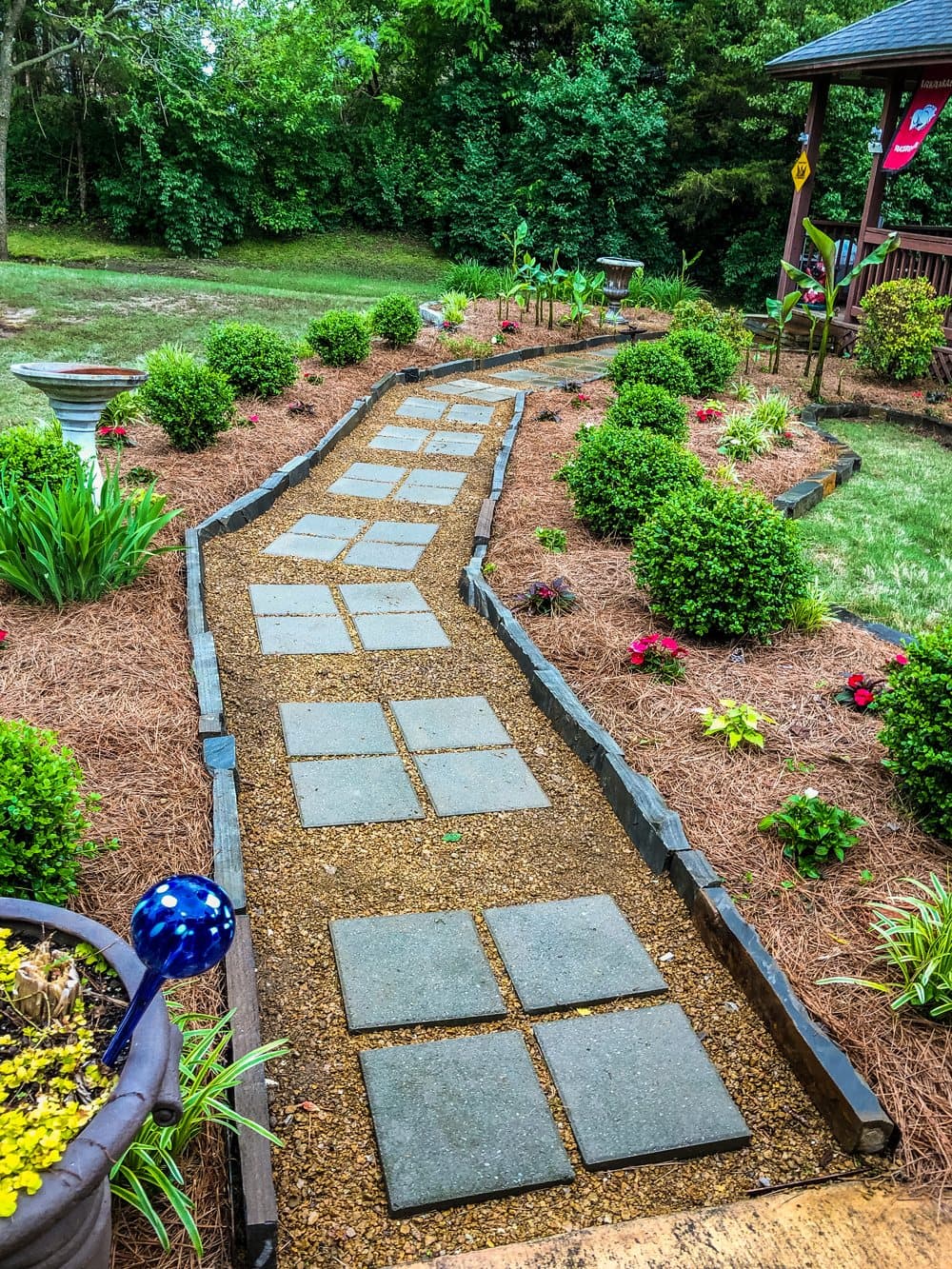
Concrete pavers flex with the ground instead of cracking, and a damaged unit can be lifted and replaced. Good pavers are made to ASTM C936, which requires high strength, low water absorption and testing through repeated freeze-thaw cycles. That standard is worth asking about by name.
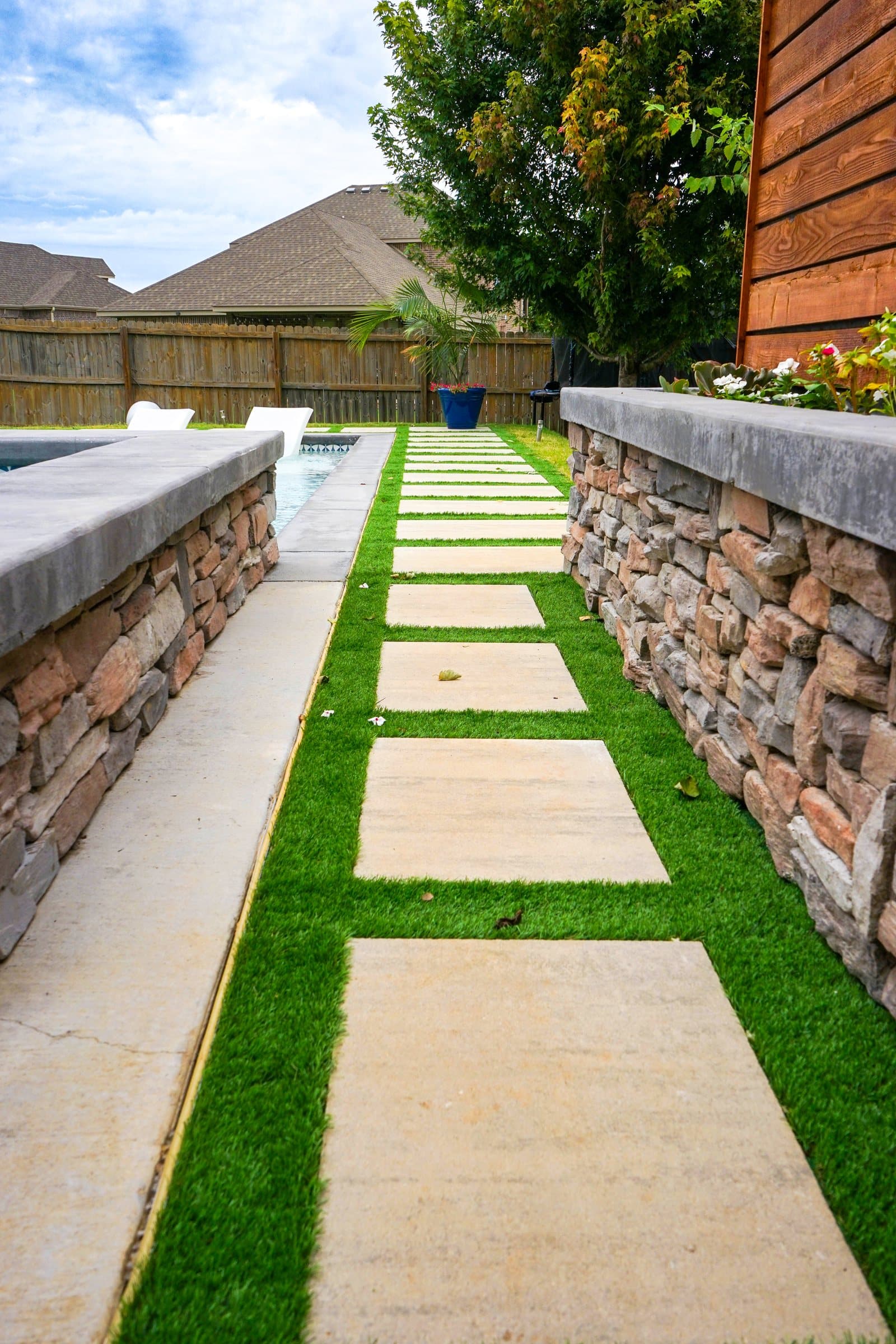
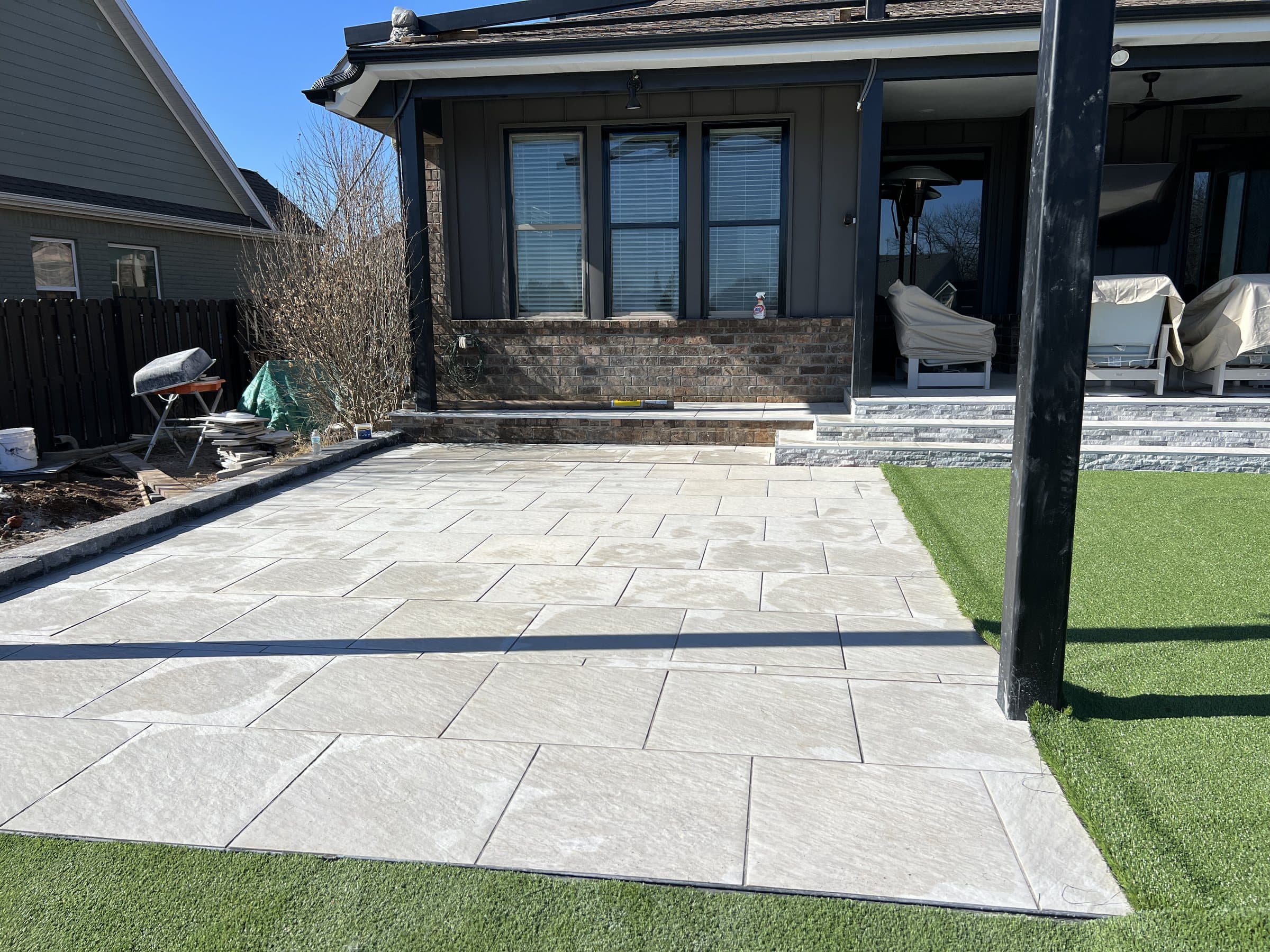
Large-format units and natural stone cost more to buy and more to lay, and they look it. On a contemporary house in Pinnacle Hills or a stone cottage near the Bentonville square, that is often money well spent. Our comparison of pavers and stamped concrete goes through the trade-offs in detail.
05What else ends up in a real patio quote?
Most finished patios include more than a flat surface, and those extras are where a headline number grows. It is better to plan them now than to discover them halfway through.
- Steps and level changes where the patio meets the house or the lawn. On sloping lots these are often unavoidable
- Seat walls and planters, which double as edge definition and somewhere to put people
- Drainage: channel drains, a drain line that actually discharges somewhere, or regrading around downspouts
- Low retaining walls where the patio is cut into a slope
- Conduit and gas sleeves run under the base now for lighting, a heater or a future kitchen
- A fire pit or fireplace, which is often what makes a patio get used in October
- A cover, the single biggest factor in how many months a year the space works
Some of these can wait for a later phase. The ones that live under the surface, drainage and conduit in particular, cannot, because adding them later means lifting what you paid to lay.
06Why can nobody give you a real patio price over the phone?
A firm number given sight unseen is either padded to protect the contractor or pitched low to get into your back yard, and neither is what you will pay. The site decides the price.
What a visit settles: the grade and where water currently goes, whether there is rock or shale near the surface, how machinery gets in, where the utilities run (Arkansas 811 locates them free before any digging), and whether the city has anything to say about it. In Rogers a covered patio needs a permit; in Fayetteville a sloping lot can trigger a grading permit. Those are real costs and real weeks, and they belong in the quote.
The consultation costs nothing here. What we will tell you on the phone is where projects start, around seven and a half thousand dollars, and what would push yours above it. Call (479) 379-2226 or send us a note about what you want the space to do.
07How does timing affect what a patio costs?
Timing changes the schedule more than the price, but the schedule has costs of its own. Spring is when every contractor in the metro is booked, and a wet spring stops excavation and compaction far more often than a dry cold spell does.
The useful move is to start the conversation in autumn or winter for a spring build. Design, any permit review and material ordering happen before anyone breaks ground, and with the leaves off the trees in February the grade and drainage are far easier to read on a site visit than they are in July. Price follows scope; the calendar decides whether you are using the patio in May or in August. Our guide to the best time of year to build covers the weather side in detail.
One cost that timing does touch is concrete. Pours need to be protected from hard freezes while they cure, and a slab poured into marginal weather needs more care, not less. A contractor who pours regardless of the forecast is saving time at your expense.
The other is rework. A patio built quickly in a wet week, on a base that was never properly compacted because the ground would not take it, costs twice: once to build and again to lift and relay. Waiting a fortnight for the ground to dry is almost always the cheaper option, even if it does not feel like it at the time.
08Can a patio be financed?
Yes, and plenty of people do it, because a patio built properly once is cheaper than one built twice. We offer financing through Acorn Finance, which lets you compare options without committing.
Financing changes when you can build, not how it should be built. If the budget is tight, the right move is a smaller patio on a full-depth base, not a larger one on a thin base. Build the bones properly, then add the cover, the kitchen or the fire feature in a later phase. Our guide to budgeting an outdoor living project sets out the order to spend in.
FAQCommon questions
How much does a patio cost in Northwest Arkansas?
Projects here generally start around seven and a half thousand dollars and rise with size, material, slope and access. A site visit is what turns that into a real number.
Is a patio cheaper than a deck?
Usually over the life of it, because there is nothing to re-stain, replace or re-fasten. Up front it depends on the ground work involved.
What is the cheapest patio that is still worth having?
Stamped concrete or standard pavers on a properly built base. The base is not the place to save; the surface is.
Why is my patio quote so much higher than my neighbour's?
Usually ground and access. Shallow rock, a slope, shale that moves, or a site that has to be worked by hand all add real cost that a flat lot next door may not have.
Does a patio need a permit in Northwest Arkansas?
An at-grade patio usually does not, but a covered patio needs one in Rogers, and grading on slopes can need one in Fayetteville. Rules were checked September 2026; confirm with your city.
Does a patio add value to a house in Northwest Arkansas?
Outdoor living is taken seriously in this market. A well-built patio reads as part of the house; a failing one reads as a job the buyer has to redo.
Can I finance a patio?
Yes. Financing is available through Acorn Finance, and you can compare options before committing to anything.
REFSources
- ICPI Tech Spec 2: Construction of Interlocking Concrete Pavementsorco.com
- Arkansas Geological Survey: Karst in the Arkansas Ozarks, Part 2arkansasgeological.wordpress.com
- Talk Business & Politics: Shale rests at root of construction problemstalkbusiness.net
- National Weather Service Tulsa: Fayetteville frost and freeze climatology (32F)weather.gov
- City of Rogers: When is a permit required?rogersar.gov
NEXTGet it looked at properly
Everything above is general guidance. What your ground actually needs is a site visit, and ours costs nothing. Francisco Gallardo walks it, reads the grade and the drainage, and tells you what is possible.