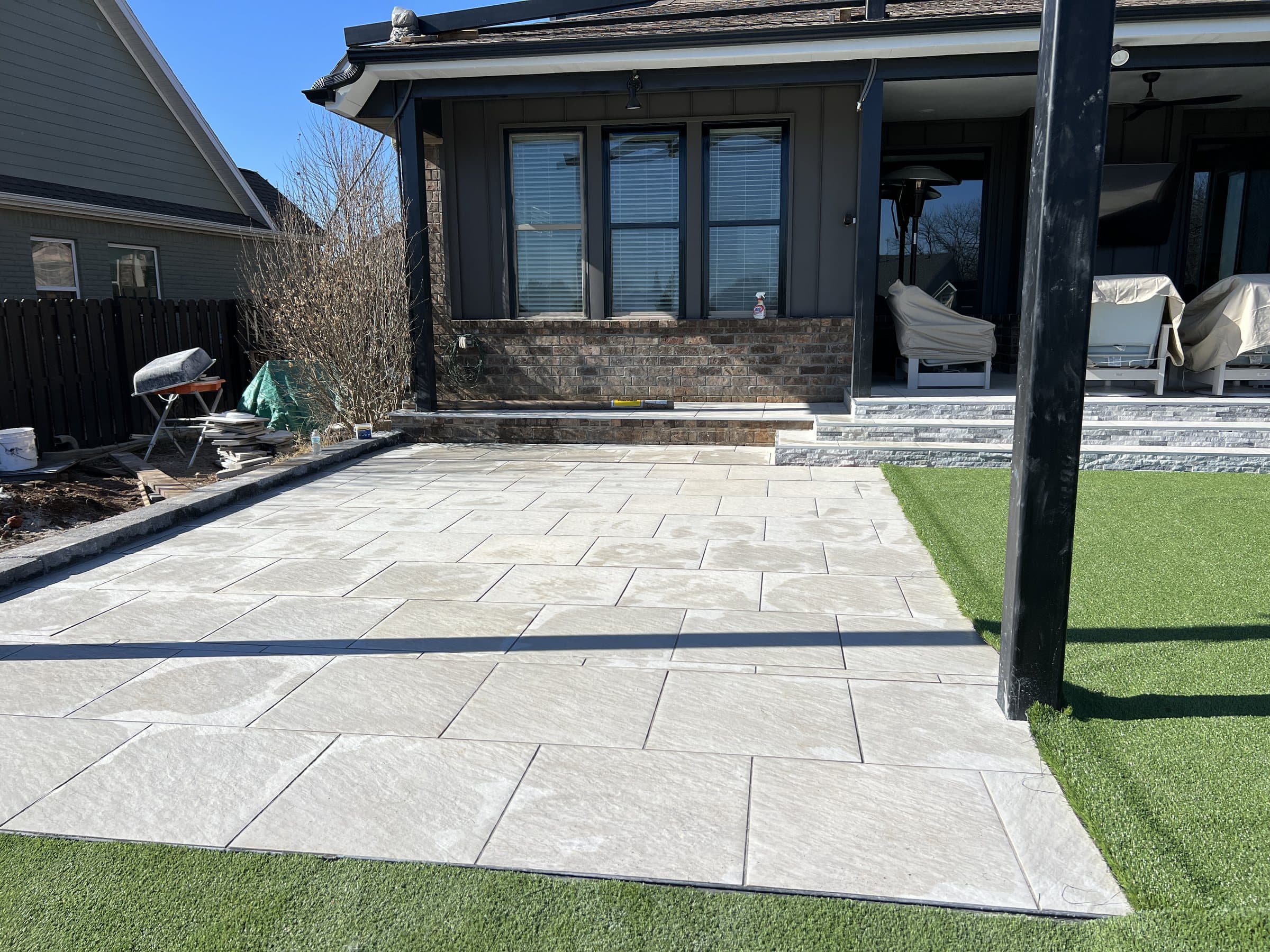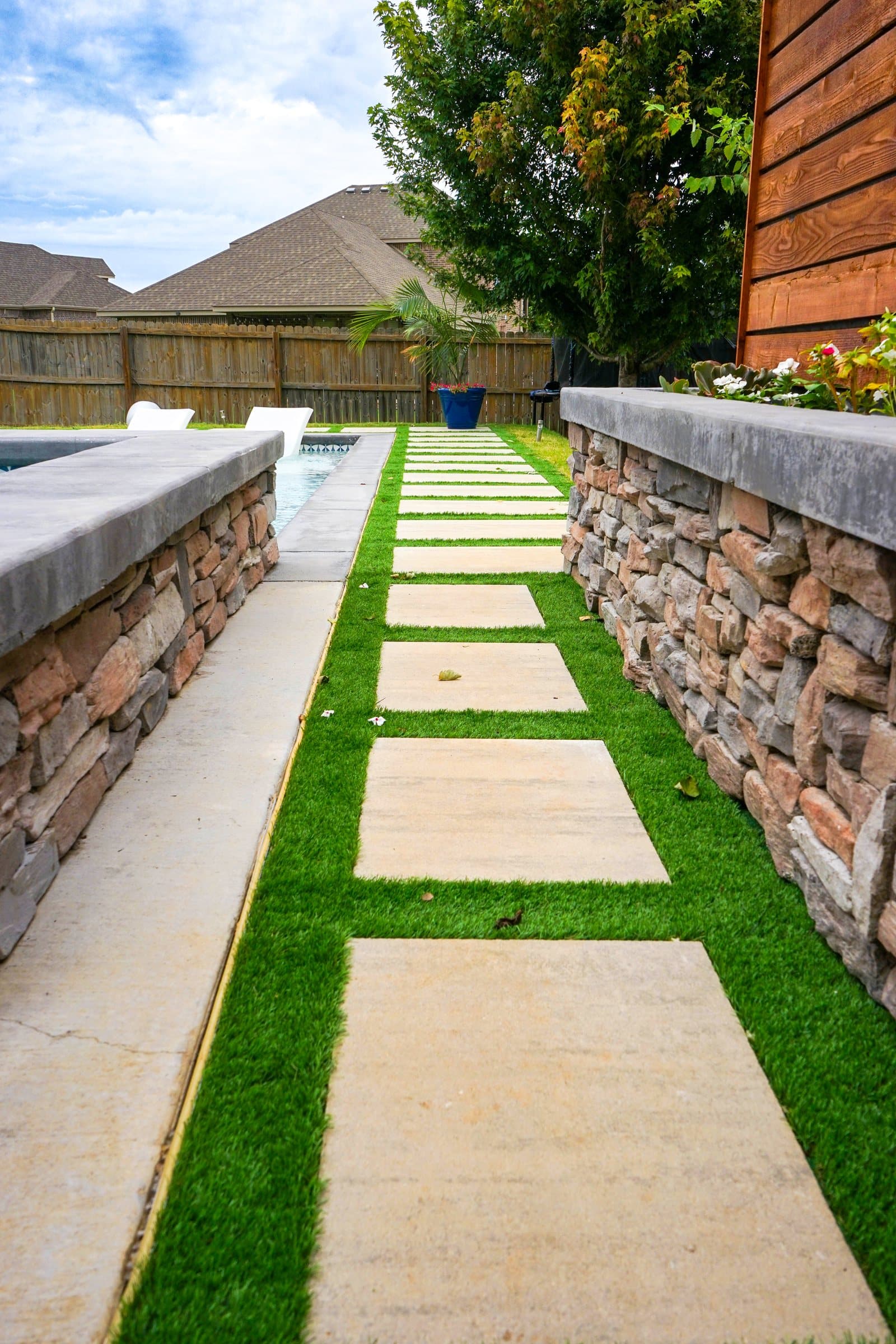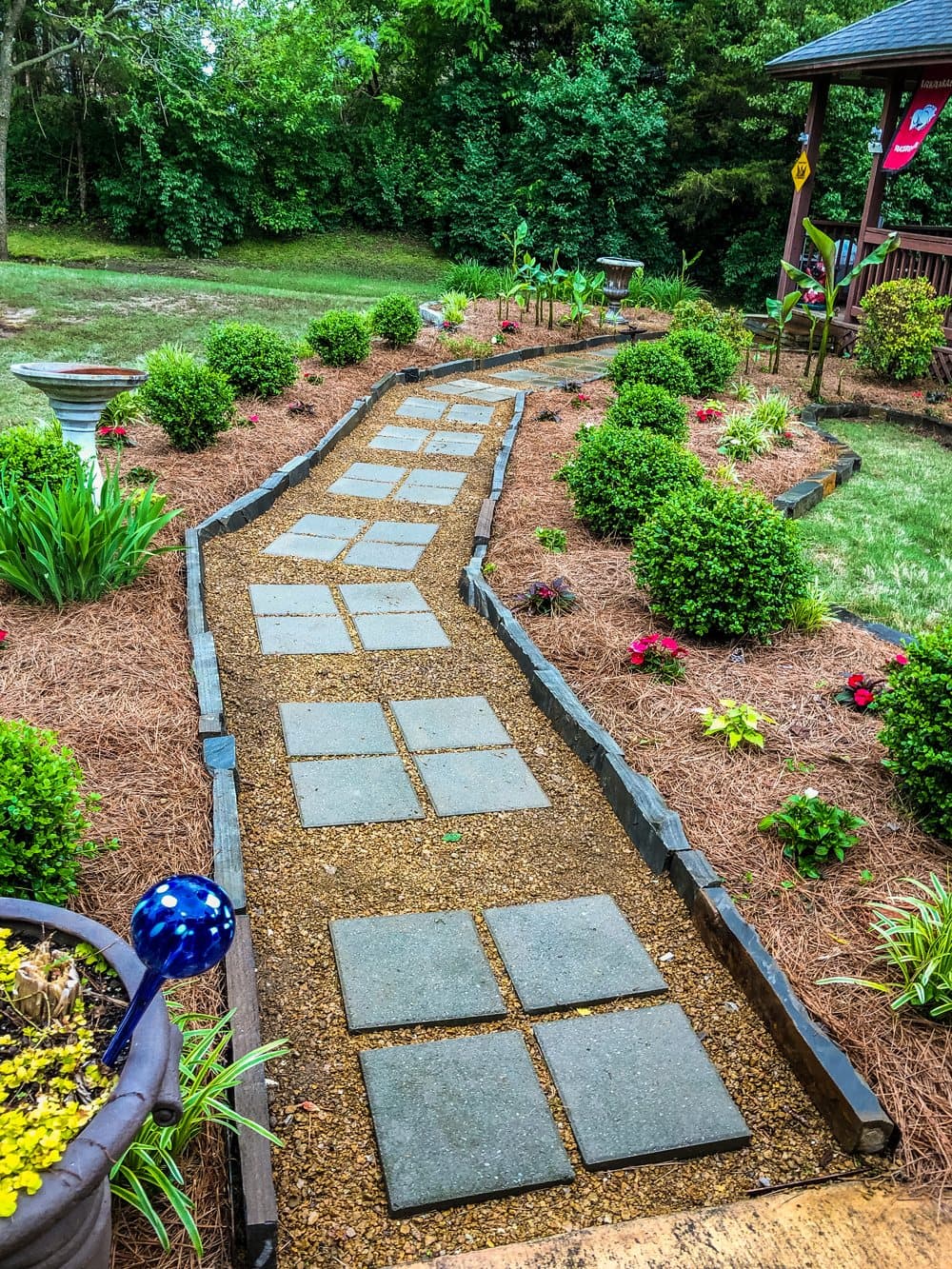

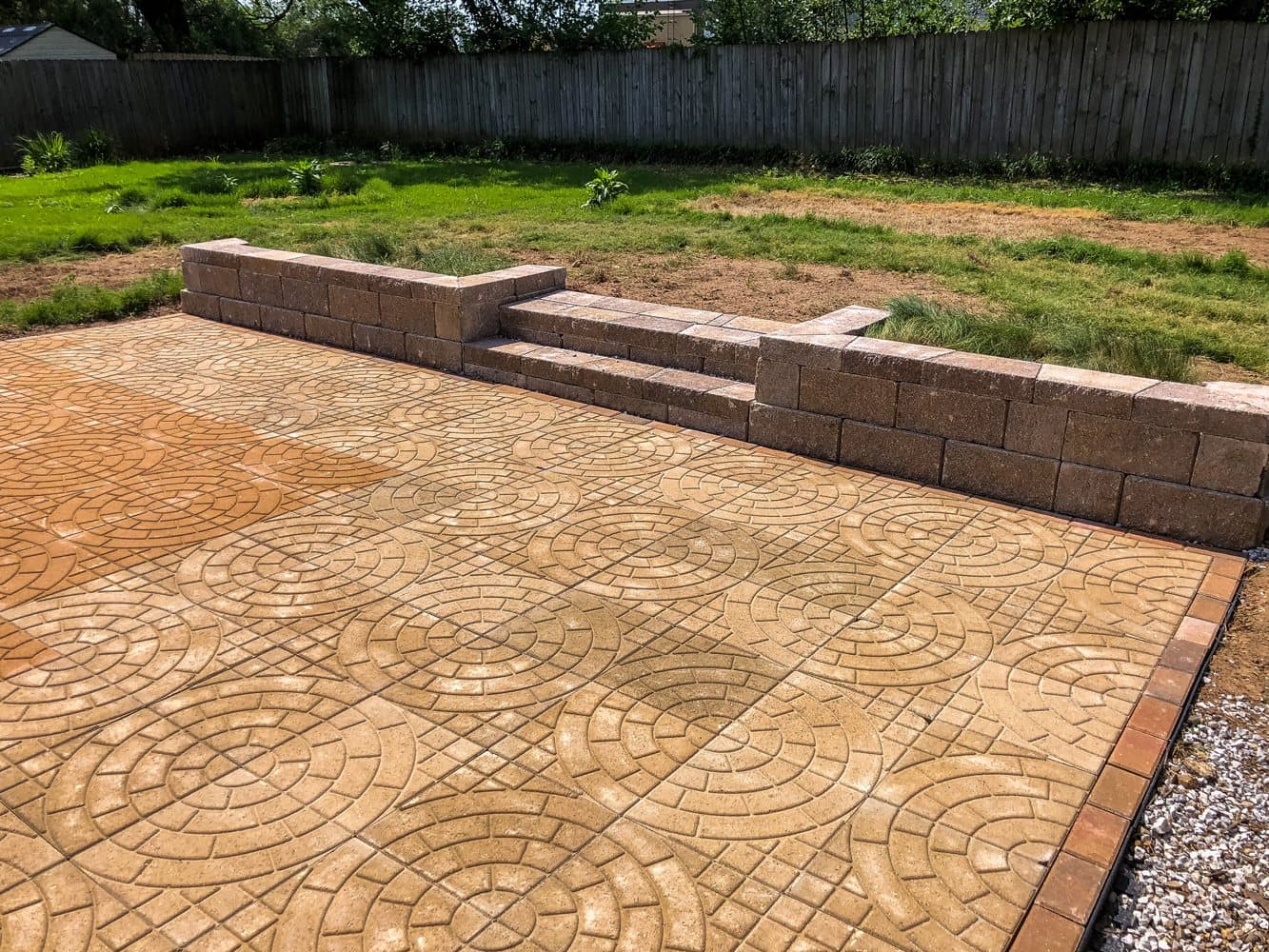
Pavers handle Arkansas freeze-thaw better because they are individual units on a flexible base: the ground moves and the surface moves with it, and a damaged unit can be lifted and replaced. Stamped concrete is one slab, so it depends entirely on its base, its air content and its control joints, and when it cracks the crack is permanent. Stamped concrete usually costs less per square foot over a large area; pavers usually cost less to live with.
01What does freeze-thaw actually do to a patio?
Freeze-thaw damages a patio by letting water in, freezing it, and repeating the push over and over. Water expands roughly nine percent when it freezes. In a pore, a crack or a soft patch of base, that expansion shoves things apart, and when it thaws the space it made stays.
Northwest Arkansas gets plenty of it. National Weather Service records for Fayetteville going back to 1949 put the average first autumn frost in mid-October and the average last spring frost in mid-April, and the winter in between swings either side of freezing again and again. It is not a Minnesota winter. It is arguably a worse one for hardscape, because the ground keeps freezing and thawing instead of freezing once and staying frozen.
That cycle is why base preparation matters more here than in a warm climate, and why a patio built to a Florida standard fails in Arkansas. It also explains why the two surfaces fail differently: one flexes, the other cracks.
02Pavers or stamped concrete: how do they compare side by side?
Pavers win on movement and repair; stamped concrete wins on upfront cost across a big area and on a seamless look. Everything else depends on how well each is built.
| Factor | Concrete pavers | Stamped concrete |
|---|---|---|
| Cost per sq ft, large area | Higher | Lower |
| Response to ground movement | Flexes, individual units settle | Cracks at the weakest point |
| Repairing one spot | Lift, relevel, relay the same units | Patch shows, or cut out and repour a section |
| Reaching a pipe or cable underneath | Take up and put back | Break out and repour |
| Freeze-thaw resistance | ASTM C936 units are tested through repeated cycles | Depends on air entrainment, finishing and sealer |
| Ongoing care | Joint sand topped up, optional sealing | Resealing on the product's schedule |
| Look | Modular, joints visible | Continuous, pattern pressed in |
03Why do pavers cope with Arkansas winters so well?
Pavers cope because the whole assembly is designed to move a little without breaking. They sit on a compacted aggregate base and a bed of sand, held by an edge restraint, with sand in the joints locking them together.
The Interlocking Concrete Pavement Institute's construction guide calls for pavers made to ASTM C936. That standard sets a high average compressive strength, keeps water absorption to no more than five percent, and requires the units to survive fifty freeze-thaw test cycles. Low absorption is the point: a unit that does not take water in has nothing to freeze inside it.
The same guide sets a minimum of four inches of compacted base for patios over well-drained soil, compacted in lifts of four to six inches, and notes that thicker bases are used where freeze-thaw cycles are frequent or the soil is expansive. Both descriptions fit parts of Northwest Arkansas.
Pavers can still settle unevenly if the base was not compacted properly, and that is the usual failure. The difference is the repair: lift the affected area, fix the base, relay the same units. Nothing gets demolished. Our guide to pavers shifting or lifting covers the causes.
04Does stamped concrete crack in an Arkansas winter?
All concrete cracks, and stamped concrete is no exception; what matters is whether it cracks where you planned. It is one continuous slab with a pattern pressed into the surface, and it lives by three things.
Control joints. Cut or tooled lines that make the slab crack along a straight, planned line rather than wherever it wants. On a stamped pattern they should follow a grout line so they disappear.
Air entrainment. The National Ready Mixed Concrete Association points to air-entrained concrete as the defence against freeze-thaw scaling, the flaking of the top surface. Tiny air bubbles in the mix give freezing water somewhere to go. Concrete without enough entrained air scales, and on a stamped surface the pattern is the first thing to go.
Sealer and deicers. The sealer is part of what keeps water out of the surface, so resealing matters more here than in a dry climate. NRMCA also advises against deicing chemicals in the first winter; a new slab and a bag of rock salt is a bad combination.
When stamped concrete is built well, it is a good surface: large, continuous and economical. When it cracks, the crack is permanent, and a patch never quite matches the colour or the pattern. See our guide to a cracked concrete patio for what can be done.
05Does it matter whether I live on limestone or on shale?
It matters a great deal, because the ground decides how much movement the surface has to survive. Northwest Arkansas sits on two different geologies twenty minutes apart.
On the Springfield Plateau, which covers Bentonville, Rogers, Springdale, Bella Vista, Centerton, Cave Springs and the rest of Benton County, the rock is the Boone Formation: limestone and chert, with red clay full of chert fragments where the limestone has dissolved. The ground is generally stable, but rock is often shallow and the karst means water finds its own route. Both surfaces perform well here on a properly built, well-drained base.
From Fayetteville south into Farmington, Prairie Grove and Elkins, you are on sandstone and the Fayetteville shale, which swells when wet and shrinks when dry. University of Arkansas geologist Walter Manger summed up the difference in five words: "Limestone is good. Shale is bad." Over shale, a rigid slab has a harder life, and the flexibility of pavers earns its extra cost. Stamped concrete can still work there, but it needs a deeper base, serious drainage and realistic expectations about cracking.
06Where does flagstone fit in?
Flagstone behaves like whatever it is laid on, so the choice is really about the setting method. It is natural, irregular, and the most labour of the three to lay well.
Dry-laid on aggregate, flagstone behaves like pavers: it flexes, units can be reset, and joints can be sand, gravel or planting. It suits informal gardens and paths.
Mortared on a slab, it behaves like the slab underneath. If the slab cracks, the mortar joints crack with it, and water in a mortar joint does the same damage freeze-thaw does anywhere else.
The stone itself has to suit the climate. Some natural stones absorb water and spall after a few winters; others handle it for generations. Ask where the stone has performed in a freezing climate, not just how it looks in the yard.
07What does each one cost to live with?
Pavers usually cost more on day one and less over the years; stamped concrete is the reverse. The difference is in what maintenance and repair look like.
A paver patio needs its joint sand topped up now and then, particularly after the first year as it settles into the joints, and a weed or two pulled where sand has washed out. Sealing is optional and mostly about colour and keeping the joint sand in place. If a section settles, or you need to run a cable for lighting, or a tree root lifts a corner, the units come up and go back. Nobody can tell afterwards.
A stamped slab needs resealing on the schedule the product sets, and more often if it faces full sun or sees a lot of water. Skip it and the colour fades, the surface takes on water, and freeze-thaw starts working on the top layer. If a crack opens outside the control joints, it can be routed and filled, but it will always show. Replacing a section means cutting it out and repouring, and matching colour and pattern on a weathered slab is close to impossible.
So the real comparison is not price per square foot. It is price per square foot plus what you expect to do to it over the time you own the house.
08How do heat, grip and colour compare?
Heat, grip and colour are decided by the product and the finish, not by whether it is a paver or a slab. That is worth knowing before you rule either out.
Heat. Dark surfaces get hot in an Arkansas August, whichever material they are. A light-coloured slab is cooler underfoot than a charcoal paver, and the other way round. Near a pool, pick the colour first.
Grip. Textured finishes grip when wet; smooth ones do not. Stamped concrete with a heavy sealer can become slick, which installers deal with by adding grit to the sealer. Pavers with a tumbled or textured face are naturally better underfoot.
Colour. Pavers are coloured through the unit, so wear shows less. Stamped concrete is coloured by integral colour, a surface hardener and a release agent, and the top layer carries the look. When it wears, you see it. Neither is wrong; they age differently, and you should know which ageing you are buying.
09Which should you choose?
Choose pavers if you want the surface that tolerates ground movement and can be repaired invisibly; choose stamped concrete if you want a large, continuous surface for less upfront and you accept that a crack is permanent.
Pavers are the stronger choice over the Fayetteville shale, around pools where someone will one day need to reach a line underneath, and anywhere you want to be able to change your mind about a section later. Stamped concrete makes sense for a big, simple area on stable plateau ground, built with air-entrained concrete, properly jointed and kept sealed.
Either way, the base decides the outcome more than the surface does. A good paver on a thin base fails; a good slab on a well-drained, deep base lasts. If you are comparing quotes, ask about excavation depth, base material and compaction before you ask about colour. We are happy to walk your site and tell you which one we would build there and why. Call (479) 379-2226.
FAQCommon questions
Are pavers better than stamped concrete in Arkansas?
For freeze-thaw and ground movement, generally yes, because they flex and can be relaid. Stamped concrete costs less per square foot over a large area and can perform well on stable ground if it is built properly.
Does stamped concrete crack in Arkansas?
All concrete cracks. Control joints decide where. A properly jointed, air-entrained slab on a properly built base cracks where you planned it to.
How often should stamped concrete be sealed?
More often here than in a dry climate, because the sealer helps keep water out of the surface through freeze-thaw. Your installer should give you the interval for the product used.
Can I use rock salt on a new concrete patio?
Avoid deicing chemicals in the first winter, as NRMCA advises. After that, use them sparingly.
Do pavers heave in freeze-thaw?
Only when the base holds water or was poorly compacted. A free-draining, properly compacted base with an edge restraint keeps them flat, and if one area moves it can be relaid.
Can pavers be laid over existing concrete?
Sometimes, if the slab is sound and the levels work. If the slab is already moving, laying over it just moves the problem up an inch.
Which is better over Fayetteville shale?
Pavers, usually. Shale swells wet and shrinks dry, and a flexible surface on a deep, drained base copes with that better than a rigid slab.
REFSources
NEXTGet it looked at properly
Everything above is general guidance. What your ground actually needs is a site visit, and ours costs nothing. Francisco Gallardo walks it, reads the grade and the drainage, and tells you what is possible.