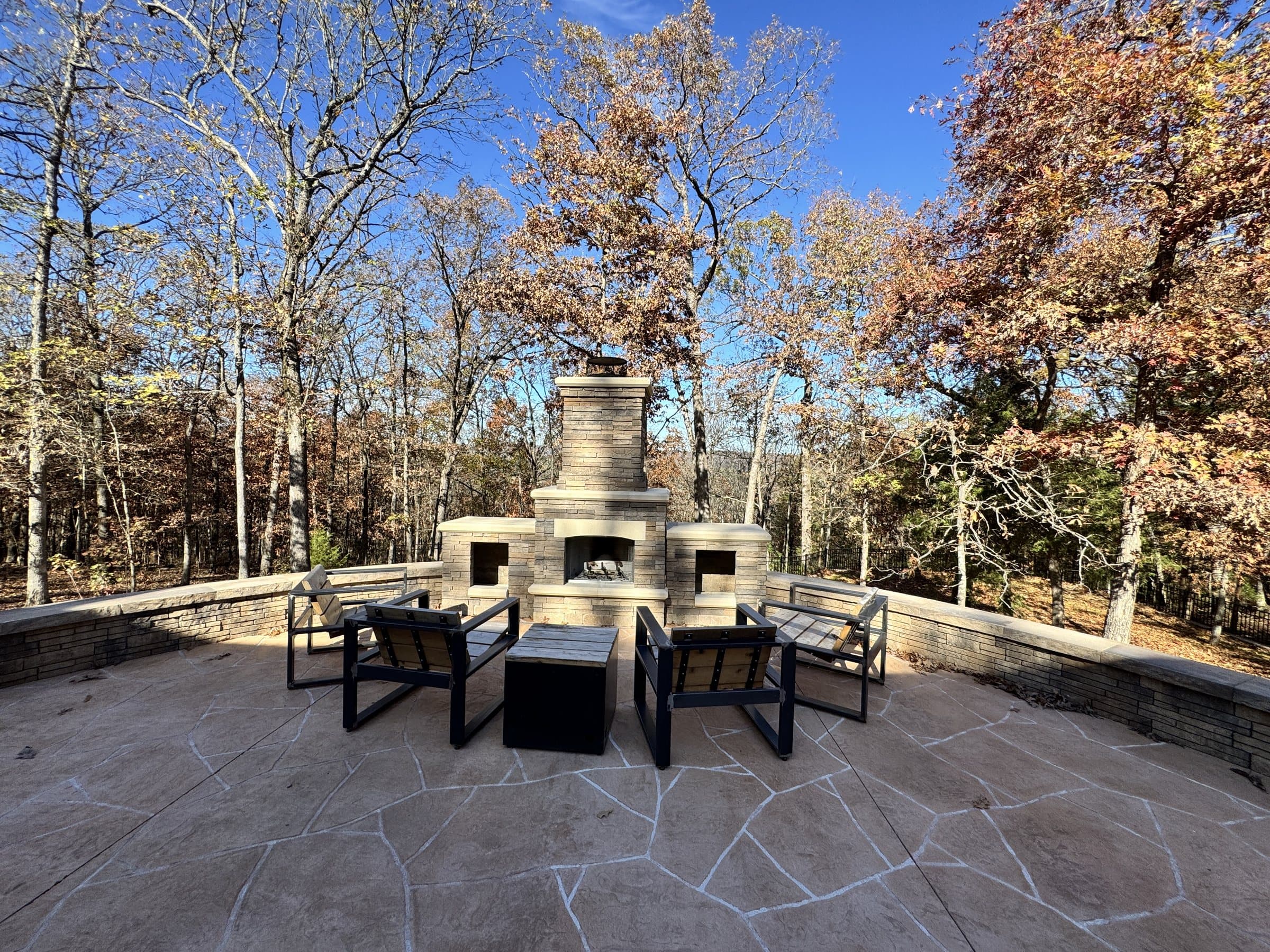
A fire feature spans an enormous range. A built-in fire pit with a gas line run to it is a modest addition to a patio project; a masonry outdoor fireplace with a chimney, a hearth and a seating wall is a structure with a footing, priced accordingly. The deciding factors are masonry mass, gas or wood, and how far the gas travels. Clearances are not optional: the model fire code keeps wood-burning recreational fires 25 feet from structures.
01Fire pit or fireplace: what is the real difference?
A fire pit is social and circular; a fireplace is architectural and directional.
| Fire pit | Outdoor fireplace | |
|---|---|---|
| How people use it | Sit around it facing each other | Sit facing it, like a room |
| Heat | All directions, lost to the sky | Thrown forward toward the seating |
| Structure | Low ring, little vertical masonry | Firebox, chimney, hearth, footing |
| Visual role | A gathering point | A focal wall, even in July |
| Relative cost | Lower | Several times a fire pit |
| Wind and smoke | Smoke goes where the wind takes it | Chimney draws smoke up and away |
A fire pit suits groups and informal evenings, and it is far cheaper because it has almost no vertical masonry. A fireplace gives a garden a back wall and a focal point, it works visually when nothing is lit, and it costs more because it is a masonry structure on a footing with a flue.
02What sets the cost of a fire feature?
Masonry mass, fuel type and distance from the gas meter.
Masonry is priced by volume and finish. A fire pit ring is a small amount of block and stone. A fireplace with a firebox, a smoke chamber, a chimney and a raised hearth is a lot of both, and it needs a footing that will not settle, because a heavy chimney that tilts cannot be straightened.
Fuel type sets the burner, the controls and the service. Gas needs a line, a burner rated for the unit and a shut-off. Wood needs a proper firebox, a flue sized for the opening, and somewhere to keep dry wood.
Distance is the hidden cost. A gas line across open ground during a patio build is inexpensive. The same line across a finished patio means lifting and relaying the patio.
03Gas or wood?
Gas gets used on a Tuesday; wood gets used on occasions.
Gas is instant, controllable and clean. You turn it on for twenty minutes after dinner and turn it off. Wood is better to look at, smells better and throws more heat, and it needs storage, tending and cleaning out, so it tends to get lit for occasions rather than ordinary evenings.
If there is any chance you will want gas out there, put the line in now even if the feature comes later. A capped line under the patio is cheap insurance.
04How much clearance does a fire feature need?
More than most people allow, and the numbers come from the code and the manufacturer, not from taste.
The International Fire Code, the model code most US fire codes are built on, says recreational fires shall not be conducted within 25 feet of a structure or combustible material, and portable outdoor fireplaces shall not be operated within 15 feet of a structure and must be used per the manufacturer's instructions. Your city decides how it adopts and amends those rules, so confirm locally.
Gas fire features are governed by their listing and the manufacturer's installation instructions, which set clearances to walls, overhead structures and combustible materials. That is why a fire feature crammed under a low pergola or against a cedar screen is a problem, and why fire and cover should be designed together.
05Can you have a fire pit under a covered patio?
Usually not a wood fire; possibly a gas feature, if its listing allows it.
A wood fire under a roof is a smoke and heat problem before it is anything else. A gas unit specifically listed for the purpose, installed to the manufacturer's clearances with the ventilation they require, is a different conversation. It is a safety question with a documented answer, not a matter of preference, and it should be settled before the roof is built.
06Do you need a permit for a fire pit or fireplace?
Gas work almost always needs one; a masonry fireplace usually does; a portable fire bowl does not.
The City of Rogers lists plumbing and mechanical work, which covers gas piping, among the work that needs a permit, along with new structures. In unincorporated Benton County, where some detached structures are exempt, new plumbing, electrical and HVAC work is still permitted and inspected. In Bella Vista, the POA's Architectural Control Committee reviews accessory structures, which a masonry fireplace is likely to be.
Rules checked at source in September 2026. We confirm them for your address.
07What makes a gas fire feature work well?
A listed burner, a shut-off you can reach, and a design that deals with wind and rain.
Gas fire pits and fireplaces use burners and control systems that are tested and listed for outdoor use. The listing and the manufacturer's installation instructions set the gas supply, the clearances and the ventilation, and they are what an inspector checks. Match-lit systems are simplest; electronic ignition needs power run to the feature, which is another reason to lay conduit with the gas line.
Wind is the everyday problem. An exposed burner blows out or gives a ragged flame, so placement, a glass wind guard or a recessed burner pan matters on open lots. Rain is the other. A fire pit bowl collects water, and without a drain it sits wet through the winter and damages the burner and the masonry around it.
08What makes a wood-burning fireplace draw properly?
A flue sized to the firebox opening, and a chimney tall enough to pull.
An outdoor fireplace that smokes into the seating area is almost always a proportion problem: an opening too large for the flue, a smoke chamber that is not shaped to funnel smoke upward, or a chimney too short to create draft. These are design decisions made before the first block is laid. Prefabricated fireboxes and flue systems come with their own sizing, which takes much of the guesswork out of it.
Overhanging trees and nearby rooflines affect draft and create a fire risk from embers, which is one more reason the fire code keeps wood fires away from structures and combustible material.
09How should seating work around fire?
Built-in seating turns a fire feature into a room, if it is placed at a comfortable distance.
A seating wall around a fire pit, or facing a fireplace, gives the space shape and means nobody has to drag chairs out. It has to sit far enough from the fire that people are warm rather than roasted, with room to walk behind anyone seated, and it wants a cap stone that is comfortable to sit on and sheds water.
Loose furniture is more flexible and cheaper. Many good schemes do both: a seating wall on one or two sides and movable chairs on the others, so the circle can grow when more people turn up.
10Where should a fire feature go?
Somewhere that gives you a reason to walk out into the garden.
A fire feature hard against the back of the house rarely earns its money. Put it where it creates a destination, with seating that faces something, and it changes how the whole space gets used in the shoulder months. The National Weather Service's freeze climatology puts the average first fall frost at Drake Field in mid-October and the last spring frost in mid-April, so a fire feature is what keeps the garden in use through the months either side.
Think about prevailing wind and smoke direction relative to the house, the seating and the neighbours. A fire pit placed where the evening breeze pushes smoke across the table will be used less every year.
11What does freeze-thaw do to outdoor masonry?
It punishes water getting into the wrong places, so a fire feature has to shed water as well as contain fire.
An outdoor fireplace sits in the weather all year. Water that gets behind stone veneer or into mortar joints freezes and expands, and on the average winter night here it does exactly that. The detailing that prevents it is unglamorous: caps and crowns that throw water off, flashing where needed, mortar and adhesive rated for exterior freeze-thaw, and a drain in the base of a fire pit so rain does not sit in it.
Fire-rated materials go where the heat is. Ordinary stone or concrete block in direct contact with flame can crack or spall; the firebox and the pit liner are specified for heat.
12What maintenance does a fire feature need?
Very little for gas, more for wood, and the same check for both every fall.
A gas feature wants its burner ports clear of debris and insects, its drain clear, and its connections checked for leaks at the start of the season. A cover over a fire pit when it is not in use keeps leaves and water out of the burner.
A wood-burning fireplace needs ash cleared out, the firebox inspected for cracked brick or refractory panels, and the chimney checked for buildup and for animals that have moved in over the summer. Masonry joints and caps get a look each fall, because a small open joint is where freeze-thaw starts its work.
Neither is demanding. Both last far longer when somebody looks at them once a year, and the best time is early fall, before the first freeze and before the season when the fire actually gets used.
13What is the most cost-effective way to add fire?
A built-in gas fire pit added while a patio is already being built.
The trench is already open, the base is already being built, and the masonry is minimal. Our projects start around seven and a half thousand dollars, and a fire feature is usually one part of a patio or outdoor living build. Financing is available through Acorn Finance. Call (479) 379-2226.
FAQCommon questions
How far does a fire pit need to be from the house?
For wood-burning recreational fires, the International Fire Code sets 25 feet from a structure or combustible material, and 15 feet for portable outdoor fireplaces. Gas units follow their manufacturer's clearances. Confirm how your city applies it.
Can I have a fire pit under a covered patio?
Generally not a wood fire. A gas unit listed for it, installed to the manufacturer's clearances and ventilation, may be possible.
Does a fire feature need a permit?
Gas work generally does, and a masonry fireplace with a chimney usually does. A portable fire bowl does not. Your city decides the specifics.
Is gas or wood better for an outdoor fire pit?
Gas gets used far more often because it is instant and clean. Wood looks and smells better and needs storage and tending.
What is the cheapest way to get fire in the garden?
A built-in gas fire pit added while a patio is already being built, because the trench is open and the masonry is minimal.
Why is an outdoor fireplace so much more than a fire pit?
It is a masonry structure with a footing, firebox, chimney and hearth, rather than a low ring. The volume of masonry and the footing drive the cost.
Does Bella Vista need POA approval for an outdoor fireplace?
Likely yes. The POA's Architectural Control Committee reviews accessory structures, separately from any city permit.
REFSources
- International Fire Code 2018, Section 307.4.2: Recreational Firescodes.iccsafe.org
- City of Rogers: When is a permit required?rogersar.gov
- Benton County Building Safety: Permitsbentoncountyar.gov
- Bella Vista POA: The City, POA and ACCbellavistapoa.com
- National Weather Service Tulsa: Fayetteville Freeze Climatologyweather.gov
NEXTGet it looked at properly
Everything above is general guidance. What your ground actually needs is a site visit, and ours costs nothing. Francisco Gallardo walks it, reads the grade and the drainage, and tells you what is possible.