
An outdoor kitchen in Northwest Arkansas is priced by three things: the length of the run, the appliances in it, and how far gas, water and power have to travel to reach it. A short grill island is a modest project; a covered run with a grill, refrigeration, a sink and a pizza oven is a different order of cost, and most of the difference is appliances, services and the roof rather than stone. Running services while the patio ground is open is the single biggest saving available.
01What actually drives the cost of an outdoor kitchen?
Three things: run length, appliances and services, and they are very different kinds of cost.
| Driver | What it includes | How predictable it is |
|---|---|---|
| Run length | Structure, counter, finish, per linear foot | Very. Easy to measure, easy to price |
| Appliances | Grill, side burner, refrigeration, sink, pizza oven, storage | Your choice. The range is enormous |
| Services | Gas, water, power, waste drainage, trenching to reach the spot | Depends on distance and whether the ground is already open |
| Cover | Pergola, pavilion or attached roof over the run | A structure in its own right, with footings and usually a permit |
| Surface around it | Patio or deck the cook stands on | Priced like any patio, base first |
Run length is the part people estimate first and worry about most, and it is the least likely to surprise you. Appliances are where budgets quietly double. Services are where they get surprised.
02Why do appliances swing the budget so much?
Because built-in outdoor equipment spans an enormous price range, and each appliance brings its own service needs.
A grill needs gas and a safe enclosure. Refrigeration needs a dedicated circuit. A sink needs water in and waste out, and a way to drain the lines before a freeze. A pizza oven is heavy masonry or a heavy insert that needs a structural base and clearance. Each addition is an appliance cost plus a structure cost plus a service cost.
Built-in grills set into a combustible island generally need an insulated jacket, and every manufacturer publishes its own clearances to combustible material in the installation manual. Those manuals decide the cut-out, the venting and the island construction, which is why the appliance list should be settled before the island is designed, not after.
03How much do gas, water and power add?
It depends almost entirely on distance and timing.
If the kitchen sits thirty feet from the house across a finished patio, the trench for gas, water and power is expensive, and the patio has to be cut and relaid. If the ground is already open because the patio is being built at the same time, the same runs cost a fraction of that.
Waste water is the service people forget. A sink needs somewhere legal and practical to drain, and on clay that does not absorb water quickly, that is a design decision rather than a pipe into a flower bed.
Services also bring permits. The City of Rogers, for example, lists plumbing, electrical and mechanical work among the things that need a permit, and even in unincorporated Benton County, where some detached structures are exempt, new plumbing, electrical and HVAC work is still permitted and inspected.
04What does a Northwest Arkansas winter demand of an outdoor kitchen?
Every water line has to drain, and every material has to survive freezing wet.
The National Weather Service's 1991 to 2020 normals for Drake Field put the average overnight low at or below freezing on every day of January and February, with the average high above freezing. The average first fall freeze there is mid-October and the average last spring freeze is mid-April. Water left in a line through that cycle will split it.
That means drain-down provision designed in from the start: shut-offs you can reach, lines that fall to a drain point, and appliances rated for outdoor use. It also means stone, tile, adhesive and grout specified for freeze-thaw, and laid so water cannot get behind cladding and freeze there. A kitchen that looked fine in July and shed its stone veneer in February was built for the wrong climate.
05Is a roof over the kitchen worth the money?
Yes. If the budget forces a choice between more appliances and a roof over fewer, take the roof.
A covered kitchen gets used in October, March and in the rain, not only in July. The appliances and finishes last longer out of direct weather. Lighting, fans and heaters become practical. It is the single change that most increases how many months a year the kitchen earns its keep.
A roof is a structure, so it brings footings and, in most cities here, a permit. Rogers names covered patios explicitly in its permit list. The cover and the kitchen should be designed together, because post positions, venting and the grill's clearances all interact.
06Pizza oven, smoker or second grill: which extras earn their place?
The ones you will use on an ordinary Tuesday, not the ones you will use twice a summer.
Each extra appliance adds its own cost three times over: the unit, the length of counter or masonry around it, and the service it needs. A pizza oven is the heaviest of these, both in weight and in the structure under it, and it is also the one that most changes how a space gets used, because it turns a grill island into somewhere people gather for the evening.
Refrigeration and a sink are the two that most often get cut and then missed. Without them, every drink and every rinse is a trip to the house. A side burner is cheap to include and useful. A second grill or a large smoker is worth it for people who cook for a crowd and a waste of run length for everyone else.
There is no right list. There is a list that matches how you actually cook, and that is worth settling before anything is drawn.
07What does a full outdoor kitchen look like in practice?
The Swindle build in Cave Springs is the clearest example we have.
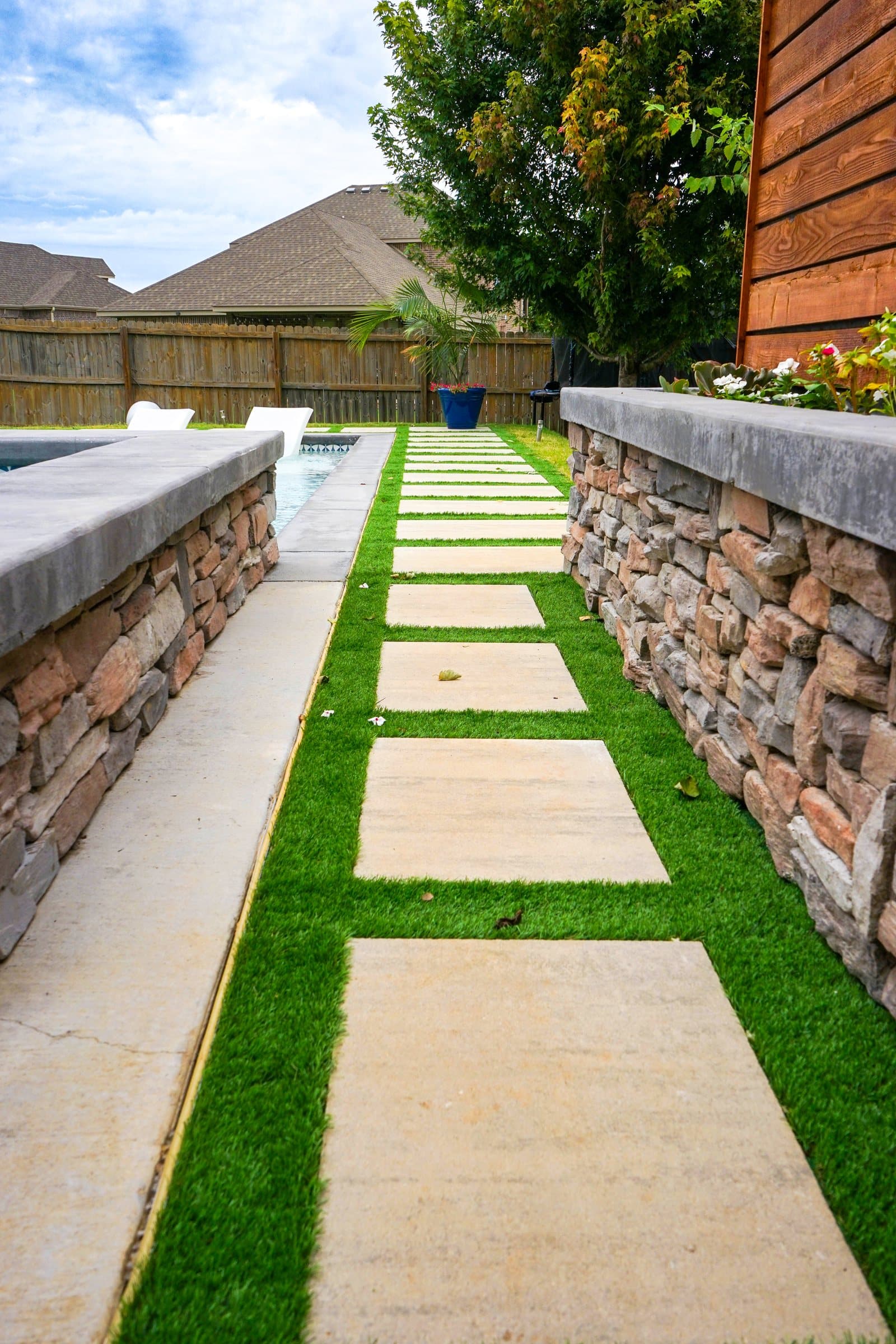
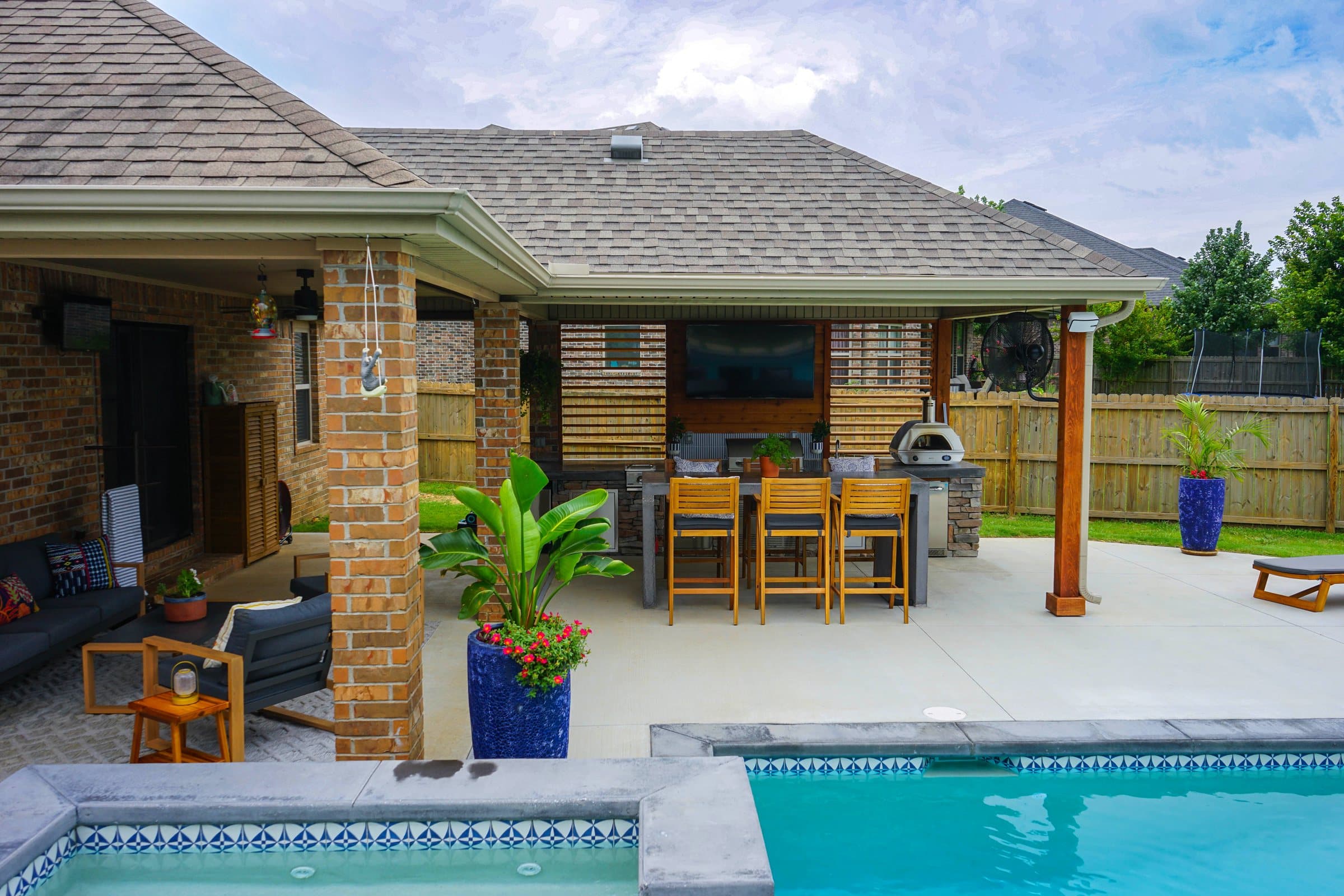
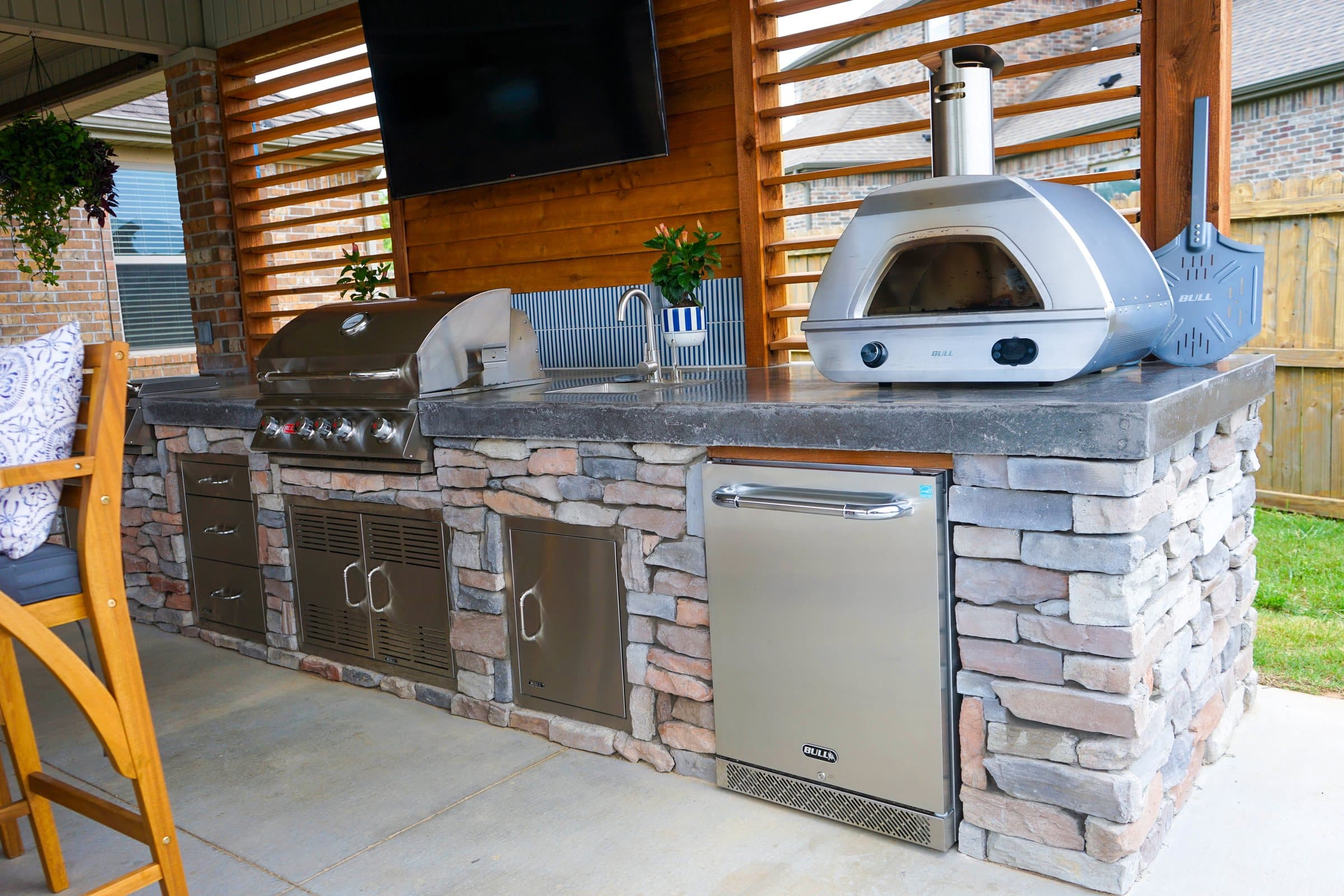
That project put a covered outdoor kitchen with a pizza oven, a stainless run and bar seating alongside a rectangular pool and raised spa, with stacked stone, large-format pavers with turf joints and cedar slat screens. The kitchen works because it was designed as part of the whole space: the cook faces the people at the bar, the roof covers the working area, and the services were planned with the hardscape rather than added to it.
You do not need that scale for a kitchen to work. You do need the same order of decisions.
08How long should the counter run be?
Longer than the first sketch, because landing space is what makes a grill into a kitchen.
A useful working rule is at least eighteen inches of clear counter on both sides of the grill, somewhere to prepare food that is not the landing space, and six feet of clear standing room in front so the cook is not in the walkway. Standard counter height is thirty-six inches; bar height is forty-two, with a twelve to fifteen inch overhang if people sit at it.
Every appliance added lengthens the run, and the run length is what sets the structure cost. That is a good reason to decide which appliances you will actually use every week, and which ones are for the brochure. Our outdoor kitchen layout guide has the full dimension table.
09Where should the kitchen sit on the lot?
Close to the house for service runs and carrying food, but placed so smoke goes away from people.
Every foot between the house and the kitchen is a foot of trench for gas, water and power, and a foot of walking with a full tray. That argues for close. Smoke, prevailing wind and the view argue for placing it with some thought: a grill venting straight into a covered seating area, or into the kitchen window, spoils both spaces.
Orientation matters for comfort too. A cook facing west into the evening sun all summer will not enjoy the kitchen. A cook facing the people at the bar, with the working surface under cover, will use it constantly.
10What should the kitchen stand on?
A properly built patio base, with a surface chosen for grease and spills.
An island is heavy, and a pizza oven heavier. They need a base that will not settle, which on this ground means excavation to firm material and a compacted aggregate base built in lifts, the same standard as a good patio. A kitchen that tilts because it was set on a thin base cannot be levelled without being dismantled.
The surface in front of the grill takes grease, marinade and dropped food. Pavers can be cleaned and, if a stain will not shift, individual units replaced. Some owners seal the cooking zone to make cleaning easier. Whatever the surface, keep it matte underfoot: a slick finish next to a grill is a hazard.
11What order should an outdoor kitchen be built in?
Design the whole thing, then build ground work, services and structure, then fit out.
- Settle the appliance list and the layout.
- Confirm permits for the structure, gas, water and electrical.
- Excavate, run every service line and conduit, and build the base.
- Build the island structure and any cover.
- Fit counters, cladding and appliances, then commission and test.
Phasing is fine, and sometimes sensible, as long as the gas line and the conduit go in during the first phase. The most expensive version of this project is the one where a patio is finished and, a year and a half later, someone decides they want a kitchen on it.
12Where do outdoor kitchen budgets go wrong?
They go wrong in the same three places every time.
An island too short to cook on. Landing space either side of the grill is the first thing cut and the first thing missed.
Services priced as an afterthought. A trench across a finished patio costs far more than the same trench dug with the patio.
No plan for winter. A split water line or a delaminated veneer costs more to fix than drain-down valves and the right adhesive cost to fit.
Our projects start around seven and a half thousand dollars, and a kitchen is usually part of a larger outdoor living build. Financing is available through Acorn Finance. The site visit is free: (479) 379-2226.
FAQCommon questions
How much does an outdoor kitchen cost in Northwest Arkansas?
It depends on run length, appliances and how far services travel. Our projects start around seven and a half thousand dollars; a covered kitchen with a full appliance list is a larger project, and the site visit is where it gets priced.
Can I add an outdoor kitchen to my existing patio?
Often, if the existing base can carry the load and services can reach the spot without destroying what is there. We look before we promise.
Do I need a permit for an outdoor kitchen?
Usually, because gas, plumbing and electrical work are involved and a roof over it is a structure. Rogers, for example, lists plumbing, electrical, mechanical work and covered patios as permitted work.
How do I winterise an outdoor kitchen in Arkansas?
Shut off and drain every water line before the first freeze, which averages mid-October at Drake Field. It is only easy if drain points were designed in.
What is the single best value addition?
A roof over it. It extends the season more than any appliance and protects everything under it.
Does a built-in grill need an insulated jacket?
If the island is built from combustible material, generally yes. The grill manufacturer's installation manual sets the clearances, and those govern.
Should the kitchen be near the house or out in the garden?
Close enough that food and people do not travel far, far enough that smoke does not roll into the house. Service distance also drops the closer it is.
REFSources
NEXTGet it looked at properly
Everything above is general guidance. What your ground actually needs is a site visit, and ours costs nothing. Francisco Gallardo walks it, reads the grade and the drainage, and tells you what is possible.