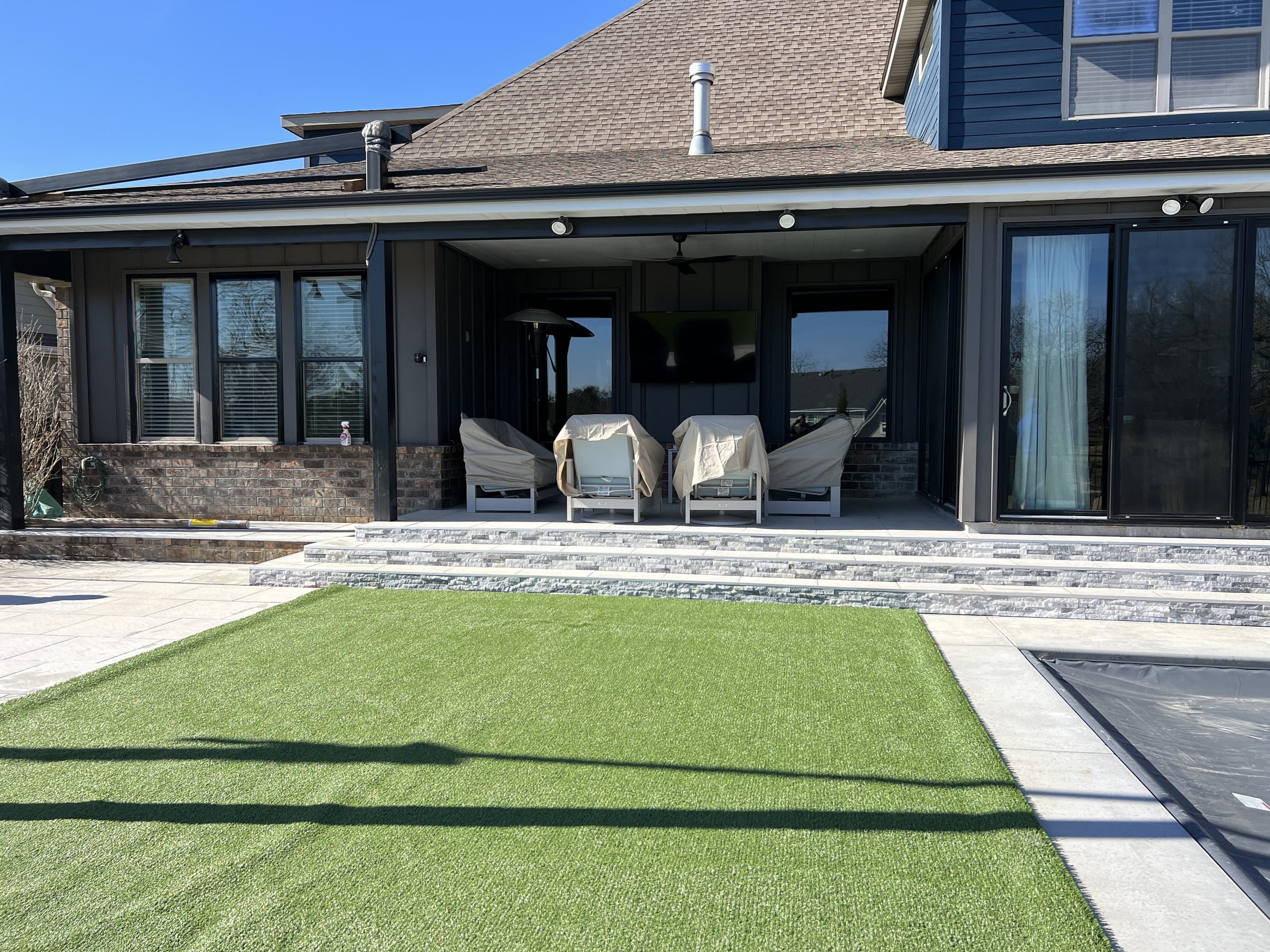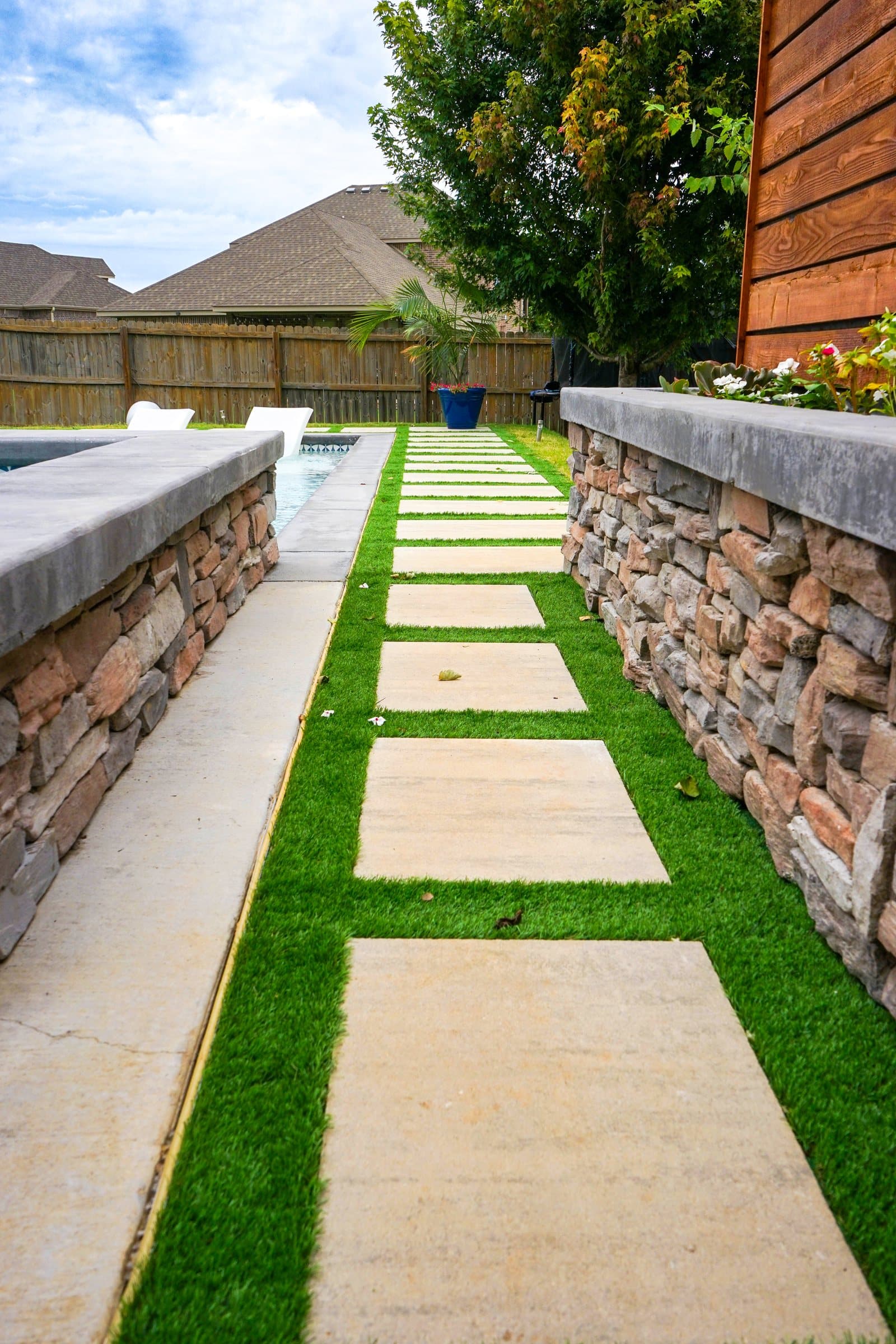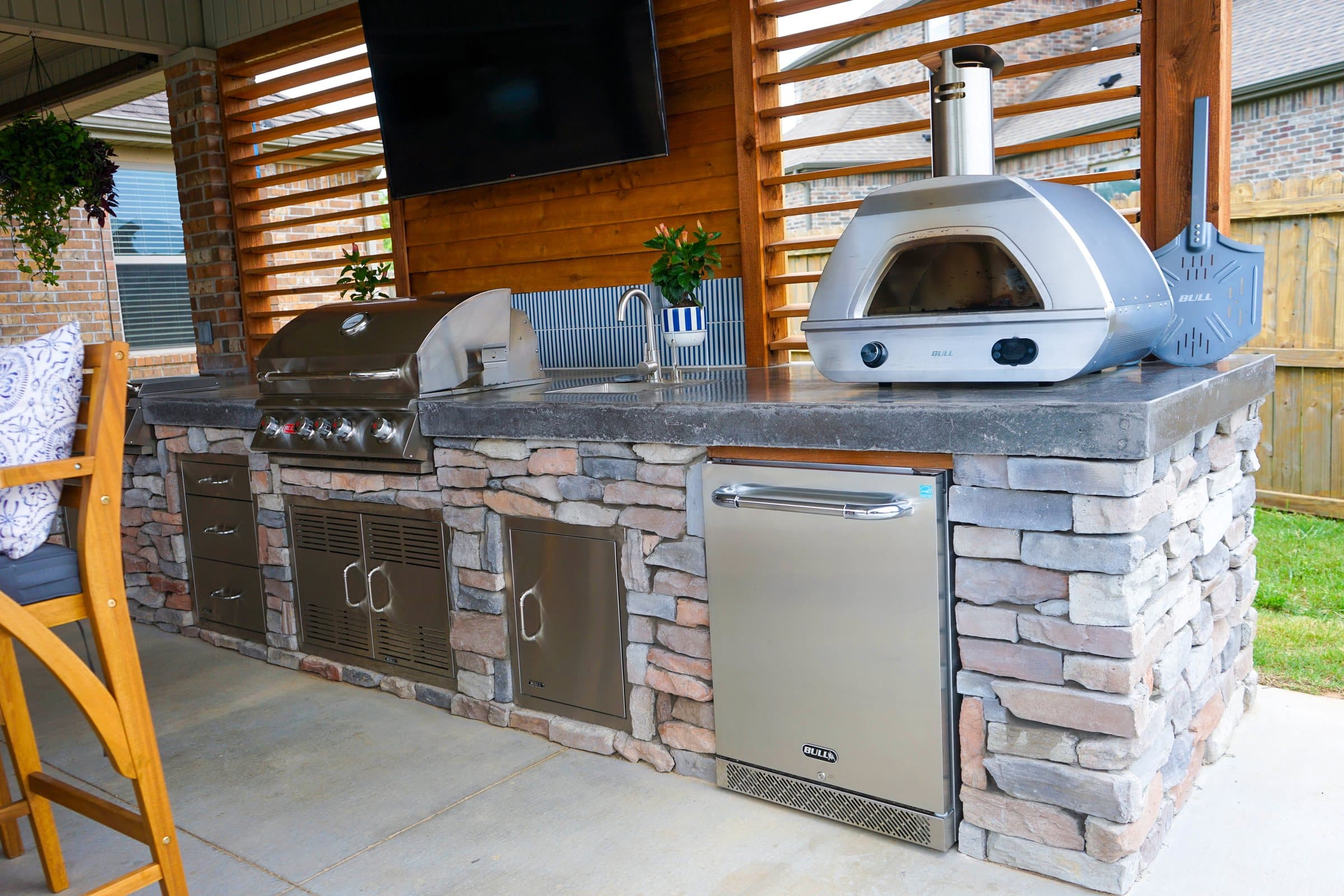

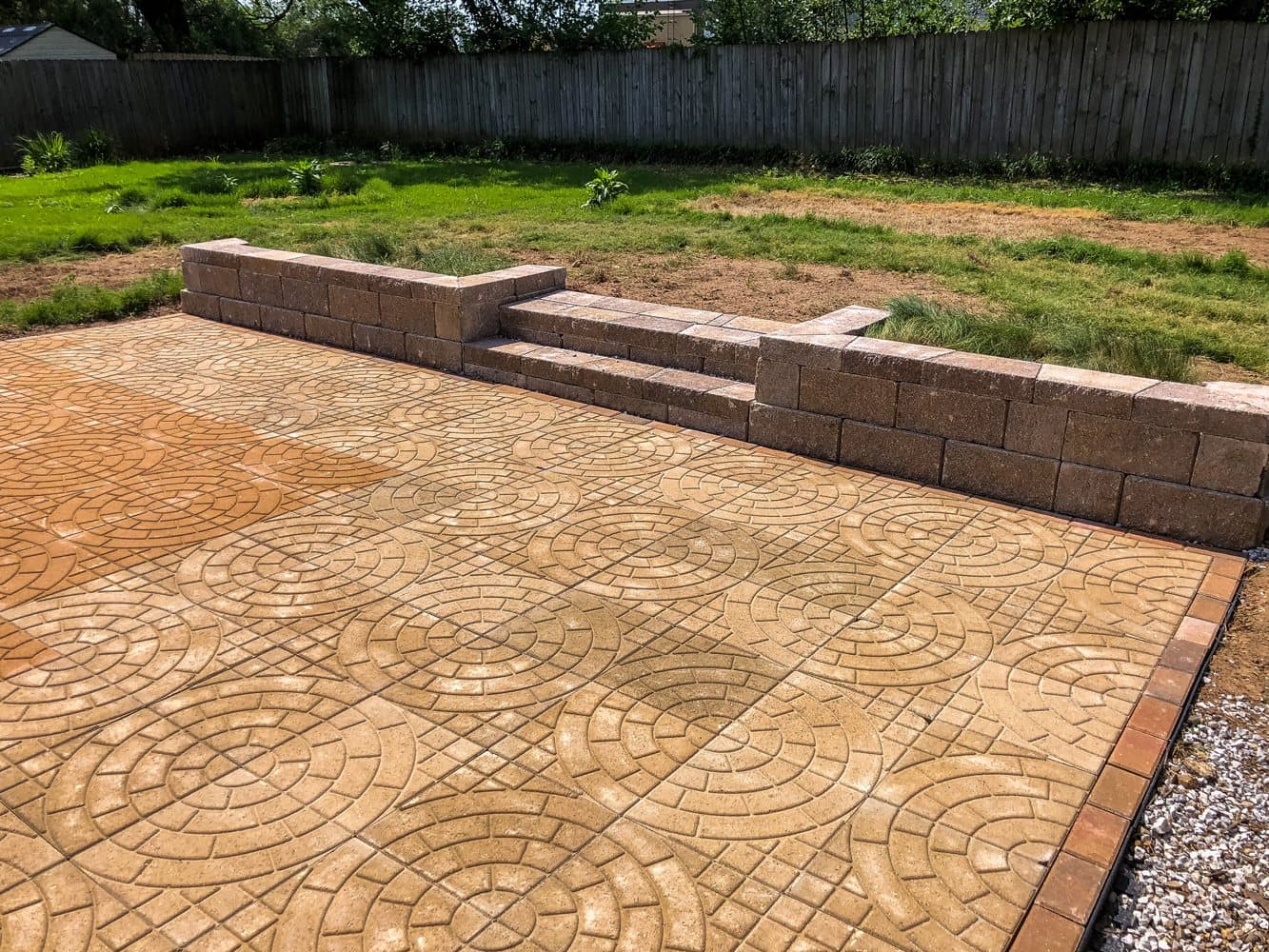
Stamped concrete generally has the lowest cost per square foot of any real patio material over a large area, which is why it is popular. You are buying one slab with a pattern pressed into it, so it lives or dies by its base, its thickness and where its control joints fall. On ground that moves, like the Fayetteville shale, that is a real risk, and it is the trade you are making for the lower price.
01Why is stamped concrete cheaper per square foot?
Because it covers a large area in one placement, with no individual units to set and no edge restraint to build.
A paver patio is hundreds or thousands of units, each placed, cut where needed and locked in with joint material and an edge. A stamped slab is formed, poured, coloured and stamped in a day or two, then cut or tooled for joints. Over a big open area that labour difference is substantial, and it is the main reason the square-foot price is lower.
The ground work is not cheaper, or should not be. A slab still needs excavation to firm material, a compacted aggregate base and falls that send water away from the house. The saving is in the surface, not the foundation.
02What is stamped concrete genuinely good at?
Large, continuous areas with a consistent pattern and no joints for weeds.
A stamped slab can run a pattern across a wide space with no gaps between units, no sand to wash out and nothing to rock underfoot. Curves, borders, inlays and pattern changes are formwork and stamping rather than cutting hundreds of units, which gives a lot of design freedom for the money.
It also suits places where a paver field would be fiddly: tight radiuses around a pool, a sweeping path, a large terrace that wants to read as one surface.
03Where does stamped concrete struggle?
Movement. A slab is one object, so when the ground under part of it shifts, it cracks.
The National Ready Mixed Concrete Association puts it plainly: cracks in concrete cannot be prevented entirely, but they can be controlled with properly designed joints. Joints decide where a slab cracks, not whether. And unlike a paver, a cracked slab cannot be repaired invisibly. You can seal or fill a crack; you cannot make a patterned, coloured surface look uncracked.
Colour fades, and a sealing cycle is part of owning it. Budget for resealing rather than being surprised by it a few years in. The sealer is also what gives many stamped patios their wet-look depth, so when it wears, the surface looks flatter and paler even though nothing structural has changed.
04What does a stamped slab need underneath it?
The same thing a patio needs: firm ground, a compacted aggregate base and falls that move water away from the house.
A slab spans small soft spots; it does not span a soft base. Where the subgrade is part rock and part clay, as it often is on the plateau, or where it swells and shrinks, as it does on the shale, the base evens out the support so the slab is not bridging between hard and soft ground. That base is compacted in layers rather than tipped and raked, because a base that keeps consolidating after the pour leaves the slab unsupported in patches.
Thickness and reinforcement are design decisions tied to use and ground. A patio carrying a hot tub or a vehicle needs more than one carrying a table. Ask for both on the quote in plain numbers. If a contractor cannot tell you how thick the slab will be, they have not decided.
05How should control joints be spaced?
Close enough that the slab cracks in the joints rather than between them.
NRMCA's guidance on joints in slabs on grade is specific, and it is worth checking a quote against it.
| Rule | NRMCA guidance | What it means for a patio |
|---|---|---|
| Maximum joint spacing | 24 to 36 times the slab thickness | A 4 in slab wants joints about every 10 ft |
| Upper limit | No more than 15 ft | Even thick slabs need regular joints |
| Panel shape | Square or nearly; length no more than 1.5 x width | Long thin panels crack across the middle |
| L-shaped panels | Avoid | Cracks start at the inside corner |
| Joint depth | At least 1/4 of slab thickness, not less than 1 in | A shallow tooled line is decoration, not a joint |
| Wire mesh | Will not prevent cracking | Mesh keeps cracks tight; it does not stop them |
On a stamped slab, joints also have to work with the pattern. A good installer plans them so they fall along pattern lines and almost disappear. A careless one cuts them wherever the saw lands, or leaves them out because they spoil the look, and the slab then picks its own crack lines.
06Why does the ground south of Springdale matter so much?
Because the Fayetteville shale swells when wet and shrinks when dry, and a rigid slab cannot follow it.
Fayetteville, Farmington, Prairie Grove and Elkins sit in the Boston Mountains, on sandstone and shale. University of Arkansas geologist Walter Manger, quoted in the Northwest Arkansas Business Journal, called the Fayetteville shale the culprit behind the area's foundation problems, because it expands and contracts as its clay weathers. His summary: "Limestone is good. Shale is bad."
On that ground, a slab on a thin base is a crack waiting for a wet spring. It can still be done well, with a thicker, well-drained base and disciplined joints, but it is the ground where the case for pavers is strongest.
North of Springdale, on the Springfield Plateau, the Boone Formation is more stable once you reach it. The risk there is the red chert-laden clay above it holding water under the slab, and rock turning up at uneven depths so the subgrade is part rock and part clay. Uneven support is uneven settlement.
07How does stamped concrete compare with pavers?
Stamped is cheaper up front over large areas; pavers are cheaper to live with on ground that moves.
| Stamped concrete | Concrete pavers | |
|---|---|---|
| Up-front cost over a large area | Generally lower | Generally higher |
| Response to ground movement | Cracks | Units shift slightly and can be reset |
| Repair | Visible patch or replacement of a section | Lift and relay the affected units |
| Access to buried lines | Cut the slab | Lift units and replace them |
| Ongoing care | Reseal on a cycle to protect colour | Top up joints; sealing optional |
| Weeds | None through the surface | Possible in joints if not maintained |
Neither is the right answer everywhere. On a flat, well-drained lot on the plateau, a well-built stamped slab is a sound choice. On sloped, poorly draining or shale ground, the extra for pavers buys the ability to fix things without starting again.
08What happens to stamped concrete in an Arkansas winter?
It freezes and thaws repeatedly, so the concrete, the sealer and the drainage all have to be right.
The National Weather Service's 1991 to 2020 normals for Drake Field put the average overnight low at or below freezing on every day of January and February, with the average afternoon high above freezing. Water that gets into the surface or sits in low spots freezes and expands night after night.
Three things protect a slab through that: falls that shed water rather than letting it pond, a sealer maintained on schedule, and no de-icing salts on a young slab. Standing water on a stamped patio is not a cosmetic issue. It is where the surface starts to scale.
09Which colours and patterns hold up best?
Colour mixed through the concrete, lighter tones and patterns with natural joint lines age best.
Colour can go in two ways: mixed into the whole batch, or broadcast onto the surface as it is finished, often with a contrasting release agent for depth. Integral colour runs all the way through, so wear and small chips do not expose a different colour beneath. Surface colour gives richer effects and relies more on the sealer to protect it.
Strong, dark colours fade most visibly in sun and get hottest underfoot. Patterns that imitate stone or slate with irregular joint lines hide a control joint or a hairline crack far better than a precise brick or tile pattern, where any line that does not match the grid stands out.
10Can stamped concrete go around a pool?
It can, with the right texture, a light colour and a sealer that does not turn slick when wet.
Pool decks are wet, barefoot surfaces. A deep texture and a matte finish grip; a smooth pattern with a glossy sealer does not. Many sealers can have an anti-slip additive mixed in, and it is worth specifying. Light colours stay cooler in August.
The slab must fall away from the pool, and the joint between deck and coping needs detailing so the two can move independently. Around a pool, the ability of pavers to be lifted for access to lines underneath is the main argument against a slab.
11Why is Northwest Arkansas concrete a local product?
Because the ingredients do not all come from here.
Manger noted in the same Business Journal piece that there is no natural sand source in Northwest Arkansas, so ready-mix plants bring sand in by rail. That is one reason concrete work here is priced the way it is, and one reason a stamped project is scheduled around plant deliveries and weather rather than the contractor's convenience.
12How do you buy stamped concrete well?
Ask four questions and compare the answers rather than the totals.
- How deep is the excavation, and what goes in as base?
- How thick is the slab, and is it reinforced?
- Where will the control joints fall, and how deep will they be cut?
- Which sealer, and how often will it need reapplying?
Those answers separate a stamped patio that lasts from one that does not, and the price difference between them is smaller than people expect. Our projects start around seven and a half thousand dollars, and the site visit is where we tell you honestly whether your ground suits a slab or pavers. Call (479) 379-2226.
FAQCommon questions
Will stamped concrete crack?
Concrete cracks; control joints decide where. NRMCA guidance is joints every 24 to 36 times the slab thickness, so about every 10 feet on a 4 inch slab, and never more than 15 feet apart.
Is stamped concrete cheaper than pavers?
Per square foot over a large area, generally yes. Over fifteen years on ground that moves, often not, because a cracked slab cannot be repaired the way a lifted paver can be reset.
Does stamped concrete need sealing?
Yes, on a cycle. Sealing protects the colour and the surface, and skipping it is the main reason older stamped patios look tired.
Is stamped concrete a good idea in Fayetteville?
It can be, with a thicker, well-drained base and disciplined joints. But the Fayetteville shale swells and shrinks with moisture, which is the ground where pavers make the strongest case.
Does wire mesh stop concrete cracking?
No. NRMCA is explicit that mesh will not prevent cracking; it helps keep cracks from opening up.
Can a cracked stamped patio be repaired?
Cracks can be sealed or filled, and badly damaged sections replaced, but a repair on a coloured, patterned slab is almost always visible.
Can you put salt on stamped concrete?
Avoid de-icing salts, especially on a young slab. They accelerate surface scaling through freeze-thaw. Use sand for grip instead.
REFSources
- NRMCA CIP 6: Joints in Concrete Slabs on Gradenrmca.org
- Talk Business / NWA Business Journal: Shale Rests at Root of Construction Problemstalkbusiness.net
- National Weather Service: Fayetteville Drake Field 1991-2020 Normalsweather.gov
- Arkansas Geological Survey: Physiographic Regions of Arkansasgeology.arkansas.gov
NEXTGet it looked at properly
Everything above is general guidance. What your ground actually needs is a site visit, and ours costs nothing. Francisco Gallardo walks it, reads the grade and the drainage, and tells you what is possible.