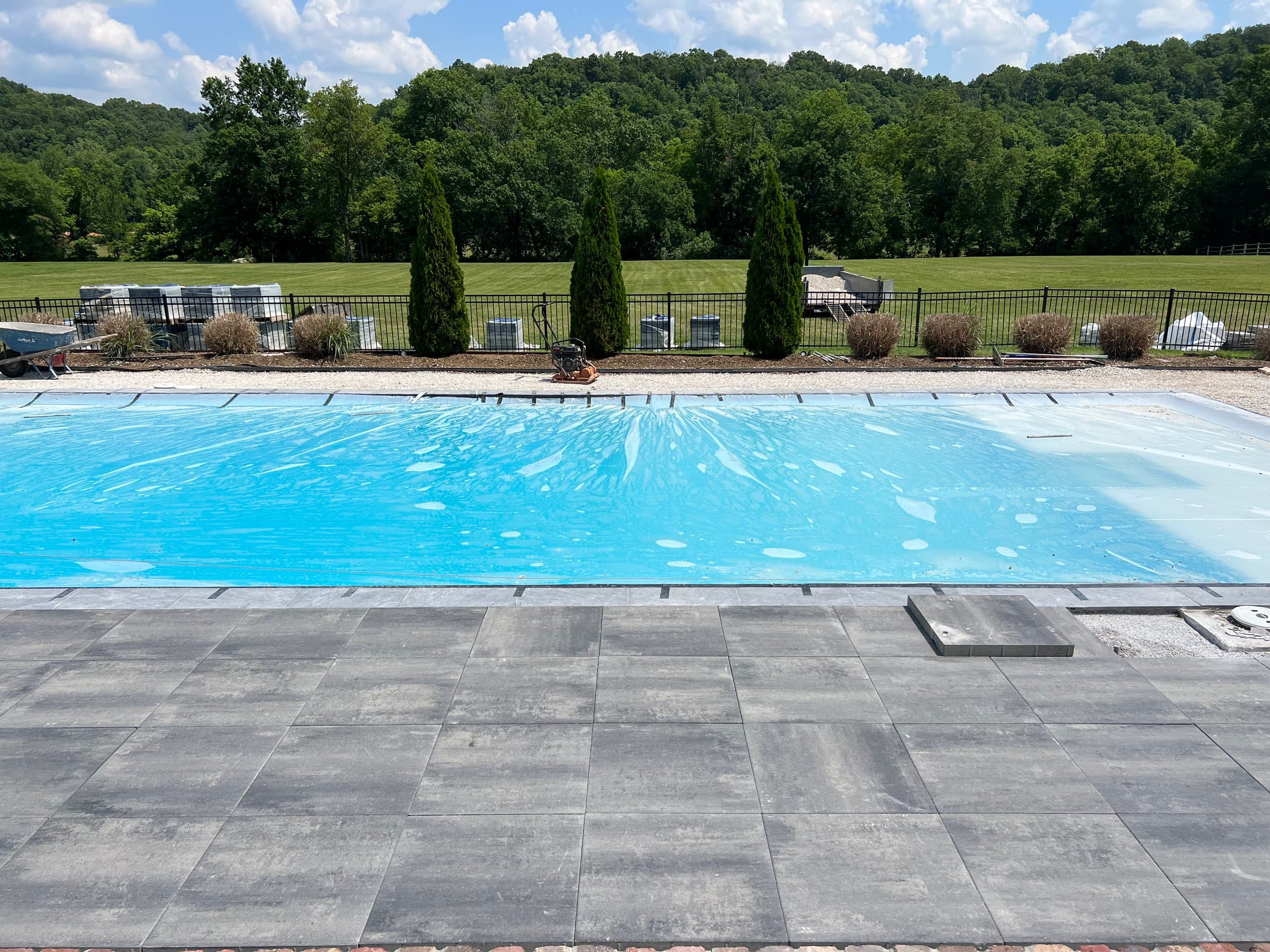

Porcelain pavers are the safer choice for a pool deck in a Northwest Arkansas freeze-thaw climate, because they are dense, absorb very little water and are uniform from one unit to the next. Travertine is warmer and softer in look and stays comfortable underfoot, but it is a natural, porous stone, so it only performs here if the grade is right, the pores are filled and it is laid so water drains away. Choose porcelain for low maintenance and a crisp modern look; choose a good, dense, filled travertine for a classic look against a traditional house.
01Why is this a harder choice in Arkansas than in Florida?
Because a pool deck here has to survive winter, and both materials are usually sold on photographs taken somewhere that never freezes. Travertine and porcelain are both staples of warm-climate pool decks. In Northwest Arkansas the deck spends months wet and cold, and National Weather Service records for Fayetteville put the average first freeze around the middle of October and the last one around the middle of April.
A pool deck is also the wettest hardscape you will own. It is splashed all summer, rained on all winter, and often sits lower than the house with runoff arriving from the lawn. Water that gets into a surface and then freezes expands by roughly nine percent. Whether a material takes that water in is the whole question.
02Side by side
Here is the practical comparison for a pool deck on Northwest Arkansas ground.
| Factor | Travertine | Porcelain pavers |
|---|---|---|
| What it is | Natural limestone deposited by mineral springs, full of natural pores | Manufactured, kiln-fired, very dense |
| Water absorption | Varies by stone and by whether pores are filled | Very low by design |
| Freeze-thaw risk | Real with open-pored, low-density stone | Low |
| Consistency | Every piece differs; that is the look | Uniform, including large formats |
| Feel underfoot | Soft, matte, comfortable barefoot | Depends on the textured finish chosen |
| Grip when wet | Tumbled finishes grip well | Choose an exterior textured finish, never polished |
| Staining | Can absorb spills unless sealed | Resists staining |
| Installation | Heavier, variable thickness, slower to lay well | Cannot be plate compacted; pre-compacted bedding and spacers |
| Replacing one unit | Matching can be difficult | Same product, straightforward if spares are kept |
| Look | Classic, warm, Mediterranean | Clean, modern, can imitate stone or wood |
03How does travertine behave through an Arkansas winter?
It depends almost entirely on the particular stone, which is why the category tells you very little. Travertine is specified under ASTM C1527, which sets requirements for absorption, density, compressive strength, flexural strength and abrasion resistance. The Natural Stone Institute's point is simple: less dense stone with higher absorption is more vulnerable to weathering, and freeze-thaw is the weathering that matters here.
Travertine is naturally full of holes. Filled travertine has those pores filled at the factory, which keeps water and dirt out of the face. Unfilled travertine leaves them open, and on a pool deck in this climate open pores collect water that freezes. Tumbled, unfilled stone looks lovely in a brochure and is the version to be most careful with in a climate that freezes.
Ask for the test data on the actual stone, not the category. A supplier who can tell you the absorption and density figures for the product you are buying, tested to ASTM, is selling stone. One who tells you travertine is fine around pools everywhere is selling a photograph.
Sealing helps, and on travertine around a pool it is usually worth doing, but sealer is maintenance, not protection from a poor stone choice. It wears and has to be renewed.
04How does porcelain behave through an Arkansas winter?
Very well, because it does not take in enough water to freeze inside. Porcelain is fired at high temperature into a dense body with extremely low absorption. That is the property that makes it attractive in a freeze-thaw climate, and it is also why it resists staining from sunscreen, leaves and barbecue spills.
The catch is installation, and it is a real catch. Porcelain pavers behave nothing like concrete pavers during laying. The MSI installation guidelines are explicit that porcelain pavers cannot be compacted with a plate compactor, so the bedding sand has to be pre-compacted and screeded flat before the units go down. They also call for 4 mm joints held with spacers and filled with polymeric sand.
A crew used to vibrating concrete pavers into place and finishing with the plate compactor will crack porcelain doing exactly what they always do. Ask whoever is quoting how many porcelain decks they have laid and how they set the bedding.
Porcelain can be laid three ways: sand-set on a compacted base, mortar-set on a concrete slab, or on pedestals. Around a pool on grade, sand-set over a properly built base is common and repairable. Mortar-set gives a rigid, very flat result but inherits every crack in the slab beneath it.
05Which is cooler underfoot?
Colour decides it more than material. A pale deck of either stays more comfortable in an Arkansas August than a dark one of either. Travertine has a reputation for staying cool, and a light-coloured, matte stone genuinely is pleasant barefoot. Light porcelain in a textured finish is also comfortable. Dark grey porcelain in full sun is not, however good it looks.
If the deck faces west and there is no shade, pick the lightest colour you can live with, in whichever material, and plan some shade from a cover or a structure.
06Which is safer when wet?
The finish decides it, not the category. Tumbled travertine has a naturally textured face that grips well. Porcelain comes in a wide range of finishes, and exterior pavers are made with textured surfaces for exactly this reason. What you must avoid around a pool is anything polished or honed smooth, in either material.
Get a sample, wet it, and stand on it barefoot. It is the test that settles the argument in a minute.
07What has to be right underneath either one?
The base and the drainage, exactly as with any paving. A dense porcelain paver on a base that holds water will still move when the base freezes. A good travertine on a base that drains will last far better than a mediocre one on a base that does not.
On the Springfield Plateau around Bentonville, Rogers and Cave Springs, rock and chert are common in the excavation, and a pool dig can hit rock. That is fine for bearing, but water in karst ground finds its own route, and the deck has to shed water away from the pool and the house. From Fayetteville south, the Fayetteville shale swells when wet and shrinks when dry, so keeping water out of the subgrade under the deck matters even more.
Porcelain installation guides require the surface to slope away from the structure. Around a pool that means designing the falls, the coping detail and the deck drains together, not leaving them to whoever lays the last course.
There is also a safety layer that has nothing to do with the stone. Pool barriers have to meet code, and the U.S. Consumer Product Safety Commission publishes barrier guidelines for home pools worth reading before the layout is fixed. The fence line affects where the deck ends.
08What about the coping and the edge of the pool?
The coping is where the choice is most visible and where the detailing matters most. It is the edge people sit on, push off from and walk along barefoot, and it is the first thing to get splashed.
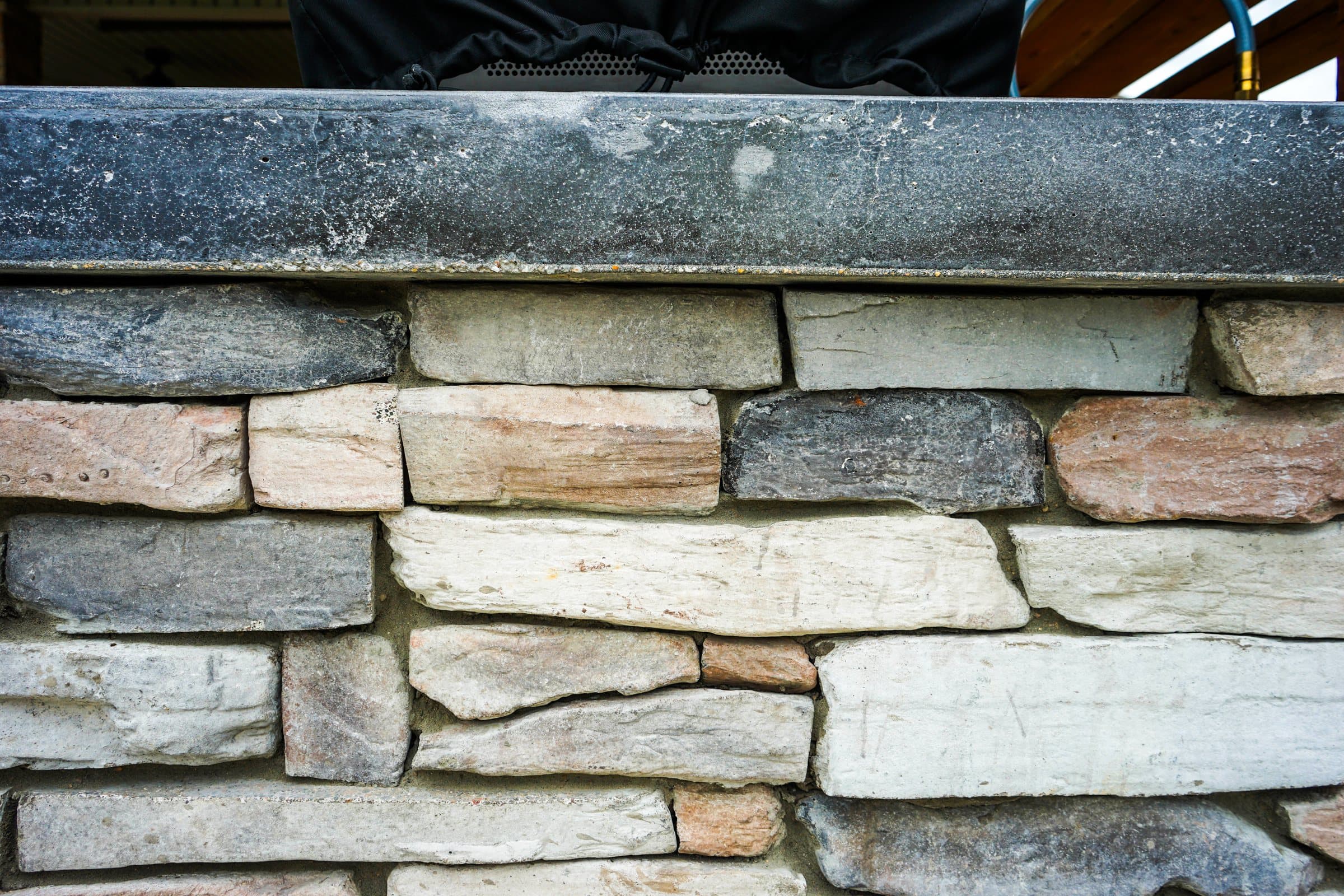
Travertine coping is a classic for good reason: a bullnosed or eased edge in a tumbled finish is comfortable to sit on and looks settled against water. Porcelain coping pieces exist in many ranges and allow the deck and the edge to match exactly, which suits a crisp rectangular pool. Many good pools mix the two approaches, using one material for the coping and another for the field, or natural stone on raised walls with a manufactured deck.
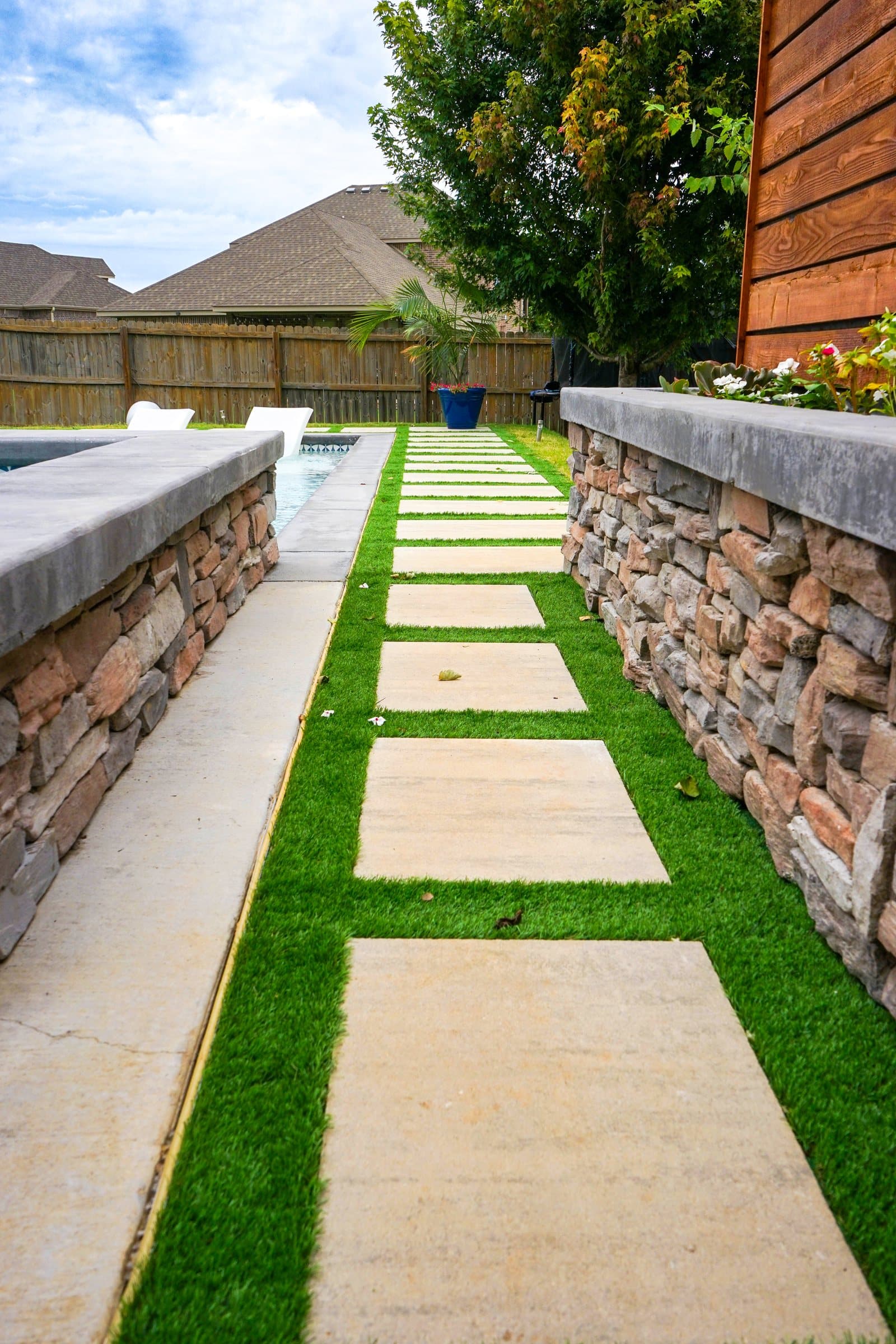
Whichever you use, the coping has to be set so water drains away from the pool rather than back into it, and the joint between coping and deck has to allow for movement. On the Swindle build, stacked stone on the raised spa wall and large-format paving on the deck were designed together for exactly that reason.
09What does each one ask of you after it is built?
Porcelain asks for very little; travertine asks for regular care. That difference is worth weighing honestly, because a pool deck gets used hard.
A porcelain deck needs its joints kept full and an occasional wash. Because the face absorbs so little, sunscreen, leaves and pool chemicals rinse off rather than soak in. Keep a few spare units from the original batch so a damaged one can be swapped without a colour mismatch.
A travertine deck needs periodic resealing, attention to any pores that open up as the fill wears, and prompt cleaning of spills before they soak in. None of that is difficult, but it is ongoing. Spare stone from the same lot is even more valuable than with porcelain, because a replacement from another quarry batch can look entirely different.
Both benefit from keeping de-icing products off the deck in winter unless the manufacturer or supplier approves them, and from keeping roof and lawn runoff away from the paving.
10Which should you choose?
Choose porcelain if you want the lowest-risk deck through a Northwest Arkansas winter, the least maintenance, a clean modern look, or large-format units with tight joints. It is the default we would steer most pool decks toward on newer houses in Bentonville, Centerton and Rogers, provided it is laid by a crew that knows porcelain is not a concrete paver.
Choose travertine if the house is traditional, the look you want is warm and softly irregular, and you are prepared to pick a dense, filled stone with test data behind it and seal it as part of normal maintenance. Chosen well and built on a base that drains, it is a beautiful deck. Chosen on looks alone, it is the one more likely to disappoint here.
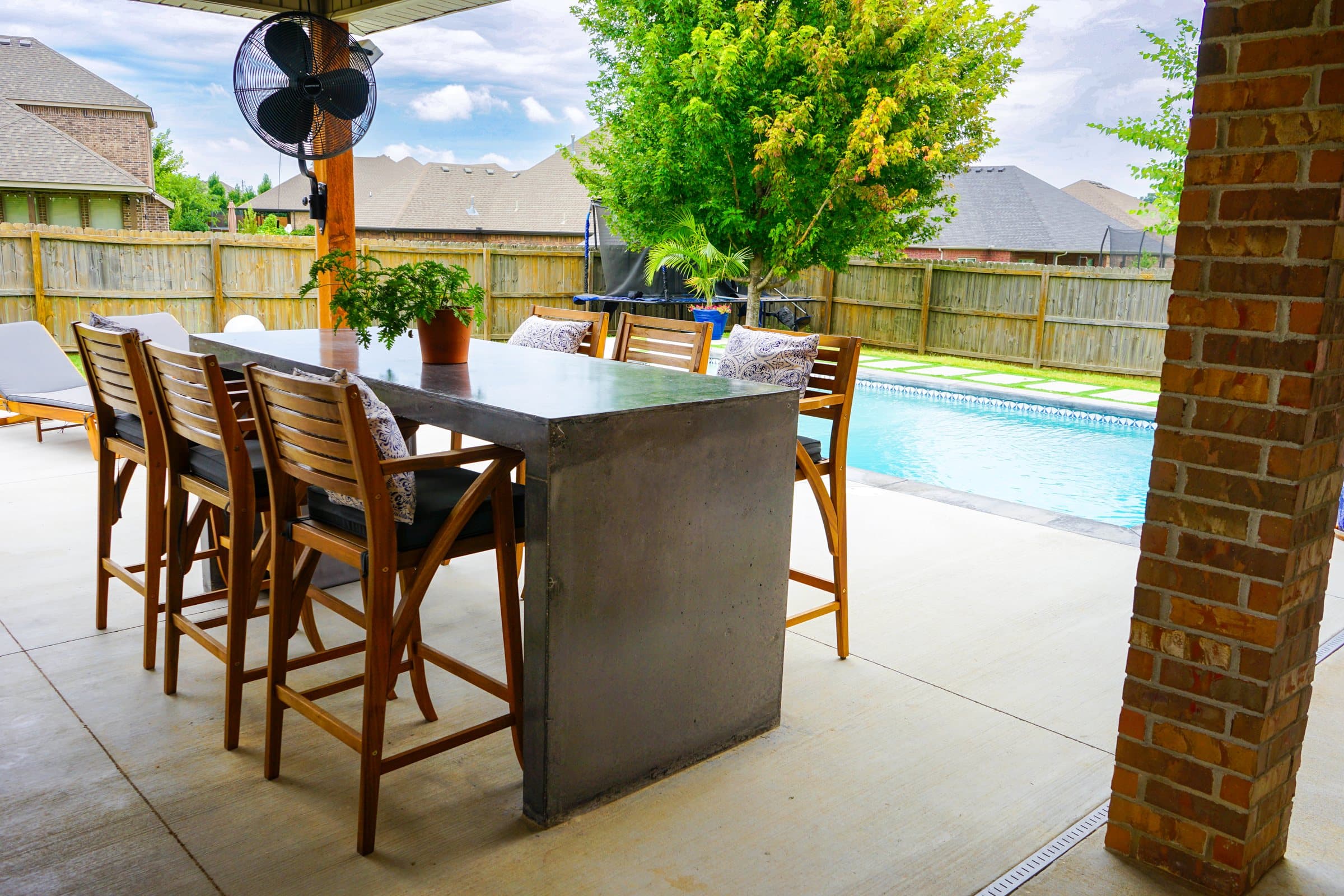
Choose neither as a way to save on the base. On the Swindle build in Cave Springs the large-format paving, the stacked stone and the turf joints only work because what is underneath them was built first.
Projects start around seven and a half thousand dollars, financing is available through Acorn Finance, and we will bring samples of both to the site. Call (479) 379-2226.
FAQCommon questions
Is travertine good for pool decks in cold climates?
It can be, if the stone is dense with low absorption, the pores are filled, it is sealed and the base drains. Open-pored, low-density travertine is the version most likely to suffer from freeze-thaw.
Do porcelain pavers crack in freezing weather?
Porcelain absorbs very little water, so freezing alone rarely damages it. Cracks usually come from installation, such as using a plate compactor on it, or from a base that moves.
Which is hotter around a pool, travertine or porcelain?
Colour matters more than material. A light matte surface of either stays cooler than a dark one in full sun.
Is porcelain slippery around a pool?
Exterior porcelain pavers come in textured finishes made for wet areas. Avoid polished or smooth finishes near water in any material, and test a wet sample barefoot.
Does travertine need to be sealed around a pool?
Usually it is worth doing, to reduce absorption and staining. Treat it as ongoing maintenance, not as a substitute for choosing a dense stone.
Can porcelain pavers be laid on sand like regular pavers?
Yes, sand-set is a standard method, but the bedding must be pre-compacted and screeded because porcelain cannot be compacted with a plate compactor, and joints need spacers.
Which lasts longer around a pool in Arkansas?
On a properly built, well-drained base, porcelain carries less freeze-thaw risk. A good dense travertine can also perform well; the stone selection and the base decide it.
REFSources
- MSI: Porcelain pavers installation guidelinesmsisurfaces.com
- ASTM C1527: Standard Specification for Travertine Dimension Stonestore.astm.org
- Natural Stone Institute: ASTM standards relevant to natural stonenaturalstoneinstitute.org
- National Weather Service Tulsa: Fayetteville frost and freeze climatology (32F)weather.gov
NEXTGet it looked at properly
Everything above is general guidance. What your ground actually needs is a site visit, and ours costs nothing. Francisco Gallardo walks it, reads the grade and the drainage, and tells you what is possible.