
Sometimes, but the patio's base decides it, not its surface. Water alone weighs about 62.4 pounds per cubic foot, so a filled hot tub puts far more load on a small area than people and furniture ever do, and the spa manufacturer's instructions set what it must sit on. Plan the electrical too, since the NEC requires a maintenance disconnect within sight and at least 5 feet from the water, and check fence rules: Bentonville requires fences around spas to be at least 48 inches high.
01How heavy is a filled hot tub?
Much heavier than anything else you will put on a patio.
The U.S. Geological Survey gives the density of water at about 62.4 pounds per cubic foot. Every foot of water depth therefore puts about 62.4 pounds on every square foot of the floor beneath it, before you add the shell, the equipment and the people sitting in it. A tub with around three feet of water is putting roughly 190 pounds per square foot of water alone onto its base, concentrated on a footprint of a few square yards.
A patio laid for people and furniture was never asked to carry that. Whether it can depends on what is underneath.
02Can an existing paver patio carry it?
If the base was built properly and the manufacturer allows pavers, it may. If not, it needs a dedicated pad.
A paver patio on a deep, well-compacted aggregate base spreads load well, and pavers carry vehicles in driveways. A patio with a thin base, one laid on uncompacted fill, or one that has already settled in places, will settle further under a hot tub, and a tub that tilts stresses its shell and frame. The spa manufacturer's installation instructions state what the tub must sit on, typically a flat, level, solid surface, and they govern the warranty. Read them before you decide.
The practical approach is to check the base where the tub will go. If the patio has already moved, or nobody knows how it was built, cutting out that area and building a proper pad flush with the surrounding paving is usually the cleaner answer.
03What about a concrete patio?
A slab may carry it, but slab thickness, reinforcement and condition all matter.
A cracked or settling slab is a sign the ground under it is moving, which on the Fayetteville shale south of Springdale is common, and adding a concentrated load makes it worse. A sound slab of adequate thickness on a good base may be fine. The manufacturer's requirements are the test, and where they are not clearly met, a dedicated pad is safer than hoping.
04What about putting it on a deck?
That is a structural design question, not a patio one.
A deck built for normal use is not designed for the concentrated weight of a filled tub. Putting one on a deck needs the structure designed for that load, usually by an engineer, and often a permit. Setting the tub at ground level on a proper pad, with a deck or patio built around it, is simpler and usually the better result.
05What electrical work does a hot tub need?
A dedicated circuit and a maintenance disconnect within sight, at least 5 feet from the water.
NEC Article 680 requires a maintenance disconnecting means for spa and hot tub equipment, within sight of the equipment, and located at least 5 feet horizontally from the inside walls of the spa unless a permanent barrier separates them. That distance is measured along the shortest path someone would take to reach it. The wiring, protection and bonding are the electrician's work and usually need a permit.
For the patio design, it means planning where the disconnect goes and how the cable reaches it. Conduit under the paving is easy while the ground is open and disruptive afterwards.
06Does a hot tub need a fence?
It depends on the city and on the cover, so check before you buy.
The City of Bentonville's fence rules say fences used to enclose pools and spas must be at least 48 inches high, with no more than 2 inches between the bottom of the fence and the ground, and its fence permit plot plan asks for the location of existing or proposed pools and spas. Other cities have their own barrier rules, and whether a lockable safety cover changes what is required is a question for the city. In Bella Vista the POA's Architectural Control Committee reviews structures and fences as well as the city.
| Check | Why |
|---|---|
| City barrier rules for spas | Fence height, gap and gate rules may apply |
| Lockable safety cover | Ask the city how it treats one; it matters for children regardless |
| Electrical permit | Dedicated circuit and disconnect |
| HOA or ACC approval | Covenants often cover visible equipment and screens |
| Manufacturer base requirement | Governs the pad and the warranty |
| Delivery route | The tub has to reach the spot |
07Where should the hot tub go?
Close to the back door, with privacy, a view and shelter from the wind.
A hot tub gets used most in the cold months, and nobody wants a long walk across a frozen garden in a wet towel. Put it close to the house, ideally with a short, level route from the door. Screen it from neighbours' windows, because a tub is the place people most want privacy. Give it a view of the garden or the sky, and shelter it from the prevailing winter wind.
Leave room behind it for the cover to fold back or for a cover lifter, and access to the equipment panel for service. Both are easy to forget and awkward to fix.
08How does the tub get there?
On its side, along a route that has to be wide and clear enough.
Hot tubs are often delivered tipped on edge on a cart and wheeled into place. The route from the street, around the house and onto the patio has to clear gates, steps, tight corners, overhead branches and air conditioning units. The retailer will state the clearance their delivery needs. Measure the route before ordering, because the alternative is a crane.
09How should the area around the tub be designed?
Slip-resistant, well drained, with a safe way in and out.
People step out of a hot tub wet onto the paving, often at night. The surface around it should have good grip when wet and fall away so splash water drains rather than freezing into a sheet in January. A step or a built seat wall helps people get in and out steadily. Lighting on the route to the door is worth having, kept low and warm so it does not light up the tub for the neighbours.
Plan where the tub drains when it is emptied for cleaning. That water has to go somewhere sensible, not across the patio and against the house.
10Should the tub be sunk into the patio?
Partly sunk or surrounded by a built edge looks better and makes getting in easier, but it needs drainage and service access.
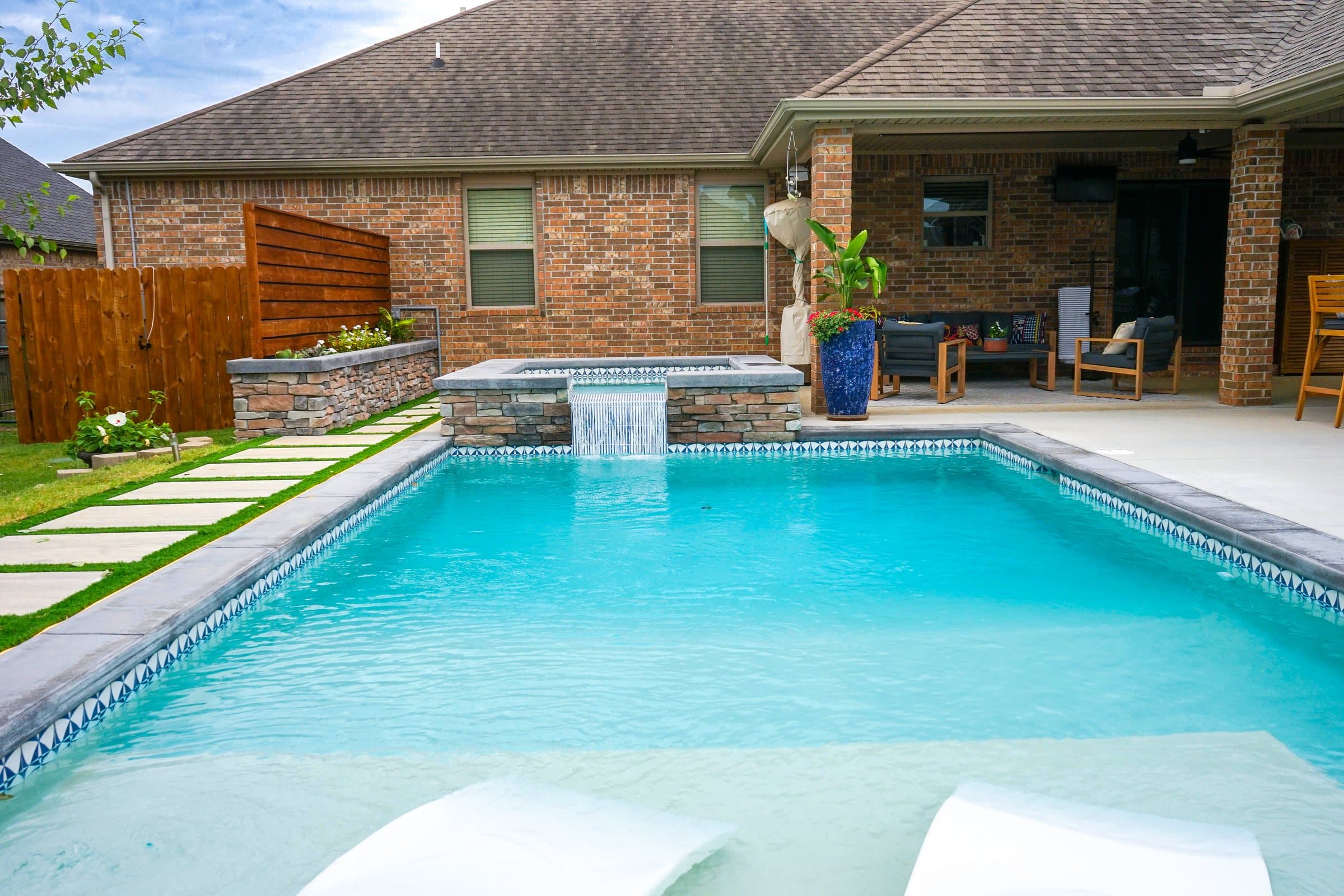
A tub set partly into the ground or wrapped in stone or a seat wall looks built in rather than delivered. It needs a drained pit, so rain does not fill the space around the tub, and a removable panel for the equipment. A fully built-in spa, like the raised spa on the Swindle build in Cave Springs, is a different product: part of the pool construction rather than a portable tub.
11Should the hot tub be under a roof?
It is not required, but cover over or near it makes winter use easier.
A tub under a pergola or at the edge of a covered patio keeps leaves out, gives shade in summer, and gives somewhere dry to leave towels and a robe. It also means the route from the door to the tub is dry in the rain and less icy in winter. The roof needs enough height for the cover to open and for steam to clear, and a solid roof directly over a tub can drip condensation. A pergola or a cover set to one side is often the better arrangement.
12What about winter and power cuts?
A hot tub is designed to run through the winter; the risk is losing power in a hard freeze.
Northwest Arkansas winters bring regular nights below freezing. A running tub keeps its own water and plumbing warm. If the power goes out for a long time in severe cold, the pipes and equipment can freeze, so know where the manufacturer says to act and how quickly. For the patio design, that means a disconnect and an equipment panel you can reach in winter, and a route to the tub that stays usable when the ground is frozen: level, well drained and lit.
13How does a hot tub look from the house?
Like a box, unless the design deals with it.
A portable tub is a large rectangle with a cover on top, and it is visible from the kitchen every day of the year. Setting it partly into the ground, wrapping it in a stone or timber surround, or placing it behind a low wall or planting so the house sees the garden rather than the cabinet all help. Screening the side that faces the neighbours does double duty as privacy.
14How do we add one to your patio?
We check the base, plan the pad, the electrical route and the screening, and tell you plainly if the existing patio will not carry it.
Projects with us start around seven and a half thousand dollars, and financing is available through Acorn Finance if you would rather spread the cost than cut the scope. Call (479) 379-2226 or send the project form, and tell us what you are trying to do with the space.
FAQCommon questions
Can I put a hot tub on pavers?
Sometimes. It depends on the base under the pavers and on the spa manufacturer's installation requirements. A patio on a thin or unknown base often needs a dedicated pad cut in where the tub goes.
How much does water in a hot tub weigh?
About 62.4 pounds per cubic foot, according to the USGS. Every foot of water depth puts about 62.4 pounds on each square foot of base, before the shell and the people.
How far does the hot tub disconnect have to be from the water?
The NEC requires the maintenance disconnect to be within sight of the equipment and at least 5 feet horizontally from the inside walls of the spa, unless a permanent barrier separates them.
Does a hot tub need a fence in Bentonville?
Bentonville's fence rules say fences enclosing pools and spas must be at least 48 inches high with no more than a 2 inch gap at the bottom. Check with the city for your situation.
Where is the best place for a hot tub?
Close to the back door, screened from neighbours, sheltered from the winter wind, with room for the cover to fold back and access to the equipment.
Can a hot tub go on a deck?
Only if the deck is designed for the load, which usually means an engineer and a permit. A ground-level pad is simpler.
Do I need a permit for a hot tub?
The electrical work usually needs one, and barrier rules may apply. In Bella Vista, the ACC reviews structures and fences too.
REFSources
- U.S. Geological Survey Water Science School: Water Densityusgs.gov
- UpCodes: NEC 680.13 Maintenance Disconnecting Meansup.codes
- City of Bentonville: Fence Permit Supplementbentonville.ar.gov
- Bella Vista POA: The City, POA and ACCbellavistapoa.com
NEXTGet it looked at properly
Everything above is general guidance. What your ground actually needs is a site visit, and ours costs nothing. Francisco Gallardo walks it, reads the grade and the drainage, and tells you what is possible.