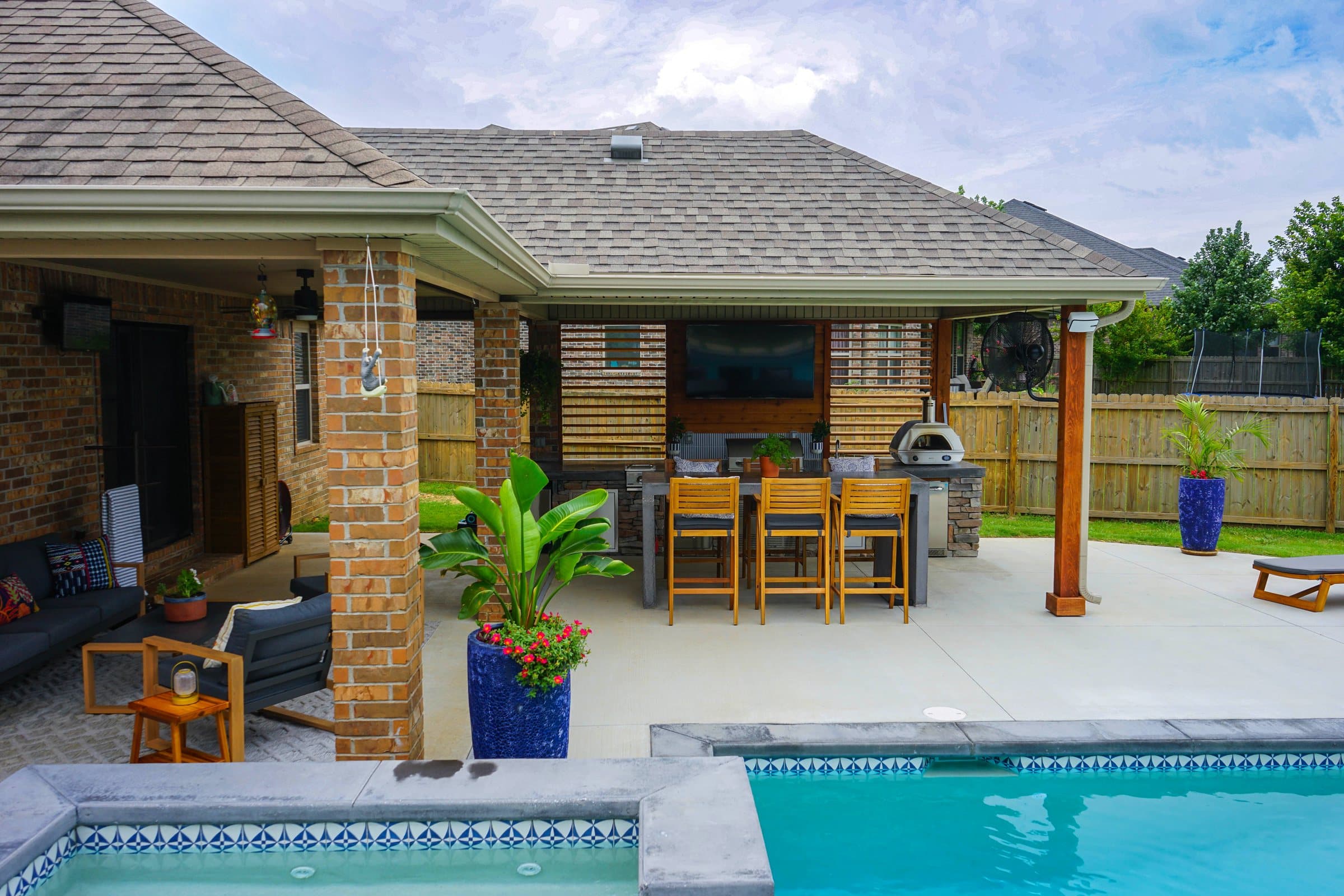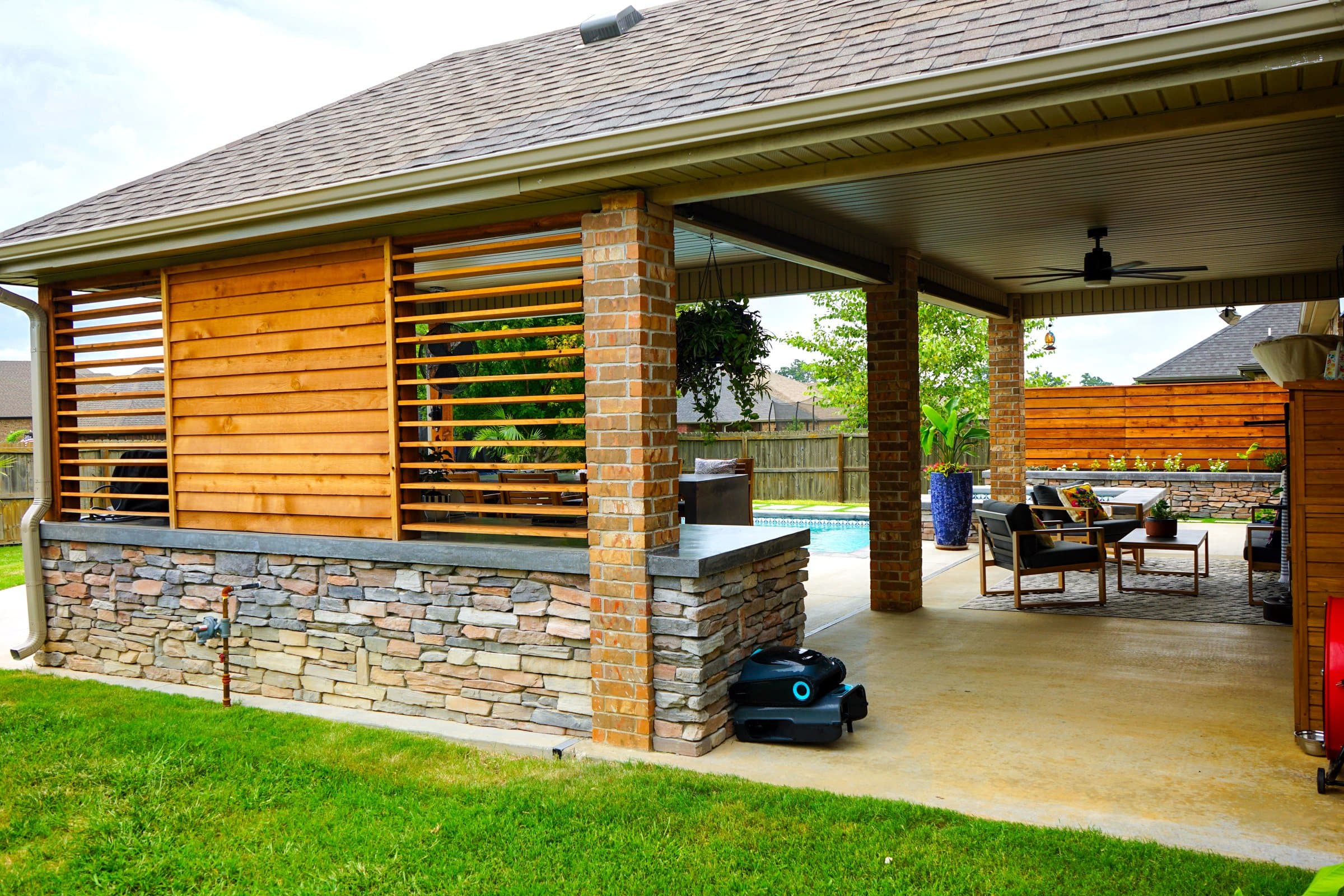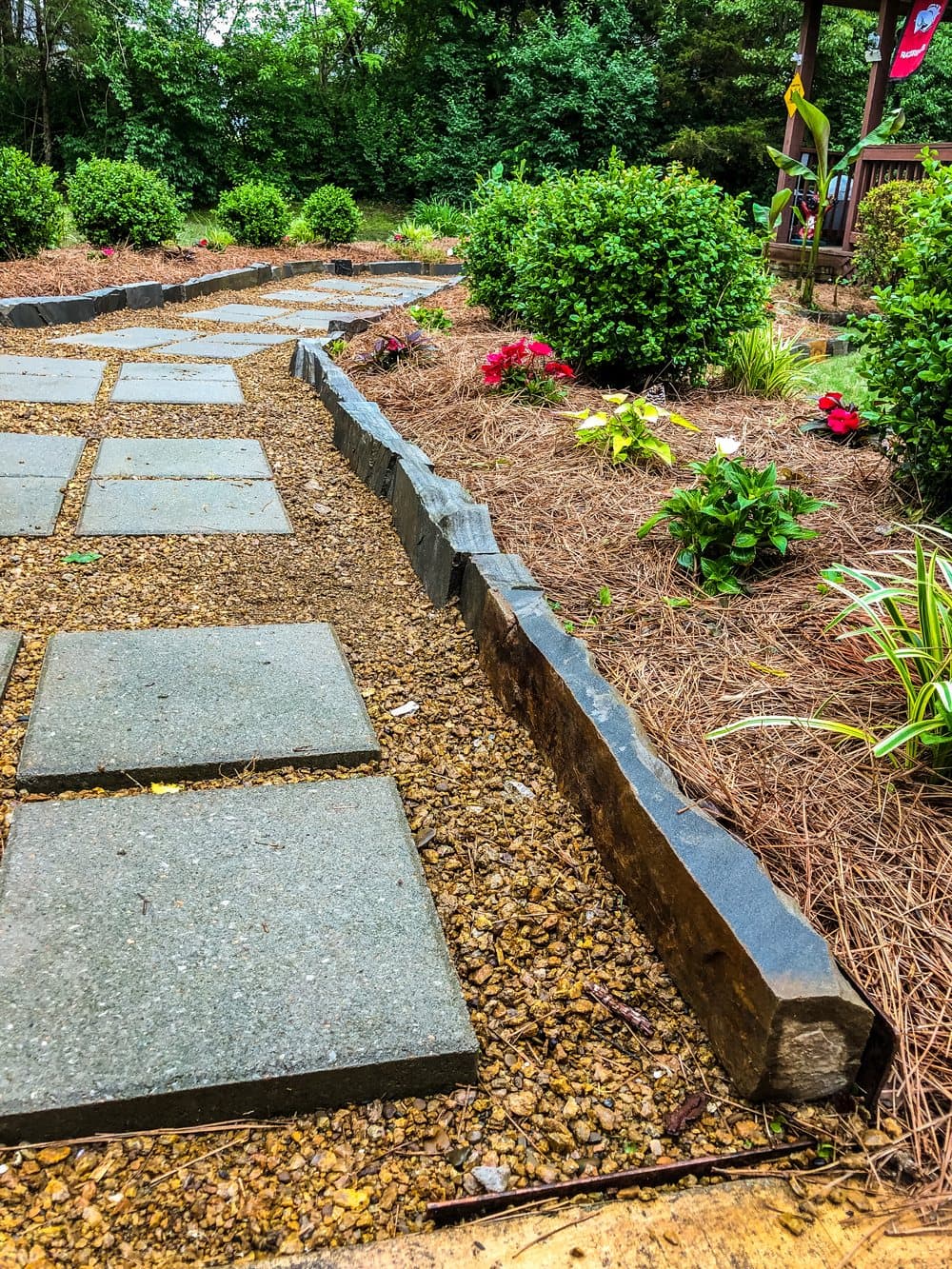
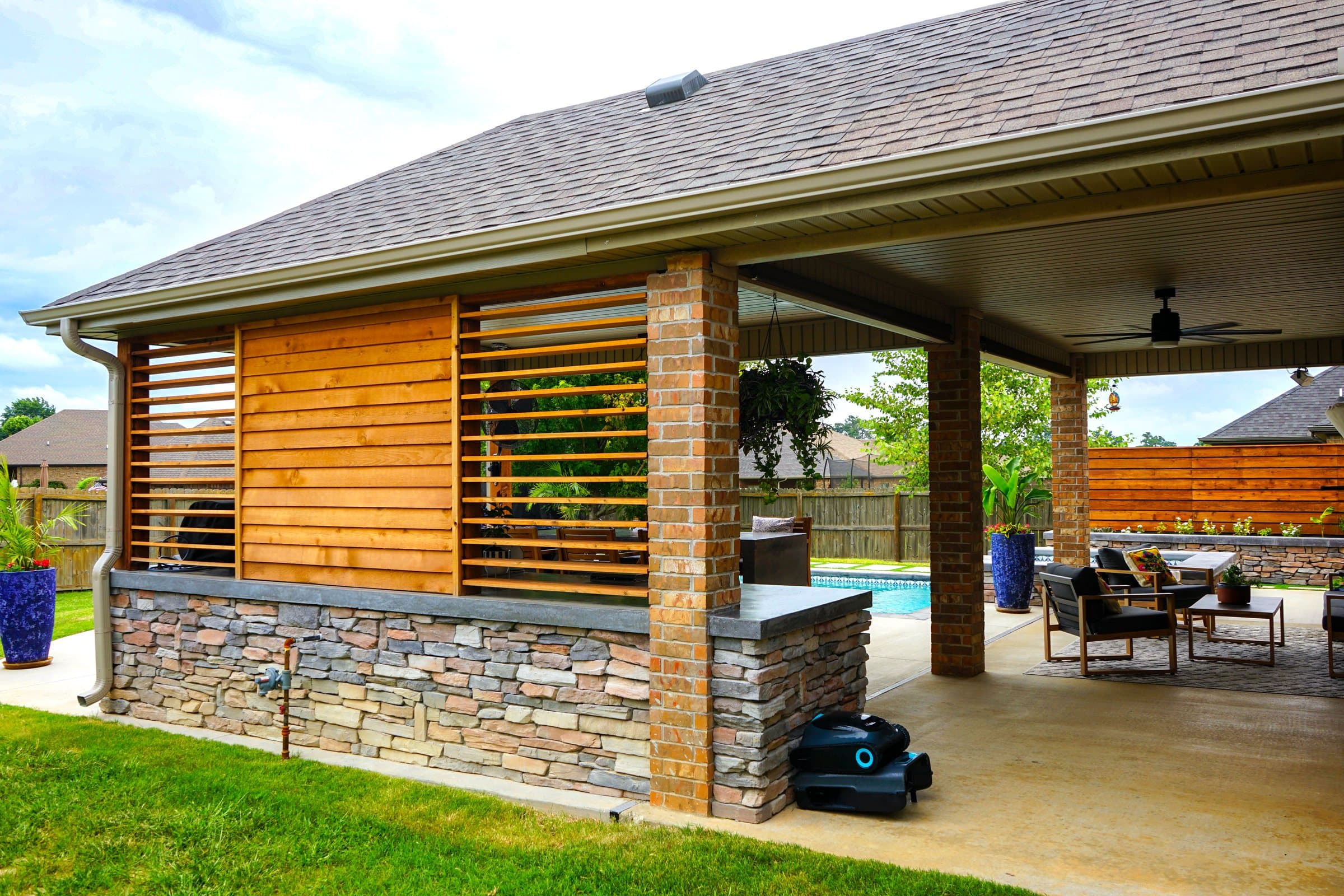
On a new subdivision lot, privacy comes from screening close to where you sit, not from the boundary. A fence is capped at six feet in Bentonville, and a neighbour's upstairs window looks straight over it, while a cedar screen, a pergola with a solid side or a planted bed beside the patio blocks far more of that view for its size. Check drainage easements, the HOA and, in Bella Vista, the ACC before you design, because they decide what can go where.
01Why does a boundary fence not give you privacy?
Because the view you want to block usually comes from above the fence, not through it.
New subdivisions across Bentonville, Rogers, Centerton and the rest of Northwest Arkansas tend to put two storey houses on lots where the back gardens face each other across a shared line. A six foot fence stops the view from a neighbour's patio. It does very little against their kitchen window, their deck or their upstairs bedroom, which look down over it into your garden. That is why people build a fence, sit out on the first evening, and still feel watched.
The fix is geometry. A screen blocks a view in proportion to how close it is to the person it is hiding. A six foot screen three feet from your chair hides you from almost any angle next door. The same six feet at the boundary, forty feet away, hides very little from a window twelve feet up.
02What do the fence rules allow?
In Bentonville, six feet maximum, with rules about easements and front yards.
| Bentonville fence rule | What it says |
|---|---|
| Maximum height | Six feet above grade |
| Front yard | No more than 36 in high |
| Street or public right-of-way | At least 5 ft back |
| Utility easement | Allowed, with a gate the width of the easement at each end |
| Platted drainage easement | Not allowed |
| Fence enclosing a pool or spa | At least 48 in high, no more than 2 in gap at the bottom |
| Permit | Required, with a plot plan showing property lines, easements and structures |
That is from the City of Bentonville's Fence Permit Supplement, read in September 2026. Other cities set their own limits; Rogers, for example, requires a permit for fences over seven feet. In Bella Vista the POA's Architectural Control Committee reviews fences in addition to the city, and most newer subdivisions elsewhere have covenants with their own rules on fence height, material and colour. Read yours before you design, not after.
03Why do drainage easements matter so much on new lots?
Because the back of a new lot is often where the subdivision's water runs, and you cannot build across it.
Subdivision plats in this region commonly carry drainage easements along rear or side lot lines, sometimes with a shallow swale that carries water from several lots. Bentonville does not allow fences in a platted drainage easement at all, and anything solid there, a wall, a raised bed, a structure, risks blocking water that belongs to more than one property. That pushes privacy screening forward, toward the house, which is exactly where it works best anyway.
Get the plat before you design. It shows the easements, the setbacks and the utility lines, and it saves you designing a screen in the one place you are not allowed to put it.
04What actually screens a patio?
Something vertical, close to the seating, on the side the view comes from.
| Option | How it helps | Time to work | Watch for |
|---|---|---|---|
| Cedar slat screen beside the seating | Blocks views at close range; lets air through | Immediate | Structure needs proper footings; HOA or ACC approval |
| Pergola with a solid or slatted side | Screens the side and the view from above | Immediate | Permit and design rules for structures |
| Covered patio or pavilion | Blocks the view from upstairs windows completely | Immediate | Permit; darkens rooms behind if attached |
| Raised planter wall with shrubs | Adds height near seating with soft edges | A few seasons for the planting | Drainage behind the wall |
| Evergreen hedge | Soft, living screen along a line | Several years | Disease in some traditional choices; space it needs |
| Boundary fence | Blocks ground level views and defines the lot | Immediate | Height cap; easements; does little against upstairs views |
Most good schemes combine two of these: a fence for the boundary and a screen or structure at the seating for the view that matters.
05How do you work out where the screen goes?
Sit where you will sit, look for the windows that bother you, and put the screen on that line.
Take a chair out to the spot where the patio will be, sit down, and note every window and deck you can see. Then have someone stand at the point where a screen might go, holding a pole or a long board upright. Move them until the board covers the window from your seated eye level. That is where the screen goes and roughly how tall it needs to be. It often turns out to be a single panel of eight or ten feet, not a wall around the garden.
Do it for standing views too, from the grill and the back door, because a cook stands taller than a diner sits.
06What about the view from above?
Only a roof or a canopy blocks a view from directly above.
Where a neighbour's upstairs window looks down into your garden at a steep angle, no vertical screen of legal height will hide a seat in the open. A pergola with tight slats, a shade sail, a covered patio or the canopy of a tree does. That is one of the strongest arguments for a covered area on new-build lots: it gives shade and rain cover, and it also takes you out of view.
If you build a pergola for this reason, run the slats to block the angle of the window, and space them tighter than you would for shade alone.
07Which plants make a good screen here?
A mix of evergreens, not a single species, and not the two old standbys.
The University of Arkansas Cooperative Extension Service notes that redtip photinia and Leyland cypress, long the default hedge and screen plants, are both in decline in Arkansas because of disease: Entomosporium leaf spot in photinia and canker diseases in Leyland cypress. A screen of one species can fail all at once when a disease arrives. A mixed planting of evergreens with different habits fails gradually, if at all, and looks less like a wall.
Planting is also slow. A screen that needs to work this summer should be a structure, with planting in front of it that will soften it and eventually take over. The Extension Service's county offices will advise on species for your site.
08Can a tree give privacy?
Yes, eventually, if it is planted in the right place.
A tree between your patio and a neighbour's upstairs window is the most natural screen there is. The Extension Service advises siting trees no closer than 15 feet from the foundation of the house. On a small new-build lot, that often puts the tree right where the patio or the drainage swale wants to be, so the tree, the patio and the water route need planning together. On the Springfield Plateau, planting holes can hit chert and rock, which is worth knowing before a large tree is ordered.
09Does sound privacy matter as much as sight?
For many people, yes, and it is harder to fix.
In a subdivision, conversation carries. A solid masonry wall or a dense planted bank reduces noise more than an open slat screen, which is designed to let air through. A water feature near the seating gives a steady sound that masks voices from next door and makes your own conversation feel more private. It needs power and a circulating pump, so plan it with the patio. Keep the water moving, because standing water breeds mosquitoes.
10How does lighting affect privacy?
A lit patio at night is on show; light it low and it is not.
Bright light on a patio after dark makes you the most visible thing on the street, while the neighbours sit in the dark. Low, warm, downward lighting at the seating, with screens and planting lit gently from the inside, lets you see each other without lighting up the garden for everyone else. Our patio lighting guide covers the details.
11Where should screening not go?
Anywhere it blocks the breeze, the light or the one view you actually like.
The temptation on an overlooked lot is to wall in the whole patio. The result is a hot, still box on a humid evening and a garden that feels smaller than it is. Screen the specific lines of sight that bother you, leave the others open, and keep at least one side of the seating open to the garden and to whatever breeze the lot gets. A slatted screen is usually better than a solid one for the same reason: it breaks the view while air still moves through.
Think about the house as well. A tall screen outside a kitchen window can make the kitchen darker. Set it where it hides the seat, not where it faces the glass.
12How do we design privacy with you?
We start with the plat, the covenants and a chair in the garden, then put the screening where it does the most work.
Projects with us start around seven and a half thousand dollars, and financing is available through Acorn Finance if you would rather spread the cost than cut the scope. Call (479) 379-2226 or send the project form, and tell us what you are trying to do with the space.
FAQCommon questions
How tall can a backyard fence be in Bentonville?
Six feet above grade, according to the City of Bentonville's fence permit supplement, with front yard fences limited to 36 inches. A permit and plot plan are required.
Can I put a fence in a drainage easement?
Not in Bentonville, which does not allow fences in platted drainage easements. Fences in utility easements are allowed with gates at each end.
How do I block a neighbour's second-floor view?
Screen close to the seating rather than at the boundary, or add something overhead such as a pergola with tight slats, a covered patio or a tree canopy.
What are the best privacy plants in Arkansas?
A mixed evergreen planting rather than one species. The UA Extension Service notes redtip photinia and Leyland cypress are in decline from disease. Your county extension office can advise on species.
Do I need HOA approval for a privacy screen?
Often, yes. Most newer subdivisions have covenants, and in Bella Vista the POA's Architectural Control Committee reviews fences and structures in addition to the city.
Is a privacy screen better than a fence?
For hiding a seating area, usually. A screen near the patio blocks far more of the view for its size than a boundary fence forty feet away.
How far from the house should a privacy tree be?
The UA Extension Service advises no closer than 15 feet from the house foundation.
REFSources
- City of Bentonville: Fence Permit Supplementbentonville.ar.gov
- Bella Vista POA: The City, POA and ACCbellavistapoa.com
- University of Arkansas Cooperative Extension Service: Hedge or Screen Plants for Arkansasuaex.uada.edu
- University of Arkansas Cooperative Extension Service: Planting Trees in Arkansasuaex.uada.edu
- City of Rogers: When is a permit required?rogersar.gov
NEXTGet it looked at properly
Everything above is general guidance. What your ground actually needs is a site visit, and ours costs nothing. Francisco Gallardo walks it, reads the grade and the drainage, and tells you what is possible.