A built structure gives shade the week it is finished; a tree gives better, cooler shade but takes years to get there and brings roots, leaves and sap. In Northwest Arkansas the best answer is often both: a pergola or cover over the seating now, and a deciduous tree planted on the west side, where the University of Arkansas Extension Service says shade trees do the most, for the long run.
01What is the real trade-off?
Time and control against quality and cost.
| Shade tree | Pergola | Solid cover or pavilion | |
|---|---|---|---|
| Shade from day one | No, grows over years | Yes, partial | Yes, full |
| Winter sun | Yes, if deciduous | Mostly | No |
| Rain cover | No | No | Yes |
| Feel of the shade | Cool, moving, dappled | Dappled, striped | Even, darker |
| Maintenance | Leaves, seed, sap, pruning | Occasional finish on timber | Gutters, roof |
| Where it can go | Needs root and canopy room | Anywhere with footings | Anywhere with footings and permits |
| Risk | Storm and ice damage, disease | Low | Low |
Neither is better in the abstract. The question is how soon you need shade, and how much you mind sweeping.
02Why does tree shade feel cooler?
Because a canopy intercepts the sun high above you and lets air move underneath.
A mature canopy intercepts sun high above you, and the air under it moves freely. A roof close over your head can trap warm air unless it is high and open or has a fan. That is why sitting under a big oak on a humid July evening feels different from sitting under a low roof. The University of Arkansas Extension Service says well-placed shade trees can cut summer utility bills by 20 percent or more, which is a measure of how much sun they intercept.
03Where should a shade tree go?
On the west side, clear of the foundation and the patio.
The Extension Service advises planting deciduous trees on the west side of the house for energy efficiency, and siting trees no closer than 15 feet from the foundation. The west is also where the patio needs shade most: at about 36 degrees north, the summer sun in the late afternoon and evening comes in low from the west, which is when most people are outside. Our pergola shade guide works out the angles.
Because that evening sun is low, a tree to the west of the patio shades it from some distance, and the patio does not need to sit under the canopy. That is good for the patio, because roots, leaf litter and dripping sap are all worst directly under the tree.
04Will tree roots damage the patio?
They can, which is why the tree and the patio need space from each other.
Roots grow where there is water and air, and the base under a patio can offer both. As roots thicken they can lift pavers or crack a slab, and cutting major roots to build a patio can harm the tree. The simplest defence is distance: plant the tree far enough away that its main roots and the patio base are not competing for the same ground. Where an existing tree has to live beside new paving, the design has to protect the root zone during construction, because heavy machinery over the roots does lasting damage.
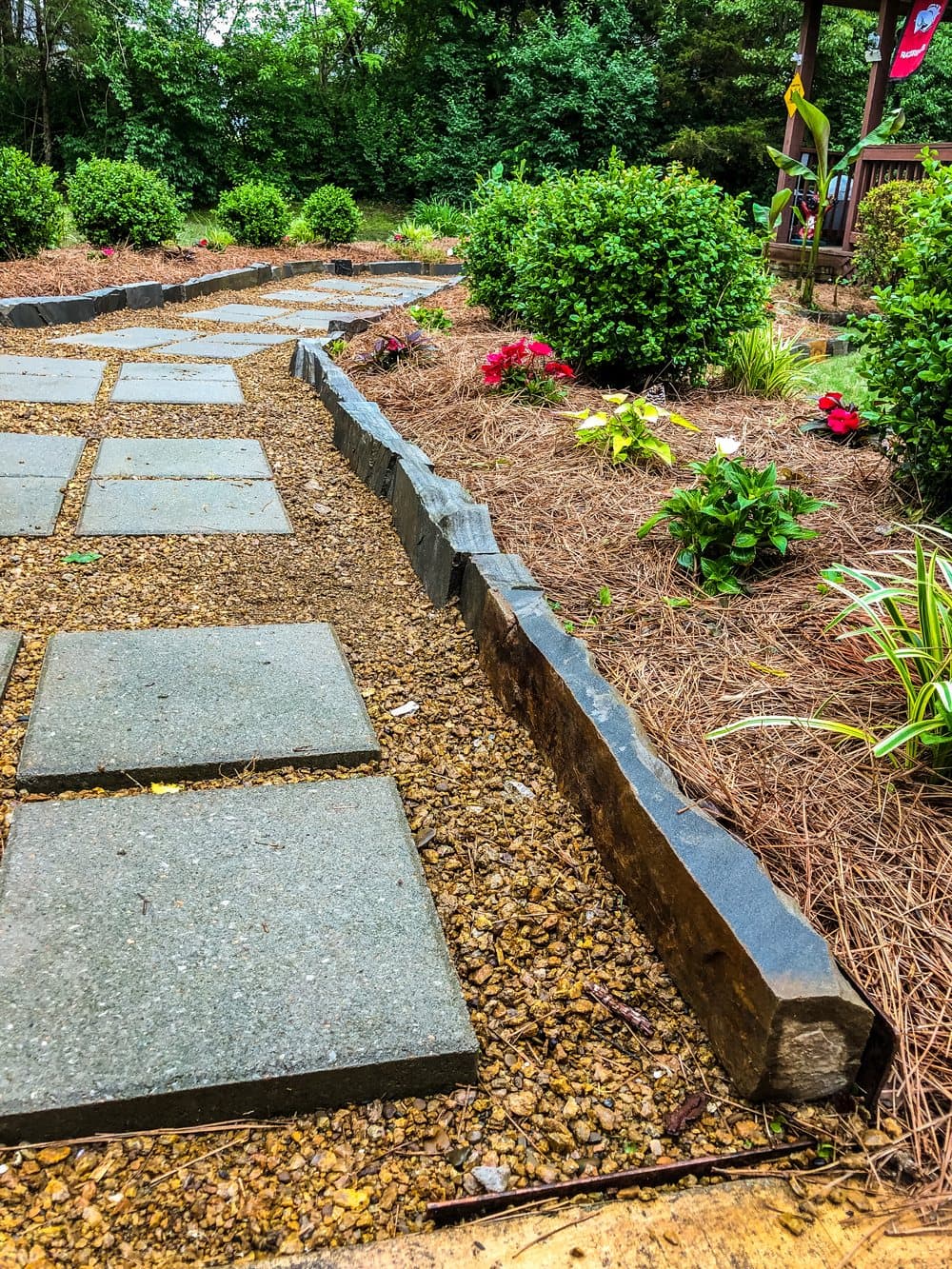
Pavers cope with root movement better than concrete, since individual units can be lifted, the root dealt with, and the units relaid.
05What about leaves, sap and pools?
Choose the species and the distance with the surface under it in mind.
Every deciduous tree drops leaves once a year and something the rest of the time: flowers, seed, fruit, twigs or sap. On a patio that means sweeping. Near a pool it means a skimmer that works harder and a cover that collects debris. Stone and pavers can stain from fruit and tannins if leaves sit wet on them. None of that is a reason not to plant a tree. It is a reason to choose the species carefully and keep the canopy to the side of the paving rather than over it.
06How long does a tree take to give real shade?
Years, and more on thin, rocky ground.
A newly planted tree needs time to establish roots before it puts on much growth, and growth rates vary widely by species and site. On the Springfield Plateau, around Bentonville and Rogers, soil over the Boone Formation's chert and limestone can be thin and rocky, which slows establishment. The Extension Service also advises checking drainage before planting, because a tree in a hole that holds water in red clay will struggle. Plant for the long run and expect the patio to need other shade in the meantime.
Planting a larger tree shortens the wait, but larger trees also need more care to establish.
07When is a built structure the better answer?
When you need shade this year, rain cover, or shade in a spot a tree cannot have.
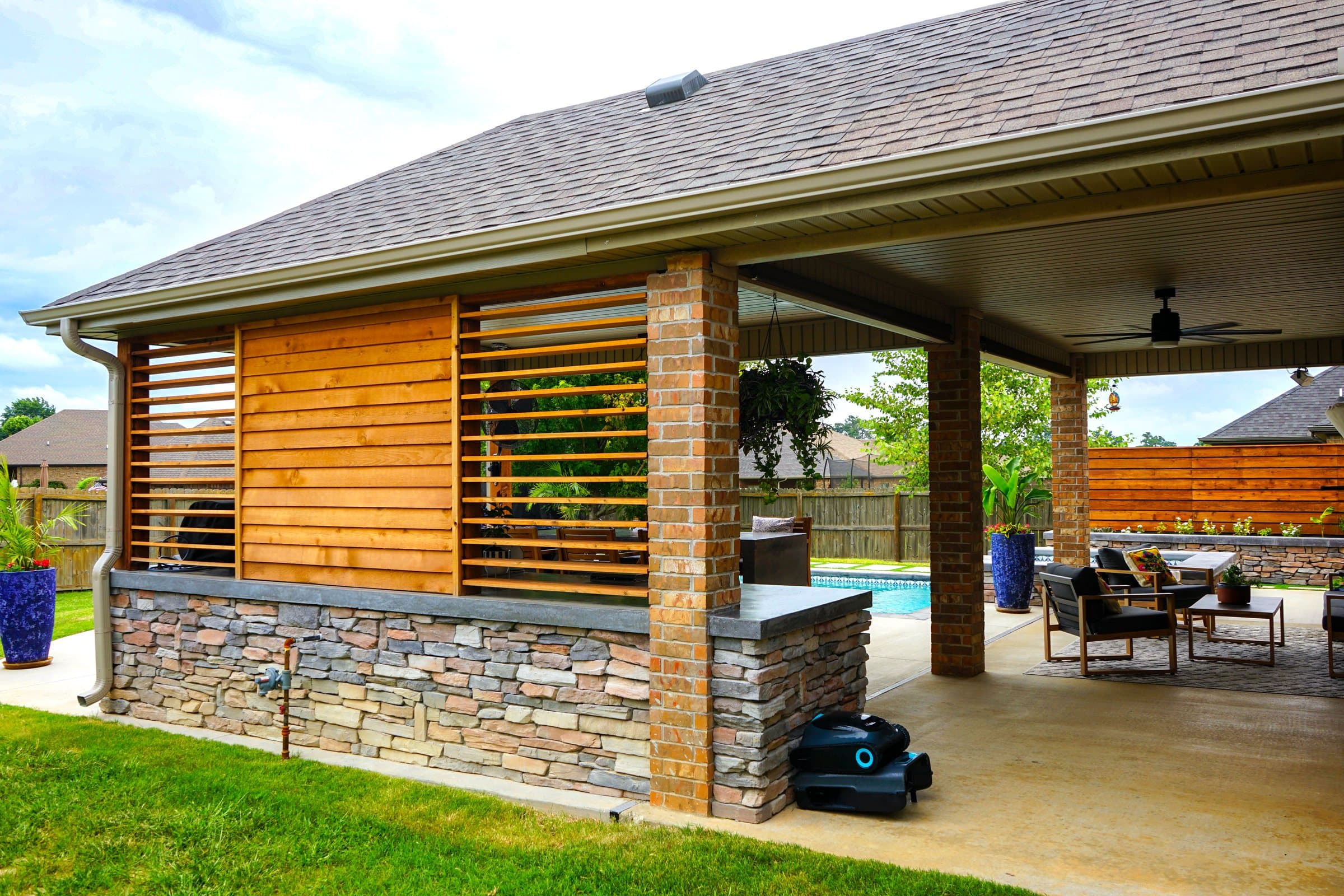
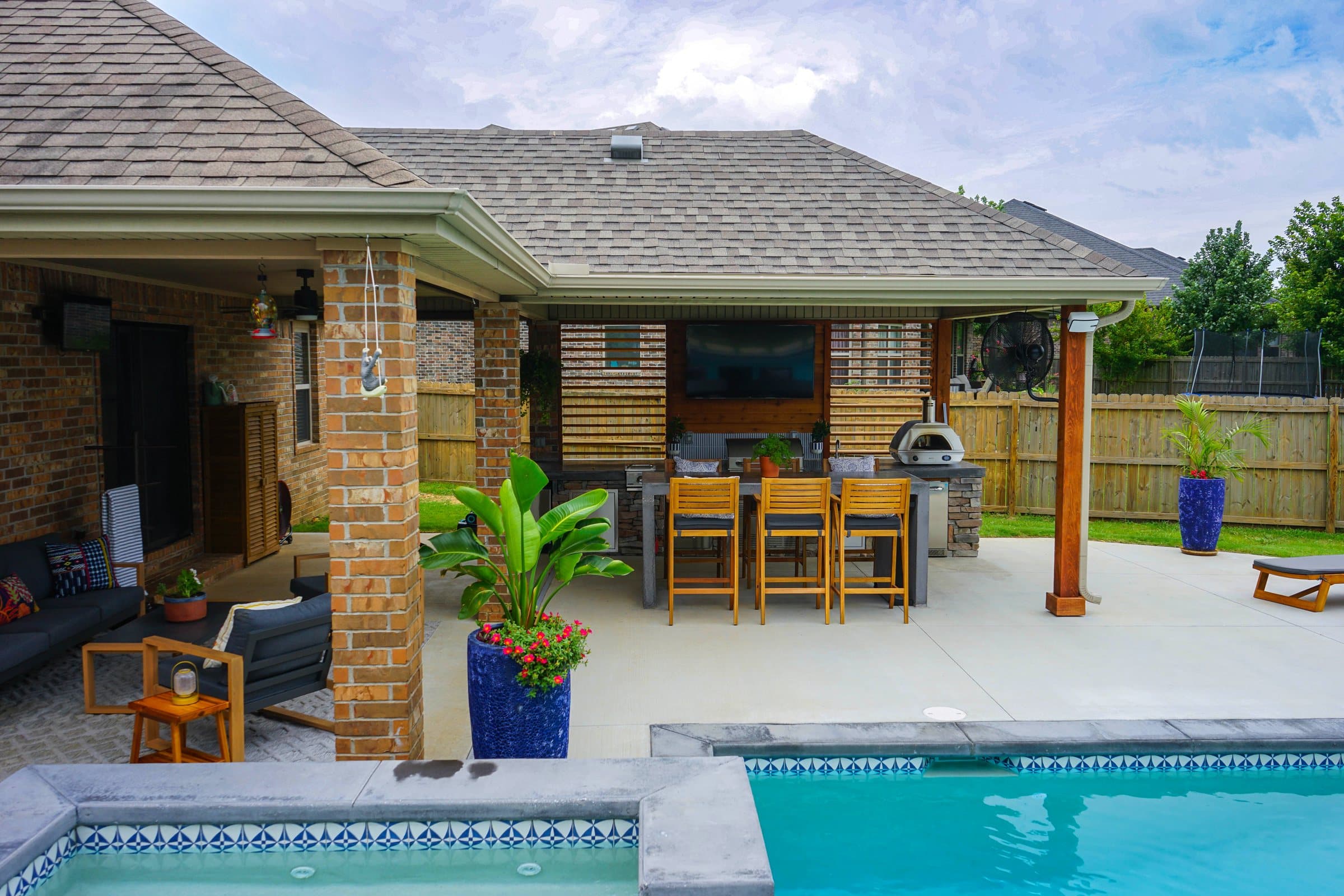
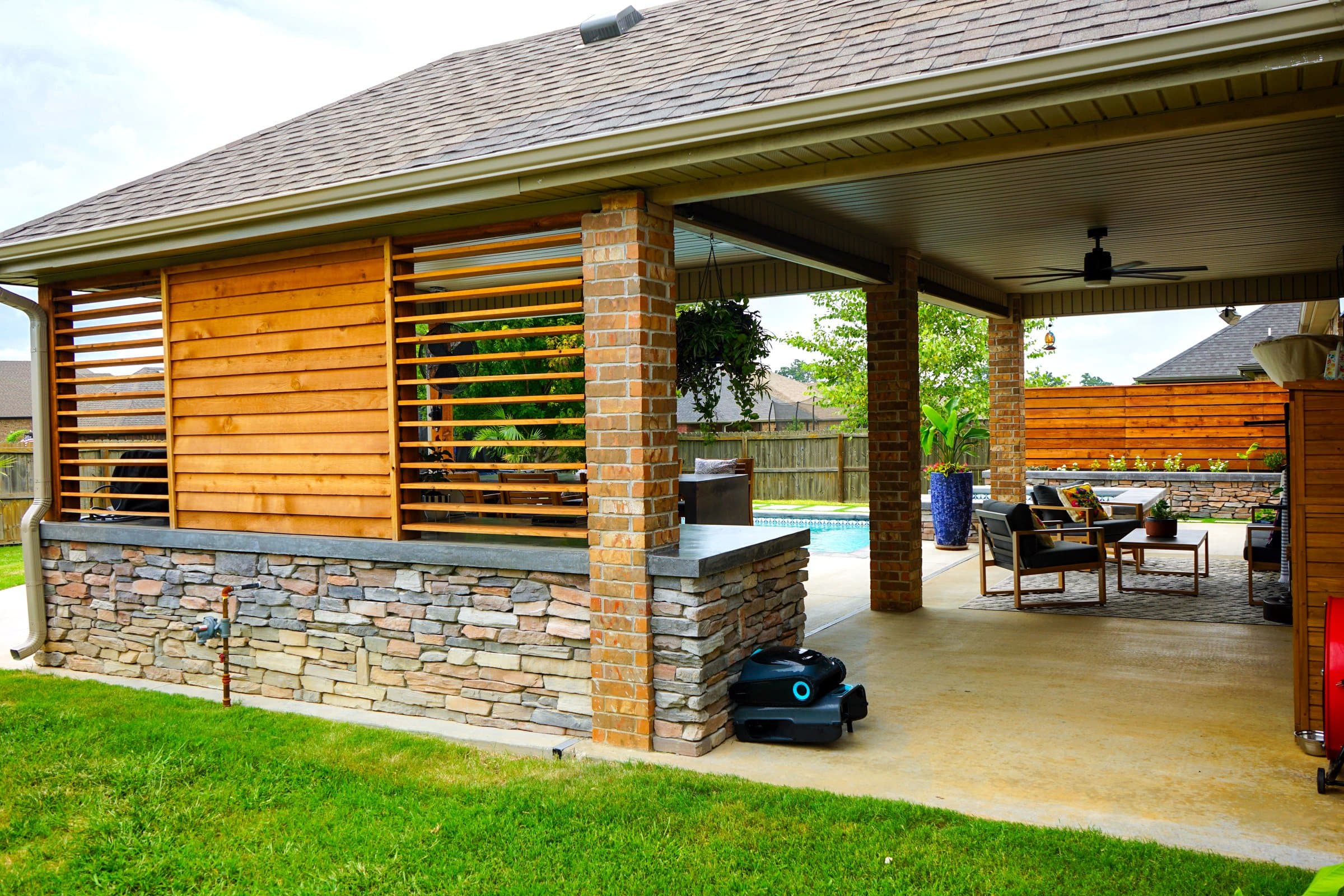
A pergola or cover gives shade the week it is finished. It can sit right next to the house, over an outdoor kitchen, beside a pool, or on a lot too small for a canopy tree to be placed well. A solid cover also keeps rain off, which a tree never does, and it carries fans and lights. On new-build lots with no mature trees, a structure is usually the only way to get shade in the first few summers.
The trade-off is winter. A solid roof blocks winter sun as firmly as summer sun, while a deciduous tree drops its leaves and lets it through. A pergola sits in between.
08Can you use both together?
Yes, and it is usually the best plan.
Build the structure where you need shade and shelter now, typically over the dining and cooking area near the house. Plant a deciduous tree to the west of the garden, where in time it will shade the lawn and the lounge area and take the edge off the evening sun on the structure itself. The structure does the work early, and the tree takes over part of it later.
Plan the tree's mature spread before you plant it, so it does not end up overhanging the structure's roof or dropping leaves into its gutters.
09What about existing mature trees?
Protect them and design around them; they are worth more than anything you can build.
An established oak or hickory on the lot gives shade no structure can match, and it cannot be replaced in a lifetime. If there is a mature tree, the patio should sit where it benefits from the shade without cutting through the root zone, and the construction route should keep machines off it. Sometimes that means moving the patio a few feet, or using a raised deck-like surface or open-jointed paving near the tree rather than a full excavated base.
10What about storms and ice?
Trees near living areas need to be sound, and species matter.
Northwest Arkansas gets thunderstorms and, in some winters, ice. A heavy limb over a patio or a pergola is a risk that a structure alone does not carry. Have large trees near seating checked by an arborist, prune dead wood, and when planting new, choose species with a reputation for strong wood. The Extension Service's county offices can advise on species for your area.
11How far does a tree's shade reach in the evening?
A long way, because the evening sun is low.
By NOAA's solar position equations, the sun over Bentonville at 6pm daylight time on the June solstice is about 29 degrees above the horizon, a little north of due west. A shadow reaches out by the height of the object divided by the tangent of the sun's elevation, so a 30 foot tree at that hour casts shade about 54 feet long. At 5pm, with the sun about 41 degrees up, the same tree shades about 35 feet.
That is why a tree well to the west of the patio can shade the evening seating without overhanging it. It also means a young tree does a surprising amount of evening work long before its canopy is wide, as long as it is in the right line.
12Does shade change what the patio should be made of?
Yes. Full sun and deep shade are hard on different materials.
Dark paving in full sun gets hot underfoot in a Northwest Arkansas summer, which matters around a pool and anywhere people walk barefoot. Lighter, textured surfaces stay more comfortable. In deep, permanent shade the problem flips: paving that never dries can grow algae and moss and become slippery, so drainage and a surface that sheds water matter more there. Under a tree, open joints and a surface that can be lifted suit the roots better than a rigid slab.
13What about shade around a pool?
Shade the seating beside the pool, not the water.
A pool wants sun on the water to stay warm and a canopy clear of it to stay clean, while the people beside it want shade. That usually points to a structure or an umbrella over part of the deck, and trees set back to the west where their evening shade reaches the loungers but their leaves fall on lawn rather than into the water. The same shadow geometry above tells you how far back they can be.
14How do we plan shade with you?
We look at where the sun comes from at the times you sit outside, what trees you have, and what shade you need this year.
Projects with us start around seven and a half thousand dollars, and financing is available through Acorn Finance if you would rather spread the cost than cut the scope. Call (479) 379-2226 or send the project form, and tell us what you are trying to do with the space.
FAQCommon questions
Is a shade tree or a pergola better for a patio?
A pergola gives shade immediately; a tree gives cooler shade but takes years. Many Northwest Arkansas gardens use a structure over the seating now and a deciduous tree to the west for later.
Where should I plant a shade tree in Arkansas?
The UA Extension Service advises deciduous trees on the west side of the house and no closer than 15 feet from the foundation.
Will a tree damage my patio?
Roots can lift pavers or crack a slab if the tree is too close. Keep distance between the tree and the patio base; pavers can be lifted and relaid if roots do intrude.
How much can shade trees save on cooling?
The UA Extension Service says properly located shade trees can cut summer utility bills by 20 percent or more.
Should a tree overhang a pool?
Better not. Leaves, seed and fruit end up in the water and on the deck. Keep the canopy to the side.
Does a covered patio block winter sun?
Yes. A solid roof blocks sun all year, while a deciduous tree lets winter sun through after its leaves drop.
How do I protect a mature tree during a patio build?
Keep machinery and excavation out of the root zone, route construction traffic away from it, and adjust the patio layout or base design near the tree.
REFSources
- University of Arkansas Cooperative Extension Service: Planting Trees in Arkansasuaex.uada.edu
- NOAA Global Monitoring Laboratory: Solar Calculatorgml.noaa.gov
- NOAA Global Monitoring Division: General Solar Position Calculationsgml.noaa.gov
- Arkansas Geological Survey: Karst in the Arkansas Ozarks, Part 2arkansasgeological.wordpress.com
NEXTGet it looked at properly
Everything above is general guidance. What your ground actually needs is a site visit, and ours costs nothing. Francisco Gallardo walks it, reads the grade and the drainage, and tells you what is possible.