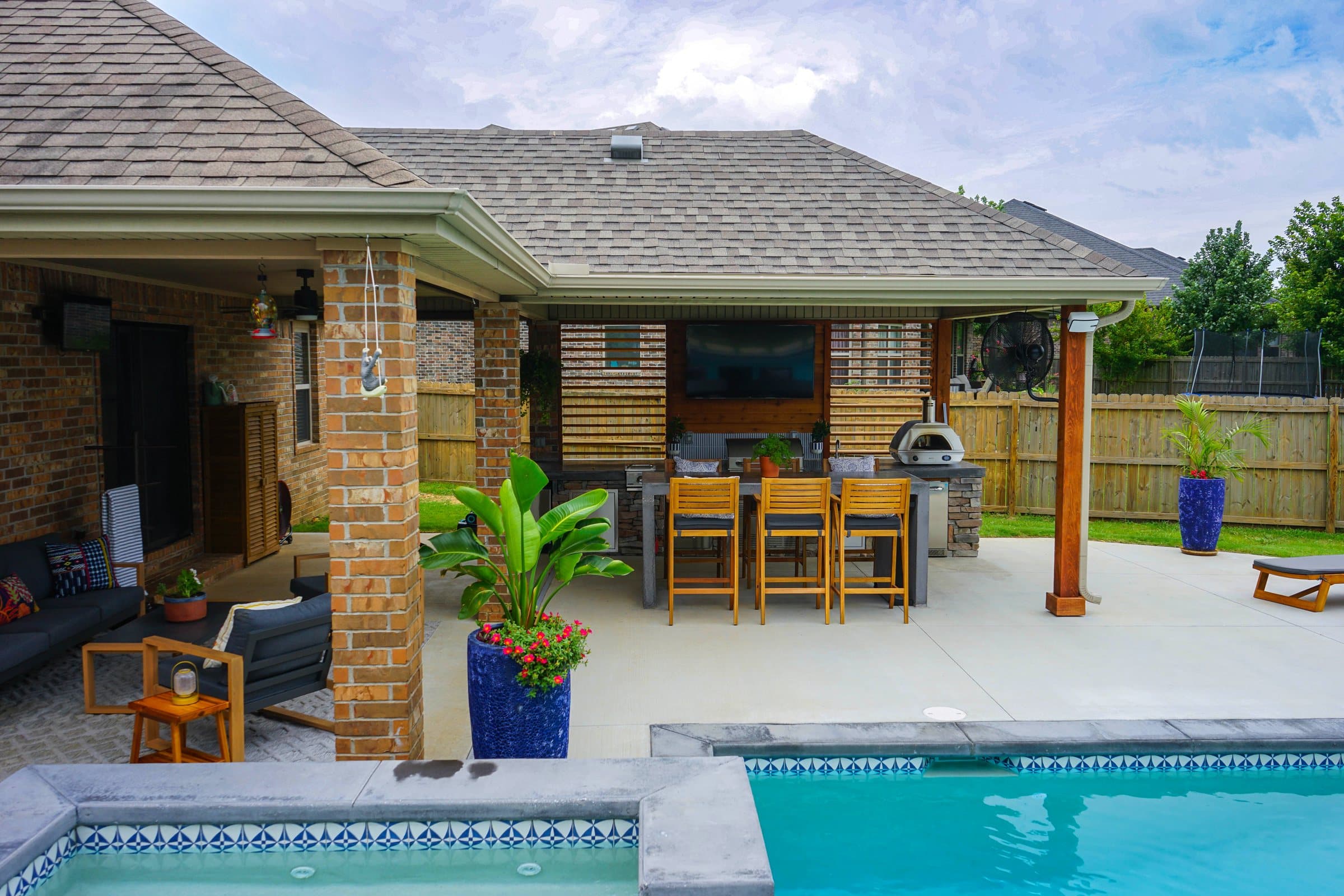
In Northwest Arkansas the summer sun is nearly overhead at midday, around 77 degrees above the horizon at the June solstice, but by 6pm daylight time it is only about 29 degrees up and coming from slightly north of due west. An open pergola roof does little against that evening sun, so the shade you actually want at dinner comes from the west side of the structure, not the top. Put the pergola where the house or trees already block the west, or plan a west screen, and run the slats north to south.
01Where is the sun in a Northwest Arkansas summer?
High and south at midday, then low and west-northwest by dinner time.
These figures were calculated for Bentonville, at about 36.4 degrees north, using NOAA's published solar position equations, which are the same equations behind the NOAA Solar Calculator. You can check any date and time for your own address on the calculator. Times are Central Daylight Time. Elevation is degrees above the horizon; azimuth is compass bearing, where 180 is due south and 270 is due west.
| Date and time (CDT) | Sun elevation | Sun azimuth | Where that is |
|---|---|---|---|
| 21 June, 1pm (near solar noon) | 77 degrees | 162 | Almost overhead, south |
| 21 June, 4pm | 53 degrees | 261 | High, a little south of west |
| 21 June, 5pm | 41 degrees | 271 | Due west |
| 21 June, 6pm | 29 degrees | 279 | Low, north of west |
| 21 June, 7pm | 17 degrees | 287 | Very low, west-northwest |
| 15 August, 6pm | 25 degrees | 270 | Low, due west |
| 22 September, 6pm | 14 degrees | 260 | Very low, south of west |
Solar noon here falls at about 1:20pm in summer, not noon, because of daylight saving and Northwest Arkansas sitting west of the middle of the Central time zone. That pushes the hot, low evening sun later into the hours you actually spend outside.
02Why does an open pergola feel hot at dinner?
Because at 6pm the sun is coming in under the roof, not through it.
Shade from a roof edge lands away from the structure by the height of the roof divided by the tangent of the sun's elevation. For a roof nine feet up, that is simple geometry on the elevations above.
| Sun elevation | When, in June | How far the shade shifts from a 9 ft roof edge |
|---|---|---|
| 77 degrees | About 1pm | About 2 ft |
| 53 degrees | About 4pm | About 7 ft |
| 41 degrees | About 5pm | About 10 ft |
| 29 degrees | About 6pm | About 16 ft |
| 17 degrees | About 7pm | About 29 ft |
By 6pm the shadow of the roof is sixteen feet east of where the roof is. If the table sits under the pergola, it is in full sun. That is the single most common complaint about pergolas in this region, and it is a placement problem, not a product problem.
03So where should the pergola go?
On the east side of something that blocks the west.
The best spot on most lots is against the east face of the house, a garage, a tall hedge or a stand of mature oaks, because those block the low western sun that the pergola cannot. A pergola on the east side of the back of a west-facing house is often shaded from late afternoon onward by the house itself. A pergola out in the middle of the lawn, open to the west, needs its own west screen or it will be unusable in July evenings.
The morning is the mirror image. The June sun rises north of east, so a pergola for breakfast wants its protection on the east and northeast. Most people in Northwest Arkansas use outdoor space in the evening, so the west side is the one to solve first.
04Which way should the slats run?
North to south, so they cut across the western sun.
Pergola slats block sun best when the sun is shining across them, not along them. Slats running north to south present their full depth to a sun in the west. Geometry tells you how much: a slat of depth d with a clear gap s blocks direct sun completely whenever the sun is lower than the angle whose tangent is d divided by s. A 2x6 on edge is five and a half inches deep; with a three inch gap between slats, that angle is about 61 degrees.
Put that against the table above. From about 3pm on a June afternoon the sun is in the west and below 61 degrees, so north to south slats at that spacing throw solid shade under the roof, until the sun gets so low that it comes in under the roof altogether. Slats running east to west do the opposite: the western sun runs straight down the gaps. At midday, with the sun high and south, neither direction does much with an open spacing. Midday shade needs tighter slats, a louvered roof or a solid one.
05What stops the low evening sun?
Something vertical on the west side.
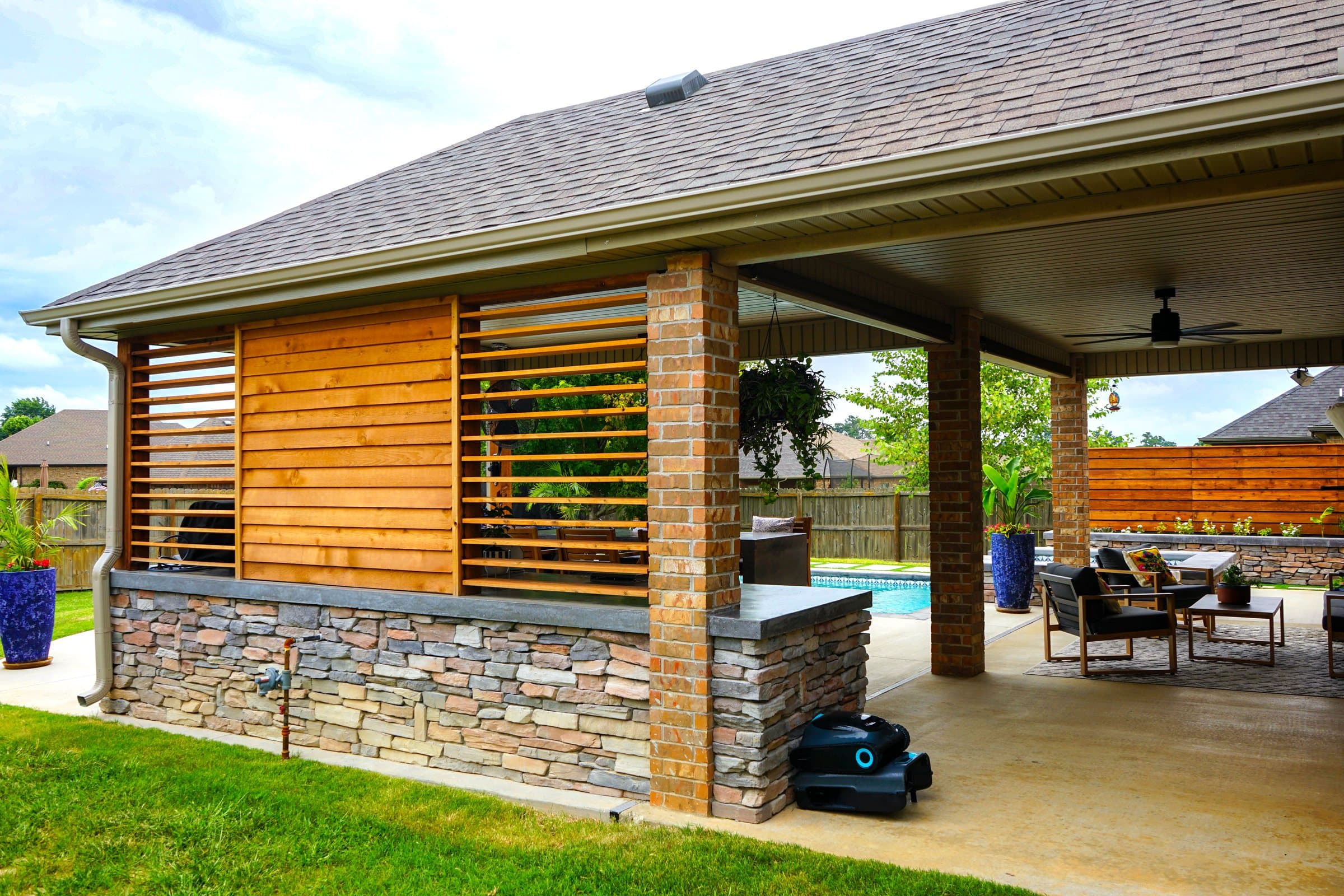
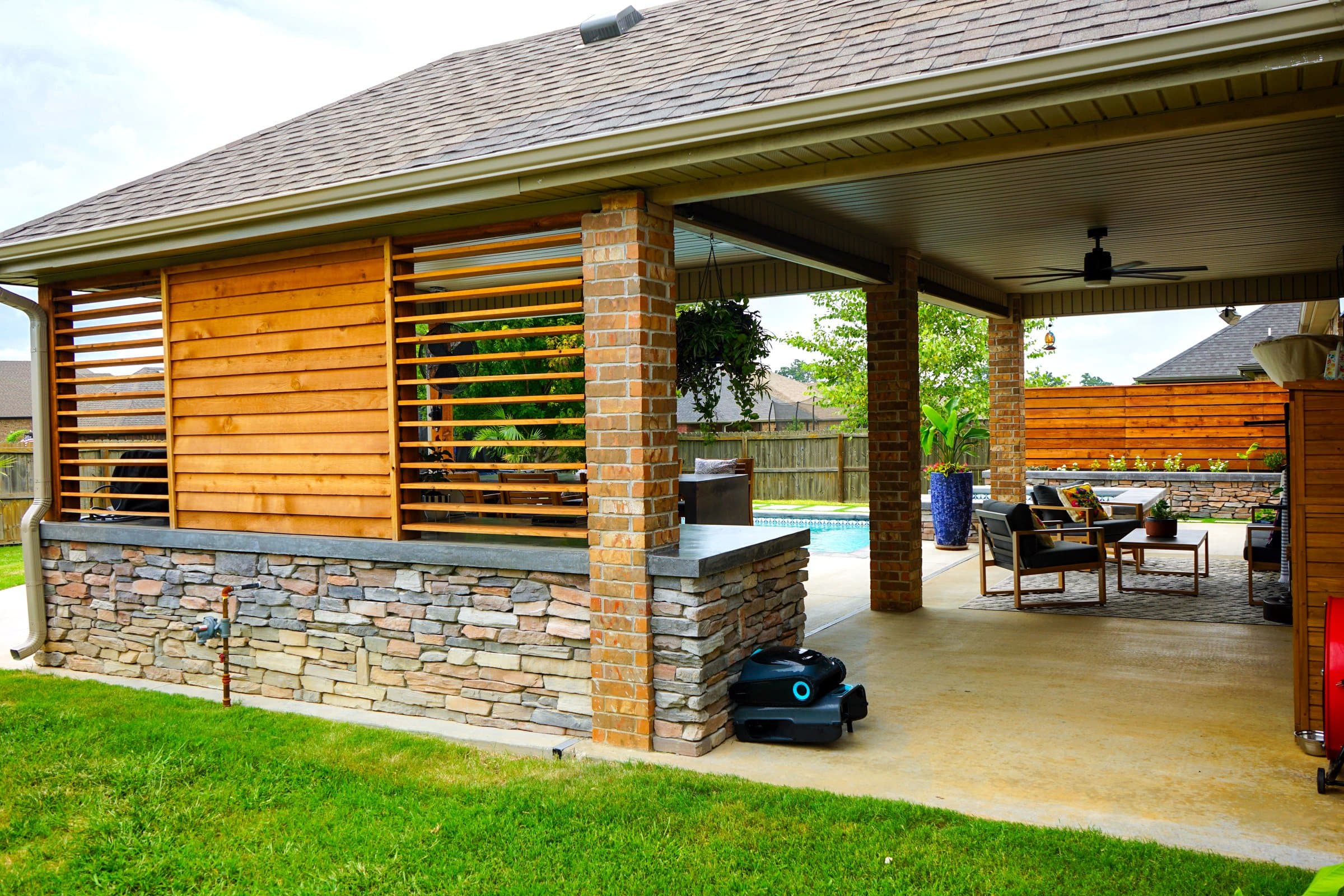
Below about 30 degrees, no practical roof overhang helps; the shade is fifteen or more feet away. What works is a vertical element between the sun and the seating: a slatted cedar screen, a wall, a row of evergreens, or retractable shades on the west bay. On the Swindle build in Cave Springs, cedar slat screens do exactly this job on the structures, and they also give privacy.
A screen does not need to be solid. Horizontal slats with gaps let breeze through, which matters in a humid Arkansas July when still air under a roof feels hotter than moving air in partial sun. The screen needs to be about as tall as the seated eye line and positioned so that at 6pm to 7pm, the sun line from the west passes through it before it reaches the chairs.
06Should it be a pergola at all, or a solid roof?
If you want reliable midday shade and rain cover, you want a roof, not a pergola.
A pergola gives dappled shade, air movement and a sense of enclosure, and it shines in spring and autumn when some sun is welcome. It does not keep rain off, and in June at 1pm, with the sun at 77 degrees, an open slat spacing lets most of it through. A solid roof blocks the midday sun completely and gives you a dry space, at the cost of a darker room behind it and, if attached, more structure and usually a permit.
Louvered roofs sit between the two and can be closed for rain. Any of them still needs the west side solved for evening use. The choice between them is covered in detail in our pergola versus pavilion versus covered patio guide.
07What does the sun do in spring and autumn?
It is lower all day, which makes a pergola more useful, not less.
At the September equinox the sun peaks at about 54 degrees here, and at 6pm it is only 14 degrees up, south of west. In the shoulder seasons, when Northwest Arkansas evenings are at their best, a pergola with north to south slats blocks much more of the afternoon sun than it does in June, because the sun spends the whole afternoon below that 61 degree line. In winter the sun peaks at only about 30 degrees, so an open pergola lets welcome low sun in under the slats at a shallow angle.
That seasonal behaviour is the real argument for a pergola over a solid roof close to the house: a solid roof darkens the rooms behind it all year, while a pergola mostly does not.
08How does wood hold up in the humidity?
Detail it to dry out and it lasts; detail it to hold water and it does not.
Humid summers and freeze-thaw winters are hard on timber that stays wet. The practical rules are to keep post bases off the paving on a standoff base, to shape slat and rafter tops so they shed water, and to leave gaps so air moves through. Cedar is a common choice here because it weathers well. Whatever the species, the structure has to be designed for the span and the footing has to suit the ground, which on the Springfield Plateau can mean hitting chert or limestone before the planned depth.
09How do you check a spot before building?
Go out at 6pm in June, or use the NOAA Solar Calculator, and look where the sun actually is.
Stand where the table will be at the time you eat and note what is between you and the sun. The calculator lets you drop a pin on your house and step through the hours for any date, showing the sun's bearing on the map. Five minutes with it tells you whether the house, a tree or nothing at all is doing the shading, and therefore whether you need a screen.
Then think about the view. A west screen that blocks the sun also blocks the sunset. Plenty of people choose to keep the view and accept the sun for twenty minutes; that is a fine decision if it is made on purpose.
10Can a pergola be attached to a brick house?
Not to the brick itself; it needs its own posts at the wall or a connection to the framing behind.
The American Wood Council's deck construction guide, DCA 6, says not to attach ledgers to brick veneer, and the same logic applies to a pergola. The brick on most modern houses is a veneer standing in front of the framing, and it is not designed to carry a structure. A pergola against a brick wall therefore usually stands on a row of posts a few inches off the wall, which also lets you set it exactly where the shade falls rather than where the wall happens to be.
An attached pergola on the east face of the house is often the best shaded spot on the lot for the reasons above. Getting the connection right is what lets you use it.
11How do we design it with you?
We start from where you want to sit and when, then place the structure around the sun, not the other way round.
Projects with us start around seven and a half thousand dollars, and financing is available through Acorn Finance if you would rather spread the cost than cut the scope. Call (479) 379-2226 or send the project form, and tell us what you are trying to do with the space.
FAQCommon questions
How high is the sun in Arkansas in summer?
At about 36 degrees north, the June sun peaks around 77 degrees above the horizon near 1:20pm daylight time, based on NOAA's solar equations. By 6pm it is about 29 degrees up and slightly north of west.
Which direction should pergola slats run?
North to south if you want afternoon and evening shade, because the slats then cut across the western sun. East to west slats let the western sun run straight down the gaps.
Why is my pergola not shading the table in the evening?
Because the evening sun is low and in the west, so the roof's shade lands many feet east of the structure. You need a vertical screen, a wall or planting on the west side.
What is the best side of the house for a pergola in Northwest Arkansas?
For evening use, a spot where the house, a garage or mature trees block the west. For morning use, protection on the east and northeast.
Does a pergola give shade at noon?
Only partial shade with a typical open slat spacing, because the midday summer sun is nearly overhead. For full midday shade, choose tighter slats, a louvered roof or a solid roof.
How close should slats be for good shade?
It depends on slat depth. A slat blocks direct sun completely when the sun is lower than the angle whose tangent is slat depth over gap. A 5.5 inch slat with a 3 inch gap blocks sun below about 61 degrees.
Can I check sun angles for my own address?
Yes. The NOAA Solar Calculator lets you place a pin on your house and see the sun's elevation and bearing for any date and time.
REFSources
- NOAA Global Monitoring Laboratory: Solar Calculatorgml.noaa.gov
- NOAA Global Monitoring Division: General Solar Position Calculationsgml.noaa.gov
- American Wood Council: Prescriptive Residential Wood Deck Construction Guide (DCA 6)resources.finalsite.net
- Arkansas Geological Survey: Karst in the Arkansas Ozarks, Part 2arkansasgeological.wordpress.com
NEXTGet it looked at properly
Everything above is general guidance. What your ground actually needs is a site visit, and ours costs nothing. Francisco Gallardo walks it, reads the grade and the drainage, and tells you what is possible.