
University of Arkansas extension guidance puts about 90 percent of a tree's roots in the top 12 to 18 inches of soil, which is exactly the layer a patio excavation removes. It advises against cutting roots over 1 inch in diameter inside the dripline, fencing trees during construction at 1 foot from the trunk for each inch of trunk diameter, and warns that adding as little as 3 to 4 inches of soil can kill a tree. Most patios near a mature oak can be built; they have to be designed around the root zone first.
01Where are a tree's roots, really?
Shallow and wide, not deep and narrow.
The University of Arkansas Division of Agriculture's fact sheet FSA5011 says about 90 percent of a tree's roots are in the top 12 to 18 inches of the soil. Colin Massey of the Washington County extension office describes them as growing mostly outward, laterally, extending at least to the dripline of the canopy and often two or three times that distance.
Most people picture a tap root and a canopy's worth of branches. The reality is closer to a wide, shallow mat, and a patio excavation, which typically removes the top several inches to make room for a base, goes straight through the part of the soil where the roots are.
02Which trees are we usually dealing with on NWA lots?
Oaks and hickories, mostly, which is what this ground grew before anyone built on it.
The USDA's soil descriptions record the native forest on the region's typical soils. On the cherty Nixa soils of the Ozark ridgetops it was mainly red oak, black oak, post oak, blackjack oak and hickory. On the Enders soils formed from shale in the Boston Mountains it was post oak, red oak, white oak, hickory and shortleaf pine. Older lots in Bentonville, Springdale, Fayetteville and especially wooded Bella Vista often have survivors of that forest in the back garden.
Mature oaks are worth a great deal to a design: shade, scale and a sense that the garden has been there longer than the patio. They are also slow to show damage, which is the trap. A tree hurt by construction can look fine for a season or two.
03What does a patio excavation do to roots?
It cuts them, and the closer to the trunk and the larger the root, the more it matters.
FSA5011's guidance is to avoid cutting roots larger than 1 inch in diameter inside the crown's dripline. A trench for an edge restraint, a drain line or a footing, run close to a trunk, can sever several of those at once. Cutting large roots close to the trunk is one of the ten mistakes the fact sheet lists as ways to kill a tree.
The practical response is to know where the roots are before the machine does. Near a valuable tree, the first dig is by hand or with an air tool, roots over an inch are mapped, and the design adjusts: the patio edge moves, the drain line reroutes, or the base is built up rather than dug down.
04Can you raise the patio level over the roots instead?
Only a little, and only with care, because burying roots can do as much damage as cutting them.
The extension fact sheet is specific: changing the grade by removing soil exposes the roots, and adding as little as 3 to 4 inches of soil can kill a tree. Roots need air as well as water; the sheet describes an ideal soil as half pore space and half solids, and fill or compaction closes those pores.
So the idea of avoiding excavation by building the whole patio up on fill over the root zone is usually a bad trade. Where a raised surface near a tree is the right design, it is done with free-draining materials, minimal depth over the roots and an arborist involved, or with a structure on a few carefully placed footings that bridges the root zone rather than burying it.
05How far from the trunk should construction stay?
One foot for every inch of trunk diameter, fenced, under the extension guidance.
FSA5011 says to use fence barriers during construction, placed 1 foot away from the trunk for each inch of trunk diameter. That works out as follows.
| Trunk diameter | Protective fence distance from trunk | Typical tree on an NWA lot |
|---|---|---|
| 6 inches | 6 feet | Young planted tree |
| 12 inches | 12 feet | Established yard tree |
| 18 inches | 18 feet | Mature oak or hickory |
| 24 inches | 24 feet | Large mature oak |
| 36 inches | 36 feet | Old forest survivor |
Inside that fence: no machinery, no stockpiled stone or spoil, no washout from mixers, and no parking. On many residential lots that circle covers much of the back garden, which is why the tree has to be part of the design conversation on day one rather than something the crew works around.
06Is compaction really that harmful?
Yes. It is the damage nobody sees, and it is often worse than a cut root.
The extension's own account of urban tree decline lists compacted soil from construction alongside impervious surfaces as the conditions that confine roots and stress trees, leaving them more open to disease and pests. A loaded skid steer crossing wet clay in March presses the pore space out of the root zone in a few passes, and clay does not recover quickly.
The fix is logistics. Pick one access route that stays outside the root zone, or lay ground protection over it, and keep to it. Store materials on the driveway, not under the canopy. Plan the job so that heavy work happens when the ground is dry.
07Will tree roots lift my patio later?
They can, and it is easier to plan for than to fix.
Roots grow toward water and air, and the base of a patio, a layer of stone with moisture trapped under it, is attractive to them. Over years a root thickening under a paver field lifts a ridge. With pavers, the fix is to lift the affected units, deal with the root in consultation with an arborist, and relay the same pavers. With a slab, the result is a crack. Keeping a generous distance, using a root barrier where the design comes close, and choosing a flexible surface near large trees are all cheaper than the repair.
On shale ground south of Springdale there is a second effect: a big tree dries the clay around it in summer, and drying shale clay shrinks. See our Fayetteville shale guide.
08Which surfaces are kindest to a tree?
The ones that need the least digging and let the most air and water through.
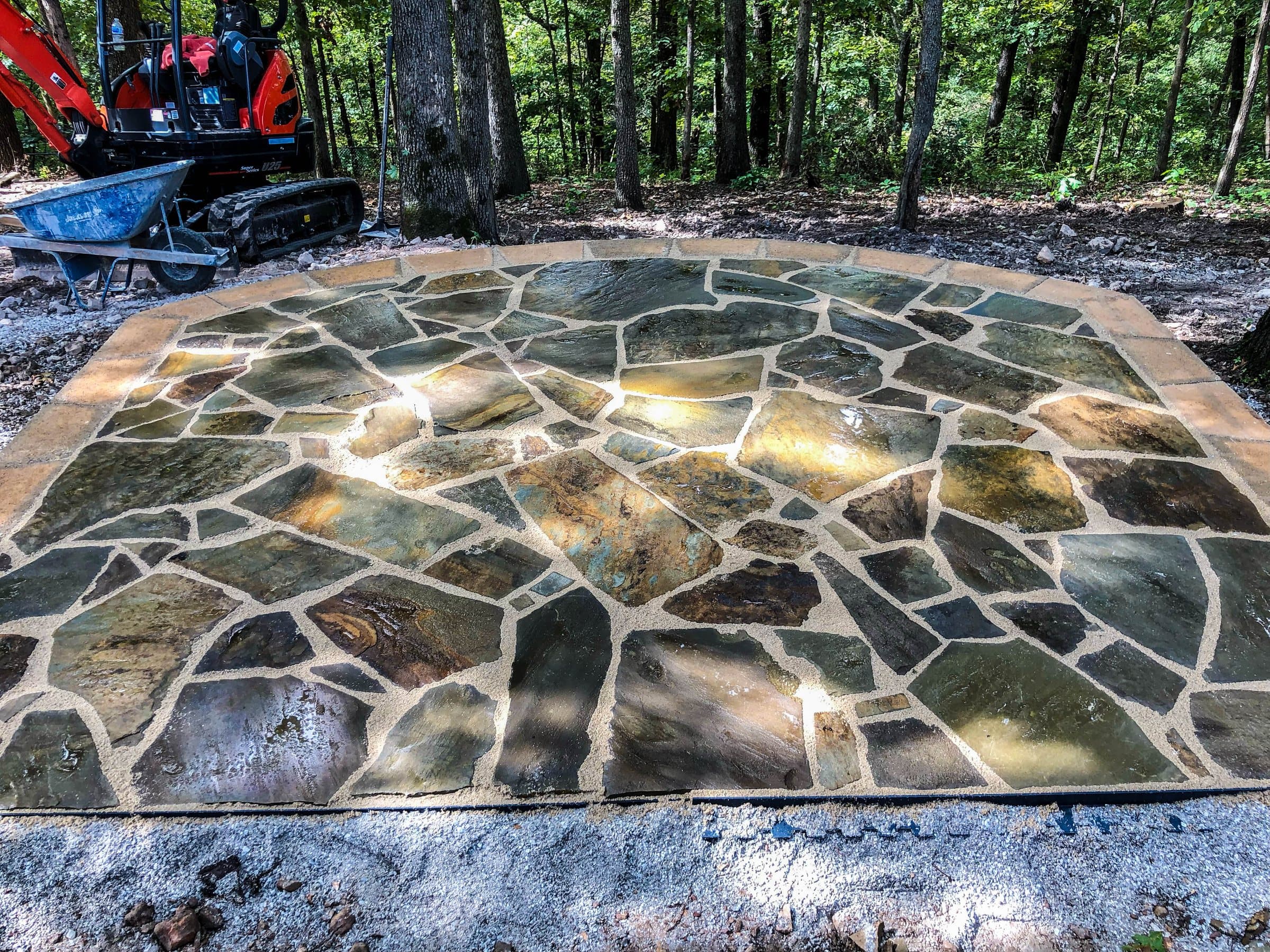
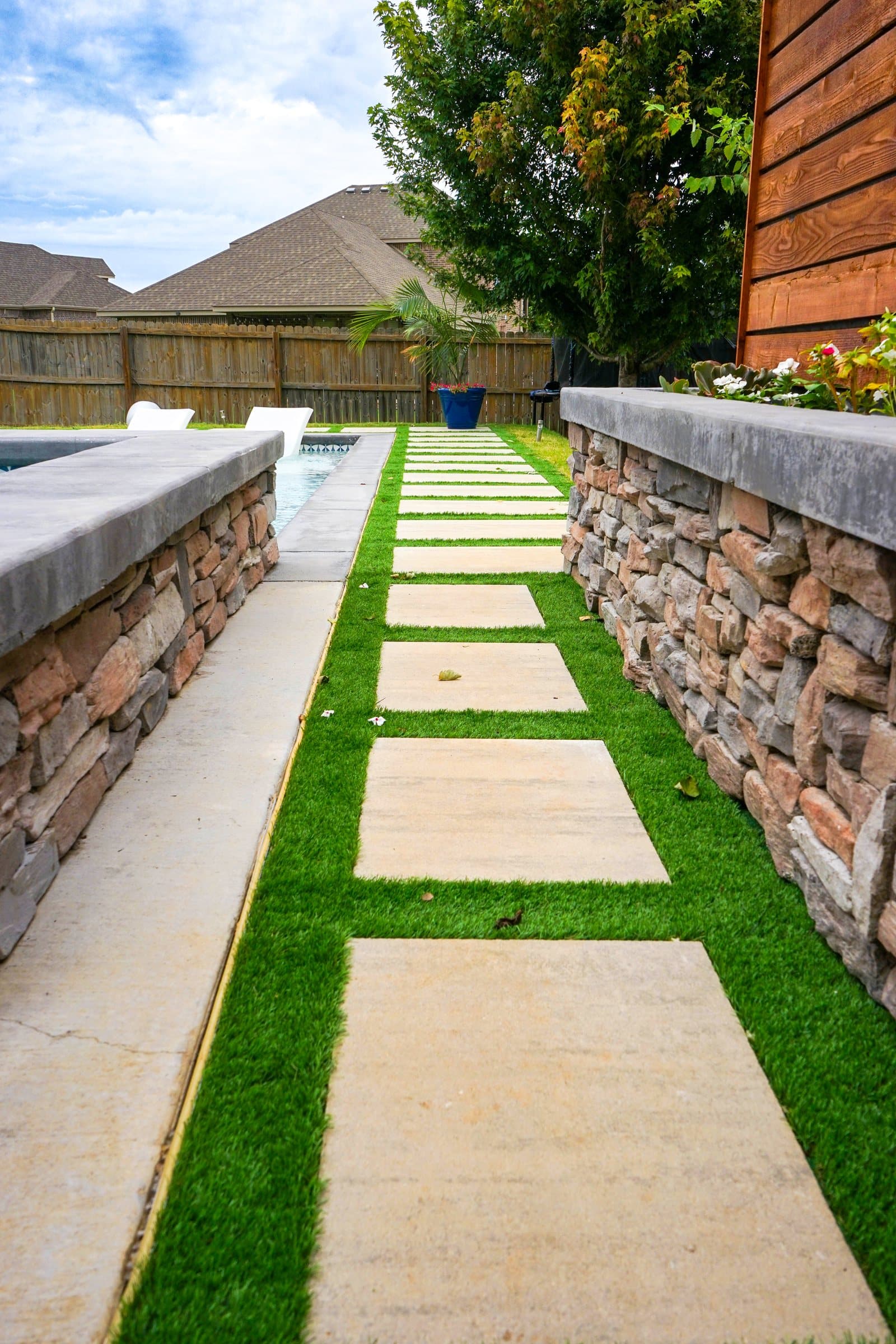
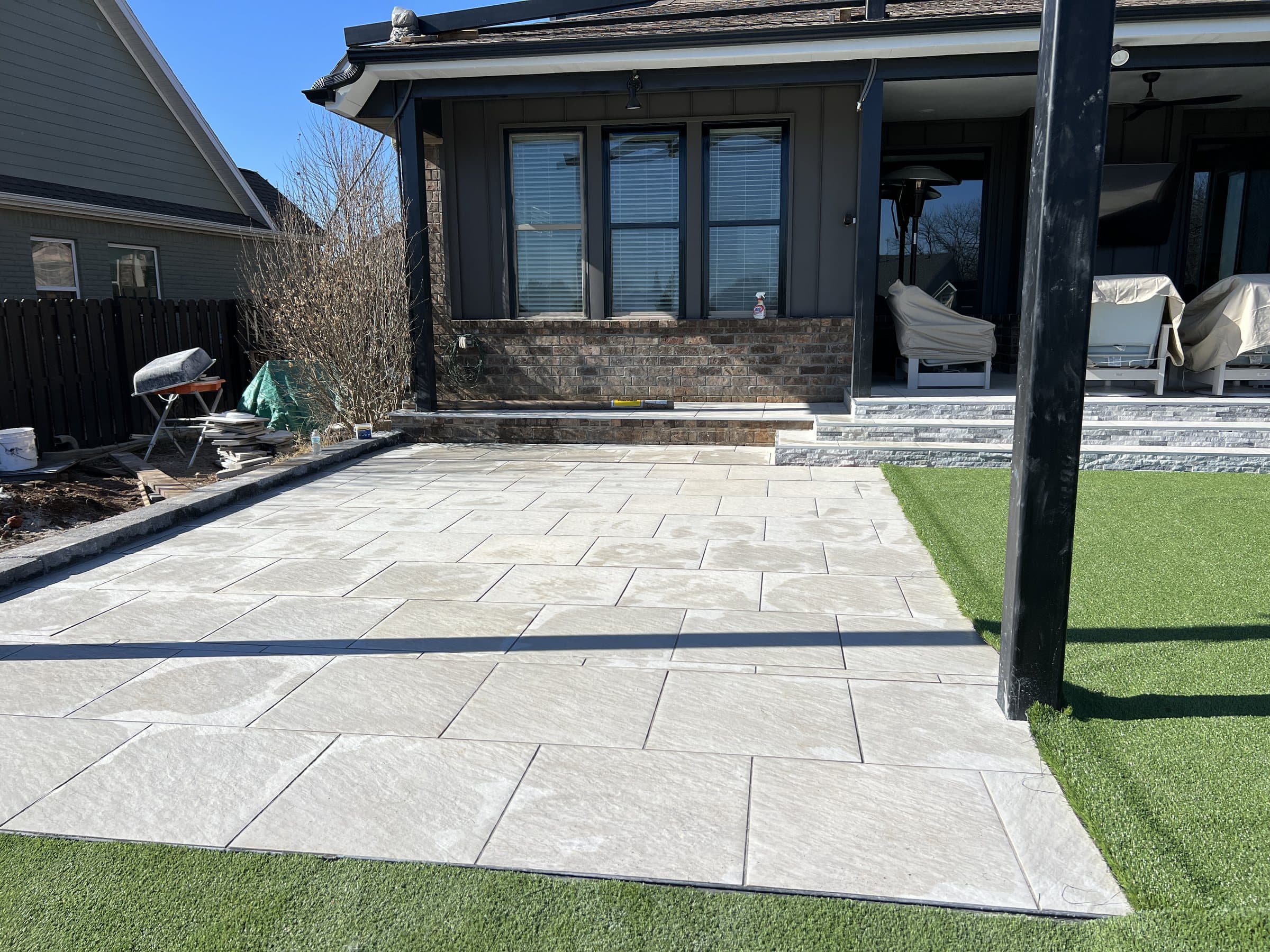
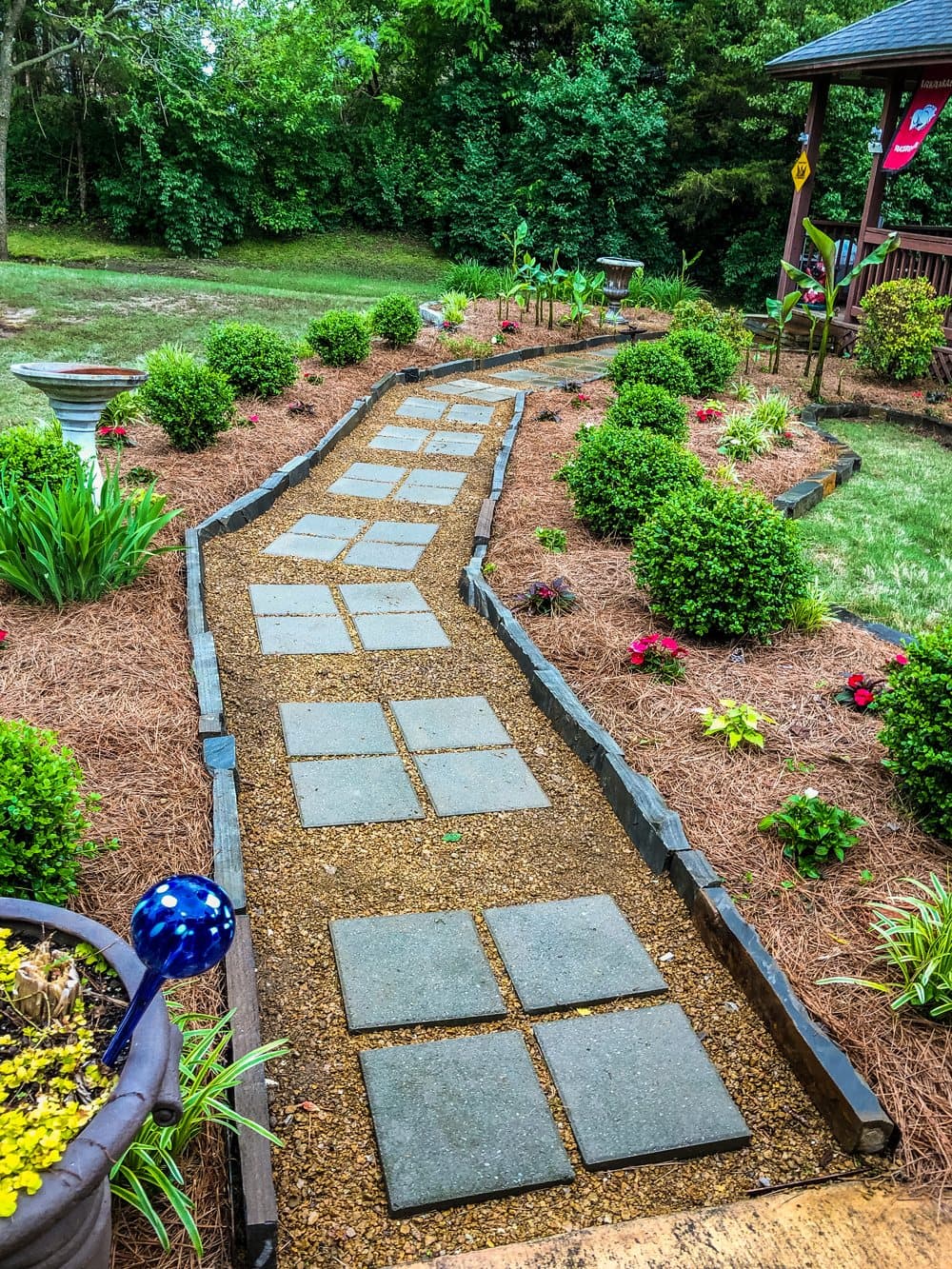
Stepping stones set in the lawn or in gravel disturb very little. A gravel or decomposed stone path lets water and air reach the roots. Pavers need a base excavation, but can stop short of the root zone and bridge its edge, and they can be lifted if a root causes trouble later. A poured slab needs the same excavation, seals the ground completely and cracks rather than flexes. A deck on a few footings, placed between the major roots, touches the soil at only a handful of points. Near a tree you care about, the design often uses more than one of these: a paved area set back from the trunk, and a lighter path or stepping stones where it passes under the canopy.
09What about a neighbour's tree?
Its roots do not stop at the fence, so it deserves the same thought as your own.
If the extension's fence distance for a tree next door reaches into your garden, the excavation for your patio can cut roots that support it. A tree that declines or becomes unstable after your project is a problem for both of you, and a large oak failing toward a house is a serious one. The sensible order is to identify any neighbouring trees close to the work at the design stage, talk to the neighbour before the machine arrives, and bring in an arborist if major roots are involved.
10Does Fayetteville regulate trees on residential projects?
In some cases. Its tree preservation code reaches single-family lots in the hillside overlay and some permitted projects.
The City of Fayetteville's Tree Preservation and Protection code, Chapter 167, applies among other things to single-family residential in the Hillside/Hilltop Overlay District and to grading permits in that district. The city's page also says applicants for development projects of 1,201 to 10,000 square feet of impervious area that require building, grading or parking lot permits prepare an abbreviated tree preservation plan. The Urban Forestry team is on 479-444-3470. Checked September 2026; confirm with the city for your lot.
11When should you bring in an arborist?
Whenever the design puts work inside the fence distance of a tree you want to keep.
An arborist can tell you how much root loss a particular tree, in its current health, can tolerate, and can supervise root pruning so cuts are clean rather than torn. That is a small cost set against losing a mature oak three summers later and paying to remove it from over your new patio. The design question and the tree question are the same question, and they are best answered together, before any excavation.
Projects with us start around seven and a half thousand dollars. Francisco Gallardo, the owner, walks the ground himself before any number is given, because on this geology the number depends on what is under the turf. The visit costs nothing. Financing is available through Acorn Finance. Call (479) 379-2226 or send the project form.
FAQCommon questions
How deep are tree roots?
University of Arkansas extension guidance says about 90 percent of a tree's roots are in the top 12 to 18 inches of soil.
How far do tree roots spread?
At least to the edge of the canopy and often two or three times that distance, according to the Washington County extension office.
Can I build a patio under an oak tree?
Often, yes, if it is designed around the root zone: hand digging near the tree, no cutting of roots over 1 inch inside the dripline and no heavy machinery on the roots.
How far from a tree should I build?
The extension guidance is to fence trees during construction at 1 foot from the trunk for every inch of trunk diameter. An 18 inch oak gets an 18 foot circle.
Can I add soil over tree roots to level a patio?
Very little. The extension fact sheet warns that adding as little as 3 to 4 inches of soil can kill a tree.
Will tree roots crack my patio?
They can lift a paver field or crack a slab over time. Distance, root barriers and a flexible surface near large trees reduce the risk.
Does Fayetteville require a tree plan for a patio?
In the Hillside/Hilltop Overlay District, and for some permitted projects of 1,201 to 10,000 square feet of impervious area, yes. Ask the Urban Forestry team on 479-444-3470.
REFSources
- University of Arkansas Division of Agriculture FSA5011: Ten Easy Ways to Kill a Treeuaex.uada.edu
- University of Arkansas Division of Agriculture: Poor root accommodation results in decline among urban red maplesuaex.uada.edu
- City of Fayetteville: Tree Preservation Ordinancefayetteville-ar.gov
- USDA NRCS Official Soil Series Description: Nixasoilseries.sc.egov.usda.gov
- USDA NRCS Official Soil Series Description: Enderssoilseries.sc.egov.usda.gov
NEXTGet it looked at properly
Everything above is general guidance. What your ground actually needs is a site visit, and ours costs nothing. Francisco Gallardo walks it, reads the grade and the drainage, and tells you what is possible.