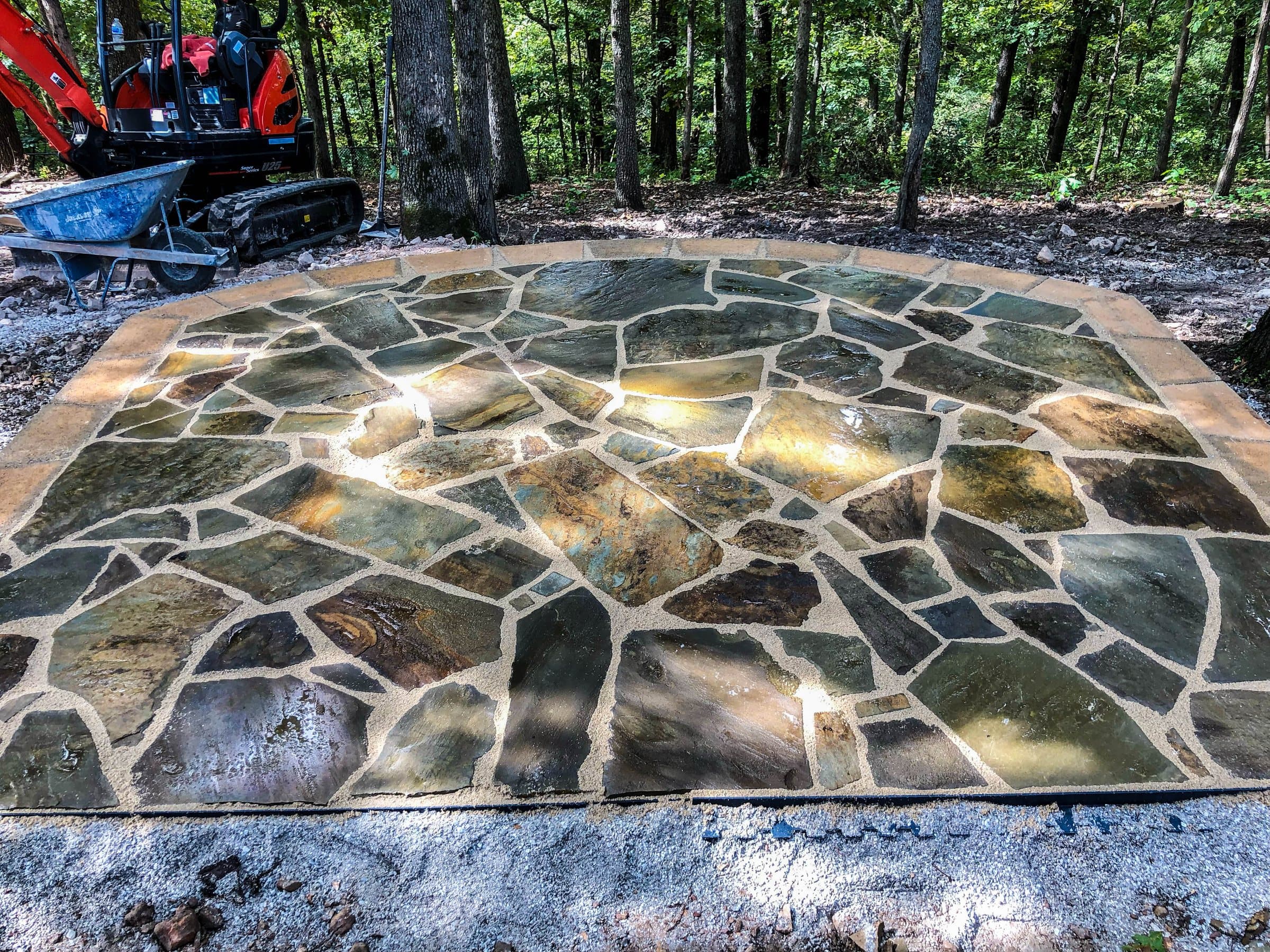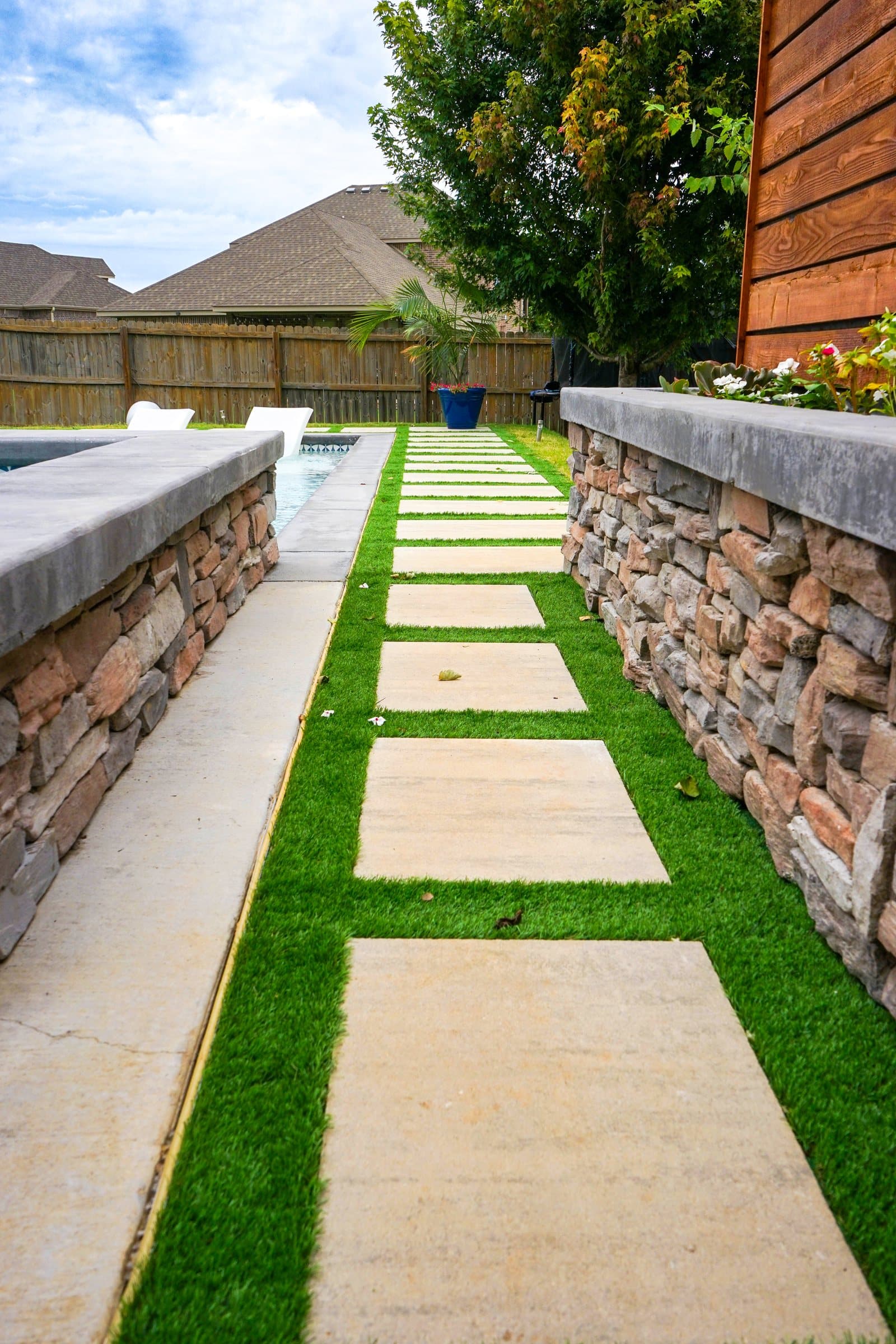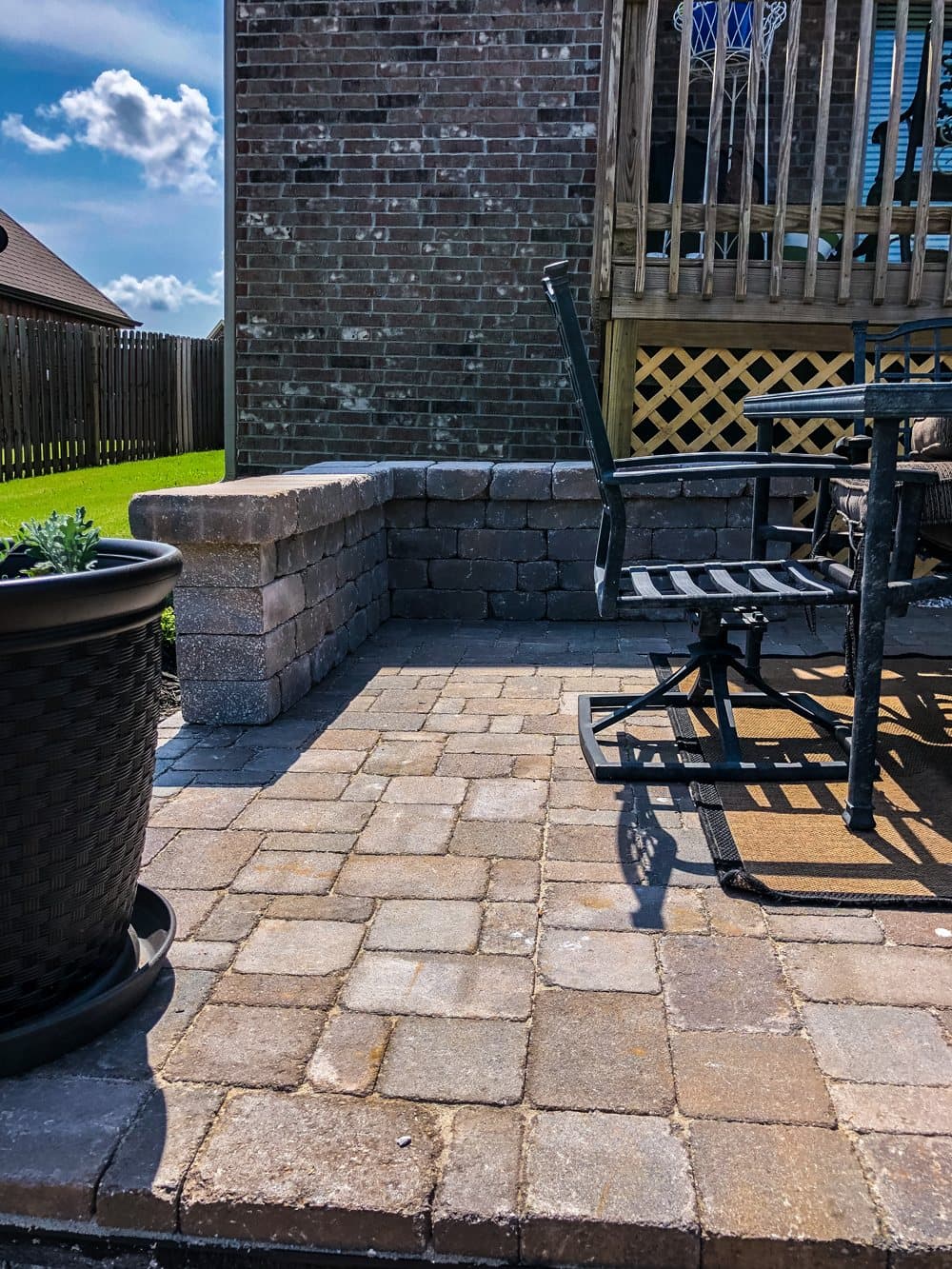

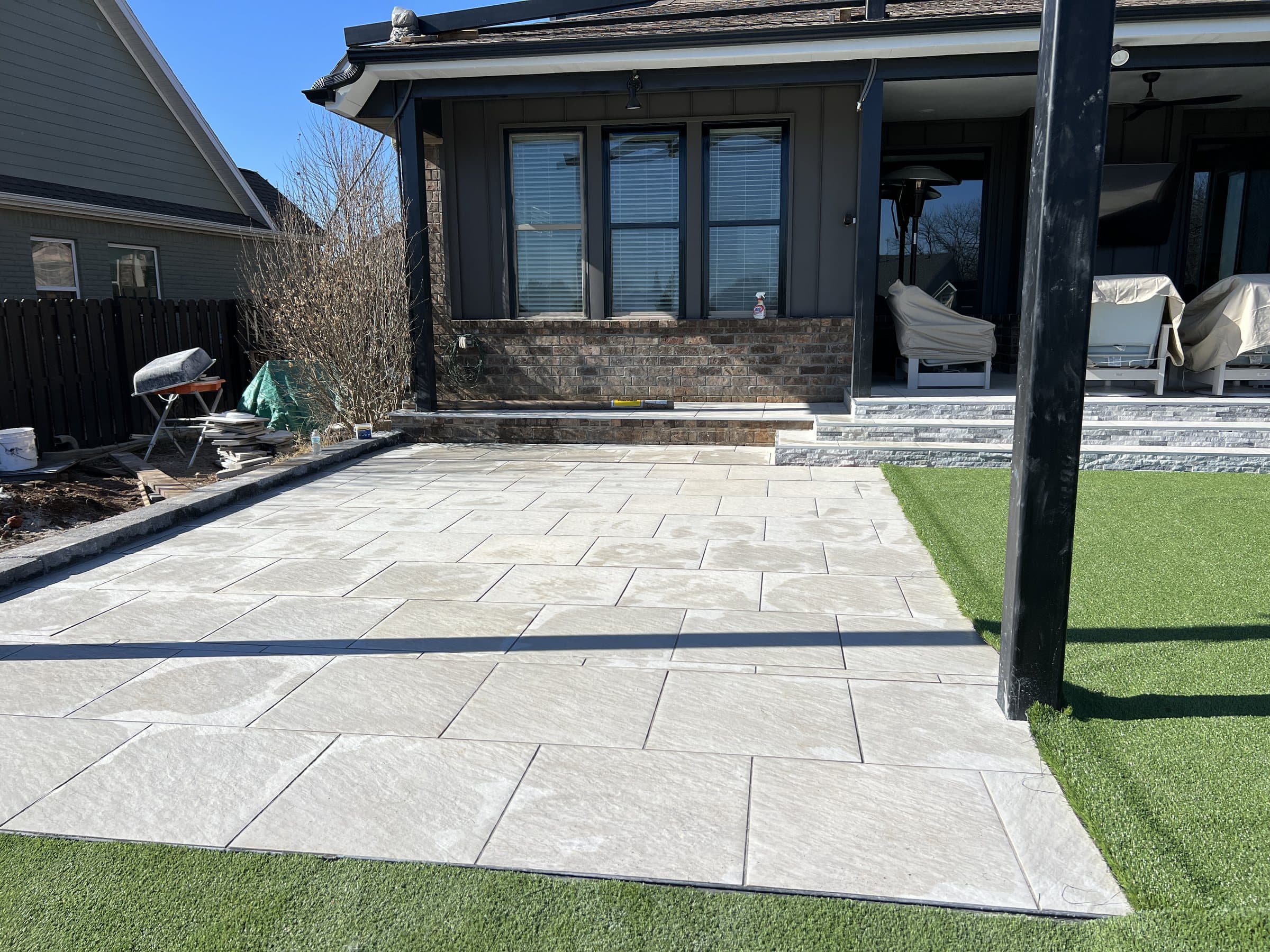
Fayetteville, Farmington, Prairie Grove and Elkins sit on the Boston Mountains, where the Fayetteville shale weathers to clay that swells when wet and shrinks when dry. University of Arkansas geologist Walter Manger called it the culprit behind the region's foundation problems. A patio on that ground has to be isolated from the moisture swings with depth, drainage and a surface that tolerates small movement.
01What is the Fayetteville shale, and where is it?
It is the rock under the Boston Mountains side of Northwest Arkansas, and it behaves very differently from the limestone to the north.
In the NWA Business Journal, Walter Manger, professor of geology at the University of Arkansas, set out the regional split: the Springfield Plateau covering Benton County and the northernmost part of Washington County is generally limestone and flint, while the Boston Mountain Plateau, which takes in Fayetteville, is generally sandstone and shale. His summary was "Limestone is good. Shale is bad." The Arkansas Geological Survey confirms the Boston Mountains are sandstone and shale and do not form karst.
| Town | Ground | The main risk to a patio |
|---|---|---|
| Fayetteville | Boston Mountains, sandstone and Fayetteville shale | Seasonal swell and shrink, slope |
| Farmington | Boston Mountains, sandstone and shale | Seasonal swell and shrink |
| Prairie Grove | Boston Mountains, sandstone and shale | Seasonal swell and shrink |
| Elkins | Boston Mountains, sandstone and shale, real slope | Movement plus runoff on grade |
| Springdale, Tontitown | Springfield Plateau, limestone and chert | Digging and slow drainage instead |
| Bentonville, Rogers and north | Springfield Plateau, limestone and chert | Digging and slow drainage instead |
02Why does shale make the ground move?
Because weathered shale becomes clay, and clay changes volume with its water content.
Manger put it simply: shale expands and contracts, caused by the clay's weathering. Clay minerals take water in between their layers and swell; they give it up and shrink. A season of heavy spring rain followed by a dry late summer is a full cycle, and the ground surface rises and falls with it. The movement is not uniform. Soil under a shaded corner, next to a downspout or beside a thirsty tree dries and wets on its own schedule, so the ground does not just move, it twists.
The USDA's description of the Enders series, a soil formed in clayey residuum from shale across the Boston Mountains of Arkansas and Oklahoma, shows what this looks like in the ground: silty clay and clay subsoil described as firm, sticky and plastic, over soft platy shale bedrock that hardens with depth, with very slow permeability.
03How big a problem is it for buildings here?
Big enough that the region's best known geologist put it at the root of local foundation failures.
The same article reports that foundation problems on this ground can add 35 to 50 percent to the cost of a foundation, and cites the piers drilled for the stadium expansion on campus as an example of how deep engineers go to get below it. Manger also offered a field test for house hunters: if the trees are straight up and down, there is no problem; if the trees are tilting, you have a problem. That is a rule of thumb, not a survey, but it is a useful one on a Fayetteville hillside.
A patio is not a house, and nobody drills piers for one. The principle carries over exactly, though: whatever you build has to be designed around a ground surface that moves each year.
04What does shale movement do to a concrete patio?
It cracks it, because a slab is rigid and the ground under it is not.
A poured slab spans the ground as one piece. When one side of the ground swells or the other shrinks, the slab has to bend, and concrete does not bend. It cracks where the stress is highest, usually in a line across the slab, often from a re-entrant corner, and the two sides then move independently, leaving a trip edge. Control joints help crack placement; they do not stop the ground moving.
Stamped concrete has the same slab underneath, so it cracks the same way, and the pattern makes a repair hard to hide. This is not an argument that concrete can never be used south of Springdale. It is an argument that it needs the ground prepared for it, and that a flexible surface is the more forgiving choice on this geology. Our pavers vs stamped concrete guide has the full comparison.
05Why are pavers more forgiving on shale?
Because a paver field is hundreds of small units that can each move a little.
Interlocking pavers on a compacted aggregate base behave as a flexible pavement. Small seasonal movement shows up as a slight undulation rather than a crack. If an area does settle or lift, those units come up, the base is corrected and the same pavers go back down. There is no patch.
That forgiveness has a limit. Pavers laid on a thin base directly over wet and dry shale clay will still move far more than they should. The base does two jobs here: it carries the load, and it puts a thickness of non-expansive, free draining material between the surface and the clay, which damps the moisture swings the clay experiences.
06How do you build a patio that survives on this ground?
Keep the moisture in the clay as steady as possible and keep the surface off it.
In practice that means excavating deeper than you would on plateau ground and replacing the clay with compacted aggregate in lifts, getting roof and surface water away from the patio edges so one side does not stay wetter than the other, shaping the subgrade so water that enters the base leaves it, and not letting a downspout discharge against the patio. Edge restraint matters more here, because a moving clay edge will let a paver field spread.
The exact depth is a site decision based on what the excavation shows, not a number to quote from a table. What does not change is the principle: the more clay you leave within reach of the surface, the more movement reaches the surface.
07What about retaining walls on shale slopes?
They are the highest-stakes structures on this ground, because saturated clay behind a wall is heavy and shale slopes collect water.
A wall on the Boston Mountains side is holding back soil that swells when it gets wet, on a slope that funnels runoff toward it. Drainage aggregate behind the wall, a perforated drain at the base with a real outlet, and a design that accounts for the soil type are what separate a wall that stands from one that leans. Fayetteville also has its own rules for walls over four feet and for hillside lots; our Fayetteville permit guide covers them.
08When is the best time to build on shale ground?
When the clay is neither saturated nor bone dry, because the moisture it is built at is the moisture it will try to return to.
Clay compacted wet is hard to compact properly and tends to settle later. Clay built on at the end of a dry summer, with deep shrinkage cracks, can swell back up under the new patio once the autumn rain arrives. Neither is a reason to stop work for months. It is a reason to look at the ground on the day, to keep excavations covered or drained if a storm is coming, and to replace the worst of the clay with aggregate rather than trying to perfect it. Our guide to the best time of year to build covers scheduling in general.
09What does shale mean for a pool or a covered structure?
Rigid structures need to be taken below the active clay or designed to ride it, and that is an engineering decision, not a guess.
A pool shell, a covered patio tied into the house, or a pavilion with a stone fireplace is rigid, heavy and expensive to repair. On shale, the footings and the pool's bearing surface are designed with the moving clay in mind, and where the structure attaches to the house the connection has to allow for the two moving differently. The flexible surfaces around them, pavers and flagstone on aggregate, are then detailed so small differential movement shows as a joint rather than a crack.
10Do trees make shale movement worse?
They can, because a large tree pulls a lot of water out of the soil in summer.
Shrinkage is driven by drying, and a mature tree dries the soil around its roots more than open lawn dries. A patio half under a big oak and half in the open can see the shaded, root-filled side shrink more in a dry August. Removing a large tree can do the opposite, letting the ground slowly re-wet and swell. Neither means the tree has to go. It means the design has to account for it, and our guide to building near trees covers the root side of that.
11How do you know if your lot is on shale?
If you are in Fayetteville, Farmington, Prairie Grove or Elkins, assume it is until the excavation shows otherwise.
The USDA Web Soil Survey will show whether the mapped soil at your address formed in shale residuum, and the description will list the subsoil texture. On site, the signs are cracks in existing concrete that open in late summer and close in spring, doors in the house that stick seasonally, and gray, platy rock or sticky clay when you dig. Existing damage on the property is worth a close look before you add anything new.
Projects with us start around seven and a half thousand dollars. Francisco Gallardo, the owner, walks the ground himself before any number is given, because on this geology the number depends on what is under the turf. The visit costs nothing. Financing is available through Acorn Finance. Call (479) 379-2226 or send the project form.
FAQCommon questions
Is Fayetteville soil expansive?
Much of it is. Fayetteville sits on the Boston Mountains, where the Fayetteville shale weathers to clay that swells when wet and shrinks when dry.
Why do concrete patios crack in Fayetteville?
Because a slab is rigid and the shale clay under it moves seasonally, unevenly. The slab has to bend and concrete cracks instead.
Are pavers better than concrete on expansive soil?
Generally more forgiving. A paver field flexes slightly and can be lifted and relaid without a patch. It still needs a deep, well-drained base on shale.
Does Bentonville have the same shale problem?
No. Bentonville is on the Springfield Plateau, limestone and chert. Its challenges are hard digging and slow drainage rather than seasonal swelling.
Which Northwest Arkansas towns are on shale?
Fayetteville, Farmington, Prairie Grove and Elkins are on Boston Mountains ground. Springdale, Tontitown and everything north are on the limestone plateau.
How can I tell if my ground is moving?
Cracks in existing concrete that open in late summer and close in spring, sticking doors, and trees that lean are all signs. Manger's rule: tilting trees mean a problem.
Can a patio be built on shale at all?
Yes. It needs a deeper aggregate base, careful drainage so the clay stays at a steady moisture, and a surface that tolerates small movement.
REFSources
- Talk Business / NWA Business Journal: Shale Rests at Root of Construction Problemstalkbusiness.net
- USDA NRCS Official Soil Series Description: Enderssoilseries.sc.egov.usda.gov
- Arkansas Geological Survey: Karst in the Arkansas Ozarks, Part 1arkansasgeological.wordpress.com
NEXTGet it looked at properly
Everything above is general guidance. What your ground actually needs is a site visit, and ours costs nothing. Francisco Gallardo walks it, reads the grade and the drainage, and tells you what is possible.