
NOAA's 1991 to 2020 normals for Fayetteville's Drake Field show an average of 93.5 nights a year at or below freezing but only 7.2 days that stay below freezing all day. So on roughly 86 days a year the air freezes overnight and thaws the next afternoon. Northwest Arkansas is not a hard-freeze climate; it is a repeated freeze and thaw climate, which is harder on wet materials and wet bases than a steady cold.
01How many nights a year freeze in Northwest Arkansas?
About 93 at Fayetteville and about 92 at the regional airport near Highfill.
NOAA's National Centers for Environmental Information publish 30-year climate normals for every long-record station. For 1991 to 2020, Fayetteville Drake Field averages 93.5 days a year with a minimum temperature at or below 32°F. Northwest Arkansas Regional Airport, the Benton County station, averages 91.6. The two stations are about 20 miles apart and agree closely, so the numbers are a fair picture of the whole area.
Colder nights are rarer. Both stations average 25.0 nights a year at or below 20°F, and Drake Field averages 0.6 nights a year at or below zero.
02How many actual freeze-thaw cycles is that?
Roughly 82 to 86 a year in the air, on the stations' own numbers.
A day that freezes overnight and then rises above freezing is one cycle. The normals also count days when the maximum stays at or below 32°F: 7.2 a year at Drake Field and 9.3 at the regional airport. Every one of those days also has a freezing minimum, so subtracting gives the number of days that freeze and then thaw: about 86 at Drake Field and about 82 at the airport.
Two cautions. That is an air temperature count. A dark paver in afternoon sun can thaw on a day the air stays cold, and a shaded, wet base may stay frozen through a mild day, so the material itself sees more or fewer cycles than the air. And it is an average: a mild winter gives fewer, a changeable one more. What the number does settle is the order of magnitude. This is dozens of cycles a year, every year, not an occasional cold snap.
03Which months do the damage?
December, January and February carry most of it, with real tails in November and March.
| Month | Nights at or below 32°F, Drake Field | Days staying at or below 32°F, Drake Field | Nights at or below 32°F, NWA Regional Airport |
|---|---|---|---|
| October | 2.8 | 0.0 | 2.3 |
| November | 12.8 | 0.2 | 10.9 |
| December | 21.5 | 2.0 | 22.0 |
| January | 23.4 | 3.1 | 23.8 |
| February | 18.5 | 1.7 | 19.2 |
| March | 11.5 | 0.2 | 10.1 |
| April | 3.0 | 0.0 | 3.1 |
| May | 0.1 | 0.0 | 0.2 |
January is the heart of it: on average 23.4 freezing nights at Drake Field against only 3.1 days that stay frozen. The National Weather Service's freeze climatology for Fayetteville, running from 1949, puts the average last spring freeze at April 16 and the average first fall freeze at October 19.
04Why is freeze and thaw worse than steady cold?
Because every cycle is a new chance for water to freeze, expand and push.
Water expands when it freezes. In a place where the ground freezes in December and stays frozen until March, that happens once. Here it happens most nights through midwinter. Water that has soaked into a porous stone, a weak concrete surface or a saturated patio base freezes at night, thaws in the afternoon, soaks in a little further and freezes again. Each cycle opens pores and cracks slightly more. That is why surfaces here spall and flake, and why a wet base heaves, even though the thermometer rarely reads anything dramatic.
The common thread is water. A dry material or a drained base does not care much how many times the air crosses 32°F.
05What does this mean for concrete pavers?
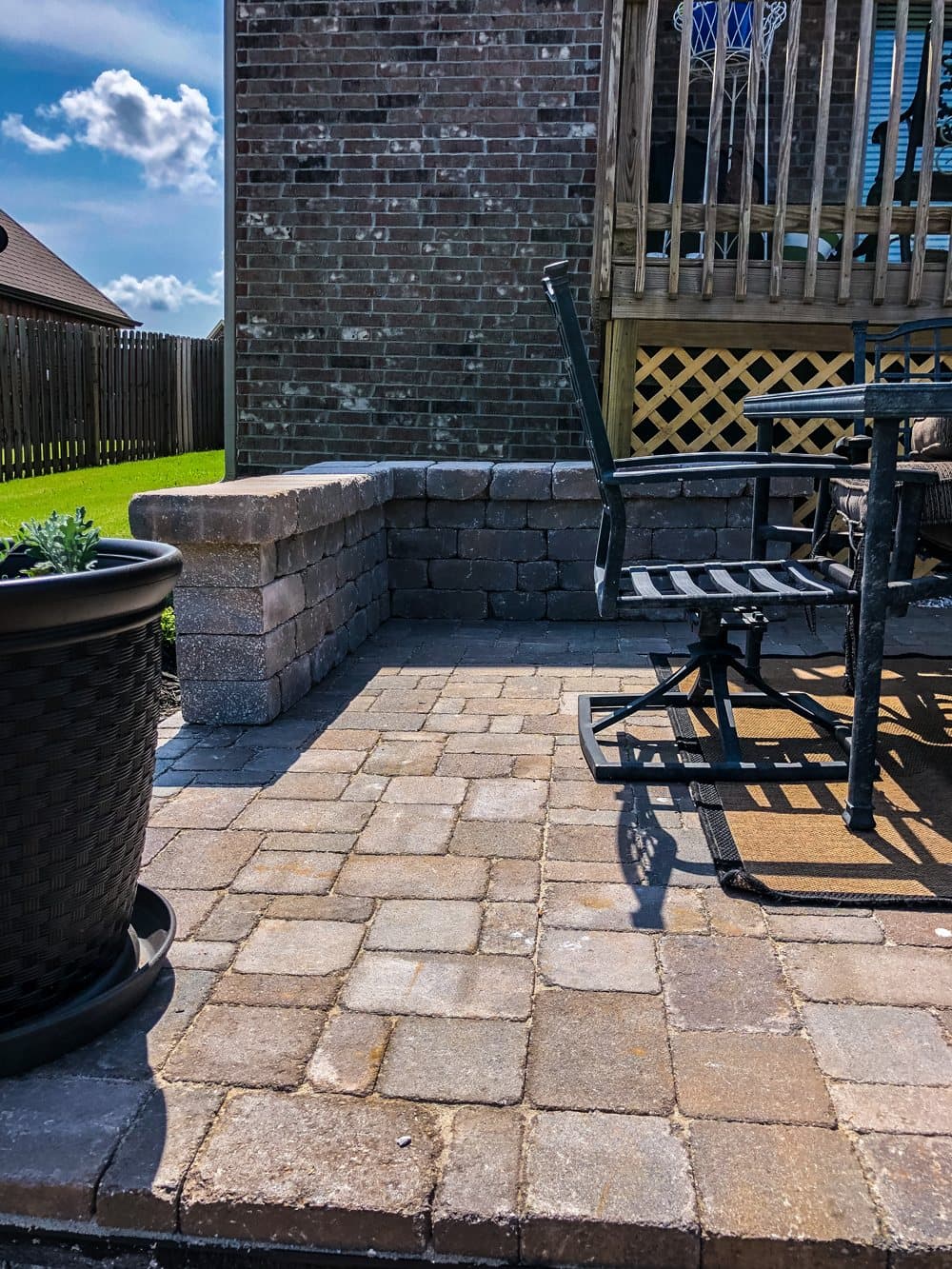
Buy pavers that have been tested for freeze and thaw, and lay them on a base that drains.
The Concrete Masonry and Hardscapes Association says concrete pavers made in the U.S. should meet ASTM C936, and that freeze-thaw durability is tested under ASTM C1645. Its guidance is an average mass loss no greater than 225 grams per square meter after 28 freeze-thaw cycles, or no greater than 500 after 49 cycles, with a 3 percent salt solution used in place of tap water where the pavers will see de-icers. A reputable manufacturer can tell you whether a product meets that. If a supplier cannot, that is the answer.
Test cycles in a lab are not the same as winters, and ASTM itself says the result is not a measure of service life. What the test does is separate products made for a freezing climate from products that are not.
06What about natural stone and flagstone?
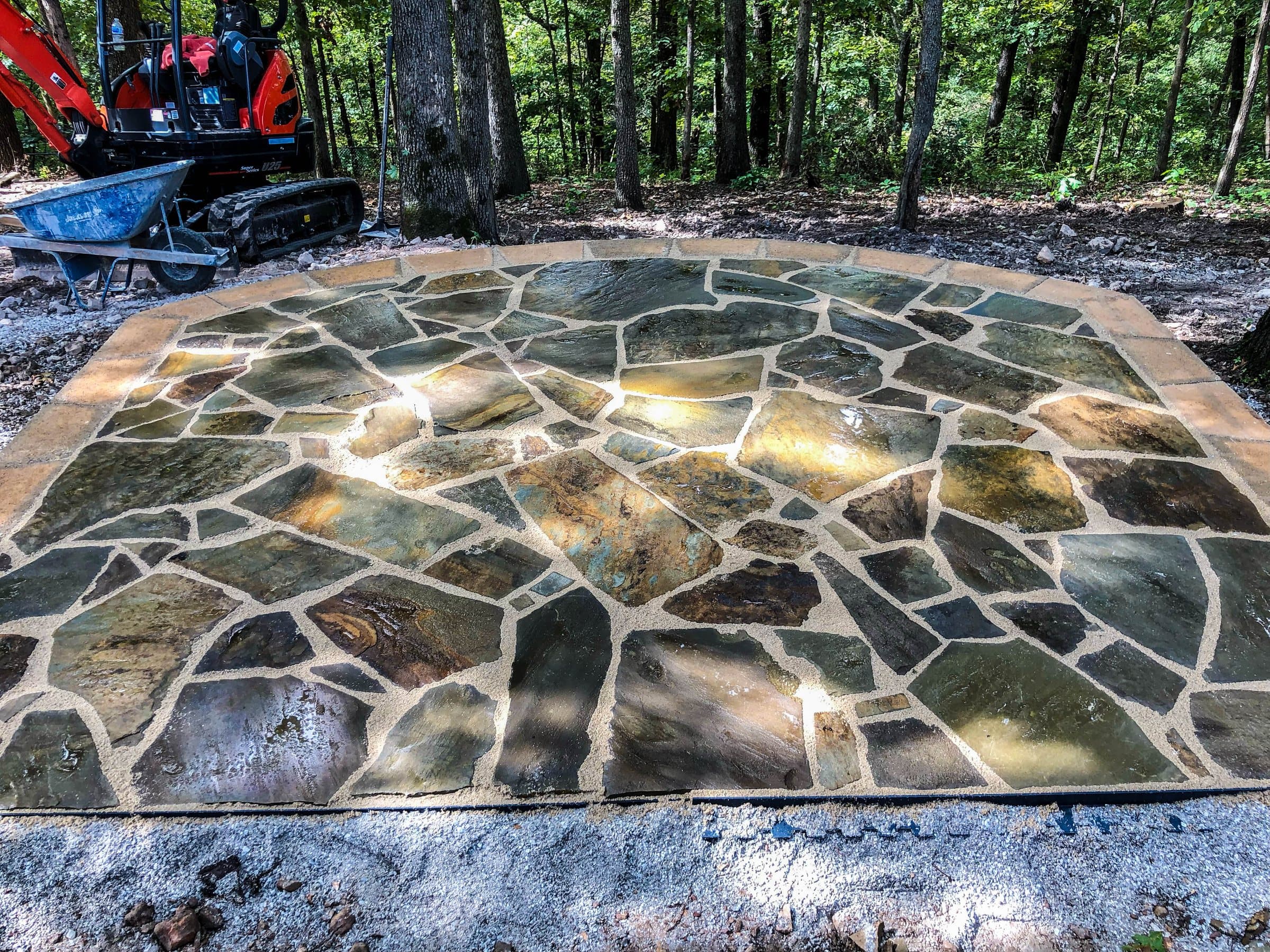
Stone varies far more than manufactured pavers, so it is chosen by type and by the specific product, not by the word "stone".
Dense stones with low absorption shrug off freeze and thaw. Soft, layered or very porous stones take water in and can flake along their bedding planes after a few winters, especially where they sit in a wet spot or are salted. Flagstone laid on a mortar bed over concrete brings the slab's cracking risk with it. The questions to ask are how much water the stone absorbs, whether the supplier has seen it perform in a freezing climate, and whether it will be laid somewhere that drains.
07Does the base matter more than the paver?
Yes. More patios fail here from a wet base than from a weak paver.
A good paver on a base that holds water will still heave, because it is the water in the base that freezes and lifts. On Benton County ground the subsoil is often slow draining, and the USDA soil description for the Tonti series, typed near Lowell, records a perched water table within 18 to 30 inches of the surface from December through April, which is exactly the freezing season in the table above. Our chert and red clay guide goes into that ground in detail.
The base answer is a compacted aggregate layer thick enough for the soil, shaped so water leaves it, and bedding material that drains: CMHA specifies ASTM C33 concrete sand and says never to use limestone screenings or stone dust for bedding.
08Is Benton County colder than Fayetteville?
Slightly, in the way that matters most: more days that stay frozen.
Northwest Arkansas Regional Airport, the Benton County station, averages fewer freezing nights than Drake Field in Fayetteville, 91.6 against 93.5, but more days that never thaw, 9.3 against 7.2. In December and January the airport also records slightly more freezing nights than Drake Field. The differences are small and both stations tell the same story. The practical point is that nobody in the region gets to treat winter as an afterthought, whether the patio is in Bella Vista or Prairie Grove.
09What does freeze and thaw do to concrete, mortar and joints?
It attacks the weakest, wettest surface first, which is usually a finish or a joint rather than the body of the material.
On poured concrete, the top fraction of an inch is where water sits after rain, so that is where scaling and flaking start, particularly on a surface that was over-worked or finished wet. On stone veneer, fireplaces and kitchen islands, mortar joints that crack let water in behind the face, and a few winters later a stone comes loose. On a paver field, joints that are not kept full let water and grit into the bedding layer. In each case the defence is the same: shed water fast, keep joints full and sound, and give the material a way to dry out between storms.
10Should you use de-icing salt on pavers?
Sparingly, and only on products rated for it.
Salt lowers the freezing point of water, which can increase the number of freeze and thaw cycles a surface goes through, and it adds its own chemical attack on concrete. That is why the freeze-thaw test above is run in salt solution for pavers that will see de-icers. With an average of 6.5 inches of snow a year at Drake Field in the 1991 to 2020 normals, most Northwest Arkansas patios do not need routine salting. Sand for grip, or a product the paver manufacturer approves, is kinder.
11Does sealing pavers protect them from freeze and thaw?
It can reduce how much water the surface takes in, but it is not a substitute for a good paver on a drained base.
A penetrating sealer lowers absorption at the surface and helps keep joint sand in place, which matters in a climate where every wet joint is a small freeze and thaw test. It does nothing for water rising from a saturated base underneath, which is where heave comes from. A film-forming sealer that traps moisture under it can make things worse. If the pavers already meet the freeze and thaw standard and the base drains, sealing is a choice about appearance and maintenance rather than survival. Our guide on sealing pavers in Arkansas goes through when it is worth doing.
12What does this mean when you are choosing a builder?
Ask about water, not about toughness.
Any contractor will tell you their work is built for winter. The useful questions are which standard the pavers meet, what the bedding layer is, how thick the base is and why, and where water that gets into the base goes. The answers tell you whether the patio was designed for 80-odd freeze and thaw cycles a year or just for handover day.
Projects with us start around seven and a half thousand dollars. Francisco Gallardo, the owner, walks the ground himself before any number is given, because on this geology the number depends on what is under the turf. The visit costs nothing. Financing is available through Acorn Finance. Call (479) 379-2226 or send the project form.
FAQCommon questions
How many freeze-thaw cycles does Fayetteville, Arkansas get?
About 86 a year in the air, from NOAA's 1991 to 2020 normals for Drake Field: 93.5 nights at or below freezing minus 7.2 days that stay frozen all day.
How many freezing nights does Bentonville get?
The nearest long-record station, Northwest Arkansas Regional Airport, averages 91.6 nights a year at or below 32°F in the 1991 to 2020 normals.
When is the last frost in Northwest Arkansas?
The National Weather Service puts the average last spring freeze at Fayetteville on April 16 and the average first fall freeze on October 19.
Which month has the most freeze-thaw cycles?
January. Drake Field averages 23.4 freezing nights in January but only 3.1 days that stay frozen all day.
What standard should concrete pavers meet for freeze-thaw?
ASTM C936, with freeze-thaw durability tested under ASTM C1645. CMHA's benchmark is no more than 225 g per square meter lost after 28 cycles or 500 after 49.
Why do pavers heave in winter?
Water trapped in the base freezes and expands. A drained base with the right bedding sand stops most of it.
Is it OK to salt a paver patio in Arkansas?
Only products rated for de-icers, and sparingly. With about 6.5 inches of snow a year on average, most patios here do not need routine salting.
REFSources
- NOAA NCEI 1991 to 2020 Annual Normals: Fayetteville Drake Field (USW00093993)ncei.noaa.gov
- NOAA NCEI 1991 to 2020 Monthly Normals: Fayetteville Drake Field (USW00093993)ncei.noaa.gov
- NOAA NCEI 1991 to 2020 Monthly Normals: Northwest Arkansas Regional Airport (USW00053922)ncei.noaa.gov
- National Weather Service Tulsa: Fayetteville Freeze Climatologyweather.gov
- CMHA Tech Note PAV-TEC-002: Construction of Interlocking Concrete Pavementscmha.org
NEXTGet it looked at properly
Everything above is general guidance. What your ground actually needs is a site visit, and ours costs nothing. Francisco Gallardo walks it, reads the grade and the drainage, and tells you what is possible.