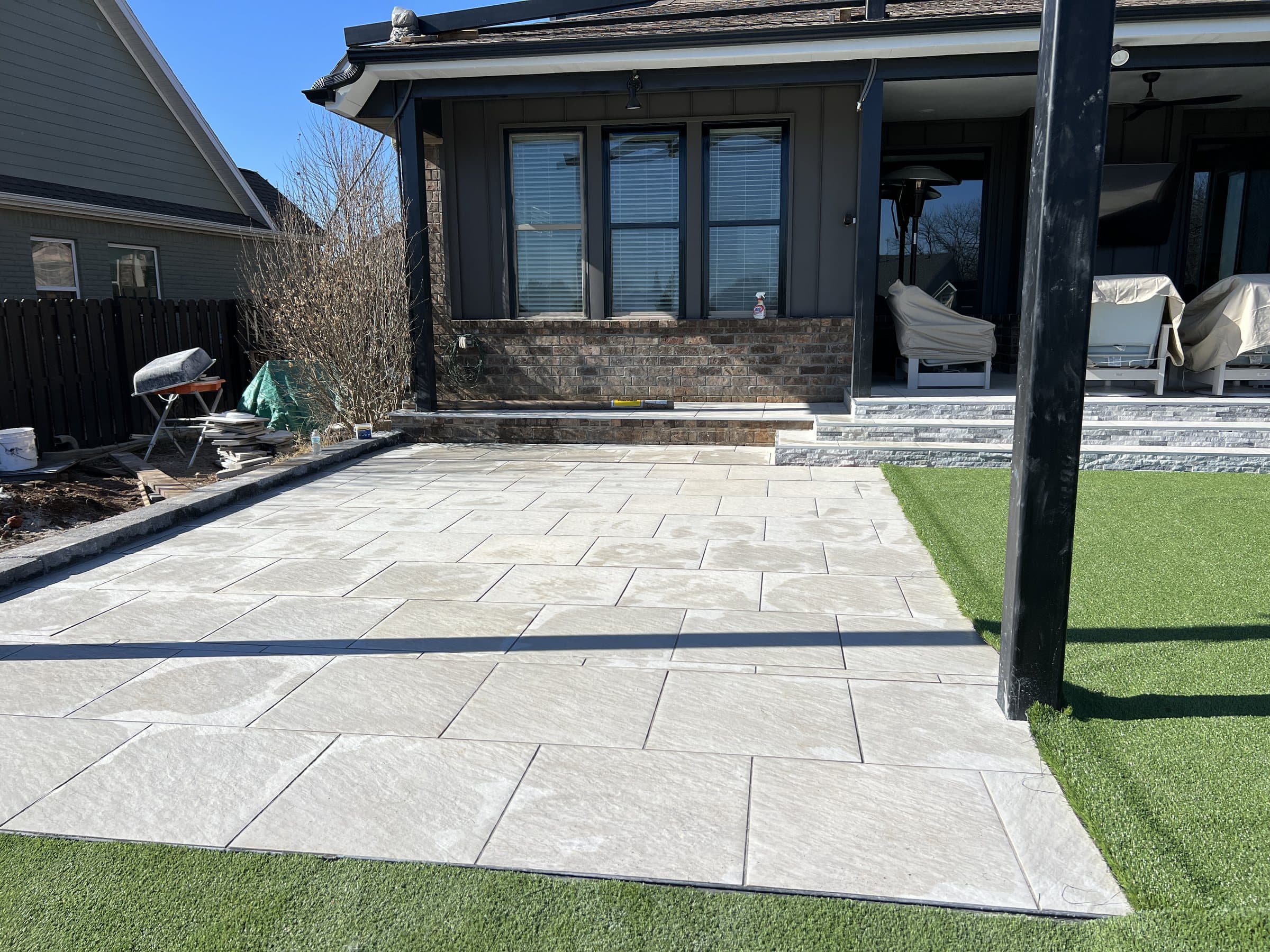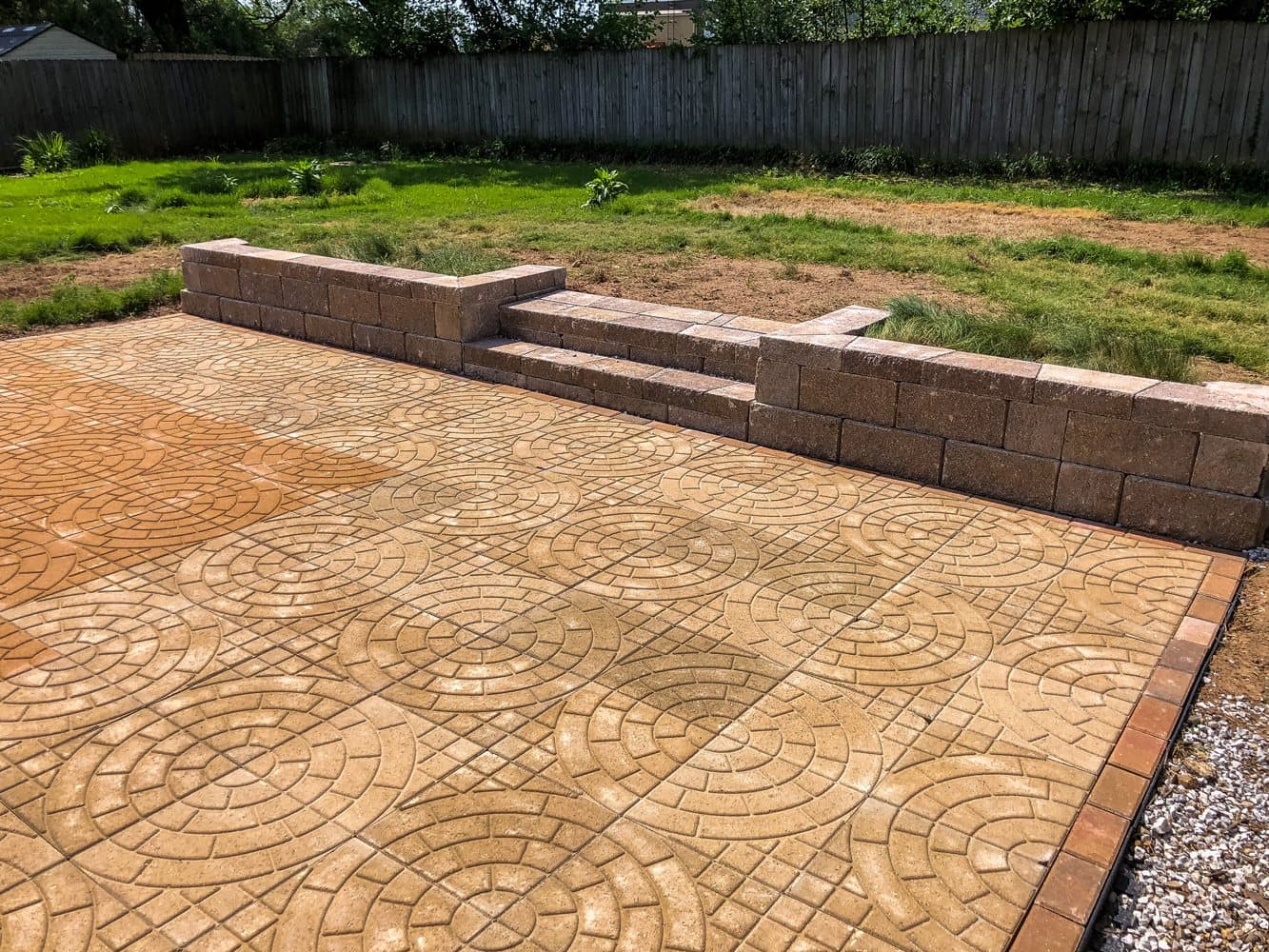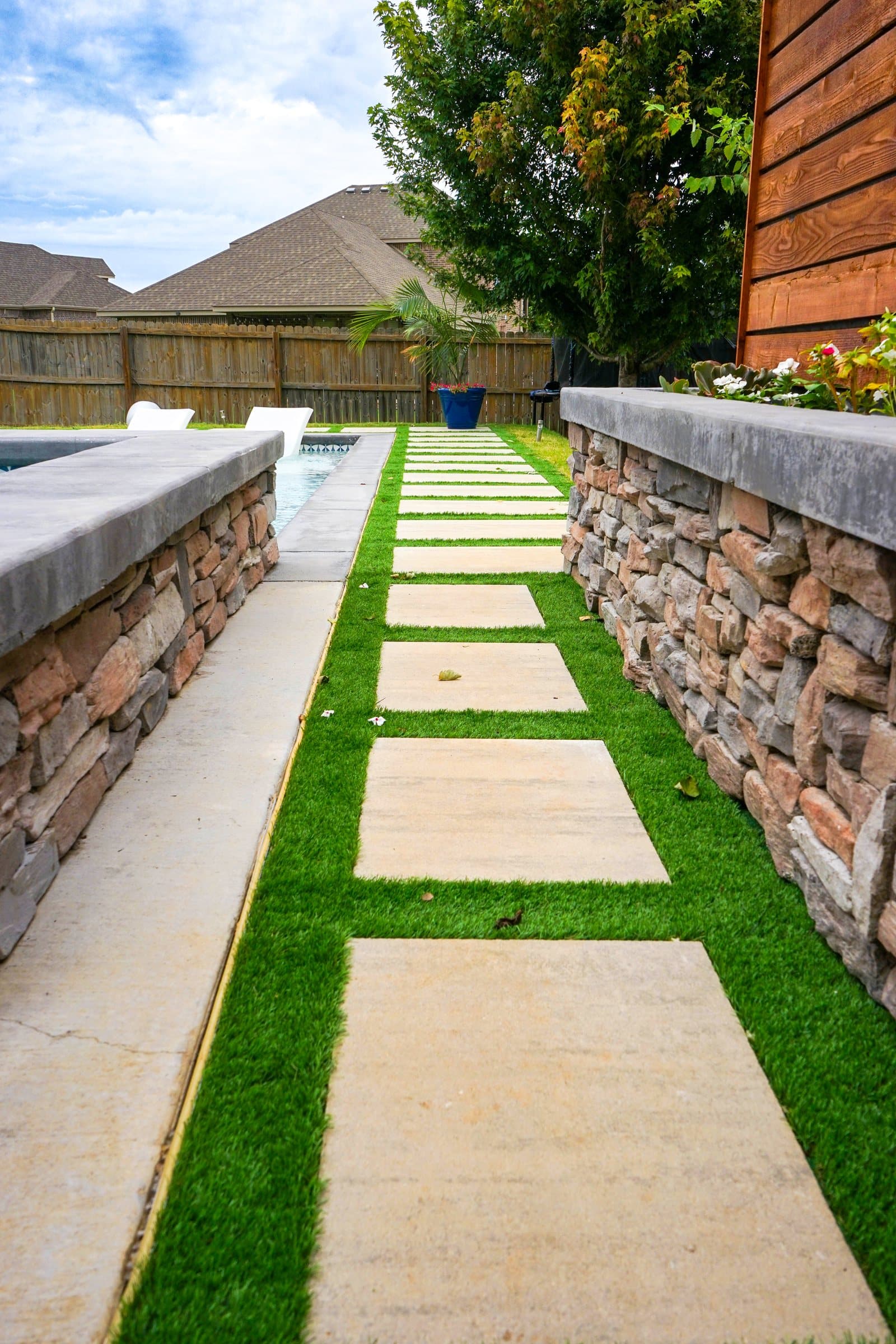

A paver patio in Arkansas lasts as long as its base, its drainage and its edge restraint hold, because the pavers themselves are rarely what fails. Units made to ASTM C936 are tested through 50 freeze-thaw cycles and can be lifted and relaid, so the surface is renewable. What wears out a patio early is water sitting in a thin, poorly compacted base, and in Northwest Arkansas that is decided largely by the ground you are building on.
01What actually decides how long a paver patio lasts?
The base decides it, and the pavers mostly go along for the ride. A paver patio is a system: compacted subgrade, a compacted aggregate base, a thin bedding layer, the units themselves, the sand in the joints and a restraint around the edge that stops the whole field creeping outward. Each layer depends on the one below it. When a patio fails, the cause is almost always a layer you cannot see.
That is good news for anyone buying one, because every one of those layers is something you can ask about before a single unit is laid. It also means two patios built with the identical paver can have completely different lives. The product on the pallet is the same. The work underneath it is not.
In this part of the state there is a sixth factor that most guides written for the rest of the country leave out, which is the ground itself. North of Fayetteville you are usually building on the Boone Formation, limestone and chert with red clay where the limestone has dissolved. From Fayetteville south you are on the Boston Mountains, where the Fayetteville shale swells when it is wet and shrinks when it dries. The same patio detail behaves differently on each, and a contractor who builds the same way on both is guessing.
02Do the pavers themselves wear out?
Rarely, if the product is made to the standard and laid properly. Concrete pavers made in the U.S. should meet ASTM C936, which ICPI Tech Spec 2 summarises: an average compressive strength of 8,000 psi, average absorption of no more than 5 percent, and resistance to at least 50 freeze-thaw cycles in a test that immerses the units in a saline solution. That test is deliberately harsher than a Cave Springs patio will see in an ordinary winter.
Low absorption is the property that matters most here. Water that soaks into a unit and then freezes expands by roughly nine percent, and a porous paver slowly spalls as that repeats. A dense, properly made unit does not take in enough water for that to happen at any meaningful rate.
The freeze season here is long enough to matter. National Weather Service records for Fayetteville going back to 1949 put the average first hard freeze, 28 degrees, around the first of November and the average last one around the second of April. That is five months in which a wet base can freeze, thaw and freeze again, often in the same week, which is why the water under a patio matters far more than the patio itself.
What does change over time is appearance. Colour on the surface softens as the exposed aggregate wears through, and a paver that looks crisp on handover day will look lived in some years later. That is weathering, not failure. The better products hold colour longer, and it is one of the few places where the price of the unit genuinely shows.
And unlike a slab, a damaged paver is not a permanent scar. It comes out, a new one goes in, and the field is whole again. Keep a few spare units from the original batch in the garage for exactly that reason.
03How the patio fails, and what each failure is telling you
Every common failure has a specific cause, and the symptom tells you which layer to look at. This is the short version; our guides on why a patio sinks and on pavers shifting and joints opening go deeper.
| What you see | Most likely cause | Usual fix |
|---|---|---|
| A dip where people walk or where a table sits | Base too thin or not compacted in lifts | Lift the area, rebuild and compact the base, relay the same units |
| Rows drifting outward at the edge, joints widening | Missing or failed edge restraint | Lift the edge courses, install proper restraint, reset |
| Weeds and ants in the joints, joints emptying | Joint sand washed out or never filled fully | Refill joints; consider stabilised joint sand |
| Water standing after rain | Too little fall, or fall toward a low point | Relay to a real slope; add drainage where needed |
| A bulge or heave in winter | Water trapped in the base freezing | Fix the drainage first, then relay |
| Broad settlement over one area | Soft or wet subgrade, or a void underneath | Excavate, find the cause, rebuild the base |
Notice what is missing from that table: pavers cracking on their own. When units crack, it is nearly always because the base under them moved first.
04Why the base is the whole answer
The base carries the load and moves the water, and a thin one does neither for long. ICPI Tech Spec 2 sets a minimum of 4 inches of compacted base for patios and pedestrian areas over well-drained soils, and notes that greater thickness is often used where there are numerous freeze-thaw cycles or expansive soils. Northwest Arkansas has both, and that minimum is written for ground that drains well, which much of ours does not.
Compaction matters as much as depth. The same bulletin describes compacting the base in lifts of 4 to 6 inches with a plate compactor, rather than filling the hole and running a machine over the top. Material compacted in one thick lift is dense at the surface and loose underneath, and the loose part is where settlement comes from two winters later.
Our guide on how deep a patio base should be in Arkansas covers the numbers. The short answer is that the right depth is decided on site, after the subgrade has been seen, and a quote that gives a base depth without anyone having looked at the ground is a guess written down.
05How does Northwest Arkansas ground change the answer?
It changes what can go wrong, so it changes what has to be built. The two halves of the metro are different engineering problems, twenty minutes apart.
On the Springfield Plateau, which covers Bentonville, Rogers, Springdale, Bella Vista, Centerton, Cave Springs and the towns around them, the Boone Formation is close to the surface. The Arkansas Geological Survey describes it as probably the most widespread and karst susceptible formation in the Ozark Plateaus. In practice that means chert and limestone turning up shallower than expected, pockets of red clay where the rock has dissolved, and water that finds its own route underground. A patio here usually lives or dies on whether the soft pockets were dug out and replaced, and whether subsurface water was given somewhere to go.
In the Boston Mountains, Fayetteville south through Farmington, Prairie Grove and Elkins, the concern is the shale. University of Arkansas geologist Walter Manger put it bluntly: "Shale expands and contracts, caused from the clay's weathering." A base laid on shale that is allowed to wet and dry will move with it. The answer is depth, separation and drainage: keep the water out of the subgrade and the subgrade stays still.
Neither ground is a reason not to build. Both are reasons to build to the site rather than to a standard detail.
06What maintenance actually extends the life?
Very little, and most of it is about water and joints. A well-built paver patio is one of the lowest-maintenance surfaces you can own, but the jobs that exist are worth doing.
- Keep the joints full. Joint sand is what locks the units together. Top it up where it has washed low, particularly after the first year when it settles in
- Keep downspouts off it. Concentrated roof water discharged onto a patio washes out joints and saturates the base in one spot
- Watch the edges. Soil and mulch built up against an edge can hide a restraint that has moved. Keep the edge visible
- Deal with a dip early. A small low spot is a small relay. Left through two winters it collects water and becomes a bigger one
- Choose de-icers carefully. In a hard freeze, use what the paver manufacturer recommends rather than whatever is on the shelf
Sealing is a choice rather than a requirement, and it has trade-offs. We have written it up separately in should you seal pavers in Arkansas.
07How does a paver patio compare with a slab over the long run?
A paver patio is repairable in a way a slab is not, and that is most of the long-run argument. When a slab cracks, the crack is permanent. You can seal it, fill it or overlay it, but it will always be there. When a paver field settles, the affected area is lifted, the base put right and the same units put back.
The same applies to what is underneath. If a line under a patio ever has to be reached, pavers come up and go back down. A slab is broken out and patched, and the patch never quite matches. Around a pool, or anywhere there is plumbing, lighting or gas under the surface, that difference is worth real money over the years.
The trade-off is that a paver patio asks a little more of its builder on day one. A slab hides a mediocre base for longer. Pavers expose it sooner, which is irritating if the base was poor and reassuring if it was good.
08What to ask before you buy one
Ask the questions that expose the base, because that is where a long life is bought. Every contractor will tell you their pavers are good. Fewer will answer these specifically:
- How deep will you excavate, and what happens if you hit rock or soft clay?
- What base material, how thick, and how many lifts?
- What edge restraint, and how is it fixed?
- What fall will the finished surface have, and where does the water go?
- Is the paver made to ASTM C936?
If the answers are specific, you are talking to someone who builds patios to last. If they are vague, the patio will be too. Our projects start around seven and a half thousand dollars, financing is available through Acorn Finance, and the site visit is where the ground gets looked at properly. Call (479) 379-2226.
FAQCommon questions
How long do pavers last compared to concrete?
The units themselves are durable and replaceable, so a paver patio is renewable in a way a slab is not. How long either lasts depends on the base and drainage under it far more than on the surface material.
Do pavers crack in freezing weather?
Units made to ASTM C936 are tested through 50 freeze-thaw cycles with low absorption, so freezing alone rarely cracks them. Cracks almost always follow movement in the base.
Why are my pavers sinking after a few years?
Usually a base that was too thin or not compacted in lifts, or water getting into the base and softening the subgrade. The fix is to lift the area, rebuild the base and relay the same units.
Can old pavers be reused when a patio is rebuilt?
Often, yes. Sound units can be lifted, cleaned and relaid on a new base, which is one of the real advantages of pavers over poured concrete.
Do I need to seal a paver patio for it to last?
No. Sealing changes appearance and can help with staining and joint sand, but it does not fix a poor base. It is a choice, not a requirement.
Does the ground in Fayetteville make pavers fail faster?
Not if the patio is built for it. The Fayetteville shale swells wet and shrinks dry, so the base and drainage need to be designed to keep water out of the subgrade.
How much maintenance does a paver patio need?
Very little: keep the joints topped up, keep roof water off it, and deal with any low spot early before it holds water through a winter.
REFSources
- ICPI Tech Spec 2: Construction of Interlocking Concrete Pavementsorco.com
- Arkansas Geological Survey: Karst in the Arkansas Ozarks, Part 2arkansasgeological.wordpress.com
- Talk Business & Politics: Shale rests at root of construction problemstalkbusiness.net
- National Weather Service Tulsa: Fayetteville hard freeze climatology (28F)weather.gov
NEXTGet it looked at properly
Everything above is general guidance. What your ground actually needs is a site visit, and ours costs nothing. Francisco Gallardo walks it, reads the grade and the drainage, and tells you what is possible.