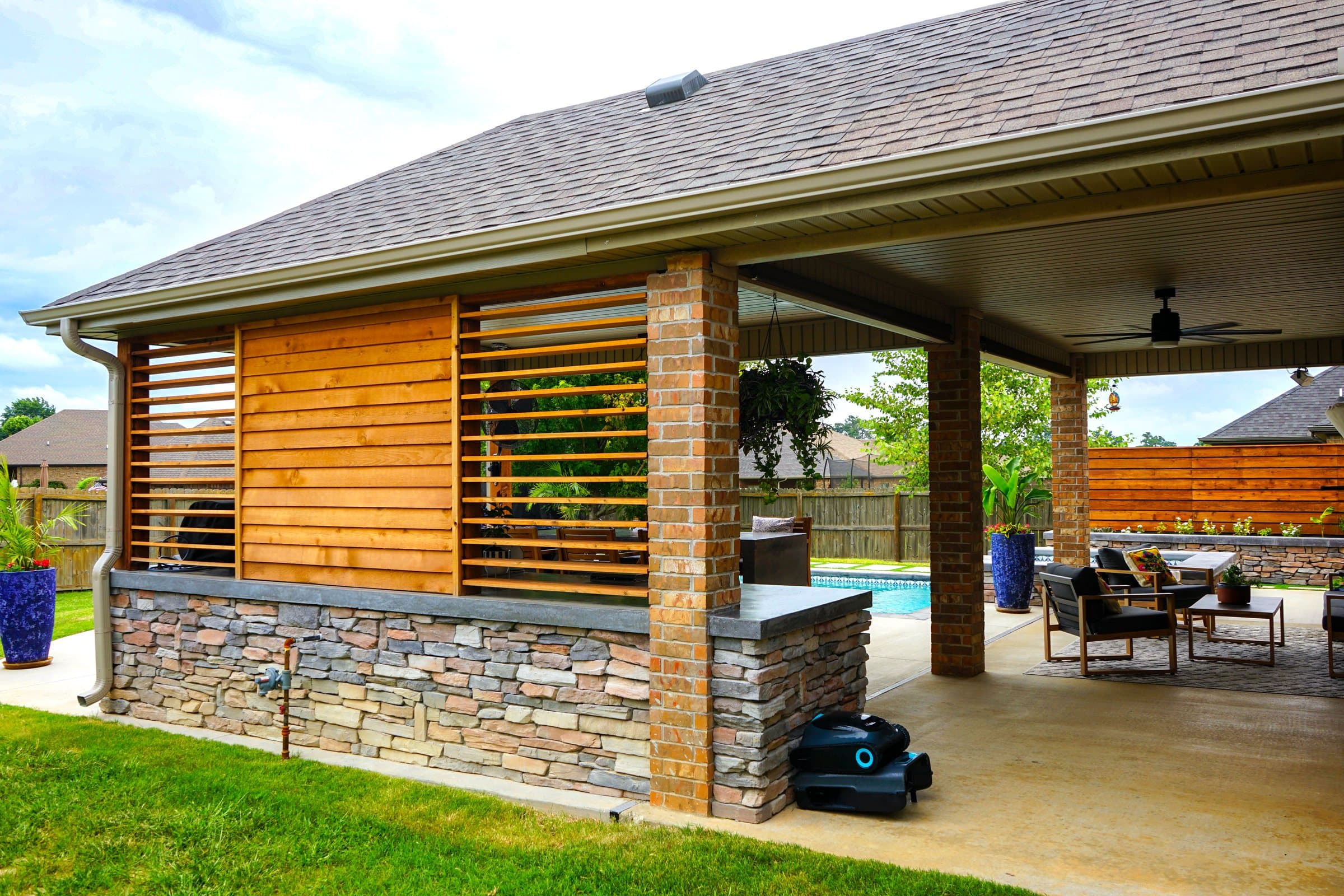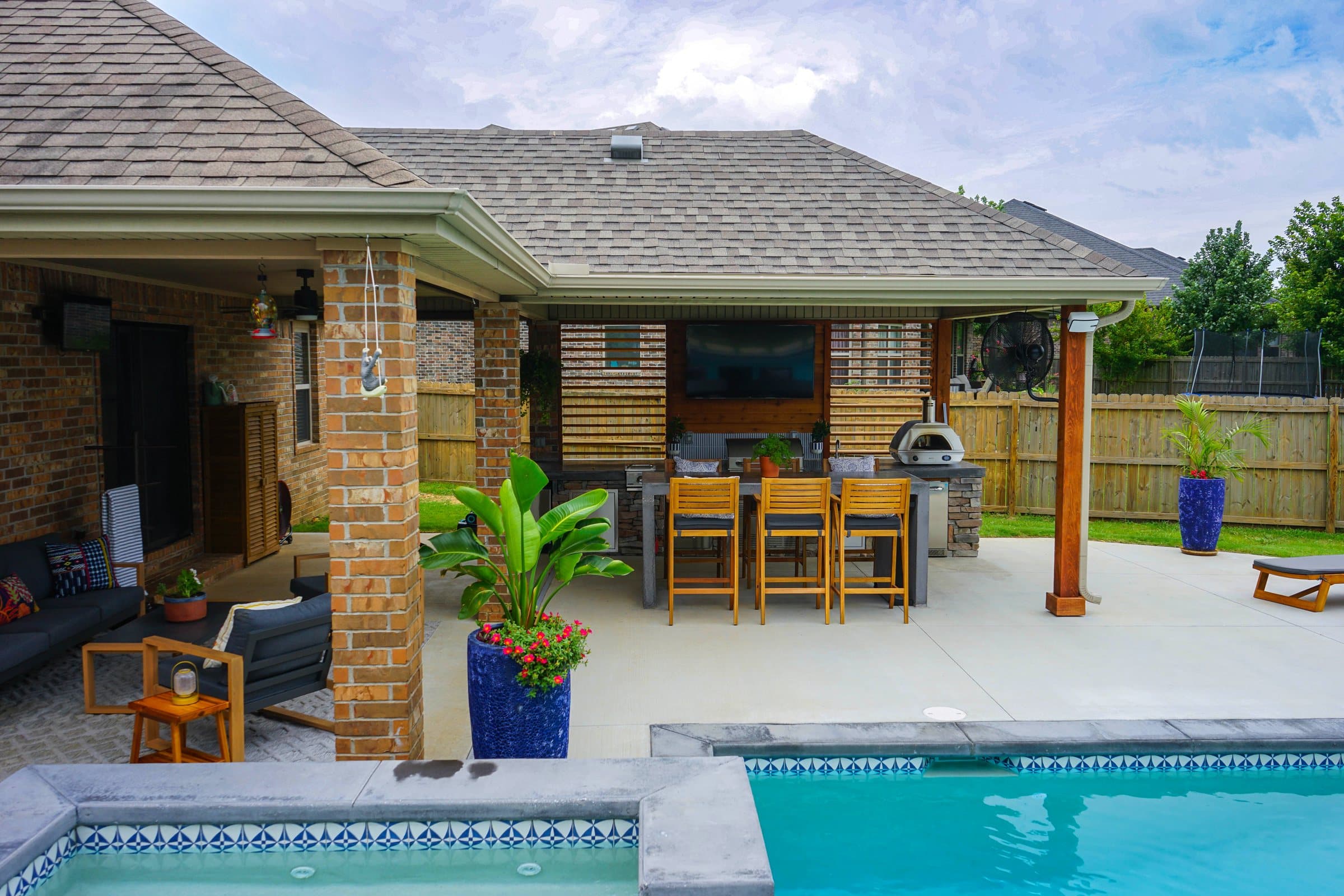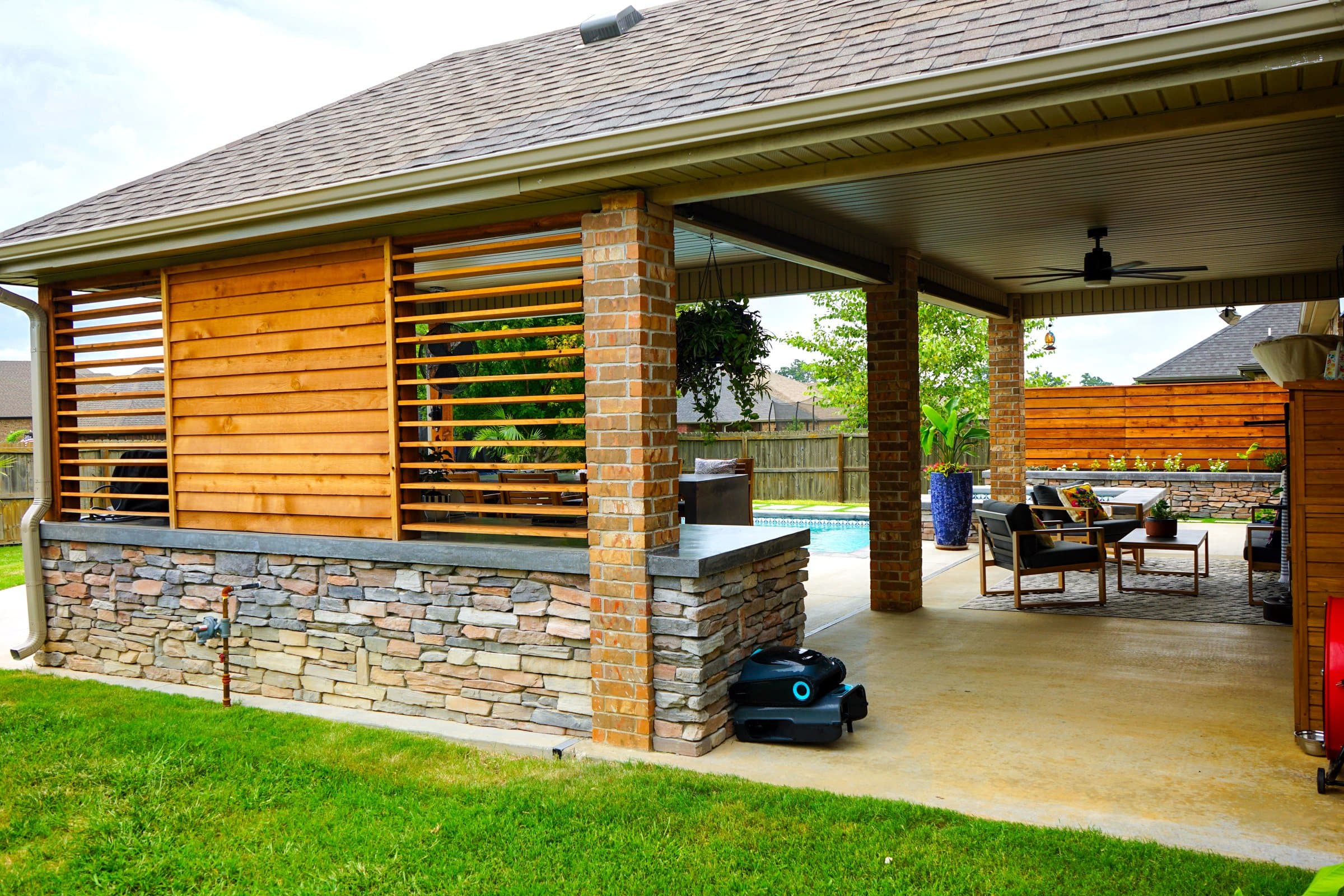

Light a patio in layers, using the lowest level that does the job: step and path lights for safety, soft downlight over dining and cooking, and a little accent light on walls and trees for depth. DarkSky's principles are a good design brief: every light has a purpose, points down and where needed, is no brighter than necessary, is on a timer or dimmer, and is no cooler than 3000K. Most residential landscape lighting runs at 30 volts or less under NEC Article 411, and the conduit goes in before the paving does.
01What is the goal of good patio lighting?
To see where you are stepping and who you are talking to, without lighting up the whole neighbourhood.
Most bad outdoor lighting is too bright, too blue and pointed in the wrong direction. A single floodlight on the back of the house blinds anyone looking toward it, flattens everything it hits and leaves black shadows behind every object. Good lighting uses many small, low, well-aimed sources, so the space reads as a room at night rather than a car park.
DarkSky International's Five Principles for Responsible Outdoor Lighting make a good brief because they line up with what looks best: light should be useful, targeted, low level, controlled and warm-colored.
02What layers should a patio have?
Safety, task and accent, in that order of importance.
| Layer | Where | Typical fixture | Aim |
|---|---|---|---|
| Safety | Steps, level changes, path edges, the back door landing | Recessed step lights, low path lights | Down onto the walking surface |
| Task | Grill and prep counter, dining table | Downlights under a roof, a shielded fixture over the counter | Down onto the work surface, not into eyes |
| Accent | Stone walls, trees, water features | Grazing lights at wall bases, shielded uplights | At the feature, not the sky beyond it |
| Ambient | Overall glow in a covered room | Dimmable fixtures, string lights on a dimmer | Low and warm |
Safety lighting is the one that cannot be skipped. Accent lighting is where the space gets its character, and it is also where people overdo it.
03What color of light looks best outdoors?
Warm white, 3000K or lower.
DarkSky recommends outdoor lighting no cooler than 3000K and prefers warmer. That also happens to be what flatters stone, cedar and skin. Cool white at 4000K or 5000K makes limestone look grey and faces look ill. Choose fixtures whose color temperature is stated, and keep it the same across the whole scheme, because mixing color temperatures is the most visible sign of piecemeal lighting.
04How should walkways be lit?
With pools of light on the ground, not a runway of glowing posts.
Path lights should throw light down and across the walking surface, with the source shielded so you see the lit ground rather than the bulb. Stagger them along alternate sides where the path curves, and place them where the path changes: a turn, a step, a junction, the gate. Even spacing down both sides of a straight path looks like an airport.
Where a walkway passes a wall, a light recessed into the wall at low height can wash the path and the wall face together, with no fixture in the planting at all. On a stone walkway, light raking across the surface shows texture and makes edges easy to read.
05How should steps be lit?
Every step, or every level change, visible from the top.
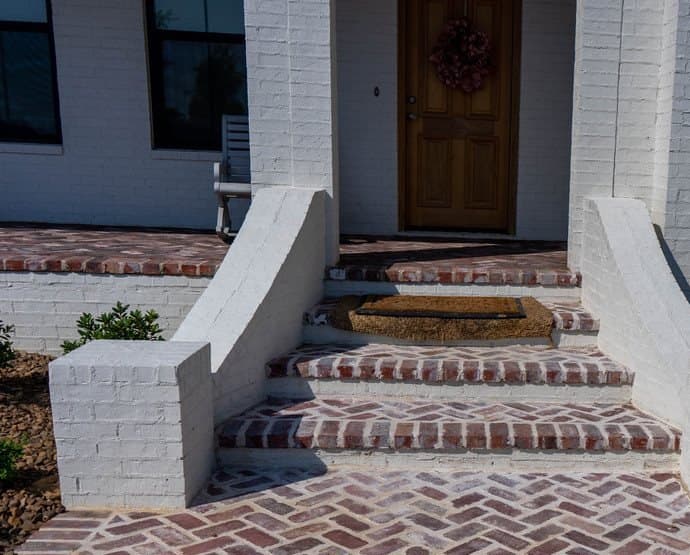
The accident on outdoor steps happens going down, when the edge of the next tread is hard to see. Recessed lights in the riser or in the side wall at each step, aimed down onto the tread, make each edge obvious. On a sloped lot with several flights, this is the lighting that matters most, and it is far easier to build into a stone or block step than to add afterwards.
Keep the fixtures low and shielded so someone walking up the steps is not looking into them.
06How bright should it be?
Dimmer than you think; outdoor eyes adapt.
Once your eyes adjust to the dark, a little light goes a long way, and contrast is what makes a space readable. A bright light near a dim area makes the dim area look black. DarkSky's low-level principle, to use the lowest light level required, is also the fastest way to a space that feels calm. Dimmers on the task and ambient layers let you turn it up for cleaning the grill and down for sitting.
If a scheme looks too dark on the first night, turn one layer up rather than adding fixtures. Adding fixtures is how schemes end up too bright.
07What voltage and wiring does landscape lighting use?
Usually low voltage, 30 volts or less, from a listed transformer.
NEC Article 411 covers lighting systems operating at 30 volts or less. It requires an isolating power supply and luminaires identified for the use, with output circuits limited to 25 amperes and 30 volts. Low voltage is why landscape lighting cable can be buried shallower than line-voltage circuits.
| Circuit | Minimum cover (NEC Table 300.5) |
|---|---|
| Landscape lighting, 30 V or less, UF or identified cable | 6 in (Column 5), except under driveways and parking areas |
| Same circuit under a residential driveway or parking area | 18 in |
| Listed low-voltage lighting system | As the manufacturer's installation instructions specify |
The transformer plugs into or is wired to a line-voltage outdoor outlet, which is electrician's work. Under a covered patio, ceiling fixtures and fans are usually line voltage and need a licensed electrician and, often, a permit.
08What has to go in before the patio is laid?
Conduit, sleeves and the fixture positions.
Cable run through planting beds is easy to add later. Cable that has to cross a patio, run up a wall or reach a step is not, because the only route afterwards is through the finished paving or masonry. Put sleeves under the patio wherever a cable might need to cross it, and set step lights and wall lights into the masonry as it is built.
Leave spare sleeves. They cost very little while the ground is open, and they are how a lighting scheme grows without lifting a single paver.
09How should it be controlled?
On a timer or a smart controller, with separate zones.
DarkSky's controlled principle is to have lights on when needed and off or dimmed when not. In practice, that means an astronomical timer that follows sunset, a later switch-off for accent lights, and separate zones for safety, task and accent so the path lights can stay on while the wall washers go off. Motion sensors suit side paths and bin areas better than patios, where a light snapping on and off mid conversation gets old quickly.
10How should a covered patio be lit?
With dimmable downlights for the room and something warm and low for the evening.
A roof gives you a ceiling, and that makes the lighting easier: recessed or surface downlights over the dining and cooking zones, on dimmers, with fixtures rated for damp or wet locations as the position requires. Aim them at the table and the counter, not at the seating, so nobody sits under a glare. A ceiling fan with a light kit is common here; put the fan and the light on separate controls so the fan can run on a humid evening without the light on.
Ceiling circuits under a cover are line voltage, which means an electrician and usually a permit. Plan the boxes before the ceiling boards go up.
11What about lighting near a pool?
Pool lighting is its own electrical category, with its own rules.
Lighting in and around pools falls under NEC Article 680, which sets distances and protection requirements for fixtures near the water. Landscape lighting on the deck and in the planting around it still follows the same design logic as the patio: low, shielded, warm, on controls. The pool builder and the electrician coordinate the pool lights themselves; the hardscape side is making sure the sleeves and fixture positions are in the deck before it is laid.
12Which fixtures survive the Northwest Arkansas climate?
Solid metal bodies, sealed lamps and fixtures rated for the location.
Outdoor fixtures here face humid summers, driving rain and winter freeze-thaw, and a step light set into masonry is expensive to replace. Choose fixtures rated for wet locations where they will be rained on, solid brass or copper bodies where you want them to weather rather than corrode, and integrated or sealed LED modules that keep moisture out. Cheap plastic path lights are fine in a flower bed you redesign every few years. They are not what belongs inside a stone wall.
13How do you keep the neighbours happy?
Aim every light at something on your side of the fence.
DarkSky's targeted principle is to shield and aim light so it points down and does not spill beyond where it is needed. In practice that means no uplight into open sky, no floodlights on the back of the house facing next door, and accent lights on trees aimed into the canopy rather than past it. It also means the timer turns accent lighting off at a reasonable hour. A garden that glows softly from within looks better from the neighbour's side too.
14How do we plan lighting with you?
Lighting is planned with the hardscape, so the sleeves, fixtures and circuits are in before the finish goes down.
Projects with us start around seven and a half thousand dollars, and financing is available through Acorn Finance if you would rather spread the cost than cut the scope. Call (479) 379-2226 or send the project form, and tell us what you are trying to do with the space.
FAQCommon questions
What color temperature is best for patio lighting?
Warm white, 3000K or lower, which DarkSky recommends and which flatters stone, wood and skin. Keep it consistent across the scheme.
How far apart should path lights be?
There is no single right spacing. Place them where the path changes, at turns, steps and junctions, and stagger them rather than lining both sides evenly.
How deep should low-voltage landscape lighting cable be buried?
NEC Table 300.5 gives 6 inches for landscape lighting at 30 volts or less in UF or identified cable, 18 inches under residential driveways and parking areas, or as a listed system's instructions specify.
Do outdoor steps need lighting?
Every step or level change should be visible from the top, especially going down. Recessed riser or side-wall lights aimed at the tread do this best.
Should patio lights be bright?
No. Use the lowest level that does the job; contrast, not brightness, makes a space readable at night. Put task and ambient layers on dimmers.
Can I add lighting after the patio is built?
In planting beds, yes. Across a patio, up a wall or into steps it means cutting into finished work, which is why sleeves and conduit go in first.
What are the DarkSky lighting principles?
Useful, targeted, low level, controlled and warm-colored: light only what needs it, aim it down, keep it dim, put it on controls and keep it at 3000K or below.
REFSources
- DarkSky International: Five Principles for Responsible Outdoor Lightingdarksky.org
- NEC Article 411: Lighting Systems Operating at 30 Volts or Lesselectricallicenserenewal.com
- NEC Table 300.5: Minimum Cover Requirementselectricallicenserenewal.com
NEXTGet it looked at properly
Everything above is general guidance. What your ground actually needs is a site visit, and ours costs nothing. Francisco Gallardo walks it, reads the grade and the drainage, and tells you what is possible.