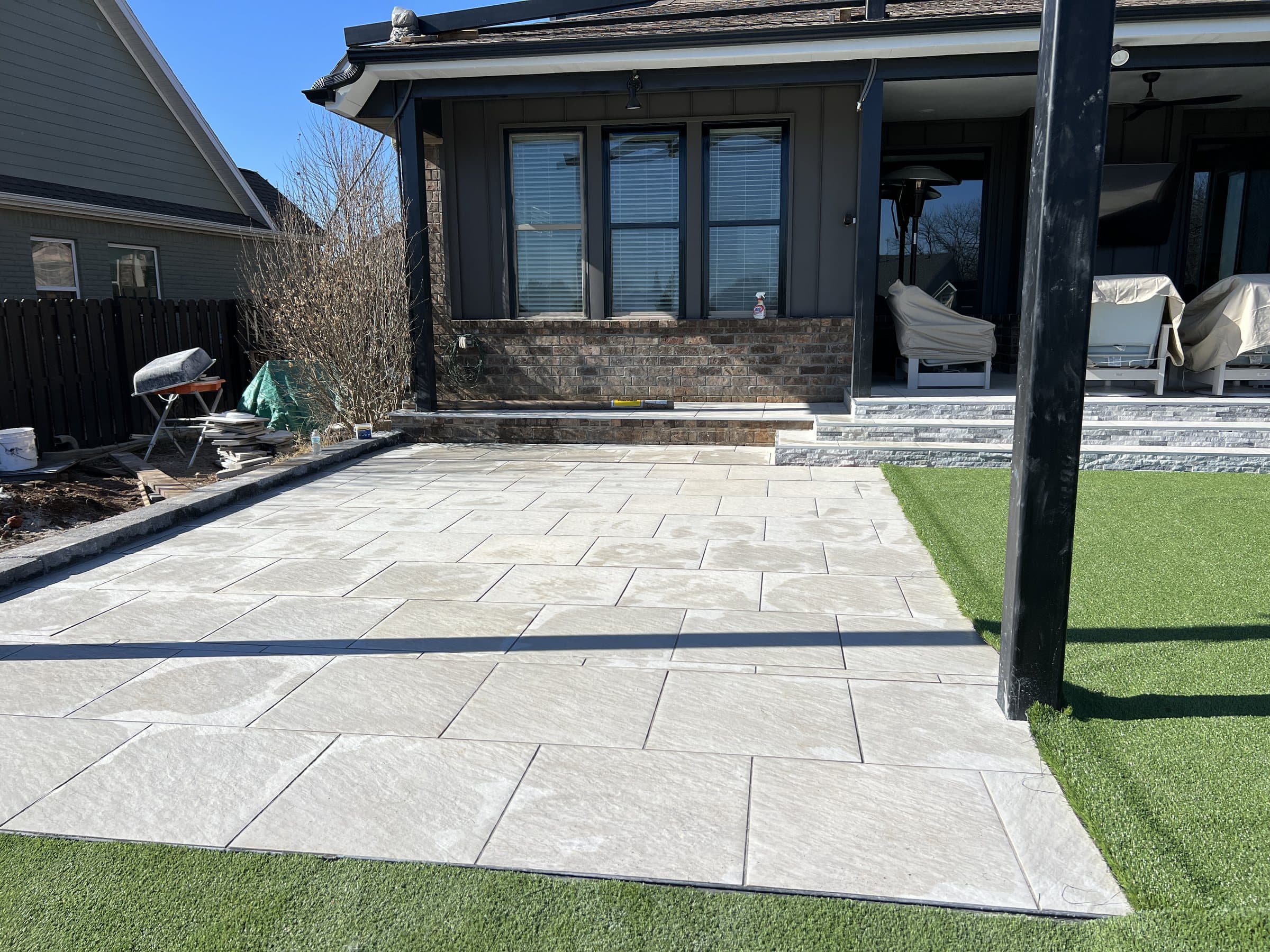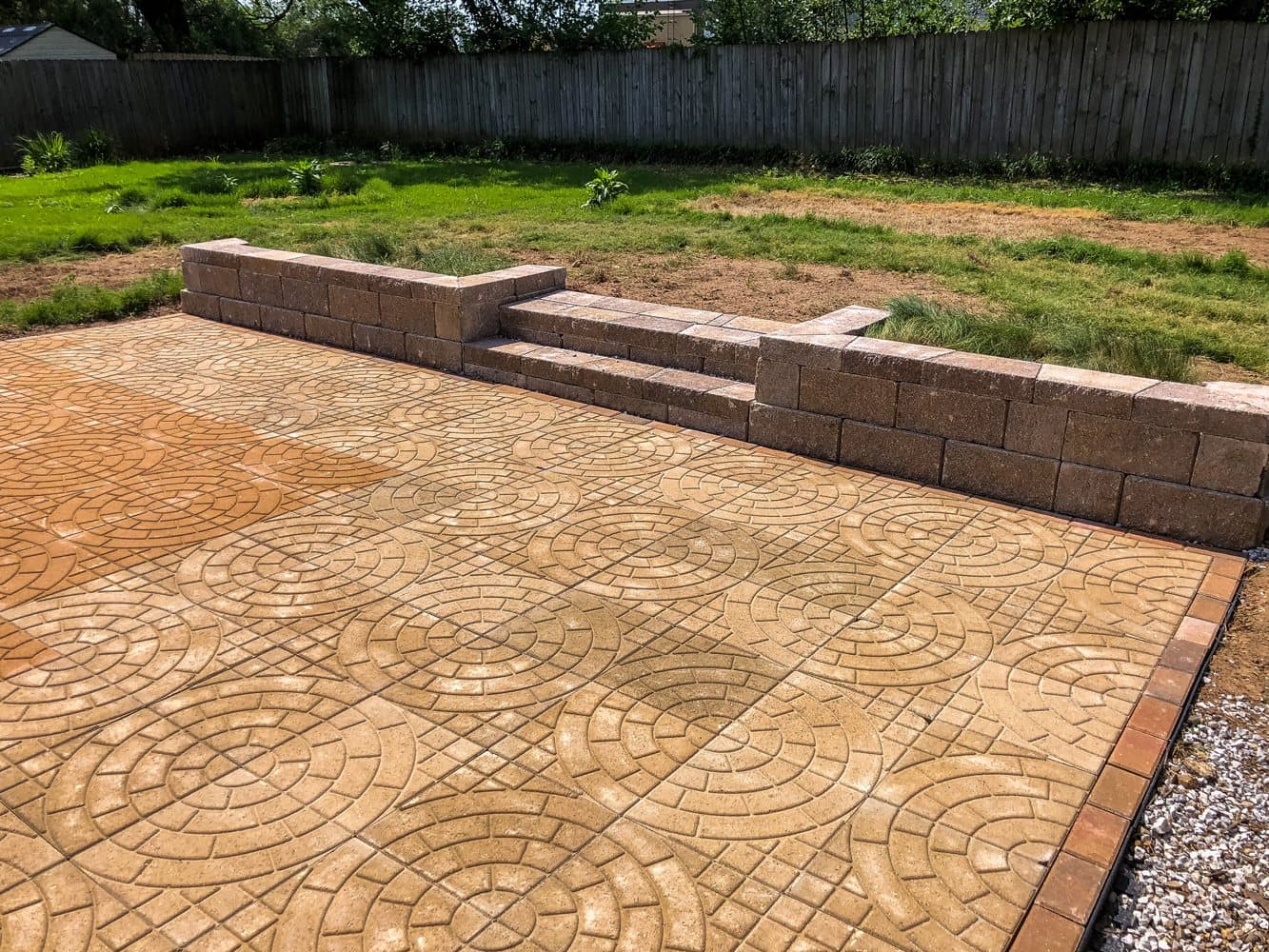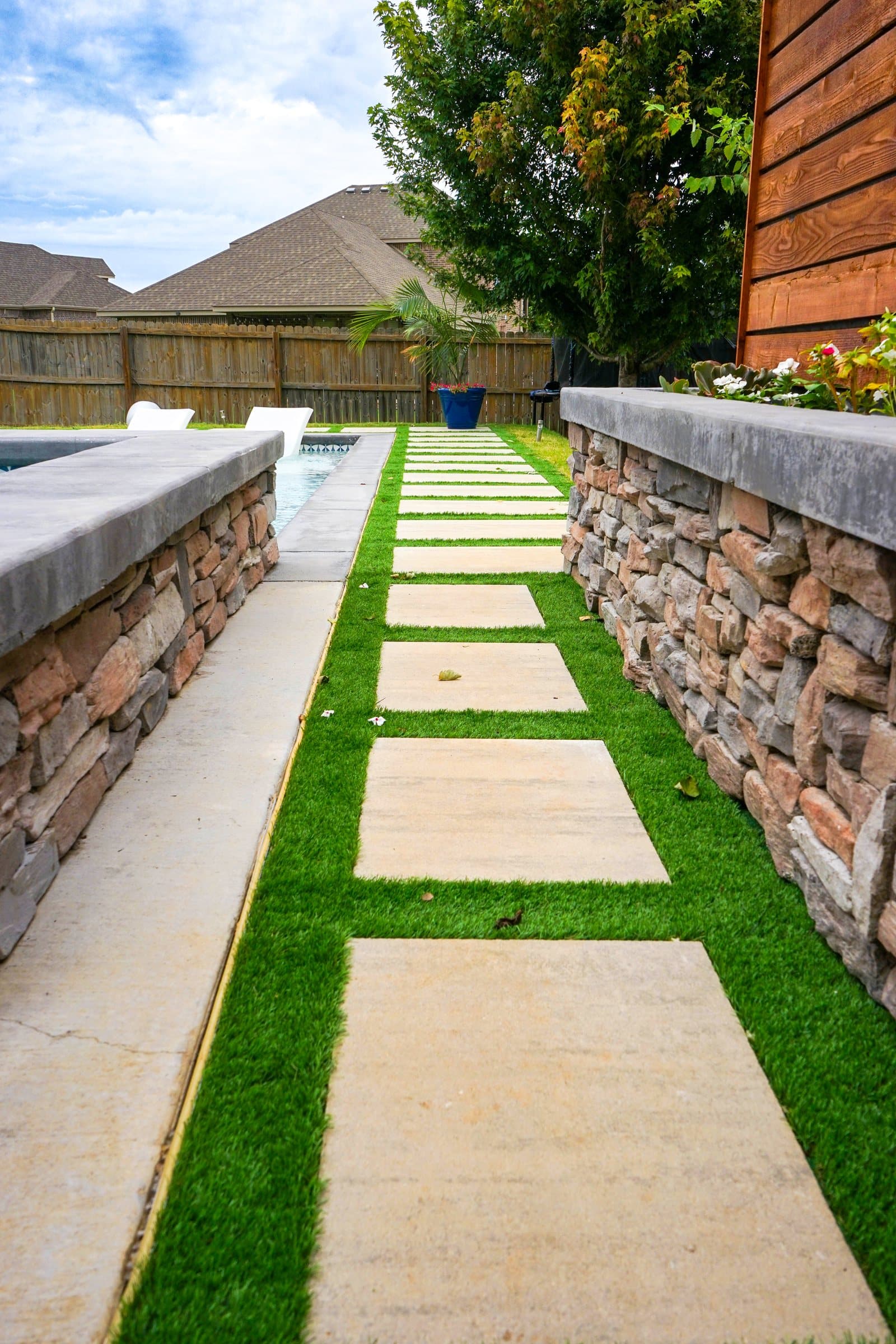

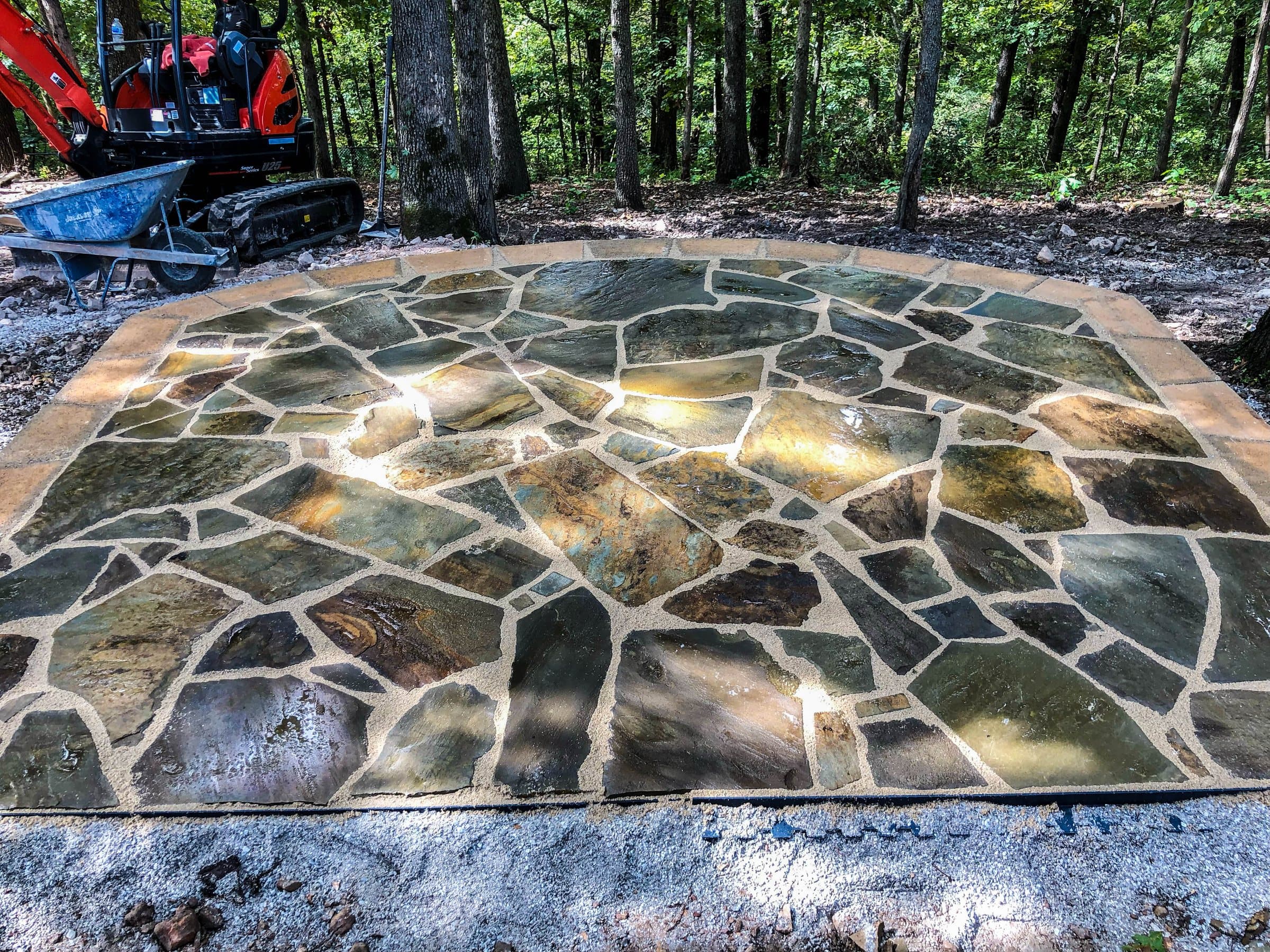
Drainage is the most common reason hardscape fails in Northwest Arkansas, and it is the line most often missing from a cheap quote. Water has to be moved away from the house and away from the structure through grade, a free-draining base and drain lines that actually discharge somewhere. If a quote does not state excavation depth, fall and where the water goes, it is not a complete quote.
01Why is drainage the thing that decides whether hardscape lasts?
Because almost every failure in this trade is water in the wrong place, and in a freeze-thaw climate water in the wrong place does damage twice.
Water sitting in a base softens it, so the surface settles where people walk. Water sitting behind a wall adds weight and pressure until the wall leans. And water that freezes expands by roughly nine percent, lifting whatever is above it, then leaves a void when it thaws. In Fayetteville the National Weather Service records an average first fall frost around 19 October and a last spring frost around 16 April, so a patio here lives through that cycle for half the year.
None of this is visible on the day the job is handed over. A patio with no fall and a drain line to nowhere looks identical to one built properly, right up until the second spring. That is why drainage is the part nobody quotes for and everybody pays for.
02What does the ground under Northwest Arkansas do to water?
It depends which of two very different grounds you are on, and a good design starts by knowing which.
North of Springdale, across Benton County and the top of Washington County, you are on the Springfield Plateau. The Arkansas Geological Survey describes the Boone Formation there as limestone interbedded with chert, and as one of the most karst-prone formations in the Ozarks, with abundant sinkholes, springs and caves. Where the limestone has dissolved you are left with red clay full of chert fragments. In practice water does not soak evenly into that ground. It finds routes through fractures and along rock, and if one of those routes runs under your new patio, you find out in the second year.
From Fayetteville south into Farmington, Prairie Grove and Elkins you are on the Boston Mountains, where the Fayetteville shale swells when it takes on water and shrinks when it dries. University of Arkansas geologist Walter Manger described it plainly: “Shale expands and contracts, caused from the clay's weathering.” On that ground, keeping water out from under the hardscape is the difference between a surface that holds and one that heaves.
Two towns twenty minutes apart are two different drainage problems. A contractor who designs them the same way is guessing on at least one of them.
03What should a proper quote say about drainage?
A proper quote says, in writing, how deep the dig goes, what goes back in, which way the surface falls and where every drop of water ends up.
| Item | What a complete quote says | What a thin quote says |
|---|---|---|
| Excavation | Depth, and what happens to the spoil | Nothing, or “prep” |
| Base | Material, compacted thickness, compacted in lifts | “Gravel base” |
| Fall | Direction and slope across the finished surface | Not mentioned |
| Surface water | Where it is collected and where it discharges | Not mentioned |
| Subsurface water | Drain lines, and where they daylight | “French drain” with no outlet |
| Downspouts | Rerouted, tied in or discharged away from the work | Left where they are |
| Walls | Drainage aggregate behind, drain pipe at the base | Block and backfill |
If those lines are missing, ask. The answers separate contractors faster than the price does. For the rest of the document, see how to read a hardscape quote.
04How much fall does a patio need?
Enough to move water off the whole surface and away from the house, consistently, with no flat spots.
The Interlocking Concrete Pavement Institute's construction guide sets a minimum surface slope of 1.5 percent for paver installations, and the direction matters as much as the amount. It must fall away from the foundation, towards somewhere the water can go. A patio that sends water at the house is worse than no patio at all.
The fall starts in the base, not the surface. If the base is laid flat and the installer tries to create fall in the bedding layer, the bedding ends up thick at one end and thin at the other, and it settles unevenly. The same guide calls for the base to be compacted in lifts of four to six inches rather than dumped and run over once, and for any perforated pipe to be sloped and directed to an outlet. Those details are unglamorous and they are the job.
05What are the classic Northwest Arkansas drainage failures?
The same handful of mistakes account for most of the failures we are called out to.
Fall toward the house. Water pools against the foundation, then finds its way under the slab or into the crawlspace.
A drain line to nowhere. Pipe installed, never daylighted, so the system fills with water and silt and stops working. A pipe that goes nowhere is decoration.
Downspouts discharging onto new hardscape. A roof collects a lot of water and a downspout concentrates all of it into one spot. Aimed at a new patio, it washes out joints and saturates the base in exactly one corner.
Retaining walls with no drainage behind them. The segmental wall industry's design guidance calls for at least twelve inches of free-draining aggregate behind the units and a drain pipe of at least three inches at the base. Without that, saturated soil pushes until the wall leans. See why retaining walls fail.
Ignoring the neighbour's water. On a slope, some of the water on your lot started on someone else's. It has to be intercepted and routed, not wished away.
06Is a French drain always the answer?
No: a French drain is one tool, and it only works if the water has somewhere lower to go.
Sometimes grade alone solves the problem. Reshaping the ground so it sheds water around the patio, into a swale or a planted area, is cheaper and has nothing to clog. Sometimes a surface channel drain across a threshold is the right answer. Sometimes the fix is rerouting two downspouts. A French drain earns its place where subsurface water is moving through the ground and needs intercepting, and only when its outlet is lower than its inlet and discharges somewhere legal.
On the karst plateau we are also careful about where water is concentrated. Dumping a roof's worth of water into one spot in ground that already has natural voids is not somewhere to experiment.
07Why do hills make this bigger, and why does flat not make it go away?
Slopes make drainage urgent; flat ground makes it slow and easy to ignore.
On the Fayetteville and Bella Vista hills water arrives with energy, carrying soil and mulch, and it has to be managed deliberately with grade, walls and outlets. In Fayetteville, slopes of fifteen percent or more, the Hillside/Hilltop Overlay and walls over four feet bring a grading permit and a sealed plan into play (checked September 2026; confirm with the city).
Flat ground in Springdale, Lowell or Centerton does not drain by itself either. It just fails more slowly and less visibly. A flat patio on a flat lot holds a sheet of water after every storm, and that water goes down into the base.
08What should you look for on your own lot after heavy rain?
The best drainage survey you can do yourself is a walk round the house in a coat during, or just after, a proper downpour.
Watch where water leaves each downspout and where it goes next. Look for sheets of water crossing the lawn toward the house, puddles that are still there an hour later, and lines of washed mulch or bare soil that show where water runs every time. Check the base of any existing wall for water seeping through the face instead of out of a drain. Look at the neighbour's side too: on a slope, their runoff is part of your design.
On shale ground further south, look at the trees. Walter Manger's advice to Fayetteville buyers was that straight trees mean no problem and tilting trees mean ground on the move. It is a crude test and a useful one.
Take photographs. A phone video of where water actually runs during a storm is worth more at a site visit than any description, because the day we visit may be dry.
09How does drainage change around a pool or an outdoor kitchen?
It gets stricter, because there is more water, more services in the ground and more expensive things sitting on top.
A pool deck has to shed splash water and rain away from the pool and away from the house at once, which usually means the deck falls to drains or to a planted edge rather than simply away in one direction. Pool plumbing and lighting lines run under or beside the deck, so the base has to drain without being saturated around them. See concrete or pavers around a pool for why repairability matters there.
An outdoor kitchen adds a sink, which adds a waste line that has to go somewhere lawful, and a supply line that has to be drainable before the first hard freeze. Both are drainage questions as much as plumbing ones, and both are far easier to design at the start than to add later.
10When should drainage be designed?
Before anything else, because once the surface is down the only way to fix what is under it is to take the surface up.
We walk the site with drainage first: where water arrives, where it sits, where it can legally leave. A February visit, with the leaves off and the ground wet, tells you more about where water goes than the same visit in July. Before any digging, Arkansas 811 is called to mark the buried utilities, which is free and required. Then the design follows the water. Call Paco on (479) 379-2226 if you want it looked at.
FAQCommon questions
How much slope does a patio need to drain?
Industry guidance for pavers sets a minimum of 1.5 percent, falling away from the house to somewhere the water can go. The fall is built into the base, not faked in the bedding layer.
Can drainage be added after a patio is built?
Sometimes, around the edges. Anything under the surface means taking the surface up, which is why drainage belongs in the original scope.
Is a French drain always the answer?
No. Sometimes grade alone solves it, sometimes rerouting downspouts does. A French drain only works if its outlet is lower than its inlet and discharges somewhere legal.
Why is water pooling on my patio?
Usually no fall, a flat spot from base settlement, or a downspout discharging onto it. Our guide to water pooling on a patio walks through each cause.
Where should my downspouts go?
Away from the house and away from the new hardscape, into a drain line with a real outlet or onto ground that can take it. Never straight onto a new patio.
Does karst ground in Benton County affect drainage?
Yes. Water moves through fractures and along rock rather than soaking in evenly, so it has to be routed deliberately rather than assumed to disappear.
Do I need a grading permit in Fayetteville?
You may, if the site is in the Hillside/Hilltop Overlay, in a floodplain, on a slope of fifteen percent or more, or involves a retaining wall over four feet. Checked September 2026.
REFSources
- ICPI Tech Spec 2: Construction of Interlocking Concrete Pavementsorco.com
- CMHA (formerly NCMA) SRW-TEC-004: Segmental Retaining Wall Designcmha.org
- Arkansas Geological Survey: Karst in the Arkansas Ozarks, Part 2arkansasgeological.wordpress.com
- City of Fayetteville: General Grading Plan Requirementsfayetteville-ar.gov
- National Weather Service Tulsa: Fayetteville frost and freeze climatology (32F)weather.gov
NEXTGet it looked at properly
Everything above is general guidance. What your ground actually needs is a site visit, and ours costs nothing. Francisco Gallardo walks it, reads the grade and the drainage, and tells you what is possible.