
An outdoor kitchen in Northwest Arkansas needs three things a warm-climate one does not: water lines that can be fully drained, materials and appliances that tolerate freeze-thaw, and a roof. The roof is the biggest single factor in how much it gets used. Covered, an outdoor kitchen is usable for most of the year here; uncovered, it is a summer appliance.
01What makes an outdoor kitchen different in Northwest Arkansas?
Winter is the difference: a kitchen here has to survive months of freezing and thawing, not just a hot summer.
The National Weather Service's Fayetteville records put the average first fall frost around 19 October and the average last spring frost around 16 April, with hard freezes of 28°F typically from early November to early April. That is roughly half the year in which water left in a pipe, a joint or a porous stone can freeze. Water expands by roughly nine percent as it freezes, and it will split a copper line or lift a tile as easily as it heaves a patio.
A kitchen designed for Arizona or Florida and built here without changes will look good for one summer. One designed for this climate is built to handle real freeze-and-thaw seasons, and it is used from March to November without anyone thinking about it.
02Does an outdoor kitchen need a roof?
Yes, if you want it used for more than nice weekends in summer.
This is the whole article in one line. A covered kitchen gets used in March and October and on rainy evenings in June. An uncovered one gets used when the forecast is perfect, which in Northwest Arkansas is less often than people remember. A roof also keeps rain and ice off the counters and the appliances, which extends the life of everything else on this page.
The roof can be a covered patio tied into the house, which keeps the cook close to the indoor kitchen, or a freestanding pavilion placed where the view and the evening light are best. We cover that choice in pergola, pavilion or covered patio. An open pergola is not a roof, and it does not protect a kitchen.
A roof over a cooking area also has to be designed for it: clearances and venting around the grill, and a ceiling that is not going to collect grease and smoke. That is a design decision, not something to improvise on install day.
03How do you stop water lines freezing?
You design every water line so it can be completely drained, and then somebody actually drains it before the first hard freeze.
Any line that cannot be fully emptied will eventually freeze and split. The fix is built in at the start: a shutoff inside the heated envelope of the house or in a protected location, lines that fall back to a drain point, and no low loops where water can sit. The University of Arkansas Cooperative Extension's standing advice for outdoor faucets applies directly: turn off the supply, drain all the water from the spigot and the pipe so nothing is left behind, and disconnect hoses and attachments.
This is the most common winter failure in outdoor kitchens in this climate, and it is entirely preventable at build time. It is also why the sink, the ice maker and the refrigeration need thought beyond the catalogue page: anything holding water has to be emptied or protected when the temperature drops.
04Which materials survive freeze-thaw?
Materials survive when water cannot get into them or behind them, and the detail matters more than the product name.
| Element | What winter does to it | What to specify |
|---|---|---|
| Water lines | Trapped water freezes and splits the pipe | Fully drainable runs, accessible shutoff, no low loops |
| Stone and tile cladding | Water behind it freezes and pushes it off | Detailing that sheds water, stone suited to freezing climates |
| Countertops | Standing water and ice at joints and edges | A surface that sheds water, sealed where the material needs it |
| Cabinets and doors | Swelling, rust, failed hardware | Genuinely outdoor-rated units, not indoor cabinetry under a roof |
| Appliances | Moisture and freezing in components | Units rated for outdoor use, covered when idle |
| Kitchen base and slab | Settlement and heave under a heavy island | Base designed for the load and kept dry |
Stone and tile have to be laid so water cannot get behind them and freeze. Counters should shed water rather than pool it. Cabinetry needs to be genuinely outdoor-rated, and stainless appliances should be specified for outdoor use and still covered when they are not in use, even under a roof.
05What does the ground under the kitchen have to do?
It has to carry a heavy masonry island without moving, which on Northwest Arkansas ground means designing the base rather than assuming it.
A stone-clad island with a pizza oven is far heavier per square foot than a patio with chairs on it. If the base under it settles or heaves differently from the patio around it, the counters crack at the joints and the doors stop closing.
On the Springfield Plateau, around Bentonville, Rogers, Bella Vista, Centerton and Cave Springs, the Boone Formation puts limestone and chert close to the surface, so excavation often hits rock sooner than planned. That is good bearing, but it has to be dealt with properly. From Fayetteville south, the Fayetteville shale swells wet and shrinks dry, which is why UA geologist Walter Manger summed it up as “Limestone is good. Shale is bad.” On shale, keeping water away from the kitchen base is not optional.
06What do people actually use?
Grill, refrigeration, prep space and somewhere to sit, in that order.
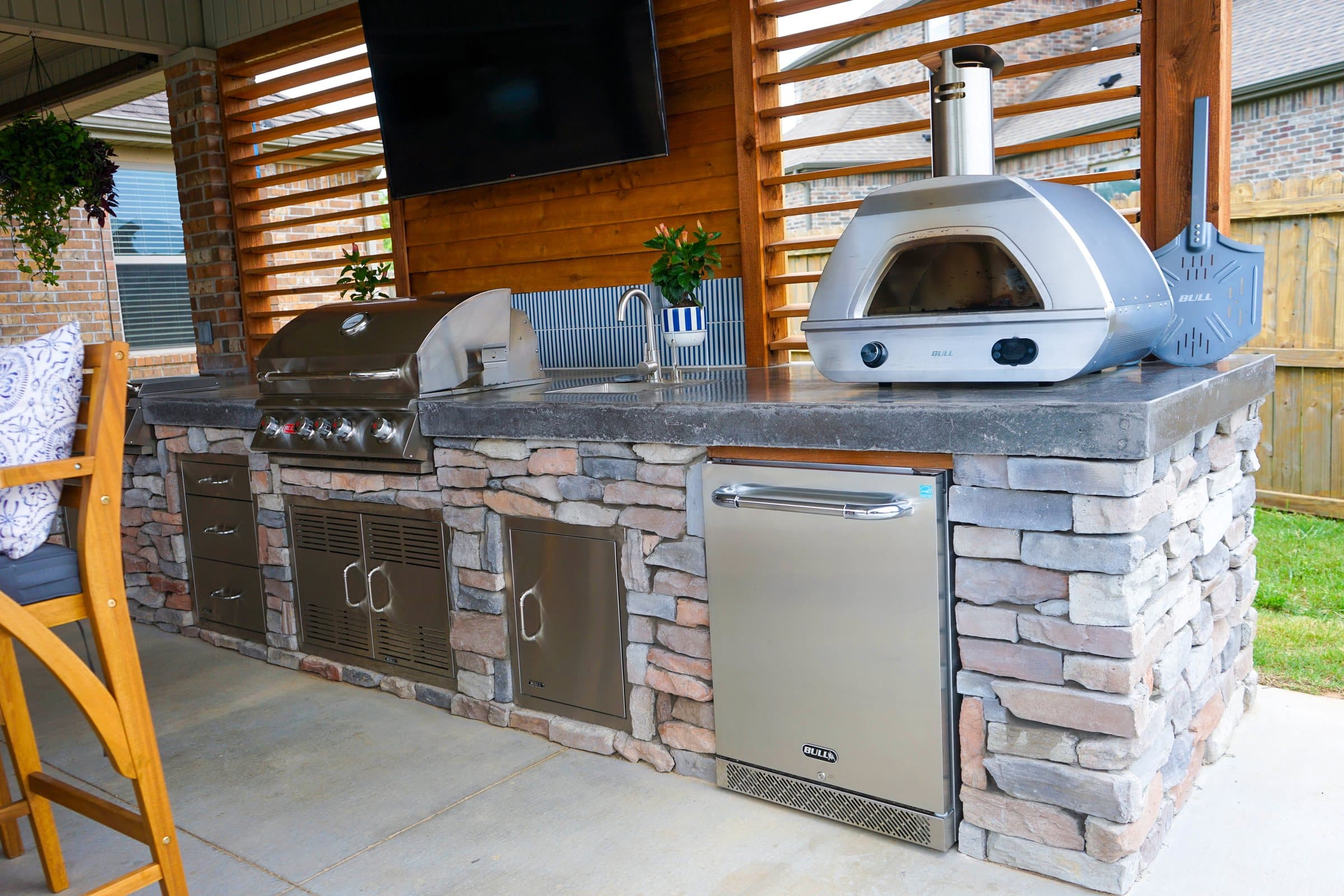
A pizza oven gets used more than most people expect, and it is what guests gather around. A sink is loved by the person cooking and ignored by everyone else, which is reason enough. Bar seating on the far side of the counter turns the cook from a servant into the host, and it is the single layout decision that most changes how the space feels.
The Swindle build in Cave Springs is a good example of the working version: a covered kitchen with a pizza oven, a stainless run and bar seating, framed by cedar slat screens and stacked stone, overlooking the pool. It gets used because it is covered, because the cook faces the guests, and because everything needed is within a step. For clearances and counter depths, see outdoor kitchen dimensions and layout.
What gets used least: a second grill, a warming drawer nobody remembers, and anything placed so far from the seating that the cook is alone.
Lighting belongs on the same list. Task lighting over the grill and the prep counter turns a kitchen that stops at sunset into one that works through an October evening, and it is far easier to wire while the structure is going up than to add to a finished ceiling.
07Where should the kitchen go on the lot?
Put it where the cook can reach the house, the guests can reach the cook, and the smoke goes somewhere other than the dining table.
Distance from the indoor kitchen matters more than people expect. Every trip for a plate, a knife or something from the fridge is a trip, and a kitchen fifty yards away gets used for parties rather than for Tuesday dinner. On a larger lot that is a fair trade if the destination is worth it, but it should be a decision rather than an accident.
Wind and sun decide the rest. In Northwest Arkansas summer evenings, the low western sun is the thing that drives people indoors, so a kitchen that puts the cook squinting into it will be avoided. Prevailing wind decides where smoke from the grill and the pizza oven drifts; get it wrong and the smoke ends up in the seating or through an open window. Cedar slat screens on one or two sides handle a lot of this, blocking low sun and breaking the wind without closing the room in.
Levels matter too. The kitchen floor, the patio and the house threshold should agree, with the kitchen area falling away from the house like everything else. A step in the wrong place with a tray in your hands is a design fault, not bad luck. And the kitchen should sit where machinery and materials can reach during the build, which on a tight older lot around the Bentonville square is a genuine constraint.
08What services and permits does an outdoor kitchen need?
Gas, water, drainage and power all have to be planned before the patio goes down, and most of them bring a trade permit.
Checked September 2026: Rogers lists plumbing, electrical and mechanical work and covered patios among the work needing a permit. In unincorporated Benton County, detached Group U structures no longer need a building permit, but trade permits for electrical, plumbing and HVAC work still apply. Other cities differ, so confirm with yours. Before any trench is dug, Arkansas 811 has to be called to mark buried utilities; it is free and required.
Run gas, water and conduit while the ground is open, even if the kitchen is a year or two away. It costs little now and a great deal once the paving is down.
09How do you winterise an outdoor kitchen?
Drain the water lines, cover the appliances, and empty anything that holds water. It takes about half an hour and prevents the expensive failure.
- Shut off the water supply at the valve
- Open the taps and drain points and let every line empty completely
- Disconnect hoses and sprayers
- Empty and unplug the refrigeration and ice maker, doors propped open
- Clean and cover the grill and any stainless surfaces
- Clear leaves from the roof gutters so meltwater goes where it was designed to
Do it before the first hard freeze, which in Fayetteville averages around the start of November. Reverse it after the last one in spring. Call Paco on (479) 379-2226 to talk through a kitchen built for all of that from the start.
FAQCommon questions
Will an outdoor kitchen survive an Arkansas winter?
Yes, if the water lines drain completely, the materials are detailed to shed water and the appliances are outdoor-rated. Most winter failures are water left in lines.
Do I need to winterise an outdoor kitchen in Arkansas?
Yes. Shut off and drain the water lines, disconnect hoses and cover the appliances before the first hard freeze, which in Fayetteville averages around the start of November.
Does an outdoor kitchen need to be covered?
If you want it used outside of perfect summer weekends, yes. The roof is the biggest single factor in how much an outdoor kitchen gets used here.
Is a sink worth it in an outdoor kitchen?
For the cook, yes. It needs a supply line that drains fully for winter and a waste line with somewhere lawful to go, so plan it at the start.
Do I need a permit for an outdoor kitchen?
The gas, plumbing and electrical work usually needs trade permits, and a covered structure often needs a building permit. Rules vary by city, so confirm with yours.
What is the most used feature of an outdoor kitchen?
The grill, then refrigeration and prep space. A pizza oven gets used more than people expect, and bar seating changes how the whole space feels.
How much does an outdoor kitchen add to a project?
It depends on the appliance package, the masonry and the services. It is priced with the rest of the build after a site visit. Our projects start around seven and a half thousand.
REFSources
- National Weather Service Tulsa: Fayetteville frost and freeze climatology (32F)weather.gov
- National Weather Service Tulsa: Fayetteville hard freeze climatology (28F)weather.gov
- University of Arkansas Cooperative Extension: Protect pipes and conserve wateruaex.uada.edu
- City of Rogers: When is a permit required?rogersar.gov
- Benton County Building Safety: Permitsbentoncountyar.gov
NEXTGet it looked at properly
Everything above is general guidance. What your ground actually needs is a site visit, and ours costs nothing. Francisco Gallardo walks it, reads the grade and the drainage, and tells you what is possible.