
For a patio on the backfill next to a new house, wait through one full wet season, which in practice means about a year. No code sets the number. You can skip the wait by digging out the loose fill under the patio and rebuilding it with compacted aggregate, and a patio out in the yard on undisturbed ground does not need to wait at all.
01How long should I wait after building a house to put in a patio?
About a year if the patio sits on the backfill, no time at all if it does not.
There is no rule in the Arkansas residential code that says how long to wait, and we could not find one from a standards body either. The figure you hear from builders is about a year: one builder's step-by-step guide to house construction says it takes about a year for backfill to settle, and warns against filling only to grade if a patio or driveway is going over that area. A year matters less as a number of days than as a full cycle of seasons: a wet spring, a dry summer and a winter of freezes. After that, most of the settling that is going to happen quickly has happened, and you can see where the ground has dropped.
The more useful question is which part of your yard is backfill. That decides whether the wait applies to you at all.
02What is backfill, and why does it keep settling?
It is the soil pushed back around the foundation after the walls were poured, and it was never as dense as the ground it replaced.
To build the foundation, the crew dug an area wider than the house so they had room to work. Once the walls were up, soil went back into that gap. Even when it is compacted in layers, which is the right way, it ends up looser than the ground that was never dug. Rain soaks into it faster than into the surrounding soil, and each soaking lets it pack down a little more. Near the foundation it is also the hardest place to compact well, because heavy equipment has to stay off fresh walls.
In Benton County that backfill is often red clay with chert fragments, over a subsoil layer that water barely gets through. Water that gets into the backfill tends to stay in it rather than draining down, which keeps it soft through the wet months. Our guide to chert and red clay explains why the ground here drains the way it does.
03How do I know which part of my yard is backfill?
Look for the band of softer, lower or differently colored soil around the house, and ask your builder for the plans.
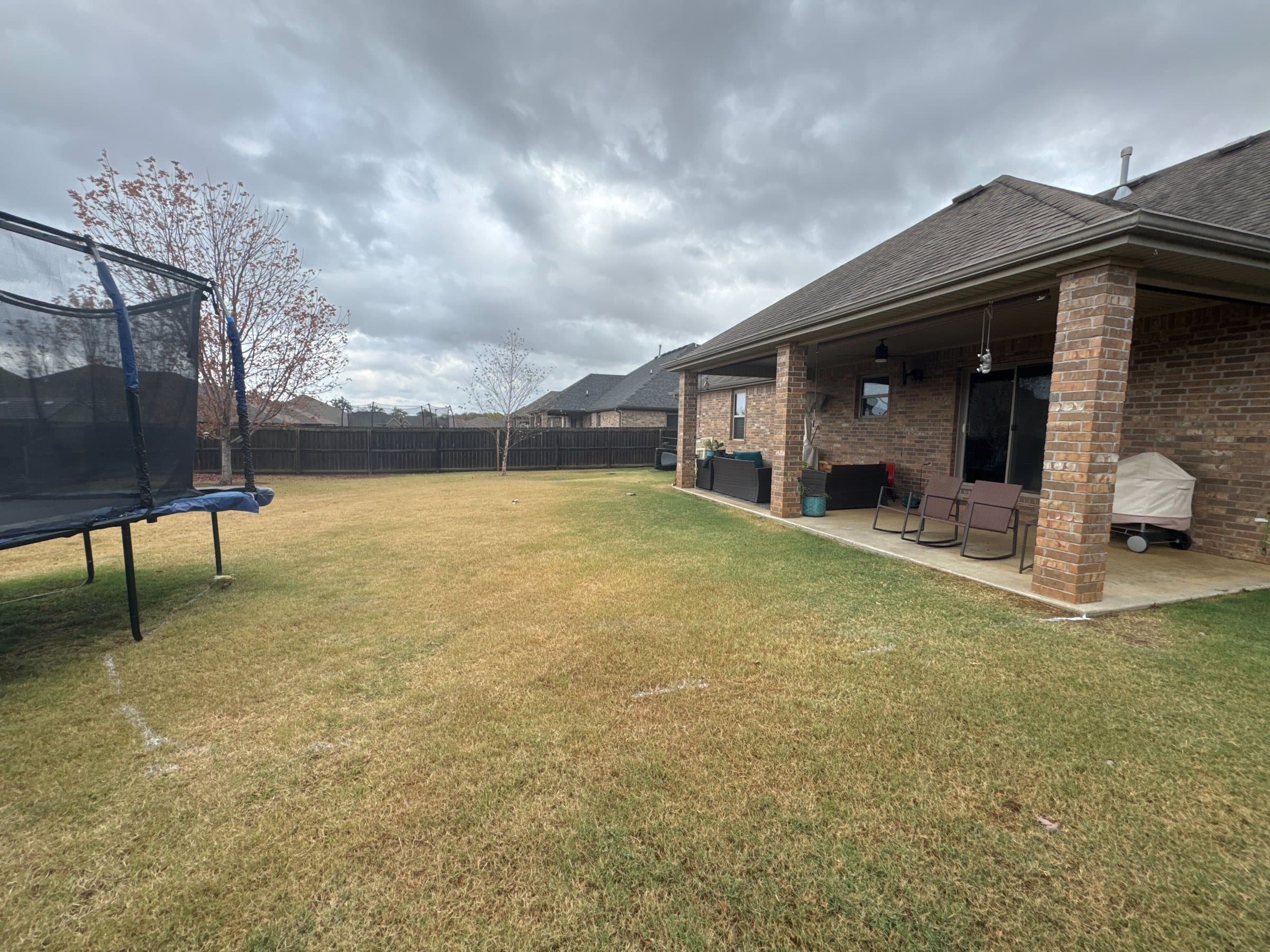
The backfill zone runs around the foundation, and it is widest and deepest where the house steps down: the low side of a walkout basement, a tall crawlspace wall or a deep garage. A house on a flat slab lot in Centerton might have only a narrow strip. A walkout on a slope in Cave Springs or west Bentonville can have several feet of fill behind the back wall. Signs in the yard itself:
- a shallow trough or step in the lawn a few feet out from the wall;
- soil that stays wet or squelches days after rain while the rest of the lawn is firm;
- sod seams along the house that have opened or sunk;
- a probe or rod that pushes in easily near the house and stops hard farther out.
A builder who is going to put a patio there should find the edge of the fill by digging, not by guessing.
04So what are the options, and what does each cost me?
Wait, dig it out, or build somewhere else first. Each has a real trade-off.
| Situation | Wait? | What to do instead |
|---|---|---|
| Patio out in the yard, clear of the backfill band | No | Build it now on a proper compacted aggregate base |
| Patio against the house, narrow strip of shallow fill | Optional | Dig out the fill under the patio and rebuild with compacted aggregate |
| Patio against a walkout or tall foundation wall, deep fill | Usually, or engineer it | Digging deep fill out gets expensive; waiting a season is often cheaper |
| Covered patio or pergola posts near the house | Not for the posts | Footings must go through the fill to at least 12 inches below undisturbed ground |
| Poured concrete slab against the house | Yes, or remove the fill | A slab cannot be relaid if one edge drops |
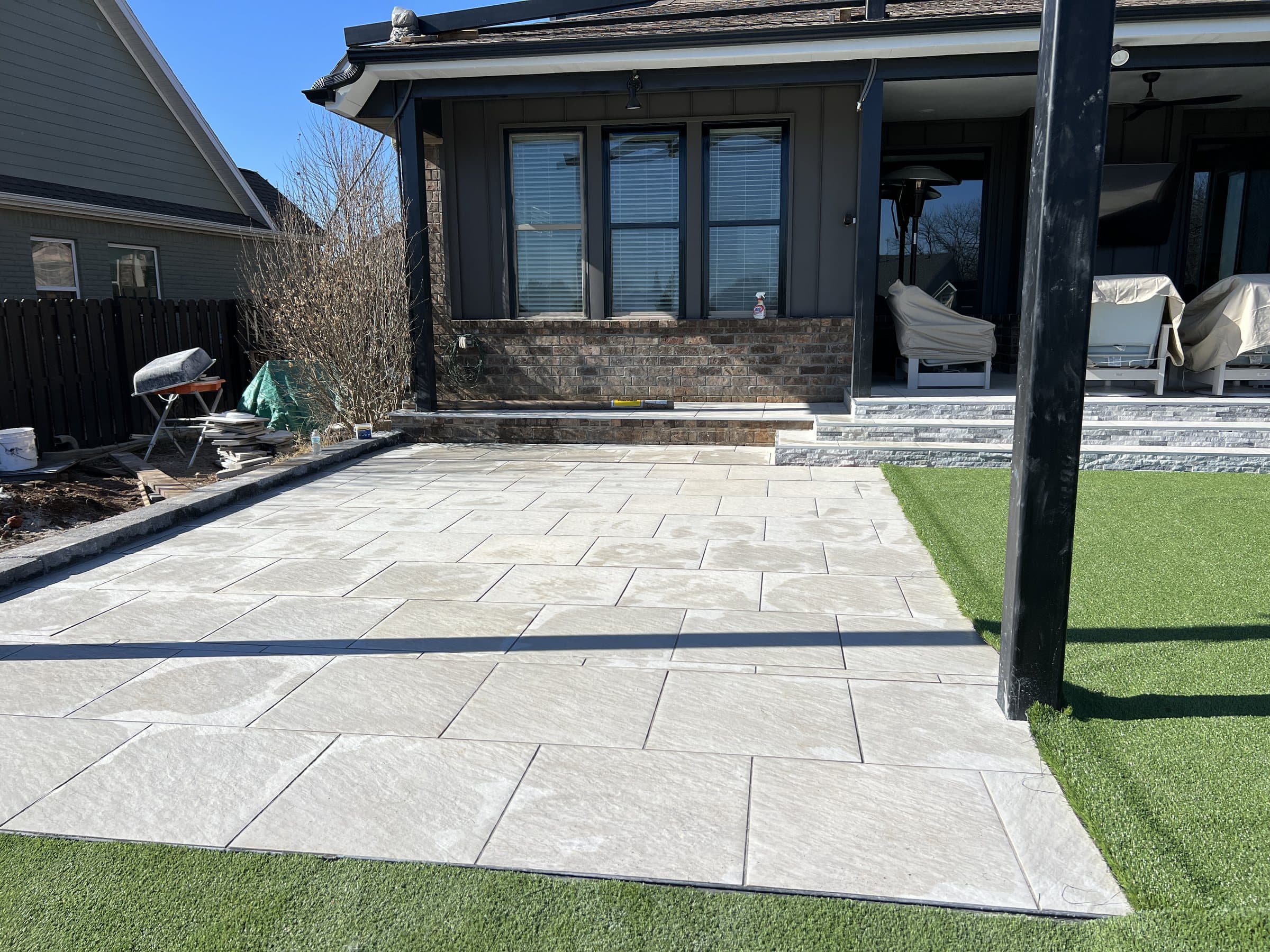
| Paver patio against the house | Shorter wait is less risky | Pavers can be lifted and the base topped up if a corner settles |
Digging out the fill costs more at the start, because it is extra excavation, extra stone and more compaction time. In exchange you get to use the patio this summer. Waiting costs nothing but time, and it lets you see what the ground does before you commit. Neither is the wrong answer. What is wrong is pouring on fresh fill and hoping.
05Does compacting the backfill replace the wait?
Proper compaction of the base under the patio does. Running a plate compactor over the surface of deep, loose fill does not.
A compactor packs the top several inches it sits on. It does little to loose soil two or three feet down. That is why the right method for building on fill is to remove it down to firm ground, or to a depth the builder can justify, and bring it back up with crushed aggregate in thin compacted lifts. Water matters as much as density. The Concrete Masonry and Hardscapes Association, which publishes the installation guidance for interlocking pavers, says that where drainage would run into impervious or expansive soils, the drain holes have to be piped to a storm sewer or another proper outlet. Dense clay counts, so the base needs somewhere to send water rather than a bathtub to hold it.
Soaking the fill with water to speed up settlement is a common site trick. It can help shallow sandy fill. On clay it mostly makes mud, and it puts water right beside your foundation, which is the opposite of what the code grading rule is for.
06What does the code say about grading around the house while we wait?
That the ground has to keep falling away from the house, and that is the thing settling undoes.
Section R401.3 of the Arkansas residential code requires the grade to fall at least 6 inches within the first 10 feet from the foundation, and any hard surface within 10 feet of the house to slope at least 2 percent away from it. When backfill settles, that fall shrinks or reverses. During the waiting year, keep an eye on it: if a low spot appears along the wall, top it up with soil and reseed rather than letting water collect there. If you are going to build a patio against the house later, the patio itself will have to meet the 2 percent rule. Our guide on how much a patio should slope covers the numbers.
07Which months matter most in Northwest Arkansas?
Spring. That is when the fill gets the most water.
NOAA's 1991 to 2020 normals for Northwest Arkansas Regional Airport put the wettest months in April and May, at 4.98 and 5.92 inches of precipitation on average, against 45.43 inches for the year. The same station averages 91.6 nights a year at or below freezing. If you closed on the house in summer, the first spring is the test: walk the backfill band after a few heavy rains and look for new low spots, cracks in the soil or water standing along the wall. If you closed in spring, you are already watching it.
When you do build, the season matters too. Our guide to the best time of year to build covers when the ground is workable.
08Is there anything we should do during the waiting year?
Yes: get the roof water off the backfill and design the patio, so the wait is not wasted.
Most of the water that softens backfill comes off your own roof. Downspouts that empty onto splash blocks against the wall pour it straight into the loosest soil on the lot. Extending them, or running them in buried pipe to a point well out in the yard, is cheap and it is the single thing that most helps the fill settle evenly instead of washing into voids. While you are at it, decide where any future lines will run, so sleeves go under the patio before the base goes down.
Use the year for approvals too. Drawings, HOA sign-off and any permit take time, and having them ready means the build can start as soon as the ground is ready.
09What if the builder already poured a patio on fresh backfill?
Watch it through the first year and measure it, rather than replacing it on day one.
Put a straightedge or a level on it across the edge nearest the house and note the reading, then check again after the spring rains. If it is tipping toward the house or cracking along a line parallel to the wall, the fill under it is settling. That is the point to decide between repair and replacement. Our guides to why patios sink and the builder-grade slab go through the choices.
The broader first-year plan, including what can go in now, is in what to build first in a new build.
Projects with Gallardo Custom Builds start around seven and a half thousand dollars. Francisco "Paco" Gallardo, the owner, walks the ground himself before any number is given, because in Northwest Arkansas the number depends on what is under the turf. Financing is available through Acorn Finance. Call (479) 379-2226 or send the project form.
FAQCommon questions
How long should I wait after building a house to put in a patio?
About a year, meaning one full wet season, if the patio will sit on the backfill next to the house. A patio out in the yard on undisturbed ground can be built right away.
We closed on a new build in Centerton three months ago. Is it too soon for a patio?
Not if the builder removes the loose fill under the patio and rebuilds it with compacted aggregate, or if the patio sits clear of the backfill band. Pouring straight onto fresh fill is the risk.
Is there a code rule for how long backfill has to settle?
No. The Arkansas residential code sets how the ground must slope away from the house, at least 6 inches in the first 10 feet, but not how long to wait before building on fill.
Can you speed up backfill settlement by watering it?
On clay it mostly makes mud and puts water beside the foundation. Removing the fill and rebuilding with compacted stone is the reliable way to build sooner.
Are pavers safer than concrete on new-build ground?
They are more forgiving. If a corner settles, pavers can be lifted, the base topped up and the same pavers relaid. A poured slab that drops has to be repaired or replaced.
Do pergola posts near the house need to wait too?
No, but their footings must go through the fill to at least 12 inches below undisturbed ground, or deeper where the city sets a frost line, such as 18 inches in Rogers.
How can I tell if my backfill has finished settling?
Check the band around the house after spring rain. If no new low spots, soil cracks or standing water appear and the grade still falls away from the wall, most of the movement is done.
REFSources
- Arkansas Residential Code 2021, Chapter 4 Foundations, R401.3 and R403.1.4 (UpCodes)up.codes
- Dave Osborne, How to Build a House 3: Services, Concrete Slab and Backfilldaveosborne.com
- CMHA Tech Note PAV-TEC-010: Application Guide for Interlocking Concrete Pavementscmha.org
- NOAA NCEI 1991 to 2020 Monthly Normals: Northwest Arkansas Regional Airport (USW00053922)ncei.noaa.gov
- NOAA NCEI 1991 to 2020 Annual Normals: Northwest Arkansas Regional Airport (USW00053922)ncei.noaa.gov
NEXTGet it looked at properly
Everything above is general guidance. What your ground actually needs is a site visit, and ours costs nothing. Francisco Gallardo walks it, reads the grade and the drainage, and tells you what is possible.