
Fix the water first, build what sits on undisturbed ground next, and wait on anything poured against the house until the backfill has settled or been dug out. The backfill is the loose strip of soil around a new foundation, and it keeps sinking through the first wet season. Plan the whole yard on paper in year one even if you build it in two phases, so the first phase never blocks the second.
01We just moved into a new build. What should we do with the backyard first?
Watch where the water goes, then fix it. Everything else comes after that.
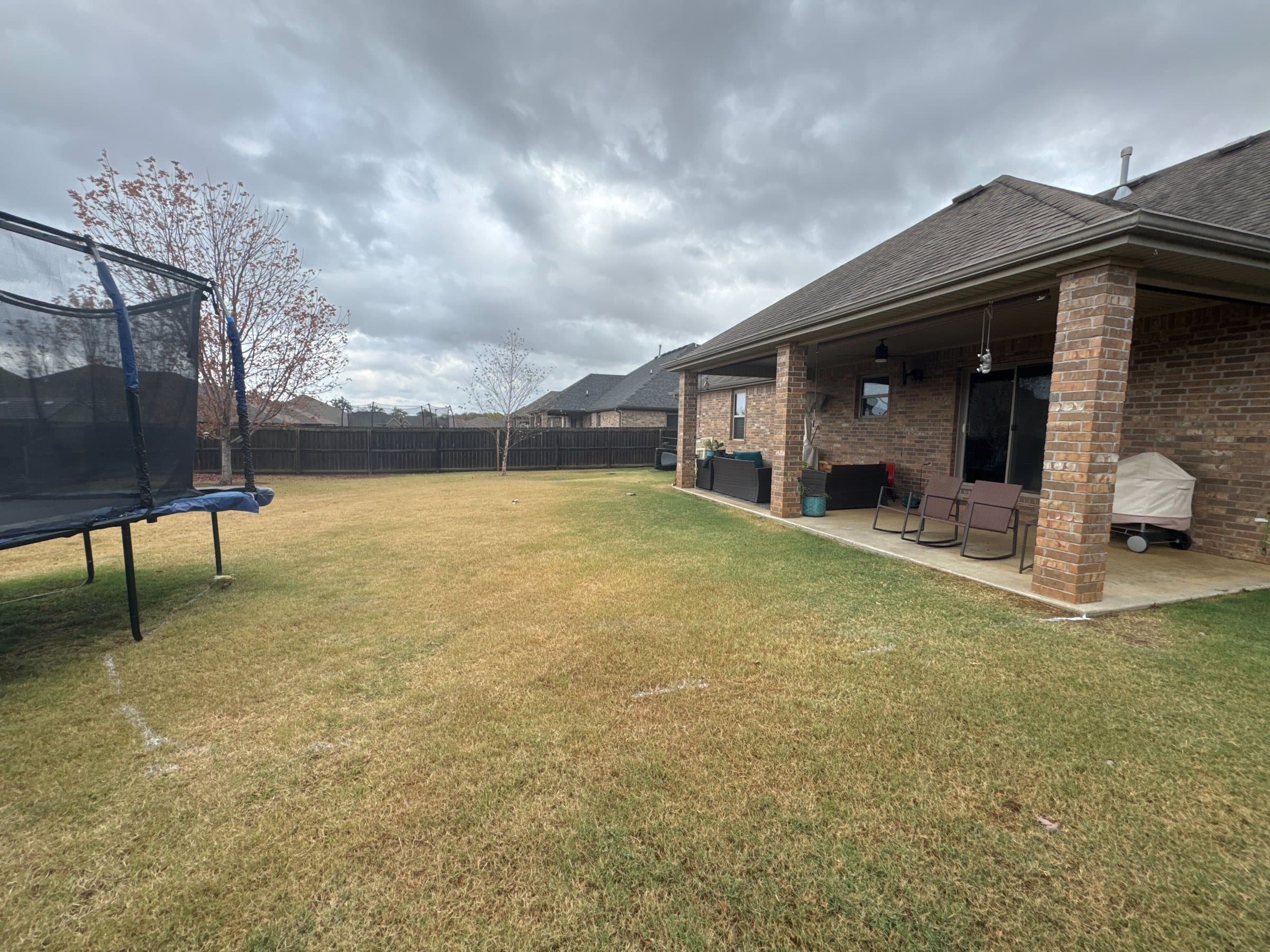
A new house in Cave Springs, Centerton, west Bentonville or Pea Ridge usually comes with the same backyard: a small builder slab by the back door, a band of loose soil around the foundation, sod laid straight onto whatever the grading left, and a downspout or two dumping onto the lawn. None of that is a defect on day one. It becomes one if you build on top of it without knowing how the lot drains.
The Arkansas residential code, section R401.3, says the lot has to be graded so the ground falls at least 6 inches within the first 10 feet away from the foundation, and any hard surface within 10 feet of the house has to slope at least 2 percent away from it. Those are the numbers your builder had to hit at handover. The question for year one is whether they still hold once the fill has settled and a few storms have run across the yard.
So the first job costs almost nothing: walk the yard in a real rain. Note where water ponds, where it runs toward the house, and where each downspout ends up. That map decides where a patio can go, whether a wall is needed, and what the drainage has to do. Our guide on drainage and grading explains what a proper fix looks like.
02Why does the ground right next to the house cause so much trouble?
Because it is not the same ground as the rest of the lot.
To pour the foundation, the builder dug out a hole wider than the house and then pushed soil back against the walls once they were up. That backfill is looser than the ground that was never dug, and it keeps settling as rain soaks through it. In much of Benton County the soil is red clay with chert in it, over a dense subsoil layer that water struggles to get through, so water that gets into the backfill tends to sit there rather than drain away. Our guide on chert and red clay covers that ground in detail.
Settling backfill does two things to a new backyard. It lets the grade by the house sink until water runs back toward the foundation instead of away from it, and it lets anything built on top of it sink with it. A patio poured onto that strip in month three is the classic result: a slab that tips toward the back door by the second spring. The next guide in this series, how long to wait after new construction, goes through the timing and the way round it.
03What can we safely build in the first year?
More than most people expect. The rule is simple: anything that does not sit on the backfill strip, and anything that makes the drainage better, can go ahead.
| Item | Year one? | Why |
|---|---|---|
| Downspout extensions and buried drain lines | Yes, first | They take roof water past the backfill before it can soak in |
| Regrading low spots that hold water | Yes | Restores the fall away from the house that R401.3 requires |
| Privacy screening and trees | Yes, with a plan | Planting time is the one thing you cannot buy back later |
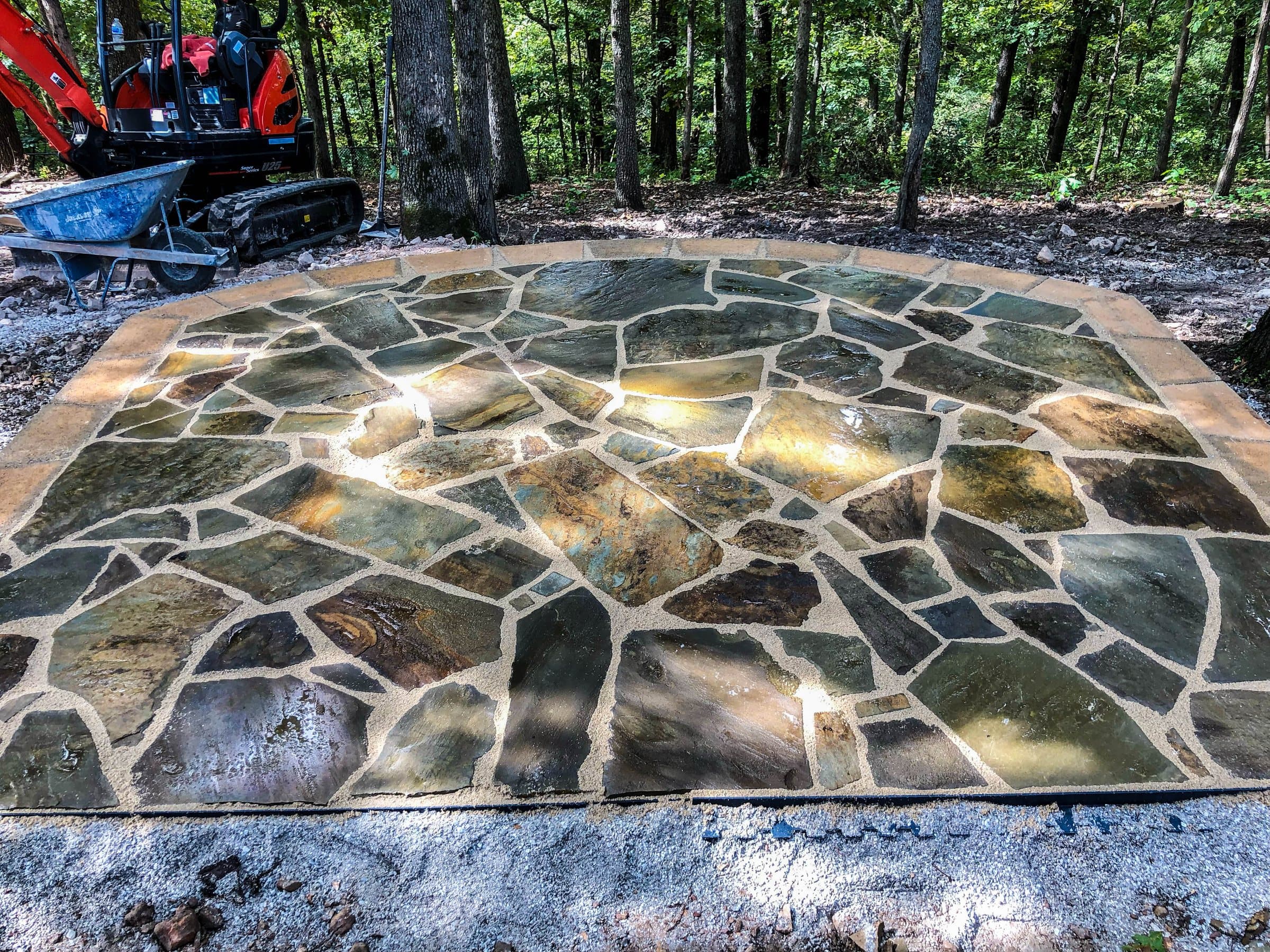
| A patio, fire pit or seating area out in the yard | Yes | Built on ground that was never dug, it behaves like any other patio |
| A freestanding pergola or pavilion on its own footings | Yes, if the footings reach undisturbed ground | The code puts footings at least 12 inches below undisturbed ground |
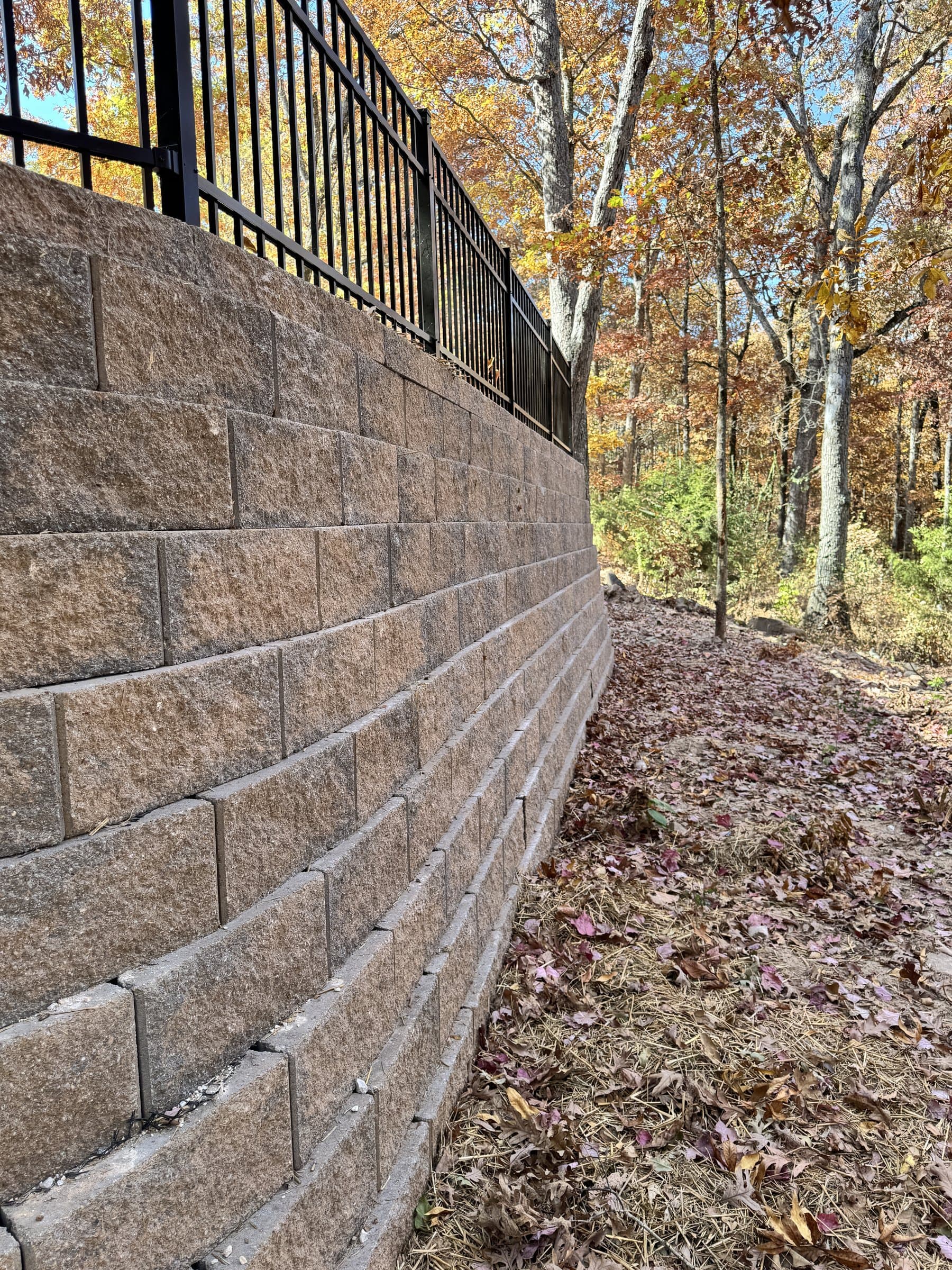
| Retaining walls on a cut slope | Usually | Cut ground is undisturbed; filled ground behind a wall needs proper compaction |
| A slab or pavers tight against the house on fresh backfill | Wait, or dig it out | This is the strip that settles |
| A pool | Plan now, build when ready | Its excavation and access route shape everything around it |
The footing point matters for anything with a roof. Section R403.1.4 of the Arkansas code says exterior footings go at least 12 inches below undisturbed ground, and cities can set a deeper frost line: Rogers publishes 18 inches. A post footing that stops inside loose backfill has not reached undisturbed ground at all, whatever its depth. Our guide on frost depth and footings has the detail.
04What should we wait a year on, and is waiting the only option?
Wait on anything poured or laid right against the house on backfill. Waiting is not the only option, though.
The honest alternative is to remove the loose fill under the new patio and rebuild that zone with crushed aggregate placed and compacted in lifts. It costs more on day one because it is more digging and more stone, but it means you do not lose a summer. On a lot where the backfill is deep, such as the low side of a walkout basement, it can be the more expensive route by a wide margin, and that is the conversation to have before anyone gives you a number.
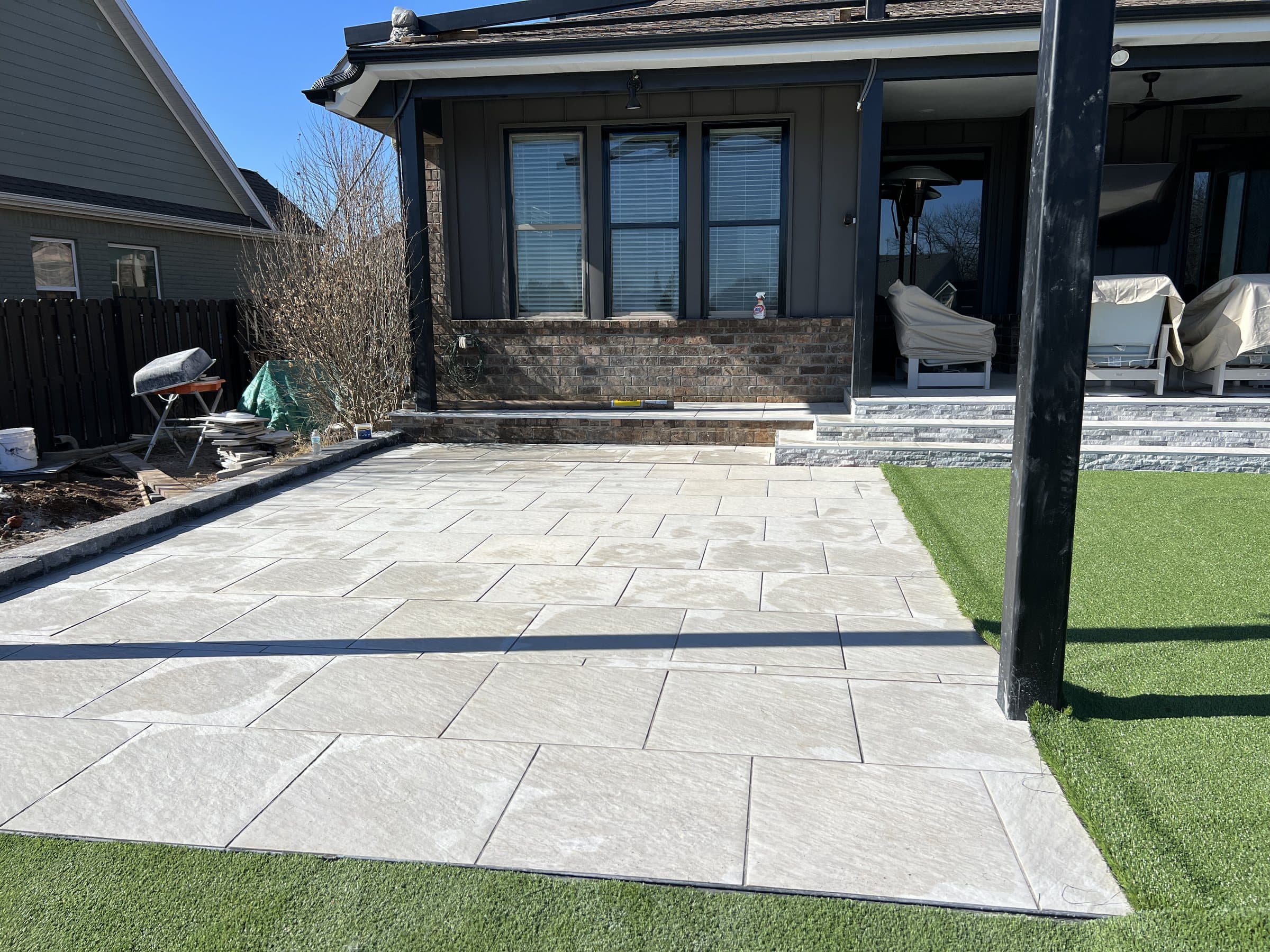
Pavers also forgive a little movement in a way a poured slab does not. If a corner settles, a paver section can be lifted, the base topped up and the same pavers relaid. A cracked slab is a cracked slab. Our comparison of pavers and stamped concrete in a freeze-thaw winter covers the trade-off.
An attached covered patio is the other item worth pacing. In Rogers a covered patio needs a building permit, and in most HOA neighborhoods it needs architectural approval as well, so the paperwork alone can take weeks. Starting the approvals in year one and building in year two is often the natural rhythm anyway. See permits in Rogers and HOA and POA approval.
05How do we plan the whole yard so phase one does not block phase two?
Draw the finished yard first, then decide what goes in this year.
Many new-build lots in Northwest Arkansas are narrow at the sides, so there is often one route for an excavator or a concrete truck to reach the back. If the first thing you build is a fence or a wall across that route, a future pool or pavilion has just become much more expensive. The same goes for power, gas and water lines: a sleeve under a patio costs very little while the base is open and a lot once the pavers are down.
A one-page plan that shows the future pool or kitchen, the equipment route, where the lines will run and which area is built first saves real money later. We cover the pool case in planning a patio now for a pool later, and the cost side of splitting a project in does phasing cost more.
06How much rain does the yard have to handle here?
More, and in bigger bursts, than many people moving in expect.
NOAA's 1991 to 2020 normals for Northwest Arkansas Regional Airport show 45.43 inches of precipitation a year, with the wettest months in spring: 4.98 inches in April and 5.92 inches in May on average. The same station averages 13.6 days a year with an inch or more of rain. A new yard with bare patches and settling backfill meets those storms in its first spring, which is exactly why it is worth watching one before committing concrete next to the house.
| Month | Average precipitation, NWA Regional Airport (inches) |
|---|---|
| March | 3.53 |
| April | 4.98 |
| May | 5.92 |
| June | 4.29 |
| Year | 45.43 |
The design side of storm water, including where to send it once it is off the roof, is in our guide to heavy rain and runoff in the Ozarks.
07What about the HOA?
Assume you need approval for anything visible, and get it in writing before you commit.
Many newer subdivisions around Bentonville, Cave Springs and Centerton have covenants that cover fences, structures, materials and sometimes colors. The architectural committee usually wants a drawing with dimensions and distances to property lines. A builder who has done this before will produce that drawing as part of the design, not as an afterthought. Read your covenants in the first month, not the week before you want to start.
08How should we budget for year one and year two?
Budget for the whole plan, then fund it in the order the ground allows.
A useful split for a new build is: drainage and grading fixes first, because they protect the house and cost least; then the pieces that sit on undisturbed ground; then the patio against the house and any attached structure. Our guide to budgeting a $10k, $25k and $50k project shows what each level usually buys.
If you are likely to be transferred in a few years, read whether an outdoor project pays back if you move before you choose between a pool and a covered patio.
Projects with Gallardo Custom Builds start around seven and a half thousand dollars. Francisco "Paco" Gallardo, the owner, walks the ground himself before any number is given, because in Northwest Arkansas the number depends on what is under the turf. Financing is available through Acorn Finance. Call (479) 379-2226 or send the project form.
FAQCommon questions
We just moved to Bentonville and our new build has a tiny concrete patio. What should we do first?
Watch how the yard drains in a real rain and fix the water first: downspout extensions, low spots and the fall away from the house. Then plan the whole yard once and build the parts on undisturbed ground before anything tight against the house.
Can we build a patio in the first year after closing?
Yes, if it sits on ground that was never dug, or if the loose backfill under it is removed and replaced with compacted aggregate. A slab poured straight onto fresh backfill next to the house is the one to avoid.
Is a builder-grade patio worth keeping?
Sometimes. If it is sound, level and slopes away from the house it can be extended or covered. Our guide on the builder-grade slab goes through the checks.
Do we need HOA approval for a patio in Cave Springs or Centerton?
Many newer subdivisions require architectural approval for structures, fences and often hard surfaces. Read your covenants and submit a dimensioned drawing before you sign a contract.
What should we run under the patio before it is built?
Sleeves for any future power, gas or water lines. They cost very little while the base is open and a lot once the surface is finished.
How deep do footings need to go for a pergola here?
The Arkansas code says at least 12 inches below undisturbed ground, and cities can require more: Rogers publishes an 18 inch frost line. Ask your building department for your address.
We might move again in four years. Is it still worth doing the backyard?
Often yes for the use you get from it, but national surveys suggest most outdoor projects do not return their full cost at sale. Keep it simple, well built and broadly useful.
REFSources
- Arkansas Residential Code 2021, Chapter 4 Foundations, R401.3 and R403.1.4 (UpCodes)up.codes
- City of Rogers: Adopted Codes and Climatic Design Criteriarogersar.gov
- NOAA NCEI 1991 to 2020 Monthly Normals: Northwest Arkansas Regional Airport (USW00053922)ncei.noaa.gov
- NOAA NCEI 1991 to 2020 Annual Normals: Northwest Arkansas Regional Airport (USW00053922)ncei.noaa.gov
NEXTGet it looked at properly
Everything above is general guidance. What your ground actually needs is a site visit, and ours costs nothing. Francisco Gallardo walks it, reads the grade and the drainage, and tells you what is possible.