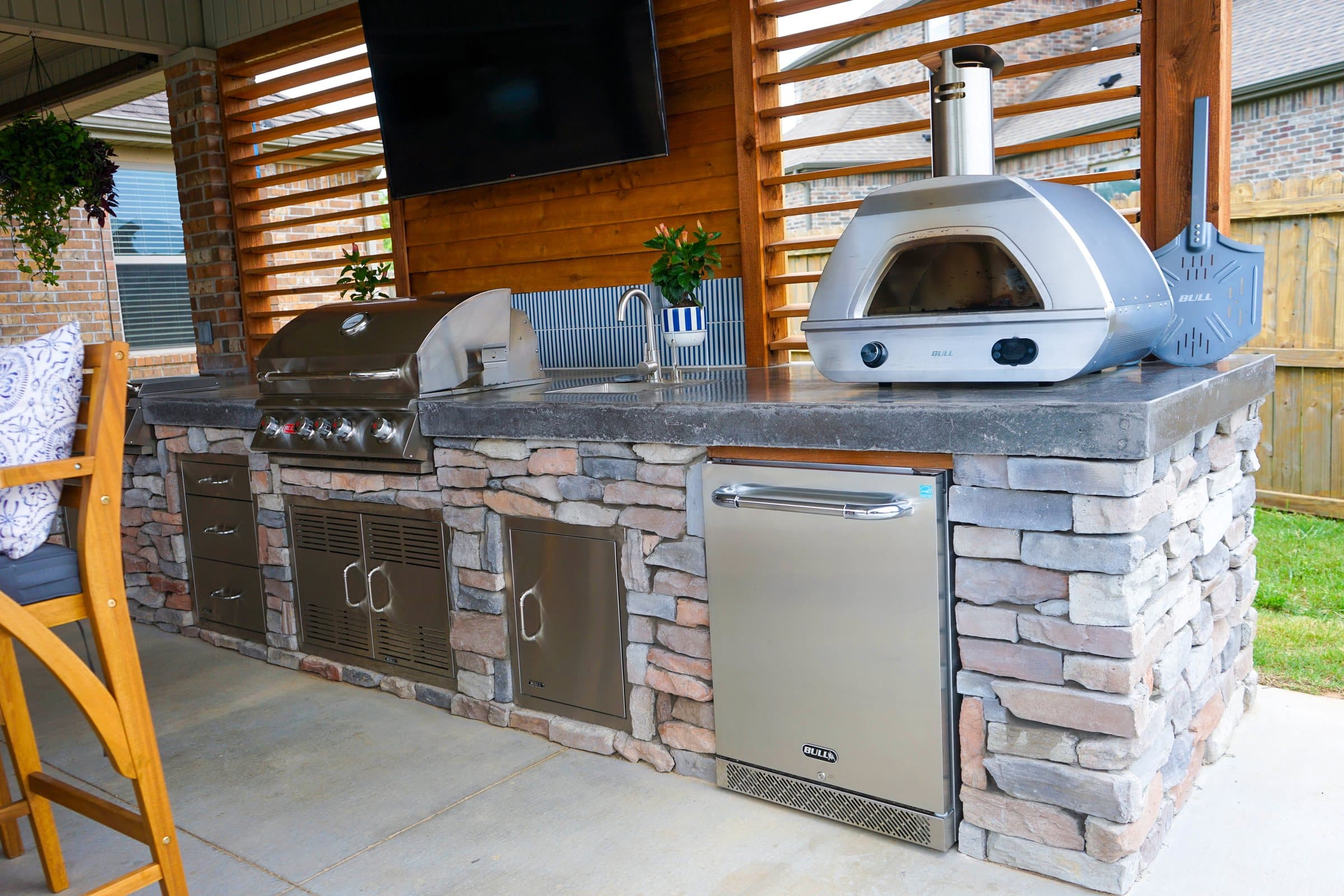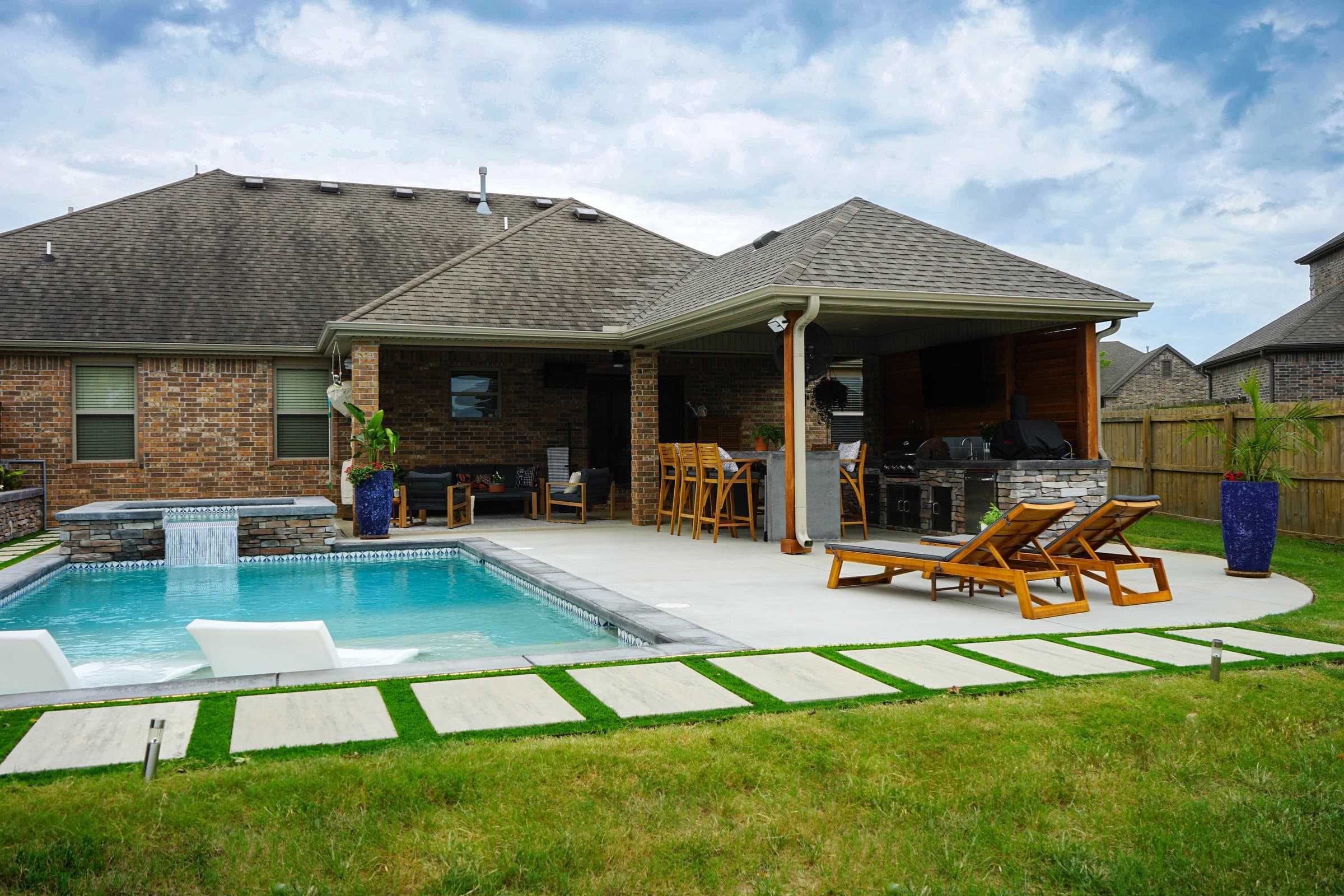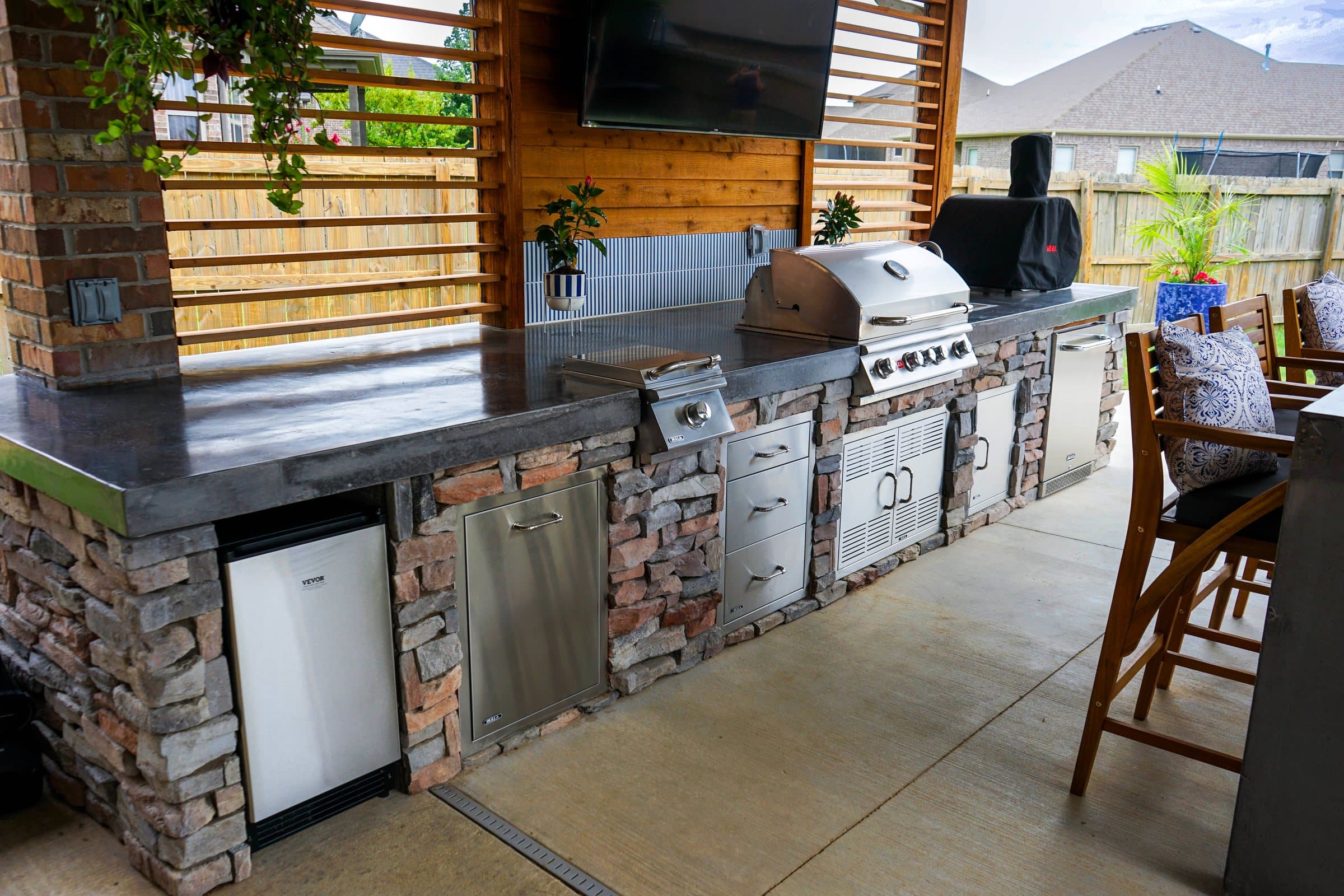

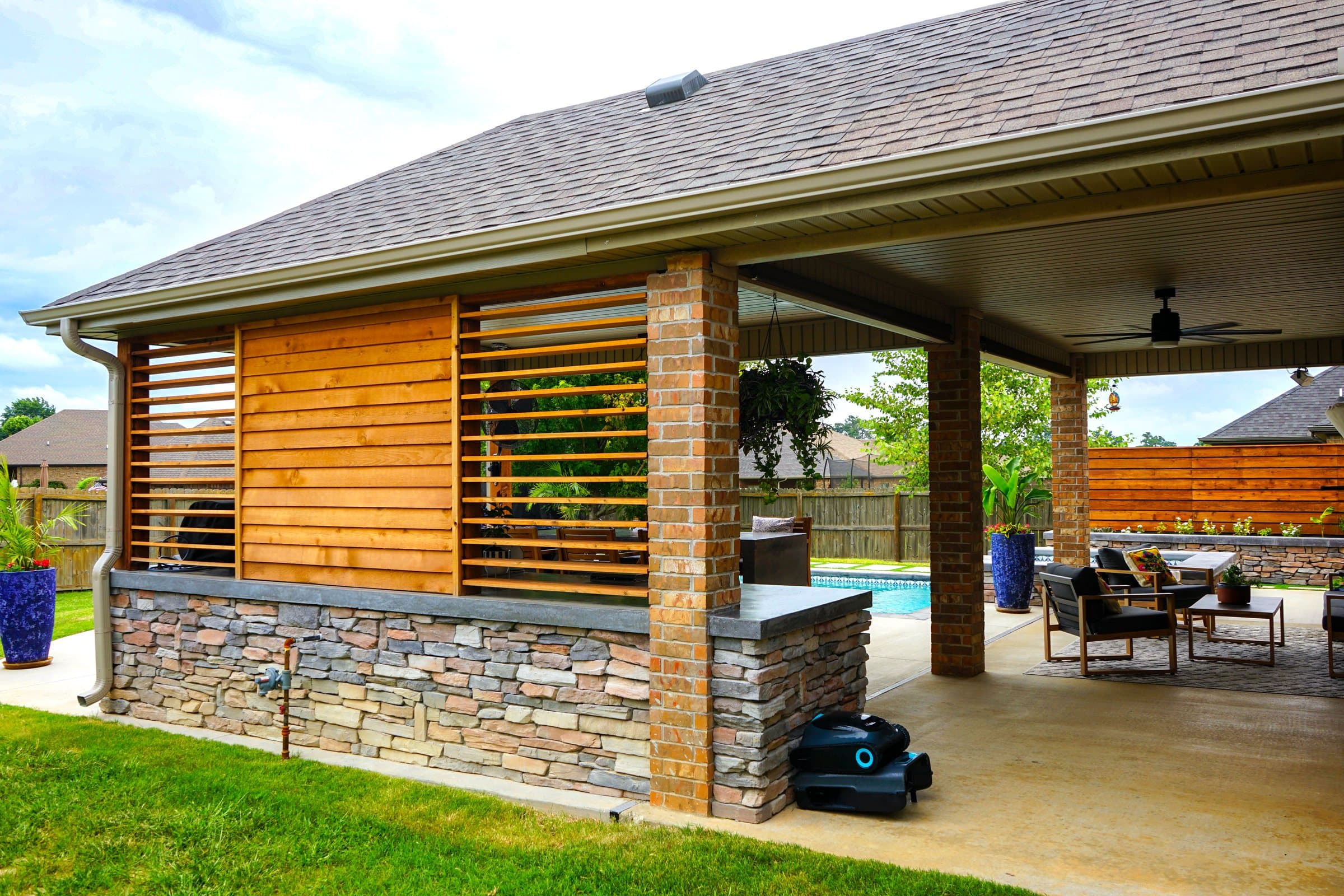
For a pavilion that survives Northwest Arkansas storms, use a roof covering with a UL 2218 Class 4 impact rating and frame it for the local design wind speed, which Rogers publishes as 105 mph. The National Weather Service's nearest point climatology, Fort Smith, shows hail at any one spot about twice a year, peaking in March, April and May. Continuous connections from roof to footing matter as much as the roofing.
01How often does hail actually hit this part of Arkansas?
Often enough to design for: about twice a year at any single spot, by the nearest published point climatology.
The National Weather Service office in Tulsa, which covers Northwest Arkansas, publishes a hail climatology for Fort Smith, based on records from 1972 to 1997. It says any specific location in the Fort Smith area can expect hail an average of two times each year. The peak is the spring transition: the chance of hail in a given year is 56 percent in May, 44 percent in April and 40 percent in March, with a smaller peak of 16 percent in November. Fort Smith is about an hour south of Bentonville and the record is old, so treat it as the pattern rather than a forecast for your street.
| Month | Chance of hail in that month in a given year (Fort Smith) |
|---|---|
| March | 40% |
| April | 44% |
| May | 56% |
| November | 16% |
The National Weather Service treats hail of 1 inch, quarter size, as severe. NOAA's National Severe Storms Laboratory gives typical fall speeds of 25 to 40 mph for stones of 1 to 1.75 inches, golf ball size being 1.75 inches. That is the range a pavilion roof has to shrug off.
02What does a Class 4 impact rating actually mean?
That samples of the product survived a 2 inch steel ball in the standard UL 2218 test.
UL 2218 drops steel balls onto a prepared roof covering. The Insurance Institute for Business and Home Safety summarises the classes: Class 1 uses a 1.25 inch ball, Class 2 a 1.5 inch ball, Class 3 a 1.75 inch ball and Class 4 a 2 inch ball, each dropped from the height needed to match the energy of a hailstone of that size. A product rated Class 4 is the highest in the scheme.
A rating is a comparison, not a guarantee. When IBHS tested 22 asphalt shingle products itself, none of them, basic or impact rated, passed more than Class 2 impacts without at least one double impact location failing the UL 2218 criteria. Its conclusion supports buying rated products while expecting that large hail can still do damage. Ask for the rating of the exact product and the exact assembly, and keep the paperwork for your insurer.
03Which roof covering is best for a pavilion here?
The one with a verified Class 4 rating that also suits the house, and there are several.
| Covering | Hail notes | Other notes |
|---|---|---|
| Standing seam metal | Many profiles carry Class 4 ratings; check the exact product | Can dent cosmetically; ask how your policy treats cosmetic damage |
| Impact-rated architectural shingles | Class 4 versions widely available | Matches most NWA houses; needs a solid deck and enough pitch |
| Standard shingles | No impact rating | Cheapest; weakest choice for this climate |
| Polycarbonate or glass panels | Varies widely by product and thickness | Lets light in; get the impact test data in writing |
| Clay or concrete tile | Varies by product | Heavy; the frame must be designed for the load |
Matching the house roof often matters more to the finished look than anything else. An attached cover usually has to match; a freestanding pavilion has more freedom. See attached vs freestanding cover.
04What wind speed should a pavilion be built for?
The design wind speed your city publishes, which in Rogers is 105 mph.
Cities that adopt the Arkansas Residential Code publish their climatic design criteria. Rogers lists a wind design speed of 105, a ground snow load of 15 psf and a frost line depth of 18 inches. Check your own city's figures; they are the basis of the engineering, not a suggestion. For comparison, the National Weather Service calls a thunderstorm severe when it produces winds of at least 58 mph, and downbursts can go well beyond that.
An open pavilion catches wind underneath its roof as well as on top, so the problem is uplift as much as push. The roof wants to lift off the beams, the beams off the posts and the posts out of the ground. A pavilion survives a spring storm when every one of those joints is tied with rated connectors and the footings are deep and heavy enough to hold it down.
An open-roofed pergola is a different case. With no solid roof it catches far less wind and lets hail through, which is exactly why it is not a storm shelter for furniture or a kitchen. If the plan is to add a solid or louvred roof to a pergola later, build the posts, connections and footings for the roofed version from the start.
05What does a storm-ready frame look like?
A continuous load path from the roof covering down to the footing, with nothing left to friction or toenails.
- Roofing fastened to the pattern the manufacturer specifies for the rated wind speed.
- Rafters tied to beams with hurricane ties or equivalent rated connectors.
- Beams fixed to posts with through-bolts or engineered post caps.
- Posts set on engineered bases or in concrete footings below the 18 inch frost depth Rogers publishes, with the footing size designed rather than guessed.
- Knee braces or a rigid frame to stop racking in a side gust.
Our frost depth guide explains why the footing depth matters here, and covered patio and pavilion costs covers what drives the price.
06How should water be handled on a storm roof?
Gutters and downspouts sized for spring downpours, discharging away from the patio and house.
The same spring storms that bring hail bring intense rain. A pavilion roof concentrates water along its eaves, and without gutters it cuts a trench in the lawn or floods the patio edge. Size the gutters and downspouts generously, and take the water to a drain, a dry well or a safe outfall. See heavy rain and runoff in the Ozarks. Where hail is common, gutter guards also stop hailstones and shredded leaves from blocking the outlets during the storm.
07What about fans, lights and heaters under the roof?
Choose fixtures rated for wet or damp outdoor locations, and fix them to the structure, not the roofing.
A pavilion is open to wind-driven rain. Ceiling fans, lights and heaters should carry the outdoor rating the manufacturer specifies for that position, and be fixed to framing designed to carry them. A fan hanging from a single screw into a thin ceiling board is the part that fails first in a gust. Plan the wiring before the ceiling goes up; see our rough-in checklist.
08Does hail damage the frame and finishes too?
Yes. The roof covering takes the headline damage, but the rest of the structure takes hits as well.
Hail marks soft wood, strips stain from the top faces of beams and rafter tails, and chips paint. A cedar pavilion that is sealed and maintained on schedule shrugs off most of it; a dry, unfinished one shows every strike. Exposed rafter tails and the tops of beams are the most exposed surfaces, and a small metal or flashing cap over them is cheap protection. Polycarbonate skylight panels are the most vulnerable part of many covers, and their impact performance varies widely by product and thickness, so get the test data for the exact panel. Light fixtures, fan blades and speakers under the eaves can be hit by stones driven sideways by wind, so mount them back from the roof edge.
09Which coverings are easiest to repair after a storm?
The ones you can still buy in the same colour and profile in five years.
A roof that has to be replaced in full because one damaged panel cannot be matched is an expensive roof. Before choosing a covering, ask whether the product line is standard or a limited run, keep a note of the exact colour name and profile, and consider buying a few spare shingles or a spare panel at the time of the build. Shingles are replaced one at a time. Standing seam panels are replaced panel by panel, which is simple on a small pavilion. Tile needs matching pieces that are sometimes hard to find later. Polycarbonate usually comes out as whole sheets. None of this is exotic, but it is the kind of thing that is easy to settle on the day of the build and hard to fix after the first big spring storm.
10What should I tell my insurer?
That the structure exists, what it is built from and what the roof is rated.
A pavilion is a new structure on your property and your policy may treat it differently from the house. Tell your agent before or at completion, send the roofing product's rating documents, and ask how cosmetic hail damage to metal is treated. Photograph the finished roof. If hail does strike, those photographs are the baseline that shows what changed.
Keep the build paperwork together in one folder: the contract, the roofing product data sheet with its impact class, the permit card and the final photographs. If you sell the house, the same folder answers the buyer's inspector.
11What should I check before signing for a pavilion?
Five things, in writing.
- The roofing product name and its UL 2218 class.
- The design wind speed the structure is built to, and who designed the connections.
- Footing depth and size.
- Gutter, downspout and discharge plan.
- Permit status: Rogers, for example, explicitly requires permits for covered patios.
Projects with Gallardo Custom Builds start around $7,500. Francisco "Paco" Gallardo, the owner, walks the site himself before any number is given, because what is under the ground and what you want to do with the space both change the answer. The visit costs nothing. Financing is available through Acorn Finance. Call (479) 379-2226 or send the project form.
FAQCommon questions
What is the best roof for a pavilion in hail country?
A covering with a UL 2218 Class 4 impact rating, such as many standing seam metal profiles or impact-rated shingles, on a frame designed for local wind.
How often does it hail in Northwest Arkansas?
The NWS Tulsa climatology for Fort Smith, the nearest published one, says any spot can expect hail about twice a year, most often in March, April and May.
What does Class 4 mean on roofing?
The product passed the UL 2218 test with a 2 inch steel ball, the largest of the four test sizes.
Will a Class 4 roof never get hail damage?
No. IBHS testing found even Class 4 shingles could fail at some double impact points. It lowers the risk; it does not remove it.
What wind speed should a pavilion in Rogers be built for?
Rogers publishes a design wind speed of 105 mph in its climatic design criteria. Check your own city's figure.
Is metal or shingle better for a pavilion roof?
Both can carry Class 4 ratings. Metal can dent cosmetically; shingles often match the house better. Choose by rating, looks and the frame.
Do I need a permit for a pavilion in Northwest Arkansas?
Often. Rogers explicitly requires permits for covered patios. Check your city before building.
REFSources
- National Weather Service Tulsa: Fort Smith Hail Climatologyweather.gov
- NOAA National Severe Storms Laboratory: Severe Weather 101, Hail Basicsnssl.noaa.gov
- IBHS: Relative Impact Resistance of Asphalt Shingles (summary of UL 2218 tests)ibhs.org
- City of Rogers: Adopted Codes and Climatic Design Criteriarogersar.gov
NEXTGet it looked at properly
Everything above is general guidance. What your ground actually needs is a site visit, and ours costs nothing. Francisco Gallardo walks it, reads the grade and the drainage, and tells you what is possible.