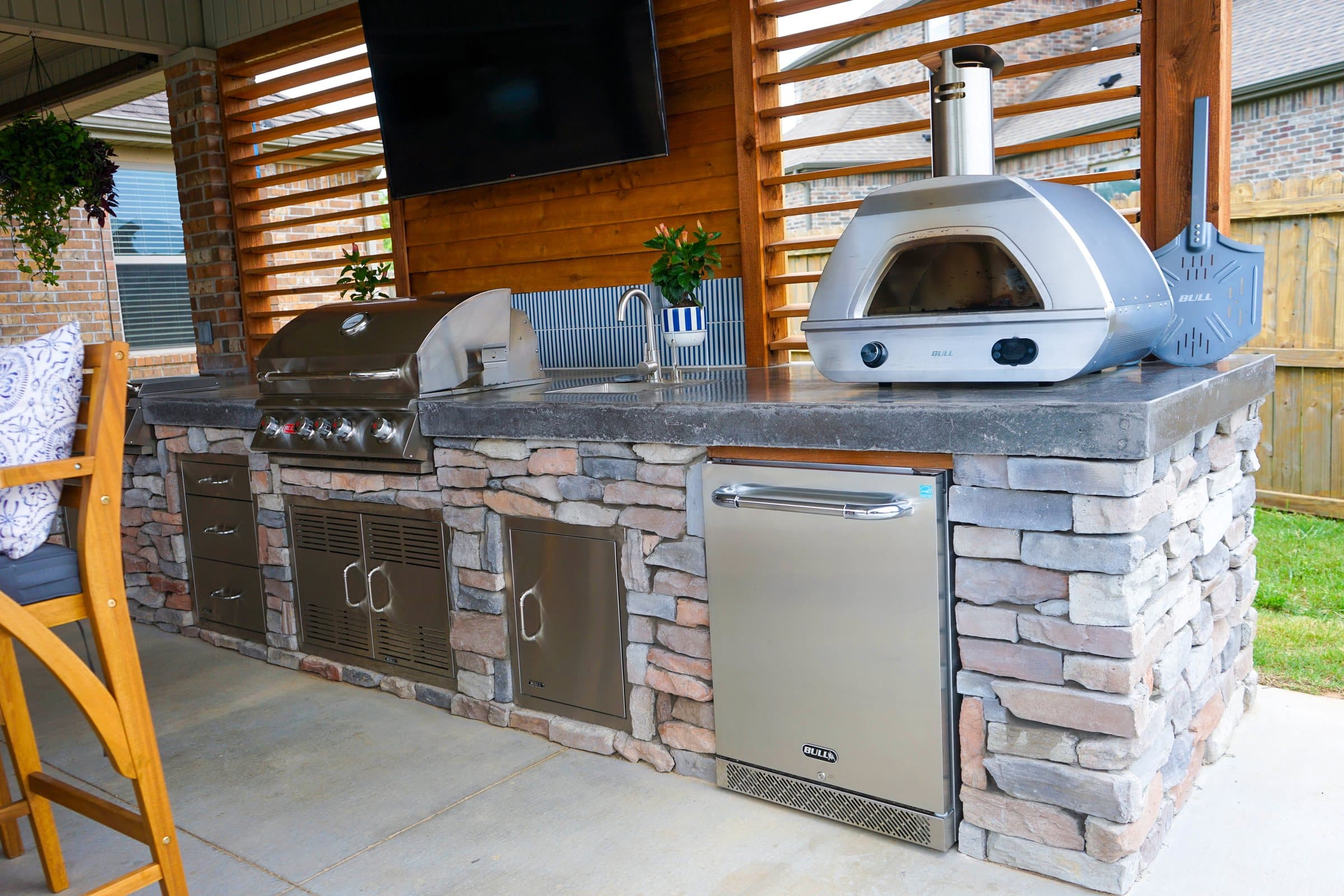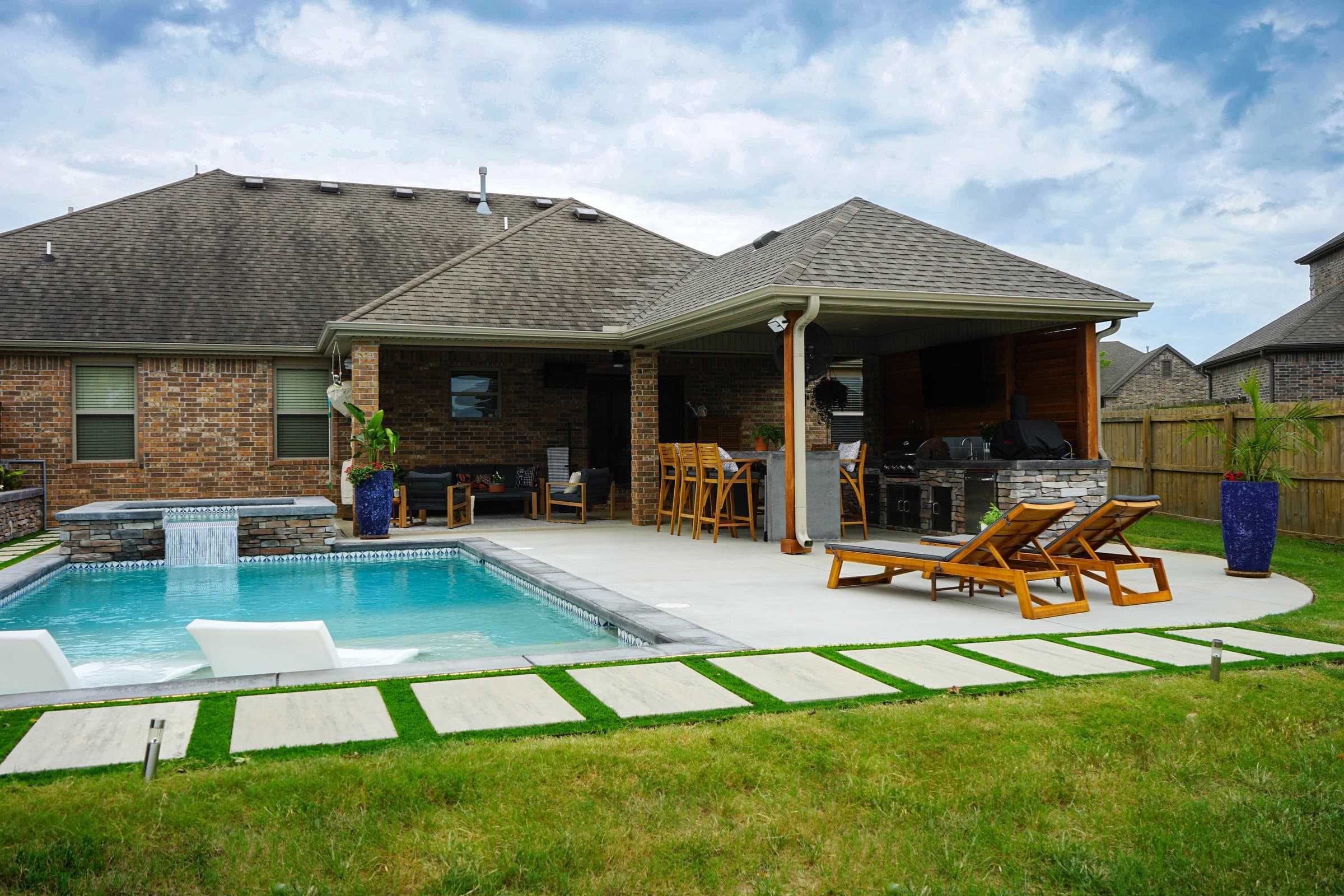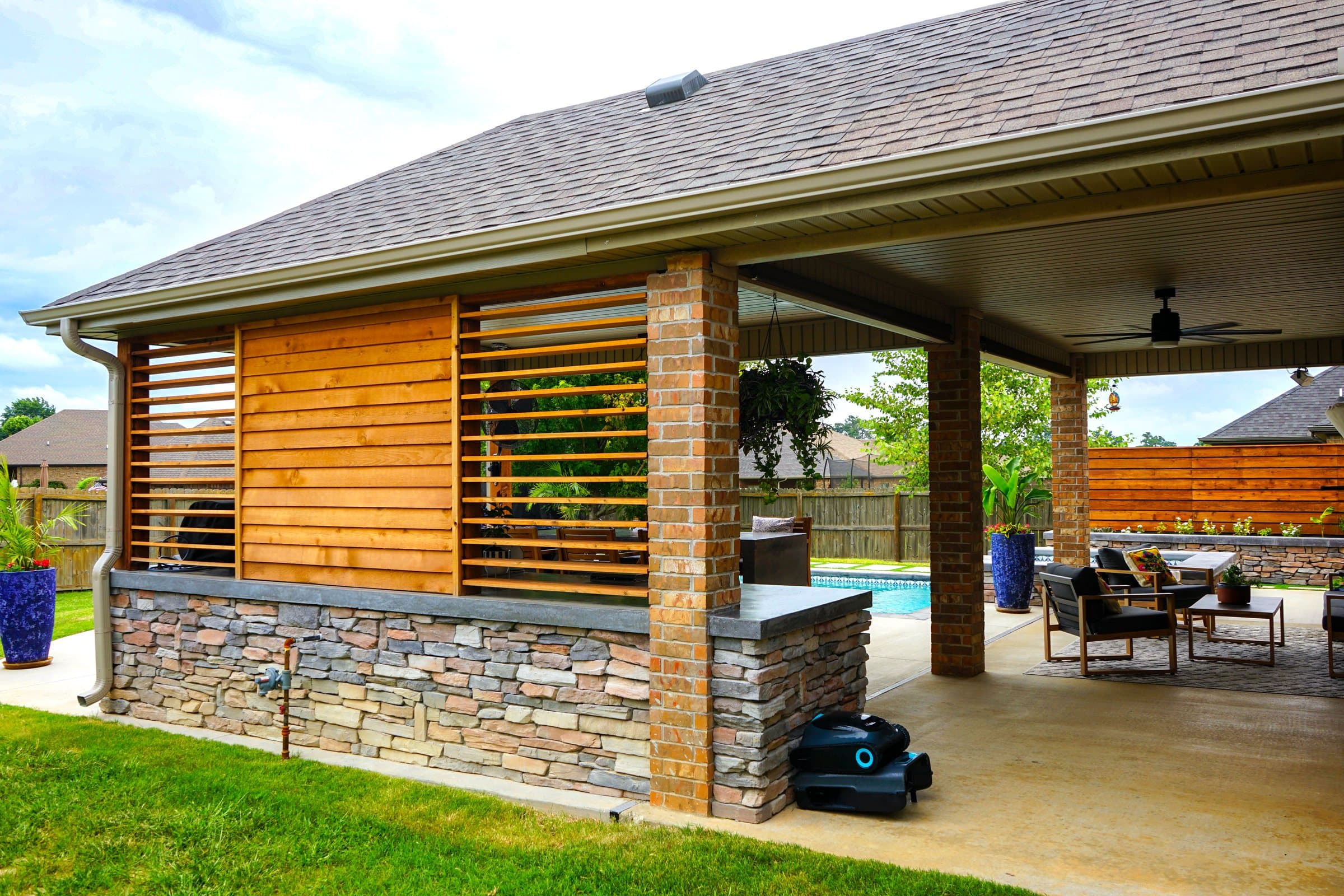

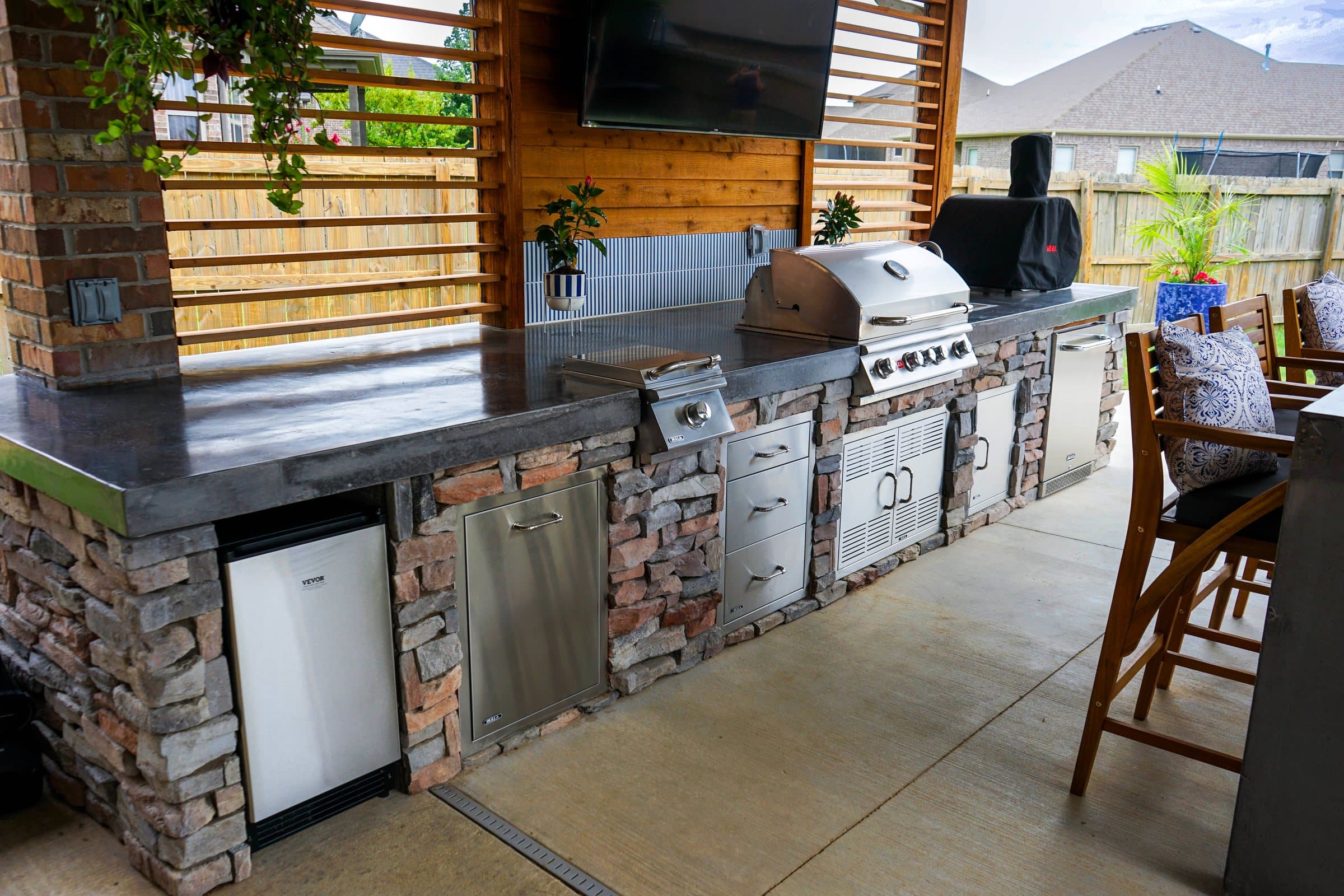
Before a patio is poured or paved, run everything you might want in the next ten years: power, gas, water and a drain, low-voltage cable for TV and audio, and spare empty conduit. Under the NEC, PVC conduit in a yard needs 18 inches of cover, direct-burial cable 24 inches, and a residential 120-volt GFCI circuit of 20 amps or less 12 inches. Gas piping generally needs 12 inches. Call Arkansas 811 before anyone digs.
01Why does the rough-in have to happen first?
Because a sleeve costs almost nothing before the surface goes down, and cutting a finished patio costs a great deal.
The most common regret we hear on an existing patio is not the material or the size. It is that there is no power at the far end, the TV has a cable running across the stone, or the gas grill someone wants now needs a trench through a slab. Every one of those could have been a length of pipe laid in the base. This guide is the list we go through with owners before any base material arrives. It is written for a household that intends to use the space for years: cooking, watching the game, heating the space in November, and maybe a hot tub or kitchen later.
You do not have to have decided on every appliance. The point of a rough-in is that it keeps options open. A capped sleeve that is never used costs very little; a missing one can mean lifting part of a finished patio or running a cable where it should not be.
02What electrical should be run under or to the patio?
Receptacle circuits where you will use them, dedicated circuits for the heavy loads, and a switched circuit for lighting.
Rogers, for example, has adopted the 2020 National Electrical Code, and the NEC's baseline for a house at grade is at least one outdoor receptacle, accessible from grade and no more than 6.5 feet above it, at the front and at the back. The 2020 edition requires GFCI protection for outdoor outlets on the circuits a patio uses. A serious outdoor room needs far more than the minimum. Think about each of these and decide now, even if the appliance comes later.
- General receptacles at the kitchen counter, the seating area and the far end of the lawn.
- A dedicated circuit for an outdoor refrigerator or ice maker.
- A receptacle for a pellet grill, rotisserie or smoker controller.
- Ceiling fan and light circuits in any pavilion, with switches at the house door.
- Electric heaters: many need a dedicated circuit; check the model's specification before sizing it.
- A hot tub, if one is even a possibility; see adding a hot tub to a patio.
- Landscape and step lighting; see patio and walkway lighting.
All of it should be designed and installed by an electrician under a permit where your city requires one. Our job is to make sure the conduit is where the electrician needs it before the base is compacted.
03How deep do electrical lines have to be buried?
It depends on the wiring method; NEC Table 300.5 sets the minimum cover.
Cover means the distance from the top of the cable or conduit to finished grade, not the depth of the trench. These are the general figures for a residential yard.
| Wiring method | Minimum cover, general locations | Notes |
|---|---|---|
| Direct-burial cable | 24 in | No conduit; hardest to replace later |
| Rigid or intermediate metal conduit | 6 in | Shallowest option; costs more |
| PVC or other nonmetallic conduit listed for burial | 18 in | The usual choice under a patio |
| Residential branch circuit, 120 V or less, GFCI protected, 20 A or less | 12 in | Reduced depth for qualifying circuits only |
| Under a residential driveway | 18 in | For each of the three main methods |
Under a slab or a patio different rows of the table can apply, and your inspector has the final word. What matters for planning is that conduit is always the better choice than bare cable: it lets a future electrician pull new wire without digging anything up.
04What does a gas line under a patio need?
Enough depth, a tracer wire if it is plastic, and a size that covers every appliance you might add.
The International Fuel Gas Code, summarised by the International Code Council, sets a minimum burial depth of 12 inches for underground gas piping. Lines to individual outdoor appliances such as a grill or a light can be 8 inches below grade if the code official approves and the route is not exposed to physical damage. Plastic pipe must have a yellow insulated copper tracer wire of at least 18 AWG, so it can be found later. Gas piping under buildings has to be in a conduit, and plastic pipe is limited under slabs, with specific exceptions for outdoor patios, walkways and driveways.
The planning point is size. A line sized for one grill will not run a grill, a fire table, a pizza oven and two patio heaters at once. Add up the ratings of everything you might want and let the gas installer size the line to that total, not to today's shopping list. For fire features, see fire pit and fireplace costs.
05What about water and drainage?
A supply for a sink, a drain that actually goes somewhere, and a way to empty the line before a freeze.
Rogers publishes a frost line depth of 18 inches. A water line that stays full through the winter needs to be protected from freezing, which usually means depth plus a shut-off and drain point inside the house so the outdoor run can be emptied in autumn. The drain side is harder: a sink needs somewhere legal to discharge, and that decision affects where the kitchen can go. We settle it with the plumber at the design stage.
Surface drainage belongs in the same conversation. A patio that sheds water toward a drain inlet needs the pipe laid before the base. See drainage and grading.
06What low-voltage lines should go in for TV, audio and Wi-Fi?
At least one empty conduit to each place a screen, speaker, camera or access point might go.
Low-voltage cable, whether for a TV, speakers, a network or cameras, should run in its own conduit, apart from the power circuits. The technology changes faster than the patio does, so the most valuable thing to bury is an empty conduit with a pull string in it, from the house to the pavilion or the kitchen. Good places to plan a run to:
- The wall or post where an outdoor TV will hang.
- Speaker positions at the corners of the seating area.
- A pavilion post for a Wi-Fi access point.
- Camera positions covering the gate and the back door.
- The landscape lighting transformer location.
07What about patio heaters?
Decide gas or electric now, because each needs a different line under the surface.
Mounted infrared heaters on a pavilion beam can be gas or electric. Gas heaters need a gas branch to each unit and clearances the manufacturer sets. Electric units need circuits sized to their rating, often dedicated. Free-standing propane heaters need nothing buried but take floor space and bottles. Pick the approach before the pavilion ceiling goes up, so wiring or piping runs inside the structure rather than on its face.
08Who has to call Arkansas 811, and when?
Anyone disturbing the ground, before any digging, free of charge.
Arkansas 811's own FAQ says anyone who will disturb the ground must contact them, and there is no cost. Utilities are asked to mark their lines within two full working days. Work must start within 10 working days of the ticket, while the marks are still visible, and a ticket is valid for 20 working days. Within the tolerance zone around marked lines, digging has to be by hand or a method the utility approves.
One detail catches people out: utilities only mark their own lines. Anything behind the meter, such as a line to a shed, an old gas grill, a well or a detached garage, belongs to the owner and will not be marked. Tell us about every private line you know of before excavation starts.
09How do you keep a record of what is under the patio?
Photographs and measurements before backfill, and a simple drawing.
Before the base covers anything, photograph every run with a tape measure in shot, from two fixed points such as the house corner and a pavilion post. Mark each sleeve end above ground. Keep a one-page drawing with the photos. Whoever works on the patio in ten years, including you, will know where to dig and where not to.
Hand a copy to the electrician, the plumber and the gas installer, and keep one with the house papers. When the house is sold, that drawing is worth giving to the buyer: it saves them guessing, and it shows the work was planned rather than improvised.
10What is the rough-in checklist?
Print it, and tick each line as decided, not as installed.
| Service | Decide now | Typical depth guide |
|---|---|---|
| General power | Receptacle locations and circuits | 18 in cover in PVC conduit |
| Dedicated circuits | Fridge, pellet grill, heaters, hot tub | Per NEC Table 300.5 |
| Lighting | Switched circuit and transformer location | Low-voltage runs in own conduit |
| Gas | Total load of every possible appliance | 12 in; 8 in for single outdoor appliance lines if approved |
| Water | Sink location and winter drain-down | Protected from the 18 in Rogers frost depth |
| Drain | Where sink and surface water discharge | Laid before the base |
| TV, audio, network, cameras | Every possible device position | Empty conduit with pull string |
| Future sleeves | Pool, hot tub, fire feature, irrigation | Capped, marked, photographed |
If a pool is on the horizon, read planning a patio for a future pool as well.
Projects with Gallardo Custom Builds start around $7,500. Francisco "Paco" Gallardo, the owner, walks the site himself before any number is given, because what is under the ground and what you want to do with the space both change the answer. The visit costs nothing. Financing is available through Acorn Finance. Call (479) 379-2226 or send the project form.
FAQCommon questions
What should I run under a patio before pouring?
Power in conduit, a gas line sized for future appliances, water and a drain, empty conduit for TV and audio, and spare sleeves for anything you might add.
How deep does electrical conduit have to be under a yard?
Under NEC Table 300.5, 18 inches of cover for PVC conduit in general locations, 24 inches for direct-burial cable and 6 inches for rigid metal conduit.
Can a patio circuit be buried only 12 inches deep?
Yes, if it is a residential branch circuit of 120 volts or less, GFCI protected and rated 20 amps or less.
How deep does a gas line for a grill need to be?
The fuel gas code sets 12 inches generally, with 8 inches allowed for a line to a single outdoor appliance where the code official approves.
Do I have to call 811 in Arkansas for a patio?
Yes. Anyone disturbing the ground must contact Arkansas 811. It is free, and utilities mark their lines, though not private lines behind the meter.
Should I bury conduit even if I have no plans yet?
Yes. An empty conduit with a pull string is the cheapest insurance against cutting the patio later.
Who installs the wiring and gas under a Gallardo patio?
The appropriate trades, under permit where required. The design coordinates their runs so sleeves are in place before the base is compacted.
REFSources
- NEC Table 300.5 minimum cover requirements (reference table)zing2.app
- NEC 210.52(E)(1): Outdoor outlets, one- and two-family dwellingselectricallicenserenewal.com
- ICC CodeNotes: Underground Gas Piping System Requirements in the I-Codesiccsafe.org
- Arkansas 811: Frequently Asked Questionsar811.org
- City of Rogers: Adopted Codes and Climatic Design Criteriarogersar.gov
NEXTGet it looked at properly
Everything above is general guidance. What your ground actually needs is a site visit, and ours costs nothing. Francisco Gallardo walks it, reads the grade and the drainage, and tells you what is possible.