
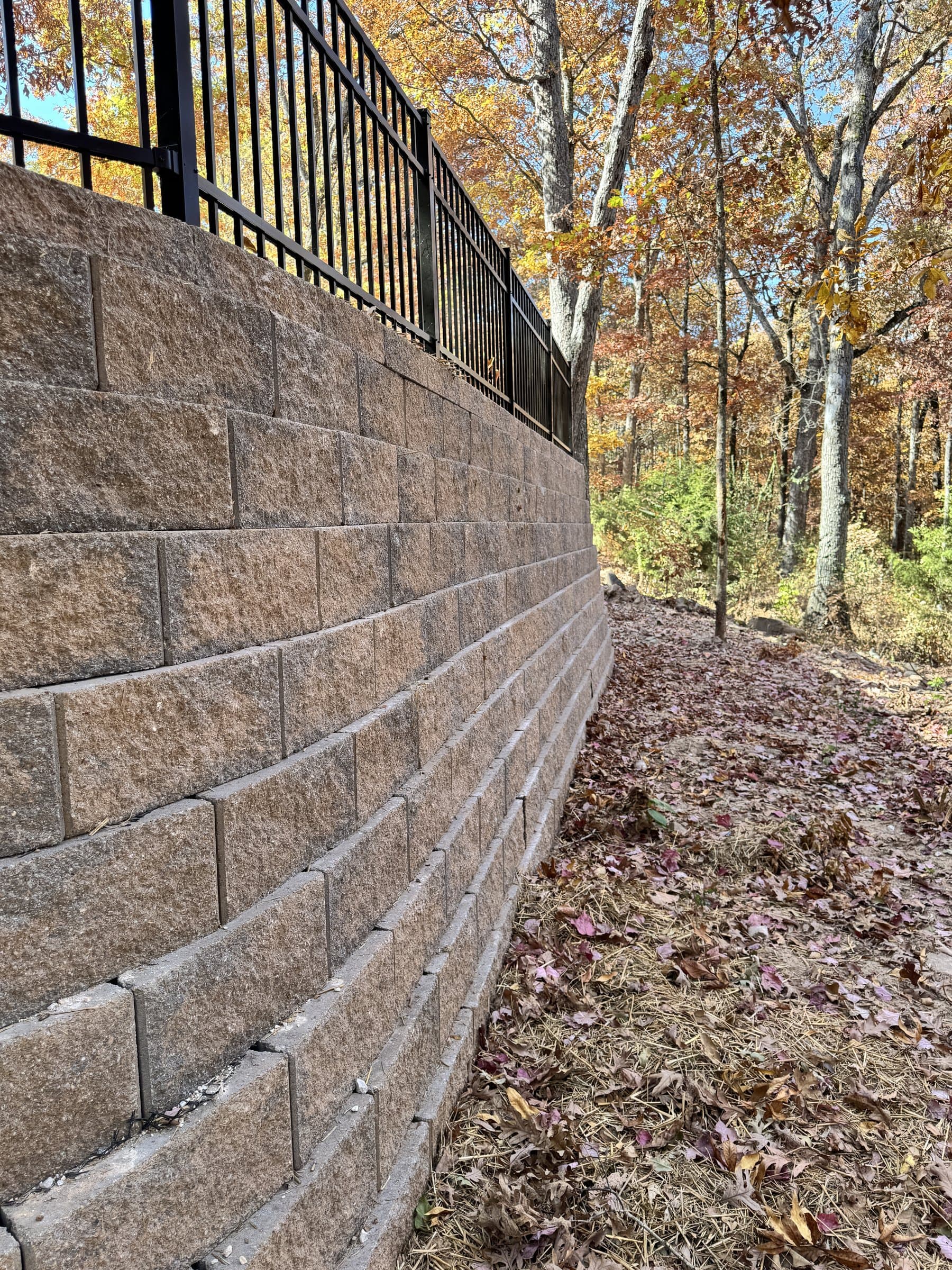
Replace an old railroad-tie or timber retaining wall when it leans or bulges, when ties are soft enough to push a screwdriver into, or when soil washes out through the gaps. Most owners replace it with segmental concrete block or natural stone, with drainage behind it. The EPA says creosote has no registered residential uses and treated wood should not be burned, though old ties can usually go out with ordinary trash.
01How do I know an old timber wall is failing?
Movement, rot and soil loss. Any one of them is a warning; two together mean it is time.
Timber walls were the default in a lot of Rogers, Bella Vista and older Bentonville and Fayetteville yards: cheap, quick and easy to cut to fit. Wood in contact with wet clay soil rots from the back and the bottom, where you cannot see it, and the wall carries on looking roughly right until it does not. Walk the wall with this list.
- The face leans out, or bulges in the middle of a run.
- A screwdriver pushes easily into the ties, especially the bottom course.
- Spikes or rebar pins are exposed or pulling out.
- Soil or gravel is washing out through gaps between ties.
- The ground behind the wall has sunk or cracked.
- Water seeps through the face after rain, or never drains from behind it.
- Ties at the ends have rotted away and the soil is slumping round the corner.
For how to read a lean, see why a retaining wall leans.
02Why do timber walls fail?
Water and time, mostly, plus the fact that many were never built as engineered walls.
A retaining wall holds back the weight of soil, and that weight rises sharply when the soil is wet. Many older tie walls were stacked without drainage aggregate behind them, without a pipe at the base and without deadmen, the ties that run back into the slope to anchor the face. Every heavy rain loads the wall a little more, and the wood gets a little weaker. See why retaining walls fail for the general mechanics. The replacement fixes the cause, not only the material.
Ozark rain makes this worse. Spring storms deliver a lot of water in a short time, and on a sloping lot that water runs downhill toward the back of every wall it meets. A wall that was just about coping for its first twenty years can give way after one very wet spring, when the soil behind it is saturated and the wood at the base has finally softened. That is why the drainage detail behind a replacement wall is not optional. See heavy rain and runoff in the Ozarks.
03Are old creosote railroad ties dangerous?
The federal position is careful rather than alarming: do not burn them, and do not use them for new residential work.
The U.S. Environmental Protection Agency says creosote is used for commercial purposes only and has no registered residential uses, and that indoor use and use in contact with food, feed or drinking water are prohibited. It also acknowledges that homeowners meet reused creosote-treated wood, noting that railroad ties are sometimes recycled as landscaping timbers. Its guidance is not to burn creosote or other preservative-treated wood in a residential setting, to avoid inhaling toxic chemicals in the smoke and ash.
On the everyday risk of old ties already in a garden, an Oregon State University wood expert answering through the Extension network's Ask an Expert service called the risks to human and plant health from old, discarded ties very low, noting that most leaching has likely already happened, and that the odour is the better-documented nuisance. We would still not build a vegetable bed against them, and we wear gloves and long sleeves when we remove them.
04Can I just replace the rotten ties?
Occasionally, for a short, low wall. Usually not.
Swapping a few visible ties treats the face and leaves the cause. The ties you cannot see, at the bottom and at the back, are usually in worse condition than the ones you can, and a timber wall is only as strong as its weakest buried course. Patching also means digging behind the wall, which is most of the work of replacing it. For a wall under knee height in a flower bed, a patch can buy a few years. For anything taller, anything near a driveway or a house, or anything that is visibly moving, replacement is the sensible answer.
05What should an old timber wall be replaced with?
Segmental concrete block for most walls, natural stone where it suits the house and garden, and sometimes no wall at all.
| Option | Suits | Watch for |
|---|---|---|
| Segmental retaining wall block | Most residential walls, including taller engineered ones | Needs the right base, drainage aggregate and geogrid where designed |
| Natural stone, dry-laid or boulder | Gardens and lower walls; an Ozark look | Height limits; heavy machinery access |
| Stacked stone on a concrete core | Formal walls and seat walls | Cost; footing below frost |
| New pressure-treated timber | Low garden edging | Will rot again in time; not our choice for structural walls |
| Terracing into two or three lower walls | Tall single walls on a slope | More space; each wall stays under permit and engineering thresholds more easily |
| Regrading to a gentle slope | Where there is room | No wall to fail; needs space and planting |
Segmental block is what we build most often for this job: it is designed to be a retaining system, it drains, and it can be engineered to height. See retaining wall vs terracing and retaining wall costs in NWA.
06Do I need a permit to replace a retaining wall?
It depends on the city and the height, and Bella Vista's threshold is the lowest.
| City | When a retaining wall needs a permit | Also |
|---|---|---|
| Bentonville | Over 4 ft | Permit through eTrakit with a plot plan; grading is separate |
| Rogers | Over 4 ft | Check the building department for your lot |
| Fayetteville | Over 4 ft | Grading permit; plan sealed by an Arkansas-registered engineer |
| Bella Vista | 2.5 ft and higher | City Miscellaneous Improvements permit and POA ACC approval |
Wall height is measured on the finished wall, not the old one, so a replacement that is taller or longer can cross a threshold the old wall did not. Rules change; confirm with your city before building. Our Benton and Washington County permit guide and when a wall needs an engineer have the detail.
07Can the new wall go exactly where the old one was?
Usually close to it, but check the line, the trees and the access first.
Old timber walls were sometimes built on or near the property line, across an easement, or hard against a neighbour's tree. A replacement is a good moment to confirm where the line is, whether an easement on the plat restricts building, and whether roots of a large tree will be cut by the excavation behind the wall. See building near trees. The new wall is usually thicker at the base than the old one and needs room behind it for drainage aggregate and, for taller walls, geogrid. That can move the face forward a little, or the slope back. Access matters too: on older lots, the only route for a machine is sometimes through a side yard with a fence or a gate that has to come down temporarily.
08What about ties used as steps or garden edging?
Treat them the same way: check for rot, and replace them in stone when they fail.
Railroad ties were also popular as landscape steps and bed edging on slopes. Rotted tie steps are a trip hazard, especially for older family members, because the edge that looks solid can crumble underfoot. Stone or block steps with consistent risers and a handrail are the usual replacement; see step-free and age-friendly design. Low tie edging in a flower bed can wait until it fails, but do not use old ties to edge vegetable beds.
09What happens to the old ties?
They are removed, kept out of any fire, and disposed of properly.
The EPA says creosote-treated wood can usually be disposed of through ordinary trash collection as municipal solid waste, while noting that state and local governments may have their own instructions. Check with your local waste service for quantities beyond a few ties. Never burn them in a fire pit or a brush pile. On the job we stack them away from the work and haul them off with the rest of the demolition.
10How is a replacement wall built?
In this order, whatever the material.
- Arkansas 811 call, then careful removal of the old wall, protecting whatever is above it.
- Excavation back into the slope to make room for drainage and, where designed, geogrid.
- A compacted base below the first course, set level and partly buried.
- A drain pipe at the base, taken to daylight or a safe outlet.
- Clean drainage aggregate behind the wall as it rises, and compacted soil beyond it.
- Caps, planting and a surface that sheds water away from the top of the wall.
On the chert and clay ground under much of Benton County, excavation often meets rock, and that affects cost and time. See building on chert and red clay.
The whole job is usually quicker than owners expect once the old wall is out, but the timing depends on weather, because clay behind a wall should not be compacted when it is saturated. We schedule the excavation for a dry spell and keep the slope covered and drained if rain arrives partway through. For how long hardscape jobs take generally, see how long a patio takes.
Projects with Gallardo Custom Builds start around $7,500. Francisco "Paco" Gallardo, the owner, walks the site himself before any number is given, because what is under the ground and what you want to do with the space both change the answer. The visit costs nothing. Financing is available through Acorn Finance. Call (479) 379-2226 or send the project form.
FAQCommon questions
My railroad tie retaining wall is rotting. What should I replace it with?
Most often segmental concrete block with drainage behind it, or natural stone for lower walls. Tall walls on slopes are often better split into terraces.
How do I know if my timber retaining wall needs replacing?
Leaning or bulging, soft ties, exposed spikes, soil washing through gaps and sinking ground behind the wall are the signs.
Are creosote railroad ties safe in my yard?
The EPA says creosote has no registered residential uses and treated wood should not be burned. An extension expert called the risk from old ties very low.
How do I dispose of old railroad ties?
The EPA says creosote-treated wood can usually go in ordinary trash collection. Check local rules for large amounts, and never burn it.
Do I need a permit to replace a retaining wall in Bella Vista?
If the wall is 2.5 feet or higher, yes, from the city, and the POA ACC must also approve it.
Do I need a permit for a retaining wall in Bentonville, Rogers or Fayetteville?
Walls over 4 feet need a permit in each; Fayetteville also requires a plan sealed by an Arkansas-registered engineer.
Can I just replace the rotten ties?
Only on a short, low wall. The buried ties are usually worse than the visible ones, and patching leaves the drainage problem in place.
REFSources
- U.S. EPA: Creosote (residential reuse, burning and disposal)epa.gov
- U.S. EPA: Overview of Wood Preservative Chemicalsepa.gov
- Ask Extension (Oregon State University expert): Creosote Railroad Ties used in Landscapingask.extension.org
- City of Bella Vista: Retaining Wall Fact Sheet (revised 2025)bellavistaar.gov
- Bella Vista POA: The City, POA and ACCbellavistapoa.com
NEXTGet it looked at properly
Everything above is general guidance. What your ground actually needs is a site visit, and ours costs nothing. Francisco Gallardo walks it, reads the grade and the drainage, and tells you what is possible.