
It can, because Benton County adds new construction to the assessment rolls the year after it is finished, and Arkansas taxes it at full value outside the usual caps. How much depends on the value the assessor gives the structure, not on what you paid for it, and on your district's millage. For most outdoor projects the increase is modest.
01Will a pavilion increase my property taxes in Arkansas?
If the assessor adds value for it, yes, and the rules make sure it goes on at full value.
Arkansas property tax follows a simple chain. The county assessor estimates the market value of the property. The assessed value is 20 percent of that market value, which is set by state law. The tax is the taxable assessed value multiplied by the millage rates of the city, county and school district where the property sits. A pavilion or outdoor kitchen enters that chain only if it changes the assessor's market value for your property.
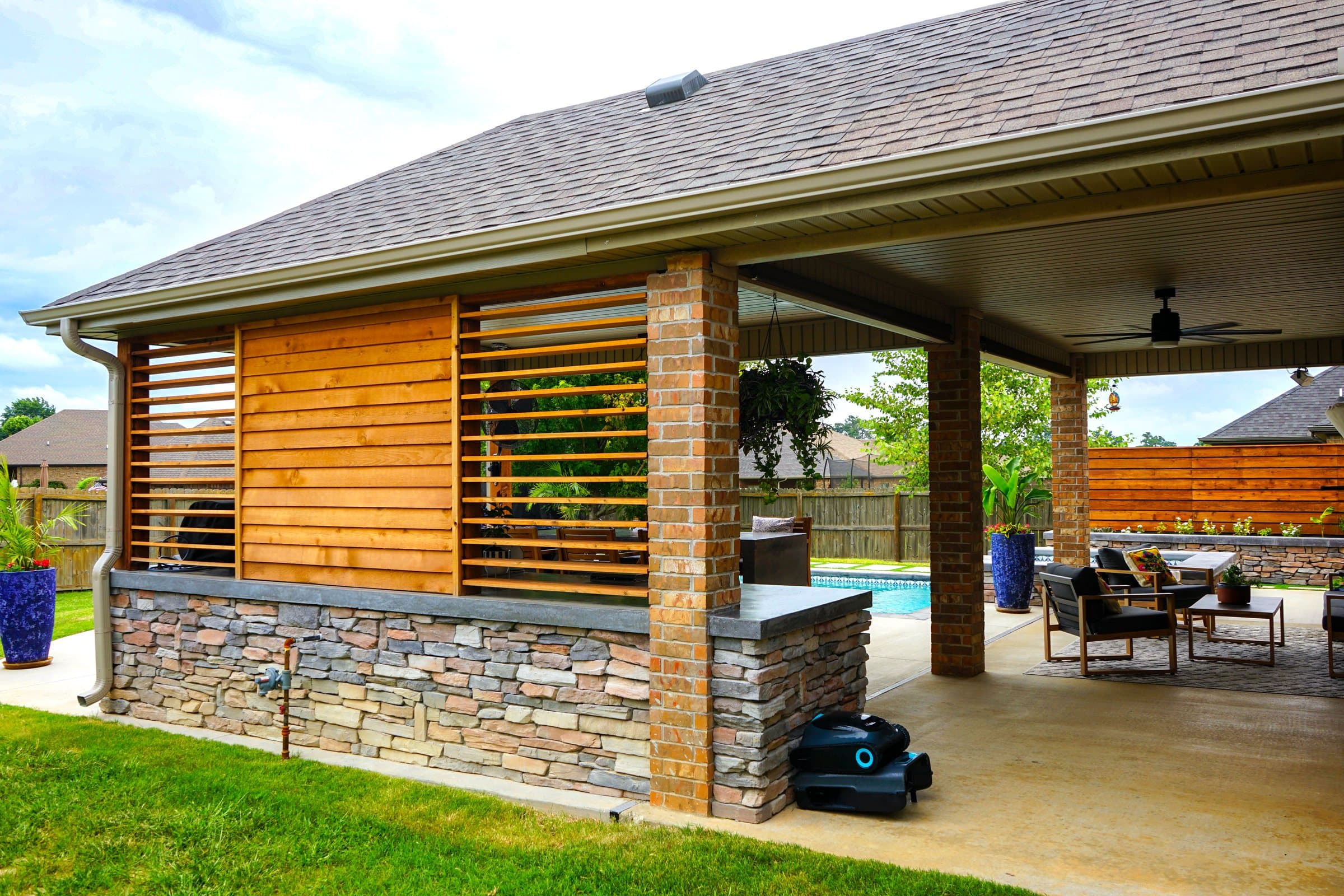
The Arkansas Department of Finance and Administration, which oversees assessors, says that when appraising residential property the assessor collects data on existing structures, including dwellings and outbuildings, and on other improvements, and it gives fences, pools and driveways as examples. A roofed pavilion is a structure. A built-in kitchen with a counter, grill and utilities is an improvement. Both are the kind of thing assessors record.
02When would the higher tax start?
The January after it is finished, on the bill after that.
Arkansas values real property as it stands on January 1 of the assessment year. The state's own FAQ says new construction that did not exist on January 1 is picked up as new construction and becomes taxable as of January 1 the following year, although partial construction on the site on January 1 can add value too. The Benton County Assessor puts it the same way: newly constructed building improvements, or substantial modifications or additions to existing properties, completed in 2025 are added to the assessment rolls for assessment year 2026. So a pavilion finished in spring 2026 would normally be on the rolls for assessment year 2027.
You do not need to report it yourself for it to be found. The county runs reviews across the county for new construction and additions, and it appraises every parcel at a county-wide reappraisal. Benton County's last was in 2024 and the next is scheduled for 2028; state law requires one every four years.
03Doesn't the 5 percent cap protect us?
Not for new construction. That is the part people miss.
Amendment 79 to the Arkansas Constitution limits how fast the taxable value of a homestead can rise, to 5 percent a year, and other property to 10 percent, until it reaches full assessed value. The Department of Finance and Administration is explicit that those caps do not apply to newly discovered real property, new construction or substantial improvements, and that new construction is assessed at full value. It defines substantial improvements as renovation, reconstruction and refurbishment that adds 25 percent or more to the value of the property.
For homeowners over 65 or disabled, whose homestead value is frozen, the same department says the assessed value may increase if there is new construction or substantial improvements. In other words, the freeze stays on the house, and the new work is added on top of it.
Where a small structure falls between those definitions is a question for the assessor, not something we can answer from the statute. If it matters to your decision, ask the Benton County Assessor's office before you build.
04How much could it actually add? A worked example.
Here is the arithmetic, with made-up values so you can swap in your own.
Suppose the assessor decides a new pavilion adds $30,000 to your property's market value. That is the assessor's figure, not your contract price: it could be more or less than what the project cost. The assessed value added is 20 percent of that, $6,000. The tax is that assessed value times your total millage. The Benton County Assessor's own site uses 0.0527, or 52.7 mills, as an example school district rate when it explains how a penalty turns into dollars. We use it here only as an illustration.
| Step | Illustration | Where the number comes from |
|---|---|---|
| Market value added (assessor's opinion) | $30,000 | Hypothetical; your assessor decides |
| Assessed value added (20%) | $6,000 | Arkansas assessment rate of 20% of market value |
| Millage rate | 52.7 mills (0.0527) | Example rate used on the Benton County Assessor's site |
| Added tax per year | about $316 | $6,000 times 0.0527 |
Your real millage is on your tax statement. Arkansas collectors have to show the rate levied by each taxing unit on the statement, so check the total on your own bill rather than relying on the example. Rates differ between school districts and between cities and unincorporated areas.
05What does the timeline look like from build to bill?
Longer than people expect. The first bill that includes the new work arrives well over a year after it is finished.
Arkansas taxes are paid the year after the assessment. The state's FAQ says taxes for real property are due from the first business day in March through October 15 for assessments made during the previous year, with a 10 percent penalty after October 15. Put together with the January 1 rule, a pavilion finished in May 2026 plays out like this:
| Date | What happens |
|---|---|
| May 2026 | Pavilion finished |
| 1 January 2027 | It exists on the assessment date, so it is valued for assessment year 2027 |
| During 2027 | The assessor records it; you should receive notice of any change in value |
| March to 15 October 2028 | The 2027 taxes, including the new work, are payable |
If you are likely to sell within a couple of years, that lag means the buyer may be the one who first pays tax on it. It also means the prorated tax figure at your closing may not yet reflect the new structure.
06Can we challenge the value the assessor puts on it?
Yes. A change in value comes with a notice and a right to appeal.
The state's list of taxpayer rights includes being sent a notice that sets out the amount of any change in the value of your property, your right to appeal it and the procedure to follow. Appeals go to the county equalization board. If the value placed on an outdoor structure looks high, the useful evidence is simple: the contract price, photos, and what the structure actually includes. Keep your paperwork from the build for exactly this reason.
07Does a patio at ground level count too?
Possibly, but it is less clear than a roofed structure, and we will not guess.
The state's list of improvements an assessor collects includes driveways and pools, which are flat, so ground-level hardscape is not automatically ignored. How much value a Benton County appraiser attaches to a paver patio, a seat wall or a fire pit, if any, is not published in anything we could find. A covered structure, an outdoor kitchen with utilities and a pool are much more likely to be valued than a patio alone.
08Does needing no permit mean no tax?
No. Permits and assessments are separate systems.
Cities decide what needs a building permit, and some small structures are exempt. In unincorporated Benton County, for example, detached accessory structures in the Group U category have not needed a county permit since late 2023, apart from pool barriers. None of that changes what the assessor values. Our guide to permits in Benton and Washington counties covers the permit side, and the city guides for Bentonville, Rogers and Cave Springs go into detail.
09What about the homestead credit?
It is unaffected by an outdoor project, and it is worth claiming if you have not.
The Department of Finance and Administration says homeowners may receive a homestead property tax credit of up to $500 a year on their principal residence, and that the legislature has authorized an increase to up to $600 beginning with the 2026 tax bills. The state says proof of eligibility has to be registered with the county assessor on or before October 15 of the year after the assessment, so if you moved in recently, check that yours is on file.
10So should the tax change what we build?
Rarely on its own, but put it in the numbers for a roofed structure or a pool.
On the illustration above, a few hundred dollars a year is small against the cost of the structure and the use you get from it. On a short stay it is one more line in the calculation that our guide on whether an outdoor project pays back if you are transferred walks through. What you should not do is assume the 5 percent cap will hide it; it will not. And if the exact figure matters, the Benton County Assessor's office is the only place that can tell you how a specific structure is likely to be treated. A short call with a sketch and a description before you sign is cheap insurance against a surprise on the bill two years later.
For the structures themselves, see pergola, pavilion or covered patio and what an outdoor kitchen costs.
Projects with Gallardo Custom Builds start around seven and a half thousand dollars. Francisco "Paco" Gallardo, the owner, walks the ground himself before any number is given, because in Northwest Arkansas the number depends on what is under the turf. Financing is available through Acorn Finance. Call (479) 379-2226 or send the project form.
FAQCommon questions
Will a pavilion increase my property taxes in Arkansas?
Usually some. The assessor can add value for it, the assessed value is 20 percent of that, and new construction is not covered by the Amendment 79 caps. The amount depends on the assessor's value and your millage.
We just built an outdoor kitchen in Bentonville. When would it show up on the tax bill?
Arkansas values property as of January 1. Work finished during 2026 would normally be added for assessment year 2027, and taxes for an assessment year are billed the following year.
Does the 5 percent homestead cap limit the increase from a new structure?
No. The state says the 5 and 10 percent caps do not apply to new construction or substantial improvements, which are assessed at full value.
I am over 65 with a frozen assessment. Will adding a pavilion break the freeze?
The freeze stays on the existing home, but the state says the assessed value can increase for new construction or substantial improvements, so the new work is added on top.
Does a paver patio raise property taxes in Benton County?
It may add little or nothing, but we found no published rule on how Benton County values flat hardscape. Roofed structures, kitchens and pools are more likely to be valued.
If my structure did not need a permit, is it tax free?
No. Permits and property assessment are separate. The assessor values improvements whether or not a permit was required.
How do I find my actual millage rate?
It is on your property tax statement, which must show the rate levied by each taxing unit. Rates vary by school district and by city.
REFSources
- Arkansas Department of Finance and Administration, Assessment Coordination Division: Frequently Asked Questionsdfa.arkansas.gov
- Arkansas Department of Finance and Administration: Property Tax Relief (Amendment 79)dfa.arkansas.gov
- Arkansas Department of Finance and Administration: Residential Real Estate appraisaldfa.arkansas.gov
- Benton County Assessor: Appraisal Departmentbentoncountyar.gov
- Benton County Assessor: Assessbentoncountyar.gov
NEXTGet it looked at properly
Everything above is general guidance. What your ground actually needs is a site visit, and ours costs nothing. Francisco Gallardo walks it, reads the grade and the drainage, and tells you what is possible.