
To keep a patio clean under oak trees, clear leaves and catkins before they sit wet, help the surface dry fast with slope and light, and pick materials that hide stains. Tight, stabilised joints resist moss. University of Arkansas extension guidance ties moss to heavy shade, compacted or acidic soil and moisture, so the fixes are light and drainage, not only chemicals. Spring oak pollen is a short, heavy season that a hose handles.
01What does an oak drop on a patio through the year?
Pollen and catkins in spring, leaves and acorns in autumn, and shade all summer.
Older lots in Bella Vista, Rogers, Fayetteville and the wooded parts of Bentonville often keep oaks and hickories from the original forest. They are the reason those gardens feel established, and they are also the reason a patio beneath them needs a plan. This guide sits alongside building near trees, which covers protecting the roots during construction. Here the subject is living with the tree once the patio is built.
| Season | What falls | What it does to a patio | Main response |
|---|---|---|---|
| Spring | Pollen and catkins | Yellow film on everything; catkins clog joints and gutters | Rinse; blow out joints and gutters |
| Summer | Shade, some debris | Surfaces dry slowly; moss and algae start in damp corners | Light, airflow, slope |
| Autumn | Leaves and acorns | Wet leaves stain; acorns roll underfoot | Clear weekly; do not let piles sit |
| Winter | Late leaves, twigs | Wet mats hold moisture on the surface | Clear after storms |
02How bad is oak pollen, and what can be done about it?
Heavy for a few weeks in spring, then gone. A hose and a routine deal with it.
The University of Arkansas Division of Agriculture notes that the male catkins of post oak release millions of pollen grains every spring. It describes counts above 1,500 grains per cubic metre of air as very high for tree pollen, and spring counts often over 5,000, with levels usually highest between 5 and 10 in the morning. On a patio that shows as a yellow-green film on stone, furniture and cushions.
The practical answers are simple. Keep cushions stored during the peak weeks. Rinse the surface and furniture rather than sweeping dry pollen into the air. Plan a hose bib within easy reach of the seating area when the patio is designed. A screened pavilion keeps a good share of the debris off the furniture as well; see mosquitoes and humidity for screened options.
03Why do oak leaves stain a patio?
Tannins. Wet leaves left on a porous surface leach a brown, tea-coloured stain into it.
Oak leaves are rich in tannins, and when they lie wet on concrete, pavers or light stone, the tannin soaks in. A leaf that blows across a dry patio does nothing. A mat of leaves left for a week of drizzle in November leaves a print. The single best defence is timing: clear leaves before they sit wet, weekly in the peak of the fall.
Where a stain has formed, use a cleaner sold for tannin or organic stains on that material, follow the paver or stone manufacturer's instructions and test a hidden corner first. Some cleaners suitable for concrete are wrong for limestone or travertine. A sealer can make the surface less absorbent, so stains lift more easily; our sealing pavers guide covers whether it is worth it here.
04Why is moss growing on my patio?
Shade and moisture, the same reasons it grows in the lawn next to it.
The University of Arkansas extension lists the conditions moss favours: heavy shade, compacted soil, acidic pH and moisture problems. Its advice for lawns is to fix the cause, including limbing up trees to let in more light and solving drainage, rather than rely on a moss killer; copper sulfate, it notes, kills moss only temporarily. The same logic applies to hard surfaces. Moss and algae on a patio are a sign that part of it stays damp and dark.
- Raise the canopy: an arborist can limb up lower branches to let in light and air.
- Check the slope: a patio that holds water in one corner grows moss in that corner. See how much a patio should slope.
- Stop runoff from beds or lawn washing soil and moisture onto the surface.
- Clear debris so the surface dries between rains.
Moss is also a slip hazard. On a path used by older family members, it is worth dealing with promptly; see age-friendly outdoor design.
05Which surfaces cope best under oaks?
Mid-tone, textured, tight-jointed surfaces on a good slope.
| Surface | Leaves and stains | Moss | Notes |
|---|---|---|---|
| Concrete pavers, mid or blended tone | Hides tannin marks well | Moss in joints if damp | Individual units can be replaced |
| Light limestone or travertine | Shows tannin stains most | Algae in shade | Beautiful; needs the most attention under oaks |
| Darker natural stone | Hides stains | Moderate | Can get hot where the sun reaches |
| Broom-finish concrete | Stains show on pale mixes | Low on a good slope | Cracks cannot be swapped out |
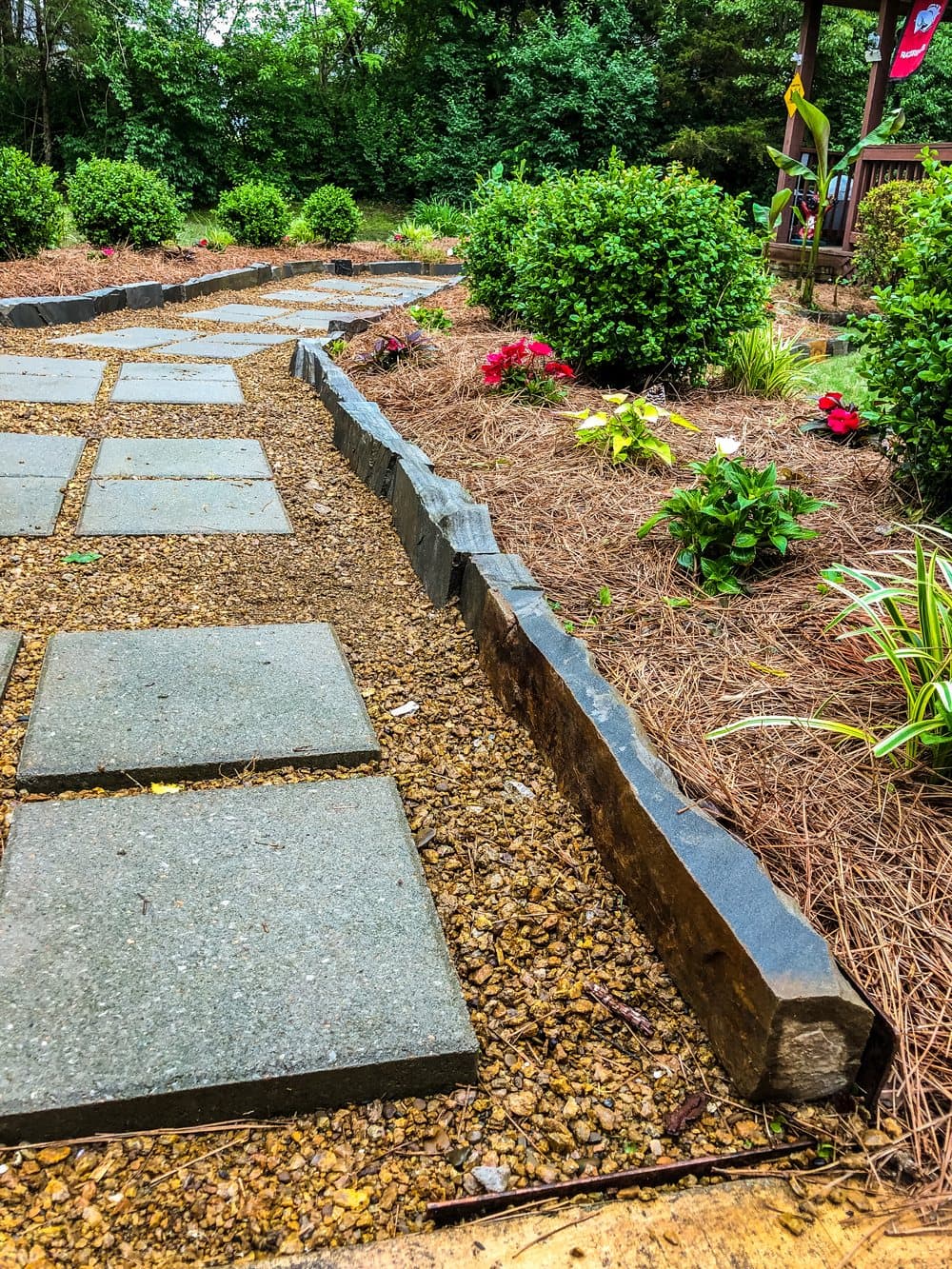
| Gravel or decomposed granite | Leaves are hard to rake out | Low | Kind to roots; awkward for furniture |
For the broader choice, see natural stone vs concrete pavers.
06What about the joints between pavers?
Tight joints with a stabilised fill resist weeds, moss and ants better than open sand.
Open, sand-filled joints under trees collect organic debris, stay damp and become a seedbed for moss and weeds. Polymeric joint sand, which hardens after watering, holds up better, and narrow joints give less for debris to lodge in. Joint sand does wear and wash out over years, so it is part of the maintenance cycle, usually alongside cleaning and any resealing. See pavers shifting and joint problems.
07How do gutters and covers behave under oaks?
They catch everything, so plan for cleaning them.
A pavilion or covered patio under oaks has gutters that fill with catkins in spring and leaves in autumn. Gutter guards, larger downspouts and a roof pitch that sheds debris all help, as does leaving a clear gap between the roof and the lowest branches. Flat or low-pitch roofs hold wet leaves and stain or grow moss. Ask how the gutters will be reached for cleaning before the cover is designed, not after. For covers generally, see pergola placement and shade.
08What should grow around a patio under oaks?
Shade-tolerant groundcover rather than a lawn that struggles.
The University of Arkansas extension is candid that growing grass under a large shade tree can be difficult, if not impossible. It suggests trying grass only where the shade is lighter and letting moss or another groundcover take the deepest shade. For a lawn-like look it suggests mondo grass, a low groundcover that needs mowing only once a year, with stepping stones where there is foot traffic because it will not take heavy wear. Around a patio that means fewer bare, muddy patches washing soil onto the stone, and less to mow.
09What about acorns?
They are a rolling hazard underfoot in autumn, so treat them like leaves.
In a heavy acorn year, a patio under a big oak can be covered in them. They roll under a shoe, which matters on steps and for anyone unsteady on their feet. A textured surface helps a little; clearing them regularly helps more. Keep the main walking route and the steps clear first. A leaf blower moves most of them, and a stiff broom deals with the rest.
10Is a pressure washer a good idea?
Used gently, sometimes. Used hard, it damages the surface and strips the joints.
A pressure washer turned up high can etch concrete pavers and soft stone, blast out joint sand and drive water into the base. For routine cleaning under trees, a hose, a stiff brush and a cleaner made for the material do most of the work. Where deeper cleaning is needed, use a low setting and a wide fan tip held at a distance, follow the manufacturer's advice for that product, and plan to top up the joint sand afterwards. If the patio is sealed, check whether the cleaner you plan to use is compatible with the sealer.
11Is it worth giving up some shade for less upkeep?
Sometimes a little. Rarely the whole tree.
A mature oak is worth protecting. Limbing it up, thinning it with an arborist or moving the patio a few feet toward the light usually solves the upkeep problem without losing the tree. Removing a healthy mature oak to save sweeping is a trade we rarely recommend. Deciding where the patio sits in relation to the canopy, at the design stage, is the cheapest upkeep decision you will make. See shade trees vs built shade.
12What does a realistic upkeep routine look like?
Short and seasonal. Print it and keep it by the back door.
- Spring, during pollen: rinse surfaces and furniture weekly; clear catkins from gutters and joints.
- Early summer: look for damp corners and moss; trim back overhanging shrubs.
- Autumn: blow or rake leaves weekly; never leave wet piles on the patio.
- After leaf fall: clear gutters; check drains and downspouts are running.
- Every few years: clean, top up joint sand and reseal if the surface is sealed.
None of this takes long when it is done on time. The patios that look tired under oaks are almost always the ones where leaves were left to sit through a wet autumn, the joints were never topped up and the corner that holds water was never regraded. The ones that stay clean had those three things designed in on day one: a slope that drains, a surface that hides a little staining, and joints that do not give moss a foothold. That is the conversation to have at the design stage, while the trees are standing next to you.
Projects with Gallardo Custom Builds start around $7,500. Francisco "Paco" Gallardo, the owner, walks the site himself before any number is given, because what is under the ground and what you want to do with the space both change the answer. The visit costs nothing. Financing is available through Acorn Finance. Call (479) 379-2226 or send the project form.
FAQCommon questions
How do I keep my patio clean under oak trees?
Clear leaves and catkins before they sit wet, keep the surface sloped and in as much light as you can, and choose a mid-tone, tight-jointed surface.
How do I get tannin stains off pavers?
Use a cleaner sold for tannin or organic stains on that material, following the manufacturer's instructions, and test a hidden spot first.
Why is moss growing on my patio?
Moss favours heavy shade, moisture, compaction and acidity, per University of Arkansas extension. More light and better drainage are the lasting fixes.
Does copper sulfate get rid of moss?
The University of Arkansas extension says it kills moss only temporarily. Fix the shade and moisture that let it grow.
When is oak pollen worst in Arkansas?
In spring. University of Arkansas extension reports tree pollen counts often over 5,000 grains per cubic metre then, highest between 5 and 10 in the morning.
What patio material is best under oak trees?
Mid-tone concrete pavers or darker stone with tight, stabilised joints. Pale limestone and travertine show tannin stains the most.
Should I seal my patio if it is under trees?
It can make stains easier to lift. Our sealing pavers guide covers when it is worth doing in Arkansas.
REFSources
NEXTGet it looked at properly
Everything above is general guidance. What your ground actually needs is a site visit, and ours costs nothing. Francisco Gallardo walks it, reads the grade and the drainage, and tells you what is possible.