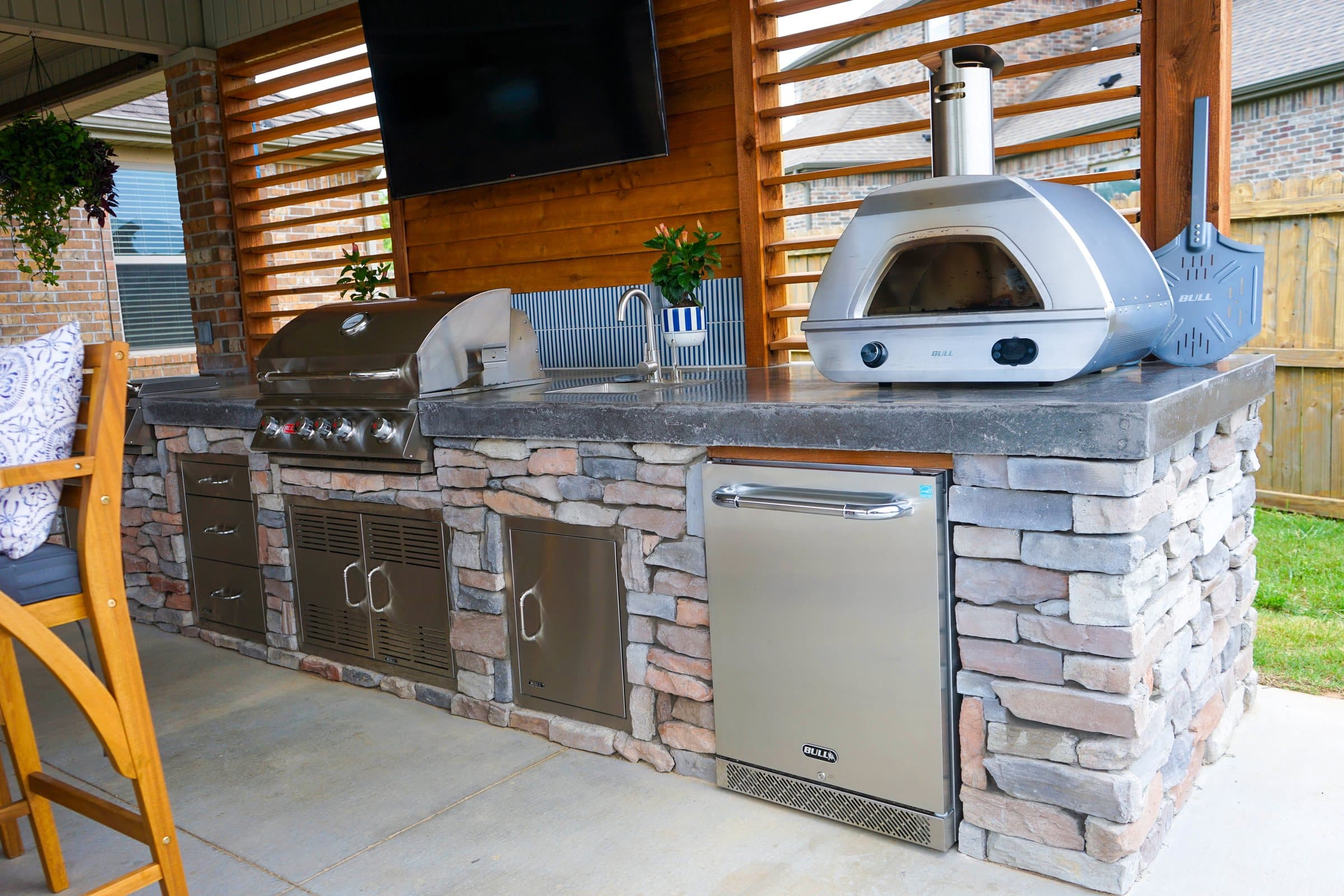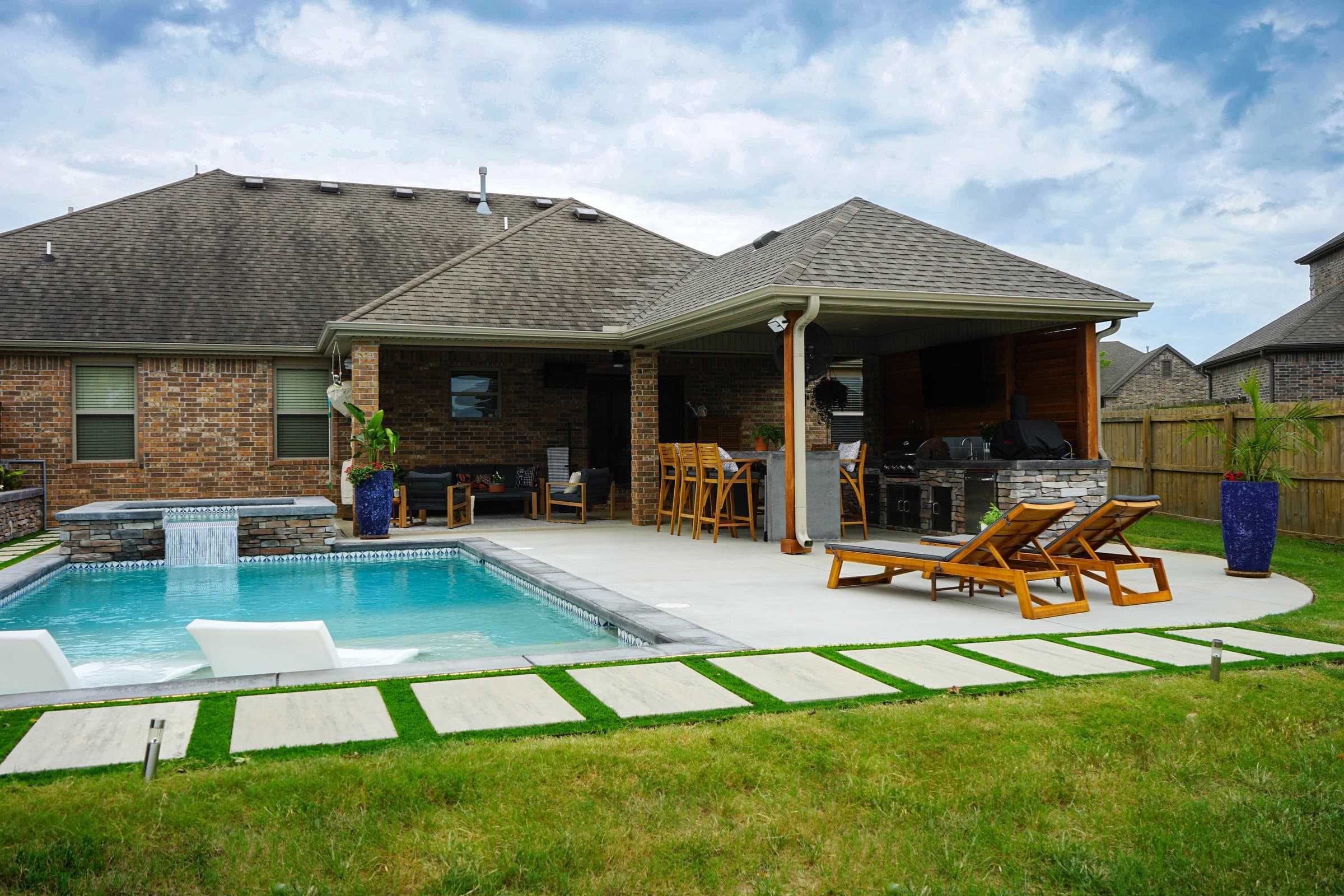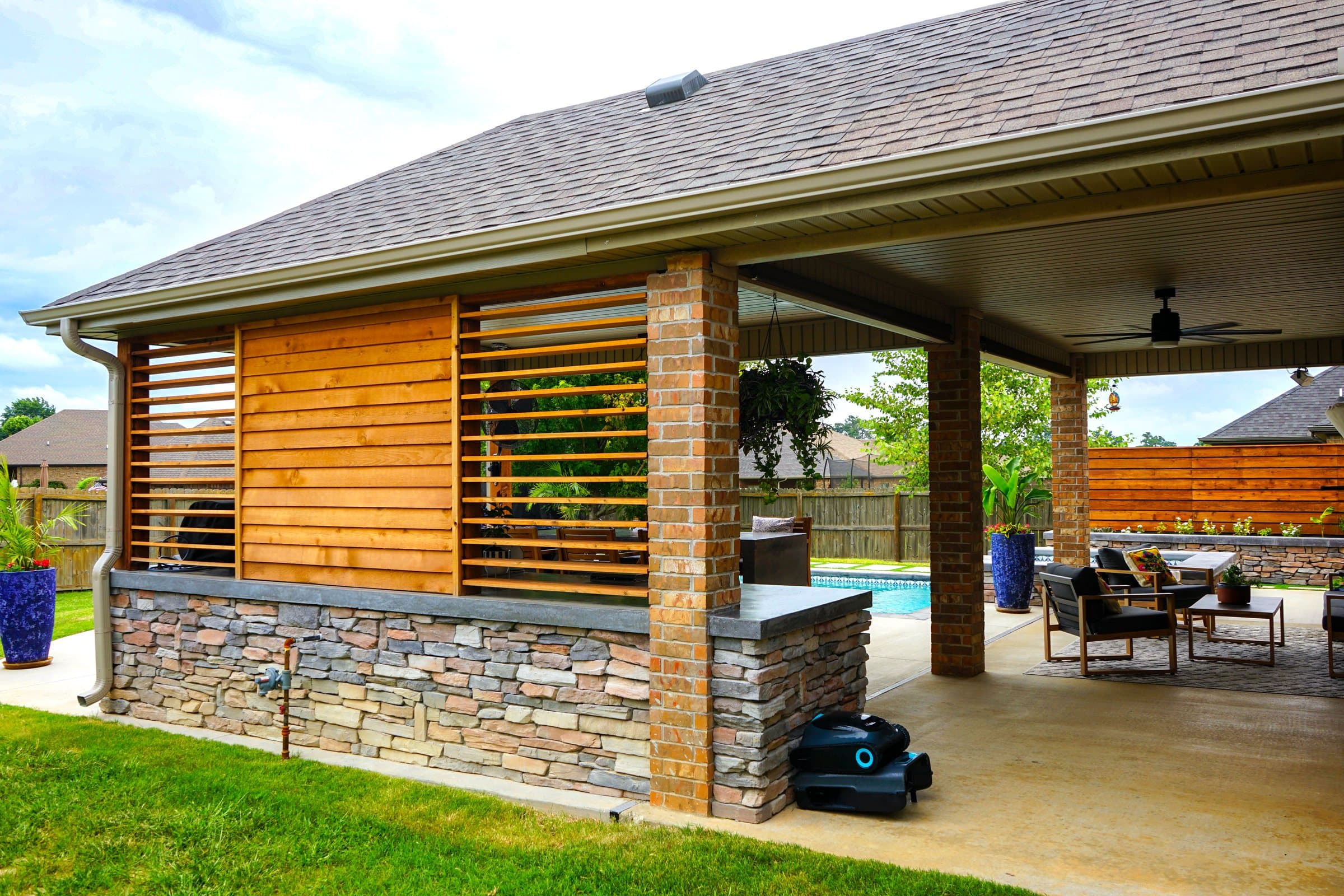

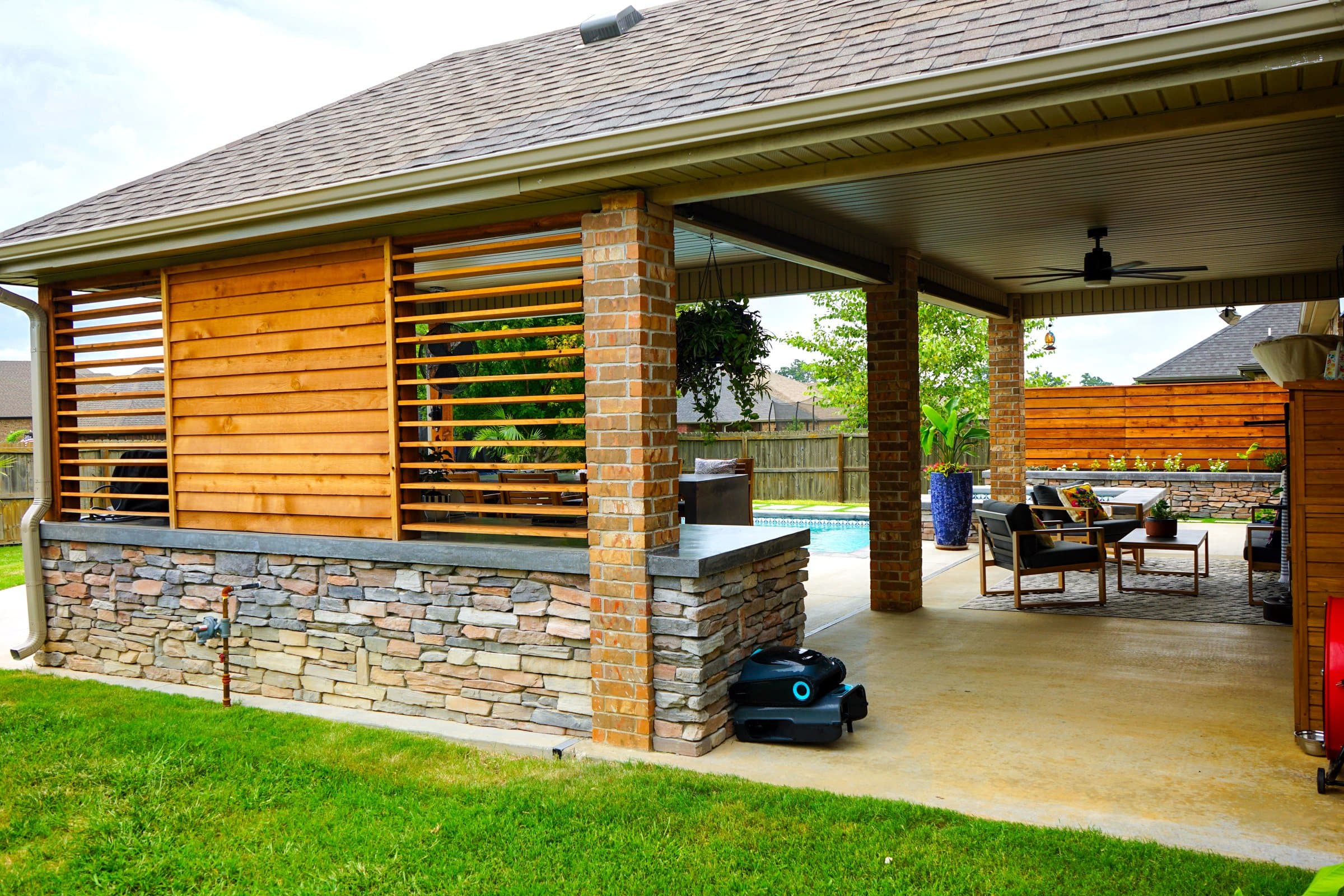
Design a family backyard in zones: a flat play lawn in sight of the kitchen and patio, a patio large enough for the whole family to eat together, and a separate teen space further out. Any walking surface more than 30 inches above the ground within 36 inches of its edge needs a guard at least 36 inches high under the IRC. The CPSC says play equipment needs protective surfacing at least 6 feet beyond it, and never concrete or asphalt.
01How should a family yard be split between lawn and patio?
By what each age actually does there, with the lawn flat and the patio next to the house.
Small children need open, soft ground to run on and a parent who can see them from the kitchen window or the patio table. Older children need room for a ball, a goal or a trampoline. Teenagers want somewhere that is theirs, far enough from the adults to talk. Adults want to cook, eat and sit down. The mistake is designing for one of those and forgetting the others, or paving so much of a modest yard that there is nowhere left to kick a ball.
| Zone | Who it serves | Where it goes | Surface |
|---|---|---|---|
| Main patio and dining | Everyone | Against the house, by the kitchen door | Pavers or stone |
| Play lawn | Young children | In direct sight of the patio and kitchen window | Grass or turf, flat |
| Play equipment | Young children | On the lawn edge, clear of walls and fences | Protective surfacing |
| Teen zone | Teenagers and their friends | Further out, with its own seating and light | Pavers, gravel or turf |
| Utility strip | Parents | Side yard | Gravel or pavers for bins, bikes and tools |
For sizing the patio itself, see how big a patio should be.
02Where should the play lawn go?
Where you can see it, where it is flat, and where it drains.
Sightlines come first. Stand at the kitchen sink and at the patio table and look: the play lawn should be in view from both. Flat matters next. A ball game on a slope ends in the neighbour's yard, and on the hillier lots around Rogers, Bella Vista and Fayetteville the only way to get a flat lawn is often a terrace held by a low wall. See designing a sloped backyard for how that is done. Drainage matters third: a lawn that stays wet for two days after rain is a lawn nobody plays on.
Grass or artificial turf is a real choice here. Turf stays green through a busy summer and does not turn to mud, but it gets hot in direct sun. Our turf vs grass guide weighs it up for Arkansas.
03When does a wall or drop need a guard rail?
When the drop is more than 30 inches, under the residential code.
The International Residential Code, section R312.1.1, requires guards on open-sided walking surfaces, including stairs, ramps and landings, that are more than 30 inches above the floor or grade below at any point within 36 inches horizontally of the edge. R312.1.2 sets the guard height at not less than 36 inches. On the open side of stairs, openings must not let a 4 3/8 inch sphere through. Those are code minimums for a new structure; your inspector applies them.
| Situation | What the code rule means in practice |
|---|---|
| Raised patio 24 in above lawn | No guard required by R312.1.1; consider planting or seating at the edge |
| Terrace 32 in above the lawn below | Guard at least 36 in high |
| Low wall with a steep bank beyond it | Measure grade 36 in out from the edge; if the drop there exceeds 30 in, a guard is required |
| Steps down from a raised patio | Guard on open sides where the rule applies; handrails as required |
With children, we often go further than the minimum. A 24 inch drop onto stone is not trivial for a three year old. A seat wall, a planting bed or a hedge along the edge keeps small feet away from it without a rail.
04How should retaining walls near play areas be treated?
As edges, not as climbing frames, and built by the book.
Children will climb any wall they can reach. Keep the top of a wall that faces a play area either low enough to be harmless or finished with a cap and a planted strip or fence that discourages walking along it. Taller walls bring engineering requirements of their own; see when a retaining wall needs an engineer. Never let a wall become a patio edge with a drop behind it that no one planned.
05How much room does play equipment need?
At least 6 feet of protective surfacing around it, and more in front of and behind swings.
The U.S. Consumer Product Safety Commission's Outdoor Home Playground Safety Handbook says about 50,000 children a year go to U.S. emergency rooms with injuries from home playground equipment, and about 80 percent of those injuries come from falls. Its guidance for placement and surfacing is specific:
- Place equipment at least 6 feet from any structure or obstacle, such as a house, fence, shed, tree or pole.
- Extend protective surfacing at least 6 feet from the equipment in all directions.
- In front of and behind swings, extend it a distance equal to twice the height of the top bar.
- Keep at least 9 inches of wood mulch, engineered wood fibre or rubber mulch under equipment up to 8 feet high, or 9 inches of sand or pea gravel up to 5 feet high. An initial fill of 12 inches compresses to about 9.
- Do not install play equipment over concrete, asphalt or any hard surface. Grass and dirt do not count as protective surfacing.
That footprint is bigger than most people expect, and it is the reason we mark it out on the ground at the design stage instead of leaving a gap and hoping the swing set fits.
06What makes a good teen zone?
Its own seating, its own light and power, and some distance from the house.
Teenagers use a yard at night. A fire pit or fire table with built-in seating, a string of lights, a receptacle for speakers and phone chargers, and a surface that does not mind being walked on in muddy shoes will get used. Put it at the end of a path, not beside the kitchen. A basketball pad or a hitting net needs a flat, hard area with space around it and should be positioned so balls do not end up in the grill. Plan the power before the surface goes down; see our rough-in checklist.
07Which materials survive children?
The ones that can be repaired a piece at a time and do not punish a fall.
Pavers are a good family surface because a stained or cracked unit can be lifted and replaced. Natural stone with a textured finish grips better when wet than a polished one. Rounded or chamfered edges on seat walls and steps are kinder to knees than sharp arrises. Loose gravel is fine for a path but not beside a play area, where it ends up on the patio and underfoot. For the trade-offs between materials, see natural stone vs concrete pavers.
Think about heat as well. Dark stone and turf in full sun can be uncomfortable for bare feet on a summer afternoon, so keep the surfaces children run across barefoot in shade or in lighter tones, and keep a hose or outdoor shower within reach of the lawn.
08How much shade does a family yard need?
Enough over the play lawn and the table that the yard is usable on a July afternoon.
A play lawn in full sun from noon to five is empty in an Arkansas summer. Put the lawn where a tree or the house shades part of it in the afternoon, or plan a pergola or pavilion beside it where parents can sit and still see. Artificial turf in particular needs shade in summer, because it heats up in direct sun. See shade trees vs built shade and, for evenings, mosquitoes and humidity.
09Where do bikes, balls and toys live?
Somewhere close to where they are used, or they live on the patio.
A family yard without storage turns the patio into a store. A bench with a lid by the lawn, a small shed or a covered bay at the side of the house for bikes and scooters, and a hard, level route from that store to the driveway keep the entertaining space clear. On a sloping lot, the bike route matters: children will ride down whatever path exists, so make it one that does not end at a wall or a flight of steps.
10What about a pool?
A pool changes every other decision in the yard, including the barrier.
A pool with young children needs a barrier, and the rules for pool barriers apply even where other structures do not need a permit; unincorporated Benton County, for example, stopped requiring permits for detached accessory structures in 2023 but kept pool barriers. If a pool is planned or possible, design the lawn and patio around it now. See space around a pool and planning a patio for a future pool.
11How do you design for the kids you will have in ten years?
Keep the hard landscape permanent and the play elements temporary.
The sandpit becomes a vegetable bed, the swing set becomes a hammock, and the play lawn becomes the place for a bigger dining table or a hot tub. Build the patio, walls, drainage and sleeves for the long run, and treat the play equipment as furniture that will change. A lawn edge that is already on the right level, with a sleeve for power beneath it, turns the next change into an afternoon rather than a project.
Projects with Gallardo Custom Builds start around $7,500. Francisco "Paco" Gallardo, the owner, walks the site himself before any number is given, because what is under the ground and what you want to do with the space both change the answer. The visit costs nothing. Financing is available through Acorn Finance. Call (479) 379-2226 or send the project form.
FAQCommon questions
How do I design a backyard for kids and entertaining?
Zone it: a patio by the house for adults, a flat play lawn in sight of it, and a separate teen area further out with its own seating and light.
At what height does a patio or wall need a railing?
The IRC requires a guard at least 36 inches high where a walking surface is more than 30 inches above the grade below within 36 inches of the edge.
How much space does a swing set need?
CPSC guidance is at least 6 feet of clear, protected space all round, and twice the height of the top bar in front of and behind swings.
Can I put a swing set on the patio?
No. The CPSC says not to install home play equipment over concrete, asphalt or any hard surface.
How deep should mulch be under a play set?
At least 9 inches of wood mulch or rubber mulch for equipment up to 8 feet high. Start with about 12 inches, which compresses.
Is artificial turf good for a family backyard in Arkansas?
It stays green and mud free under heavy use but gets hot in direct sun. Our turf vs grass guide covers the trade-offs.
Can the yard change as the kids grow up?
Yes. Build the patio, walls and drainage for the long term and treat play equipment as furniture that will be replaced.
REFSources
NEXTGet it looked at properly
Everything above is general guidance. What your ground actually needs is a site visit, and ours costs nothing. Francisco Gallardo walks it, reads the grade and the drainage, and tells you what is possible.